The Despised Pastor

The Despised PastorSurveys reveal that people in the United States do not have a highly favorable view of evangelical Christians, nor of pastors of evangelical Christian churches.

I agree with John Maxwell’s maxim that everything rises and falls on leadership, so this unfavorable view of evangelical Christians must be addressed first in the pastorate. The 2400-year-old words from the prophet Malachi still ring true today—

“The words of a priest’s lips should preserve knowledge of God, and people should go to him for instruction, for the priest is the messenger of the Lord of Heaven’s Armies. But you priests have left God’s paths. Your instructions have caused many to stumble into sin. You have corrupted the covenant I made with the Levites,” says the Lord of Heaven’s Armies. “So I have made you despised and humiliated in the eyes of all the people. For you have not obeyed me but have shown favoritism in the way you carry out my instructions.” (Malachi 2:7-9)

Uh oh!

Is it possible, my dear fellow pastor, that if we become men and women of the Word of God that the views of the population might begin to change?

Mouth-To-Mouth

Mouth to mouthI’ve notice that when someone feels physically tired, mentally unengaged, spiritually embattled, emotionally dry, or just plain worn out, they have an audible physical sign that is almost universal.

Those people sigh.

A sigh is an involuntary response that signifies frustration and a call for help. It should also be a reminder of the best place to find that help.

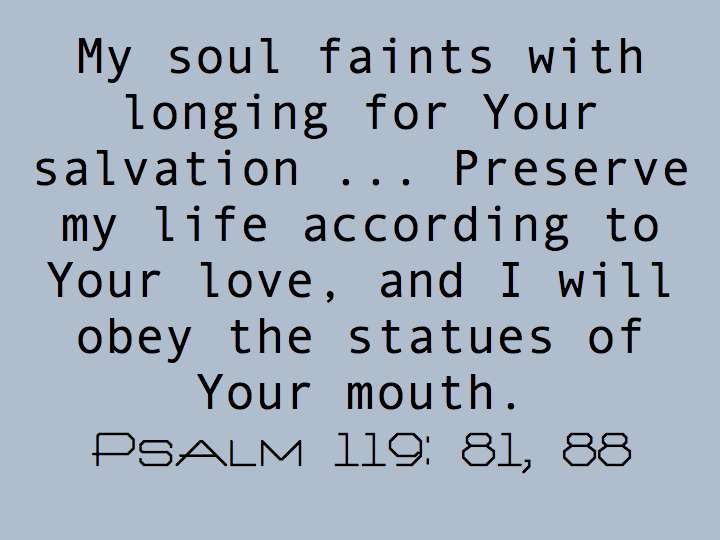
In Psalm 119, the chapter is organized in 8-verse segments. I like to look at the “bookend” verses of each section, as it usually gives a good idea of what that section is focusing on. The section called kaph has this bookended statement—

My soul faints with longing for Your salvation … Preserve my life according to Your love, and I will obey the statues of Your mouth (Psalm 119:81, 88).

Follow this progression:

  • When God created man, He breathed a soul into him. So we are created by His breath.
  • Jesus said that man does not live by bread alone, but by every word that comes from the mouth of God. God’s Word is inspired, which means it is literally God-breathed. So our soul is sustained by the breath of God.

The psalmist says his soul is sighing and wasting away, but he recognizes that his God-breathed soul can be restored through the God-breathed word. So in verse 88 he is asking God to give him mouth-to-mouth (or perhaps mouth-to-soul) resuscitation! 

The psalmist talks about clinging tenaciously to God’s Word as if it were his only lifeline … because it is! So whenever you find yourself sighing, let that be a reminder that you can get your spiritual resuscitation from the breath of God: His Word. Hold on to it as if your very life depended on it … because it does!

If you have missed any of the messages in our P119 series, you can access them all by clicking here.

Sola Scriptura

Of all the other sola statements that came out of the Reformation, sola scriptura has to be one of the most foundational. Without a firm understanding of the truthfulness of God’s Word, all other doctrinal statements are without authority. Sola scriptura means that we use the Bible as our authoritative guide for everything in our lives.

Jesus confronted the religious leaders for their misuse and abuse of Scripture. The Sadducees had a tendency to ignore the parts of Scripture which didn’t fit their “theology.” The Pharisees, on the other hand, would over-exaggerate some Scriptures which would leave other passages dwarfed or forgotten.

In Matthew 23, Jesus took on both of these incorrect approaches. What I love is that Jesus didn’t share His opinion, He didn’t argue with them, He didn’t try to convince them to accept His viewpoint. Jesus just took them back to Scripture.

  • You are in error because you do not know the Scriptures or the power of God (23:29).
  • Have you not read what God said to you (23:31).
  • David, speaking by the Spirt…says(22:43).

When Jesus said, “You are in error,” the verb tense is the passive voice. This means it was something done to them, not something they did. These religious leaders were not purposely straying from Scripture, but by listening to men instead of God they allowed themselves to be lead astray.

That’s why this insight from Luke is so powerful:

Now the Bereans were of more noble character than the Thessalonians, for they received the message with great eagerness and examined the Scriptures every day to see if what Paul said was true. (Acts 17:11)

This is great counsel for all of us. We should all listen to pastors and teachers, or read authors, through the filter of Scripture. We need to make sure we aren’t passively straying, and we do this by examining the Scripture.

If you have missed any of the messages in this series, you can find them all here.

Savoring It

For those of you who asked, here is the quote I shared this morning from John Piper—

“If you don’t read the Word and memorize the Word and meditate on the Word daily and delight in the Word and savor it and have your mind and emotions shaped by the Word, you will be a weak Christian at best. You will be fragile and easily deceived and easily paralyzed by trouble and stuck in many mediocre ruts. But if you read the Word and memorize important parts of it and meditate on it and savor it and steep your mind in it, then you will be like a strong tree planted by streams of water that brings forth fruit. Your leaf won’t wither in the drought and you will be productive in your life for Christ.”

Filled To Be Emptied

This is a post especially for my pastor friends. 

Dear Friend,

I know you have a lot on your mind. You’re probably reviewing how Sunday went and thinking about what you’re going to share next Sunday. You’ve probably got a pretty full agenda this week: staff meetings, board meetings, maybe a counseling appointment or two, and a hospital visit. There’s lots happening (there always is, right?).

Can I break into your week to ask you a simple question: What did you read in your Bible this morning for you? You know, your personal devotional time—what was God’s Word saying just to you?

Dietrich Bonhoeffer wrote this:

“We are reading the Word of God as God’s Word for us. Therefore, we do not ask what this text has to say to other people. For those of us who are preachers that means we will not ask how we would preach or teach on this text, but what it has to say to us personally.”

Here’s a simple principle: You cannot give to others what you have not received yourself. So you need to be filled up so that you can be emptied out.

Although your week may be busy, please, please, please take the time to read God’s Word for yourself. It will help you and your congregation as well.

May God fill you and then empty you, my friend, for His glory!

Cheering you on, I am your friend,

Craig

The Hard Word

As a pastor, you are going to have to deliver the hard word from time to time. You will have to address touchy subjects, both corporately and privately. It is very instructive to see how the apostle Paul approached the hard word.

In Romans 9, Paul is getting ready to address one of the most sensitive subjects of his day. The Jews felt they were “in” with God just because they were Jews, and the Gentiles were “out” with God just because they weren’t Jews. Paul is going to have to deliver the word that both Jews and Gentiles can be accepted by God because of what Jesus did on the Cross.

So notice how he begins:

I speak the truth in Christ—I am not lying, my conscience confirms it in the Holy Spirit—I have great sorrow and unceasing anguish in my heart.

1. I speak the truth in Christ. It wasn’t his opinion, but the word from God. I must settle this matter before delivering the hard word. Far too often we can put our preferences on par with God’s Word. I cannot do this!

2. My conscience confirms it in the Holy Spirit. Before I speak a hard word that people may not like to hear, I need to make sure my conscience is right before the Holy Spirit. He alone confirms His Word. The reaction of the audience, however, may or may not confirm what God says.

3. I have great sorrow and unceasing anguish in my heart. It should be a major red flag if I looked forward to delivering a painful/challenging/correcting word. I need to put myself in their place, not try to put someone else in their place!

My job as a pastor is not to condemn, nor even to convict; the Holy Spirit will do that. My job is to (a) hear God’s truth, (b) get my conscience right with the Spirit, and (c) empathize with people as I lovingly speak the truth to them.

God’s Word Is…

“Never compare this Book with other books. Comparisons are dangerous. Never think or say that this Book contains the Word of God. It is the Word of God. It is supernatural in origin, eternal in duration, inexpressible in value, infinite in scope, regenerative in power, infallible in authority, universal in application, inspired in totality. Read it through. Write it down. Pray it in. Work it out. And then pass it on.” —Smith Wigglesworth

Thursdays With Oswald—Learning From My Experiences

This is a weekly series with things I’m reading and pondering from Oswald Chambers. You can read the original seed thought here, or type “Thursdays With Oswald” in the search box to read more entries.

Learning From My Experiences

     It is all very well to have experiences, but there must be a standard  for measuring them, and a standard more worthy than my own on the line on which  I know I am worthy. The standard for Christian experience is not the experience of another Christian, but God Himself.

     On the ground of the Redemption I am saved and God puts His Holy Spirit in me, then He expects me to react on the basis of that relationship. …The only way to understand the Scriptures is not to accept them blindly, but to read them in the light of a personal relationship to Jesus Christ.

From Baffled To Fight Better

Some people have said that experience is the best teacher.

That’s incorrect.

My experience is just that… MY experience. I have to have a standard other than myself to judge that experience. As a Christian I have this: God’s Word, and the Holy Spirit to help me apply that Word to my experience. If I will use this as my standard for all of my experiences, only then will I learn something eternally useful from my experiences.

As C.S. Lewis so right stated, “All that is not eternal is eternally useless.”

A-to-Z Love

You probably have heard that Psalm 119 is the longest chapter in the Bible (176 verses). The anonymous author clearly loved God’s Word—everything about it from aleph to taw (that’s Hebrew for “from A to Z”).

The psalm’s 176 verses are divided into 22 sections, with eight verses in each section (the Hebrew alphabet has 22 letters). All of the verses except three mention God’s Word in some way (law, statutes, commands, etc.). In other words, this author loved God’s Word from start to finish, and everything in-between!

How about if we continue the A-to-Z love?

I love that God’s Word is…

A—An attitude adjustor

B—Bright hope

C—Comforting

D—Direction for life

E—Educational

F—Fulfilling my deepest longings

G—Good and good for me

H—Historically accurate

I—Illuminating

J—Just what I need, when I need it

K—Keeping me from sin’s grip

L—Liberating me from anxiety

M—Making me the God-fearing man I should be

N—Never condemning, always encouraging

O—Opening my understanding

P—Purifying my motives

Q—Quality time

R—Revealing God’s love for me

S—Strength for today

T—Temptation defeater

U—Unfailing truth

V—Visionary

W—Worth more than all my other books

X—Xenografted into my heart (James 1:21)

Y—Yahweh’s love letter to me

Z—Zoe (1 John 1:1)

Go ahead and add your A-to-Z love of God’s Word in the comments…

I also shared a series of 22 messages looking at each of the sections of Psalm 119. You can find the complete list of those messages by clicking here.

4 Leadership Requirements

I love studying leadership—leadership principles, leadership practices, and leadership people. There’s a great leadership case study in the Bible in the life of Joshua that always intrigues me.

Joshua had been through extensive preparation to become Moses’ successor. He was a recognized leader in his tribe, the general of the army, and an aide-de-camp to Moses for a number of years. But his most important leadership qualification: He was called by God.

As the story of his leadership opens in the first chapter of the Book of Joshua, God gives four requirements for Joshua (and you and me) to be effective in our leadership roles.

1.  Be yourself. God didn’t say, “Be like Moses.” In fact, the only time God talks about Moses to Joshua is to reassure him, “I will be with you like I was with Moses.” But never once does God uses a “Moses Grading Scale” for Joshua. God simply says, “You will lead these people.”

2.  Have an objective measuring stick. Feelings may change, but God’s Word never does. So God counsels Joshua to always rely on the Book of the Law.

3.  Guard your thoughts. Leaders have so many people “in their ear” wanting to lobby for their way. So God tells Joshua to not only read the Bible but meditate on it as well. One definition of meditation is to hum God’s Word. In other words, humming God’s Word will help a leader know which lobbying voice is in harmony with God’s Voice, and which lobbying voice is off-key.

4.  Guard your attitude. God repeats this to Joshua, “Do not be afraid; do not be discouraged.” Even doing everything they are supposed to be doing, leaders can become afraid to make a change, or discouraged because people aren’t following along. These feelings must be driven out with one firm declaration: “I know the Lord has called to this leadership position, so I know the Lord is with me. He will enable me to complete what He has called me to do.”

God’s direction to Joshua is still great counsel for leaders today.