Links & Quotes

link quote

Some good reading & watching from this weekend…

“Our mistake is that we want God to send revival on our terms. We want to get the power of God into our hands, to call it to us that it may work for us in promoting and furthering our kind of Christianity. We want still to be in charge, guiding the chariot through the religious sky in the direction we want it to go, shouting ‘Glory to God,’ it is true, but modestly accepting a share of the glory for ourselves in a nice inoffensive sort of way. We are calling on God to send fire on our altars, completely ignoring the fact that they are our altars and not God’s.” —A.W. Tozer

Eric Metaxas has a great take on depression in his post Depression And Black Dog Beliefs.

[VIDEO] I’m not a huge Duck Dynasty fan, but this short quote from Phil Robertson is pure gold!

Paleontologists has found the bones of a huge dinosaur called Dreadnoughtus, that was bigger than a 737 airplane! It sounds a lot like what God described to Job.

Earth has a new address. Our home supercluster is called Laniakea (for the Hawaiian word meaning immeasurable heaven).

Whether you are a Detroit Tigers fan or not, this is a great story about teammates and friends.

“We are atheists in this matter of prayer compared to the early church. Many today look upon secret prayer as hard work and boring, so they do it only occasionally. Can you imagine a husband and wife living in the same house, hardly ever speaking and yet in public speaking as if they were intimate? So some treat our blessed Lord! Prayer, hidden secret prayer, is the mightiest weapon God has given His people; yet it is neglected, disdained, and seldom used.” —David Wilkerson

“Kindness is an inner desire that makes us want to do good things even if we do not get anything in return.” —Emmanuel Swedenborg

“Now if God be wisdom, as truth and Scripture testify, then a true philosopher is a lover of God.” —Augustine


Get Some Face Time

Listen to the podcast of this post by clicking on the player below, and you can also subscribe on AppleSpotify, or Audible. 

The apostle John closed his second and third letters very similarly—

I have much to write to you, but I do not want to use paper and ink. Instead I hope to visit you and talk with you face to face, so that our joy may be complete. (2 John 12; 3 John 13)

John didn’t use his advanced years, or the difficulty and expense of travel, or the busyness of his schedule, or even the inconvenience of trying to work something into someone else’s schedule as an excuse to stay home and fire off letters.

Certainly letters have their value, but they are a one-way talking TO people. Personal visits are face to face time. They are a two-way talking WITH people. And this, John says, leads to joy for both parties!

How many excuses could I use today?

  • My schedule is so busy
  • Technology is very convenient to use
  • I’m not sure if they have the time
  • I really don’t have that much to say

Can I paraphrase John’s desire in a modern setting?

I have much to say to you, but I do not want to use Facebook or Twitter or texting. Instead I hope to visit you and talk with you face to face, so that our joy may be complete.

Make some time for face time, and you’ll be increasing both your joy and the joy of your friend as you talk WITH each other.

You may also be interested in a related post called Our Growing Communication Problem.

►► Would you please prayerfully consider supporting this ministry? My Patreon supporters get behind-the-scenes access to exclusive materials. ◀︎◀︎

Rescuing Those Who Might Harm Themselves

UnstoppableIn Nick Vujicic’s book Unstoppable (you can read my book review by clicking here), he is very transparent about his thoughts of suicide. He wrote—

“My youthful self-acceptance and self-confidence did not begin to crumble until I began relentlessly comparing myself to my peers. Then, instead of taking pride in what I could do, I dwelled on those things my mates could do that were beyond my abilities. Instead of seeing myself as enabled, I saw myself as disabled. Instead of taking pride in my uniqueness, I yearned to be what I was not.”

According to the World Health Organization, the rate of suicides has increased dramatically, and is now the third leading cause of death for fifteen- to twenty-four-year-olds. I had a friend that committed suicide, and it wasn’t until after the fact that I could put together the warning signs that he had been exhibiting.

Nick lists some indicators that someone close to you might be depressed enough to harm themselves:

  • Unusual changes in eating and sleeping habits
  • Withdrawal from friends, family, and regular activities
  • Violent actions, rebellious behavior, or running away
  • Excessive drug and/or alcohol abuse
  • Unusual neglect of personal appearance
  • Marked personality change
  • Persistent boredom, difficulty concentrating, or a decline in school performance
  • Frequent complaints about physical symptoms, often related to emotions, such as stomachaches, headaches, and fatigue
  • Loss of interest in favorite activities
  • Intolerance of praise or rewards
  • Giving or throwing away favorite possessions or belongings
  • Becoming suddenly cheerful after an episode of depression

From Nick’s own experience, he offers these helpful words—

“Often individuals in distress don’t want to talk about their issues. Don’t push it, but keep the communication open without offering advice or judgment. Just being there for them, hanging out with them, and letting then know you care can make a difference. You don’t have to solve their problems unless you are a mental health professional. …

“Sometimes it won’t be easy to stand by a friend or loved one who is dealing with despair or depression. Your loyalty will be tested. You may feel hurt, slighted, or abandoned. I would never suggest that you allow someone to mistreat you. If that happens, maintain a safe distance, but do whatever you can to help. That may mean simply being there for those who are hurting, listening to them when they are willing to talk about their concerns, and assuring them that they are loved and valued by reminding them that other people care about them. If you sense that someone is more troubled than you are equipped to handle, you should contact a guidance counselor, a trusted clergy member, or a medical or mental health professional and seek his or her advice on what to do.”

If anyone around you is exhibiting any of these signs, please reach out to them in love. It would be much better to have a friend tell you, “I’m okay, but thanks for asking,” than for you to miss an opportunity to save someone’s life.

Contact the National Suicide Prevention Hotline online or call them at (800) 273-8255.

Likeminded

Listen to the podcast of this post by clicking on the player below, and you can also subscribe on AppleSpotify, or Audible. 

How many friends do you have? I don’t mean your “friend count” on Facebook, because you and I both know that some of your “friends” aren’t really those people with whom you would share confidential information.

No, I mean real friends.

There were few people as well-known in his day as the apostle Paul. His missionary journeys took him all over the place. The stories he could tell about his adventures would keep an audience glued to their seats. He knew church leaders and governmental officials. He planted churches and trained pastors. If ever there was someone that would have had a full list of friends on Facebook, it would have been Paul.

Yet here’s what he writes to the church at Philippi:

I have no one else like Timothy, who takes a genuine interest in your welfare. For everyone looks out for his own interests, not those of Jesus Christ. (Philippians 2:20-21)

Among other things, Paul says Timothy is:

  • A servant (Philippians 1:1)
  • Trustworthy (2:19)
  • Faithful (2:20)
  • Christ-focused (2:21)
  • A hard worker (2:22)

Yet when Paul says. “I have no one like him,” he uses a Greek word only used once in all of Scripture. The King James Version translates this word likeminded. This word means equal in quality and quantity of soul.

In other words, of all of the people that would be considered a “friend” of Paul, only one—Timothy—did Paul call likeminded: someone who was Paul’s equal in soul.

If that type of friendship was rare for Paul, how much more so for you and me?

God may only bring one likeminded friend into your life (as He did with Paul). If you have that one likeminded friend, cherish that relationship and give God thanks for it! How blessed we are when we have a friend we can call likeminded!

►► Would you please prayerfully consider supporting this ministry? My Patreon supporters get behind-the-scenes access to exclusive materials. ◀︎◀︎

Praying For Your Healthy Friends

When do people typically ask you to pray for them? My guess it’s when things aren’t going so well for them.

How about you? When do you usually ask others to pray for you? When things are going well, or when you’re in a tough spot.

Why is it that we usually only think about prayer for sick friends or for friends in desperate need?

The apostle Paul wrote a letter to the Christians at Ephesus to encourage them. This church, as far as we know, wasn’t asking Paul for advice, and they weren’t facing intense persecution. They were mostly a spiritually healthy group.

So Paul wrote this to his healthy friends—

I have not stopped thanking God for you. I pray for you constantly. (Ephesians 1:16)

Paul went on to share with us his prayer for strong, spiritually healthy people (vv. 17-22). He asked God to make his healthy friends even stronger. He asked God to give them:

  • a super-abundance of the Holy Spirit
  • more wisdom and revelation
  • deeper intimacy with God
  • greater hope
  • greater power
  • and more strength

I’m not suggesting we stop praying for people in need. We definitely need to keep doing that. But perhaps it’s time to make a list of your healthy friends, and ask God to give them even more of Himself!

Here Comes Trouble!

Do you see it on the horizon? Storm clouds building, blowing in fast; wind picking up; something ominous in the air. Here comes trouble!

Jesus certainly did as He talked with His followers just before His arrest and crucifixion. Just before the storm hit, here’s what He said…

I have told you these things, so that in Me you may have peace. In this world you will have trouble. But take heart! I have overcome the world. (John 16:33)

I find something reassuring about Jesus telling me that I will have trouble. Not that trouble is enjoyable (at all!). But what is enjoyable is knowing that He knows. Nothing takes Jesus by surprise!

Jesus said that I would find my peace when I remain IN Him. When I see trouble coming, my natural tendency is to start doing things for myself. I start making plans, giving orders, gathering resources, hunkering down in my foxhole. In reality, all this does nothing but increase my level of anxiety!

Jesus has overcome. So when I stay IN Him, I overcome too.

Here’s what I’ve learned about how to stay IN Him…

  • Stay in the Word every day, but especially when I see trouble coming.
  • Stay in prayer; in fact, I should increase my prayer times.
  • Stay in worship because I don’t want to focus on the storm, but on the Overcomer.
  • Stay in contact with my friends and ask them to join me in prayer.

Check out this prayer David penned when he saw trouble coming. It’s still a great prayer for you and me today:

Keep me safe, O God, for IN You I take refuge. I said to the Lord, “You are my Lord; apart from You I have no good thing.” Therefore my heart is glad and my tongue rejoices; my body also will rest secure. You have made known to me the path of life; You will fill me with joy IN your presence, with eternal pleasures at Your right hand. (Psalm 16:1, 2, 9, 11)

Thursdays With Oswald—Don’t Explain; Pray

This is a weekly series with things I’m reading and pondering from Oswald Chambers. You can read the original seed thought here, or type “Thursdays With Oswald” in the search box to read more entries.

Don’t Explain; Pray

     Eliphaz claimed to know exactly where Job was, and Bildad claims the same thing. Job was hurt, and these men tried to heal him with platitudes. The place for the comforter is not that of one who preaches, but of the comrade who says nothing, but prays to God about the matter. The biggest thing you can do for those who are suffering is not to talk platitudes, not to ask questions, but to get into contact with God…. Job’s friends never once prayed for him; all they did was to try and make coin for the enrichment of their own creed out of his sufferings.

From Baffled To Fight Better

Great reminder: The biggest thing you can do for those who are suffering is…get into contact with God on their behalf. 

No Fast Food Prayers

If there is one thing the Holy Spirit has been speaking to me during our week of prayer, it’s this: I need to spend more time praying for people.

Not more time studying for Sunday morning messages. Not more time reading. Not even more time hanging out with people. But praying for them.

Not more time talking to them. Not more time thinking about them. But more time talking to God about them.

There is nothing better I can do.

And not just a “fast food” prayer, either, but deliberate, personalized prayer. Look what David wrote:

Don’t they know anything, all these impostors? Don’t they know they can’t get away with this—Treating people like a fast-food meal over which they’re too busy to pray? (Psalm 14:4, The Message)

Bull’s-eye!

Time to get back to praying…

Borrowed Brains

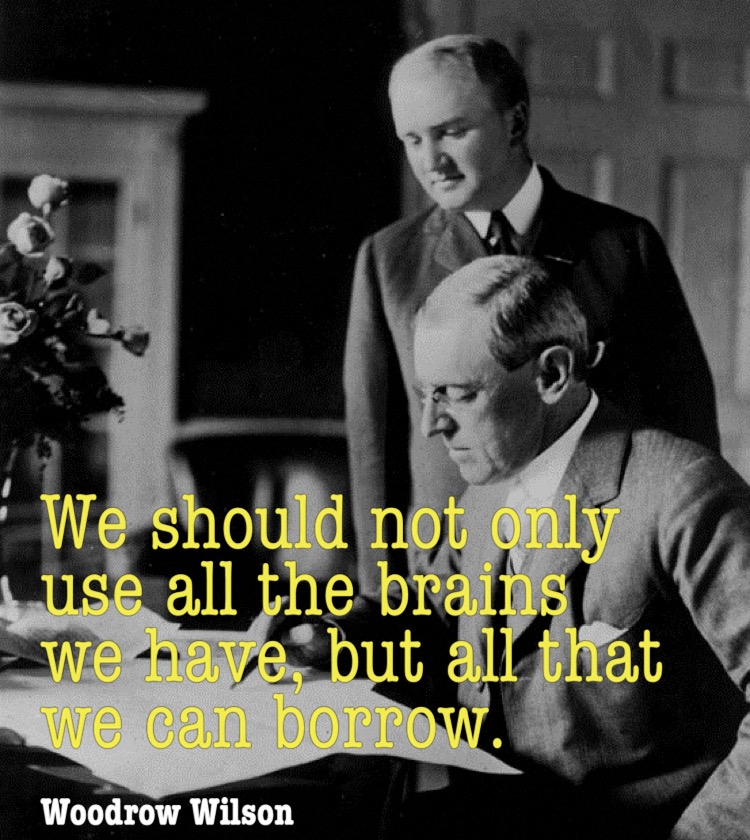
“We should not only use all the brains we have, but all that we can borrow.” —Woodrow Wilson

It’s so important to learn from others—to borrow their brains. I try to take something from other people’s brains every day.

  • Every morning I begin my day by studying the timeless truths found in the Bible.
  • Then I pray to ask God to give me the mind of Christ for my day.
  • Throughout my day I learn from the brains of other business and ministry leaders. People who have been-there-done-that and are willing to share are an invaluable source of wisdom.
  • I also consume a regular diet of biographies and autobiographies of past and present leaders. I try to put myself in their shoes to see why they made the decisions they made.
  • And I have some close friends that can give me their honest insight and critique.

One of the saddest things is to hear someone say, “I’m a self-made man” or “I’m a self-made woman.” Really?! That’s rather limited, isn’t it?

So whose brains are you borrowing? 

Sharper

Yesterday was one of those days that I was in “receive” mode. As a pastor, I usually spend more days in the “dispense” mode: teaching, counseling, advising. But yesterday I was blessed to sit back and soak in some great counsel. And I’m sharper for it.

It’s too bad that many people never take the time to allow others to advise them. Or, if they do go through the motions of “listening” to advice, they never put that counsel into action.

I met with a seasoned pastor yesterday morning. He asked me several questions to assess where I was personally and professionally, and then he gave me some invaluable insight. He’s one of those “been-there-done-that” guys who has learned the lessons of history well, and he was gracious to share with me.

Last night I invited my Impact teaching team over to my house. After sharing dinner together I listened as they weighed in on our upcoming series in our youth services. Since they are closer in age to our students, their insight into the teenage mind was so keen. They were able to help me better understand the challenges and culture of middle and high school students. And I’m sharper for it.

A few thoughts from some other wise counselors:

“A wise man will hear, and will increase learning; and a man of understanding shall attain unto wise counsels.” —Proverbs 1:5 (KJV)

“Those who will not be counseled, cannot be helped. More souls are ruined by pride than by any other sin whatever.” —Matthew Henry

“Without good direction, people lose their way; the more wise counsel you follow, the better your chances.” —Proverbs 11:14 (The Message)

“Plans fail for lack of counsel, but with many advisers they succeed.” —Proverbs 15:22 (NIV)

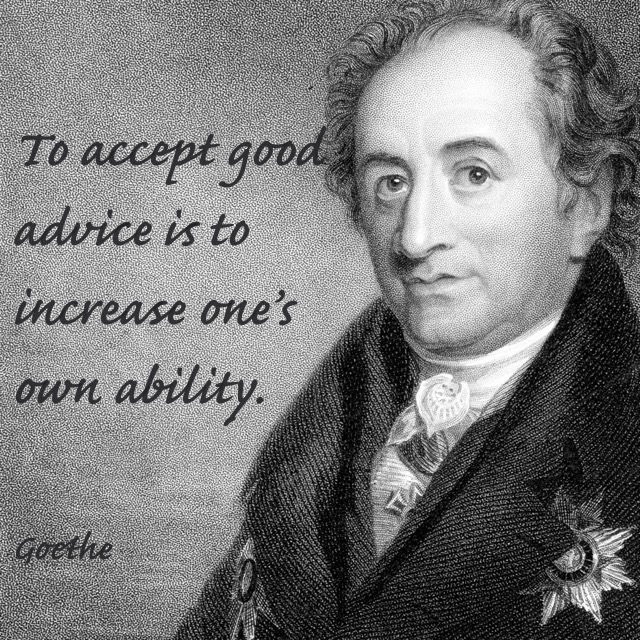
“To accept good advice is to increase one’s own ability.” —Goethe

Are you getting sharper? Are you listening to good advice?