15 Quotes From “Mansfield’s Book Of Manly Men”

Mansfield's Book Of Manly MenFrankly, fellas, there are just way too many passages I highlighted to share them all here, but I did want to give you a taste of some of the manly wisdom in Mansfield’s Book Of Manly Men. You can read my full book review by clicking here, but I suggest every red-blooded male who wants to be a manly man go get this book! You’ll be reading a lot more from me in the next few weeks that is inspired from this book.

“What makes a man a warrior is his willingness to place himself between what he holds dear and anything that threatens it. Honor is the chief motivator for the warrior. Dishonor is unthinkable. He does the right thing without expectation of reward because honor is an intrinsic value that, when manifested in one’s life, provides its own rewards.” —William Boykin

“By words like manly and manhood, I don’t mean the kind of behavior we see in the fake masculinity that surrounds us today. There’s nothing manly about a guy downing booze until he throws up in the street. There’s nothing manly about cruising for women like some predatory beast and then devouring them for pleasure before casting them aside. There’s nothing manly about making a child but then running like a coward before that child is born. There’s nothing manly about dominating a woman or treating her like a servant or leaving her with burdens that aren’t rightly hers. To think these actions make up true manhood is like thinking the average ‘gentleman’s club’ is actually for gentlemen. It’s not. Instead, it is a Palace of Perpetual Adolescence where incomplete males go to get on the cheap what they don’t have the guts to fight for righteously and make their own. … I am talking about the kind of manhood that makes a family whole, a woman safe, a child confident, and a community strong.” —Stephen Mansfield

“All it takes for a contagious manly culture to form is for one genuine man to live out genuine manhood. It creates a model, something for other men to feed upon and pattern themselves after. It also gives other genuine men a vital connection that sustains and extends who they are.” —Stephen Mansfield

“A man cannot fulfill his purpose if he is living for applause, approval, and affirmation in this world.” —Stephen Mansfield

“If a man does not have an ideal and try to live up to it, then he becomes a mean, base and sordid creature, no matter how successful.” —Theodore Roosevelt, in a letter to his son Kermit 

“Honorable men refuse to wallow in the small and the bitter. Honorable men refused to hate life because something once went wrong. Honorable men don’t build monuments to their disappointments, nor do they let others brand into them and curse them to their destruction. Honorable men seek out the highest definition of their lives, the nobler meaning granted by heritage, by their ancestors’ dreams and their parents’ hopes. Honorable man cry out to God until curses are broken and a grander purpose is achieved. Honorable man don’t settle for lives of regret.” —Stephen Mansfield

“Nothing great will ever be achieved without great men, and men are great only if they are determined to be so. For glory gives herself only to those who have always dreamed of her.” —Charles de Gaulle

“True friends stand in harm’s way for each other. True friends take the hits for one another. … Genuine men stand with their friends and look on the scars that result has signs of manly honor.” —Stephen Mansfield

“Weak men assume what they need to know will seek them out. Men of great character and drive search out the knowledge they need.” —Stephen Mansfield

“For a man to become a great man, he will have to defeat the force of bitterness in his life. No one escapes it. There is enough offense and hardship in the world to assure that all of us will be wounded and betrayed, all of us will have opportunity to drink the sweet-tasting poison of bitterness against those who have wronged us. The art of surviving untainted is to learn the art of forgiveness.” —Stephen Mansfield

“The question we all face is not whether or not we have defects. We do. Everyone of us. The question is whether we are capable of envisioning a life defined by forces greater than the weight of our flaws. The moment we can—the moment we can envision a life beyond mere compromise with our deformities—that is the moment we take the first steps toward weighty lives. Manly men know themselves, work to understand their God-ordained uniqueness and their unique brand of damage, and accept they will always be a work in progress, always be a one-man construction project that is never quite finished in this life. They don’t despair. They don’t settle. They don’t expect perfection of themselves. They understand that destiny is in the hand of God. They also understand that these destinies are fashioned in a man’s struggle against the enemies of his soul.” —Stephen Mansfield

“Every man must decide whether he will walk in the light of creative altruism or in the darkness of destructive selfishness.” —Martin Luther King Jr.

“Virtue is a state of war, and to live in it we have always to combat with ourselves.” —Jean-Jacques Rousseau

“Adversity toughens manhood, and the characteristic of the good or the great man is not that he has been exempt from the evils of life, but that he has surmounted them.” —Patrick Henry

“The man, whom I called deserving the name, is one whose thoughts and exertions are for others rather than himself.” —Walter Scott

Mansfield’s Book Of Manly Men (book review)

Mansfield's Book Of Manly MenIn my experience, men today aren’t allowed to be true men, manly men. I’m sure there are a lot of reasons why (but that’s another subject for another time), but for those men who are yearning to be the manly men that God has created them to be, Mansfield’s Book Of Manly Men by Stephen Mansfield will make you jump up and growl!

Men are wired by God in a unique way that makes them, well, men. When men embrace their God-implanted uniqueness they become manly men (which is another way of saying God-honoring men) who are better husbands, fathers, friends, and citizens. Stephen Mansfield quickly outlines his four maxims for manly men, and then shares a list of manly qualities to which all manly men should strive.

Each of these manly qualities are introduced by the life story of a manly man from history’s pages. Mansfield presents these men in all their manliness, including both their strengths and weaknesses; there are no perfect men, but there are many real men from which Mansfield allows us to learn. These manly qualities also come with some real in-your-face challenges of how to assess the growth of that quality in a man’s life.

In the foreword, written by retired Lt. General William G. Boykin (himself a true manly man), is this challenge: “This book is a must read for every American male. We must restore the understanding of what it means to be a manly man. The nation’s future depends on getting back to the fundamentals of being men of courage and values.” I couldn’t have said it any better!

I am a Thomas Nelson book reviewer.

30 Quotes From “Raising Your Child To Love God”

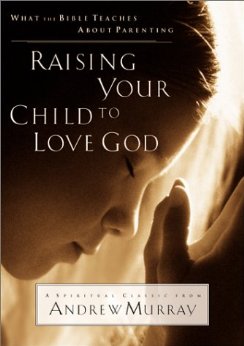
Raising Your ChildIt’s a book I called a “must read for all parents” (you can read my full book review by clicking here). After typing up my notes of all the quotes I highlighted in this book, I ended up with 18 pages of notes, so these quotes from Andrew Murray’s book are, in my opinion, the cream of the crop. Tomorrow I will share some of the prayers Murray offered in his book.

“Example is better than precept. … Love that draws is more important than law that demands. … Let parents be what they want their children to be.”

“How terrible is the curse and power of sin! Through the father the child becomes a partaker of the sinful nature, and the father so often feels himself too sinful to be a blessing to his child; thus the home becomes a path to destruction rather than to eternal life. But—blessed by God!—what sin destroyed, grace restores. … Let God’s Father-heart and His Father-love be your confidence. As you know and trust Him the assurance will grow that He is fitting you for making your home, in ever-increasing measure, the bright reflection of His own.”

“God seeks a people on earth to do His will. The family is the great institution for this object; a believing and God-devoted father is one of the mightiest means of grace.” 

“What God says of Abraham gives us further insight into the true character of this grace: ‘For I have chosen him, so that he will direct his children and his household after him to keep the way of the Lord.’ The spirit of modern so-called liberty has penetrated even into our family life; and there are parents, who some from a mistaken view of responsibility, some from lack of thought as their sacred calling, somer from love of ease, have no place for such a word as ‘command.’ They have not seen the heavenly harmony between authority and love, between obedience and liberty. Parents are more than friends and advisers; God has clothed them with a holy authority to be exercised in leading their children in the way of the Lord.”

“Oh that Christian parents would realize, just as Judah did, what it means to stand in that place for their child! How often—when our children are in danger because of the prince of this world, when the temptations of the flesh or the world threatened to make them prisoners and slaves, holding them back from ever reaching the Father’s home—are we found careless or unwilling to sacrifice our ease and comfort in order to rescue them!” 

“Oh, that the eyes of God’s people might be opened to the danger that threatens the church! It is not infidelity or superstition, it is the spirit of worldliness in the homes of Christian families, sacrificing the children to the ambitions of society, to the riches or the friendship of the world—that is the greatest danger of Christ’s church. If every home once won for Christ were a training school for His service, we would find in this a secret of spiritual strength no less than all that ordinary preaching can accomplish.”

“With a parent’s love comes a parent’s influence. … The character of a child is formed and molded by impressions; continual communion with the parent can render these impressions deep and permanent. The child’s love for a parent rises to meet the parent’s love.” 

“The first four commandments have reference to God, the last five to our neighbor. In between stands the fifth. It is linked to the first four because to the young child the parent represents God; from him the child must learn to trust and obey God. And this command is the transition to the last five because the family is the foundation of society, and there the first experience comes of all the greater duties and difficulties with humankind at large.”

“The child can only honor what he sees to be ‘worthy of honor.’ And this is the parent’s high calling: always so to speak and act, so to live in the child’s presence, that honor may be spontaneously and unconsciously rendered. … Above all, let parents remember that honor comes from God. Let them honor Him in the eyes of their children, and He will honor them there too.”

“There is nothing that drive home the word of instruction as powerfully as a consistent and holy life. … The entrance of divine truth into the mind and heart, the formation of habits and the training of character—these are not attained by sudden and isolated efforts, but by regular and unceasing repetition.”

“Love knows no sacrifice, counts nothing a burden; love does not rest until it has triumphed.”

“We don’t want to be just another family with whom God dwells and is pleased. Ours must be wholly consecrated to God. And do not be afraid that strength will not be given to keep the vow. It is with the Father in heaven, calling and helping and tenderly working both to will and to do in us, that we are working.”

“We need renewed wisdom directly from above for the individual needs of each child. Daily prayer is the secret of training our children for God. … Those who have already communicated with God and received divine teaching about their children will be those who desire still more and pray earnestly for it.”

“Nothing open the fountains of divine love and renewed love for each other more than the prayerful desire to know how to raise our children to love God.”

“Not to restrain a child is to dishonor God and the child.”

“My duty is never measured by what I feel is within my power to do but by what God’s grace enables me to do.”

“Every thoughtful parent knows that there are times and places when the temptations of sin will be more apt to surprise even the most well-behaved child. Such are the times, both before and after the child goes into a situation or circumstance where he may be tempted, that a praying father and mother should do what Job did, bring the children before God in repentance and faith and where possible to confront them with questions concerning their behavior.”

“Let us ask God to make us very watchful and very wise in availing ourselves of opportunities to admonish our children and to pray audibly with them.”

“In our family’s life, the first thing of importance must not be our earthly happiness, or even the supply of our daily needs, nor seeing to the child’s education for a life of prosperity and usefulness, but rather the yielding of ourselves to God in order to be conveyors of His grace and blessing to our children. Let us live for God’s purpose: deliverance from sin. Thus our family life will forever be brightened with God’s presence and with the joy of our heavenly home to come, of which our earthly one is by the nursery and the image.”

“‘The children of Your servants will live in Your presence; their descendants will be established before You’ (Psalm 102:25-28). Death may separate one generation from another, but God’s mercy connects them as it passes on from one to another; His righteousness, which is everlasting, reveals itself as salvation from generation to generation. … It is God’s will that His salvation should be known from generation to generation in your family too, that your children should hear from you and pass on to their children the praises of the Lord.”

“God’s purpose is that the Holy Spirit should take possession of our sons and daughters for His service; that they should be filled with the Holy Spirit, consecrated for service. They belong to Him and He to them.” 

“Jesus desires that we rise above the experiences of fatherhood on earth to know more deeply the Father in heaven.”

“The earthly father must not only make the Father in heaven his model and guide, but he must so reflect Him that his child will naturally desire to emulate the One whom he so aptly represents. … In a Christian father a child ought to have a better picture than the best of sermons can give of the love and care of the heavenly Father and all the blessing and joy He wants to bestow.”

“If we are to watch over the heavenly quality of our children, we must ourselves be childlike and heavenly-minded. … Children lose their childlikeness all too soon because parents have so little of it.”

“Fathers, you have sons whom you would fain bring to Jesus to be saved, come and hear the lessons the Lord would teach you. Let these children first send you to Jesus in confession, prayer, and trust; your faith can bring them in.”

“Your motherhood is in God’s sight holier and more blessed than you realize.”

“The effect of the good advice parents give is more than neutralized by their own behavior.” 

“A child should never be allowed to feel that his immaturity is not taken into account, that his young reasoning is not regarded, that he has not received empathy, or help, or justice that he expects. This will take a kind of love and thoughtfulness that parents are all too short of.”

“If you feel that you do not know how to teach the Word to them, to make it interesting or exciting for them, take heart—God will make it come alive to them if you are faithful to read it and live it.”

“I am the giver of their physical life, the framer of their character, the keeper of their souls, the trustee of their eternal destiny. I was first blessed that I may bless them, first taught how my Jesus loved me and gave Himself for me that I may know how to love and how to give myself for them. … And the more tenderly my love to them is stirred up, the more I feel the need to be wholly and only the Lord’s, entirely given up to the love that loves and makes itself one with me. This will fill me with a love from which selfishness shall be banished, giving itself in a divine strength to live for the children that God has given me.”

Blessing Our Children

IMG_4195So Isaac called for Jacob and he blessed him… (Genesis 28:11).

Isaac blessed Jacob once when he was deceived by Rebekah and Jacob, but here he blesses him again knowing full well that it is Jacob that he is blessing. He starts his blessing with these words: “May God Almighty bless you.”

Later God Himself appears to Jacob to affirm this blessing that Isaac has asked for. Notice how God says He will be the One pouring out the blessing: I am the Lord … I will give you this land … I will be with you … I will bring you back … I will not leave you” (vv. 13-15).

The blessing by Jacob’s Heavenly Father was initiated by the blessing of his earthly father. 

It is important for fathers to bless their children, as this puts them in a place to receive God’s blessing. In the Greek, the word bless means “good words.” So Dad,

  • Say good words to your children
  • Say good words about your children to others
  • Say good words about your children to their Heavenly Father

Don’t ever let your children wonder what God’s blessings are like. Let them know from your blessings what sort of blessings God wants to pour out on them.

God Chooses Dads

God chooses DadsThis is an amazing thing God says to Abraham:

When the men got up to leave, they looked down toward Sodom, and Abraham walked along with them to see them on their way. Then the Lord said, “Shall I hide from Abraham what I am about to do? Abraham will surely become a great and powerful nation, and all nations on earth will be blessed through him. For I have chosen him, so that he will direct his children and his household after him to keep the way of the Lord by doing what is right and just, so that the Lord will bring about for Abraham what He has promised him.” (Genesis 18:16-18)

Notice some very important aspects in this passage especially for Dads.

(1) God chose Abraham to be a father. 

God doesn’t haphazardly give children to fathers; He places children in homes on purpose. God chooses Dads!

(2) God chose Abraham for a specific paternal responsibility. 

God chooses a Dad today for the same reason He chose Abraham: So that he will direct his children and his household after him to keep the way of the Lord by doing what is right and just. 

(3) Because God gave Abraham this responsibility, He revealed intimate details to him about Abraham’s household. 

God asks, “Should I hide this from Abraham?” And then answers His own question with a resounding “No!” by telling Abraham specifically what is about to happen that will affect Abraham’s household (vv. 20-21). God wants to tell you, too, what’s happening in our culture that will affect your children.

(4) Abraham used this insight wisely. 

Verse 22 tells us, “Abraham remained standing before the Lord.” Dads, there is no better place for you to be than in God’s presence. If God chose you to be your children’s Dad, and if He specifically gave those children to you, He is your best resource for help in raising God-loving children!

Billy Graham said, “Parenting is the most important responsibility most of us will ever face, and none of us does it perfectly.” But rest assured, God wants to help us do it better!

6 Quotes On Marriage & Family From “The Book Of Man”

I really enjoyed reading The Book Of Man by William J. Bennett (you can read my book review here). The topics were very broad, so I’ll be sharing some of my favorite quotes on the different sections in this book over the next few days.

Here are six quotes about marriage and family…

“The family is the association established by nature for the supply of men’s every day wants.” —Aristotle 

“All great change starts at the dinner table.” —Ronald Reagan

General Robert E. Lee was on his way to Richmond, and was seated in the extreme end of a railroad car, every seat of which was occupied. At one of the stations, an aged woman of humble appearance entered the car, carrying a large basket. She walked the length of the aisle and not a man offered her a seat. When she was opposite General Lee’s seat, he arose promptly and said, “Madam, take this seat.” Instantly a score of men were on their feet, and a chorus of voices said, “General, have my seat.” “No, gentlemen,” he replied, “if there was no seat for this old lady, there is no seat for me.” 

“You must not encourage, but rather give yourself to what is kind and pure, chaste, true, loving, elevating, ennobling, and by all means learn to distinguish between love and lust. This is the switch at which so many are side-tracked to ruin. …Lust will degrade you; love will elevate you. Lust will make you vile, selfish, sordid, low; love will make you pure, chaste; lovable, manly. Lust will make you earthly, sensual, devilish; love will make you godlike, continent, noble.” —Rev. Lewis Johnson

“Fatherhood can sometimes be walking the floor at midnight with a baby that can’t sleep. More likely, fatherhood is repairing a bicycle wheel for the umpteenth time, knowing that it won’t last the afternoon. Fatherhood is guiding a youth through the wilderness of adolescence toward adulthood. Fatherhood is holding tight when all seems to be falling apart; and it’s letting go when it is time to part. Fatherhood is long hours at the blast furnace or in the fields, behind the wheel or in front of a computer screen, working a 12-hour shift or doing a 6-month tour of duty. It’s giving one’s all, from the break of day to its end, on the job, in the house, but most of all in the heart.” —Ronald Reagan

“And yet there is no relation on this side of the grave, more sacred, more dignified, or more elevated, than that of husband and wife. The parties might be, and should be, to each other, perpetual sources of consolation and pleasure. There should be no distrust, no suspicion, no equivocation between beings so circumstanced. They should live as much as possible as if animated by one soul and aiming at one destiny. Neither should look for perfection in the other, and yet each should endeavor to excel the other in generous efforts of gentleness, kindness, and affection.” —Robert Morris

The Book Of Man (book review)

“The purpose of this book is to explore and explain what it means to be a man,” writes William Bennett in the introduction of The Book Of Man: Readings on the Path to Manhood. It seems like an ambitious goal, but this book actually does a wonderful job in achieving that lofty goal.

If you’ve read any of the other compilations that William Bennett has pulled together (such as The Book Of Virtues), you will have a good idea of the layout of this book. In case you haven’t experienced any of Bennett’s other collections, the idea is to pull together some of the wisest words ever spoken or written on a singular topic. In so doing, the reader will get to look at that topic through the eyes of so many different people, that it will give a much fuller view of the topic.

In this book, the topic is men. What does it mean to be a man? To be a Dad? To be a husband? To be a soldier or an employer/employee? To be tough and yet loving? To be thoughtful and yet a man of action? The Book Of Man is divided into six sections:

  • Man in war
  • Man at work
  • Man in play, sports, and leisure
  • Man in the polis
  • Man with woman and children
  • Man in prayer and reflection

In each section you will find the wit and wisdom of men living and dead; of those in the modern world and the ancient; of those from Western cultures and Eastern; of those who have “been there, done that.” This is not necessarily compiled to be read from cover-to-cover (although that’s the way I enjoyed reading it), but to go to the various sections as you are learning and growing in that area. I also love the comprehensive index at the end of the book, as a way to search for a particular author or topic.

As with William Bennett’s other books, this is a great book to read aloud with others. I would especially recommend Dads reading passages with their sons, as a great tool in helping our young men learn what it means to be a true man.

I am a Thomas Nelson book reviewer.

UPDATE: I am sharing some of my favorite quotes from The Book Of Man. You can read them here, and here, and here, and here, and here, and here.

Courageous Enough To Interfere

King David was brilliant as a king, and a disaster as a father. One of the things that is very telling is what is not written when his kids mess up. The Bible tells us that David felt strong emotions, but he simply didn’t act on them. In fact, one of the most telling verses of inaction comes when his son Adonijah is trying to put himself on David’s throne—

His father had never interfered with him by asking, “Why do you behave as you do?” (1 Kings 1:6)

It takes courage to interfere with our kids when they are misbehaving.

So why don’t some dads interfere? I can think of a few reasons…

  • They didn’t have a good relationship with their own father. In David’s case, his father Jesse didn’t think too highly of David. In fact, David was the overlooked, almost-forgotten son (1 Samuel 16:8-11).
  • They’re too tired. David was so focused on building up Israel’s defenses, and defeating the bad guys, that he had nothing left emotionally and physically to interact with his kids. We need to make it our priority! John wrote: I have no greater joy than knowing my children all walk in the truth (3 John 4). Now that’s a great priority!
  • Their past sins haunt them. David sinned against Bathsheba (like Amnon did against Tamar); David murdered Uriah (like Adonijah did Amnon). So perhaps he felt like he didn’t have the moral authority to interfere with his sons. But if you read some of the wise sayings in Proverbs 6:20-29 and 7:1-5, they sound like a man who has had experience. Let your hindsight (good or bad) be your kids’ foresight.
  • They think it’s too late. It’s never too late! Never! Apparently, David learned this lesson in time and taught his son Solomon (read Proverbs 1:1 and 4:3-4). As long as there is breath in your lungs, you should be your kids’ dad!

Dads, will you be courageous enough to lovingly interfere with your kids if they are getting off track?

Will you be courageous enough to make some changes in your schedule so that you can invest the time and energy and creativity necessary to raise them up?

Will you be courageous enough to confess your past sins, and not let them hold you back from speaking into your kids’ lives?

Will you be courageous enough to start today?

Dad, you kids need you to be involved! Be courageous enough to step into their lives.

“The Bridge Builder”

I shared this poem in my Father’s Day message this morning, and several folks have asked me to share it. I’m happy to do so!

An old man walking a lonesome road,
Came at the evening, cold and gray,
To a chasm vast and wide and deep.
The old man crossed in the twilight dim,
The rolling stream had no fears for him;
But he turned when safe on the other side,
And built a bridge to span the tide.
“Old man,” said a fellow traveler near,
“You are wasting your strength with building here,
Your journey will end with the passing day,
You never again will pass this way,
You’ve crossed the chasm, deep and wide,
Why build you this bridge at eventide?”
The builder lifted his old gray head,
“Good friend, in the path I have come,” he said,
“There followeth after me today,
A youth whose feet must pass this way.
The chasm that was naught to me,
To the fair headed youth may a pitfall be.
He too must cross in the twilight dim –
Good friend, I am building this bridge for him.” —W.A. Dromgoale

I am thankful for all of the fathers who said they would be courageous enough to be a bridge-builder for their kids! May God bless you as you follow through on this noble calling.

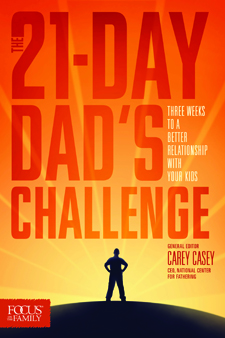
The 21-Day Dad’s Challenge (book review)

Next to being a husband, there is nothing I love more than being a Dad! I take my responsibility as a father very seriously, so that’s why I am always trying to grow in this area of my life. I just finished a 3-week journey through The 21-Day Dad’s Challenge by Carey Casey, and I am a better Dad for it.

As the name implies, this is designed to be read one day at a time over 21 days. At the end of each day’s lesson there are challenges to help Dads put into practice what they’ve just read. These challenges, I discovered, cannot be accomplished in a single day; they are intended to become lifelong habits. At the end of several of the chapters is a QR code that takes you to a short 2-minute video by Dr. Greg Smalley, who serves as a cheerleader/motivator to help Dads get moving.

I appreciated “the little things” that this book showed Dads could do right away. The principles in this book are not hard to implement, but they are simple steps that any Dad can do. At least, any Dad who wants to step up his fathering skills!

I loved it! I think lots of other Dads will too.

I am a Tyndale book reviewer.