Weekend Review

I feel so full after such a wonderfully full-filling weekend.

On Saturday morning our worship team helped kick-off Lifewalk 2011, by leading some worship songs during the registration time. I love doing spiritual battle alongside this team! It was a great way to remind everyone why we were there.

God gave us beautiful weather for Lifewalk! Along our route we stopped to pray at Cedar Spring City Hall, The Springs Church, Alpha Family Center, and Red Hawk school. When we returned to our starting point in Morely Park, we were greeted with the great news that Lifewalk had raised nearly $12,000!

I had the privilege of addressing the Lifewalk participants just before we released our balloons. I spoke from Ephesians 2:10, where we read that God created us in advance to do good works that would bring Him glory. Unfortunately, tens of millions of babies have been aborted before they had a chance to do their good works, so it is now up to us, the living, to redouble our efforts. We need to do not only the good works God prepared us to do, but also the good works of those aborted lives. It was a somber, yet empowering, reminder.

20110620-063303.jpgOn Sunday morning I spoke to our Dads on Father’s Day. I told the story of Boaz the kinsman-redeemer from the book of Ruth. Boaz was a man motivated by God’s word, and a man who did not give in to culture’s pull. Boaz was also a picture of Jesus Christ as the ultimate Kinsman-Redeemer. I challenged our Dads to remember that they are the representation of Christ to their wives and kids.

The highlight of Sunday morning for me was watching all of our Dads serve Communion to the rest of the church. Powerful! What a reminder to all of us that Dads are to love and serve their families just as Christ loves and serves His Church.

To cap it all off, I got to have lunch with both my Dad and my kids. It was a very moving thing for me to not only honor my Dad, but to read the notes my kids had written to me. Part of what I wrote to my Dad was about the investment he made in my life. Then he and I both watched that investment being compounded in the lives of his grandkids. How awesome is that!

When I experience such a full weekend, only one thought dominates my mind: How blessed am I! I love living my life to honor my Heavenly Father, and I’m so grateful I get to share that life with so many other incredible people.

I Didn’t Choose This

Hello, my name is Craig Owens and I’m a pastor. I wasn’t a PK (pastor’s kid). This isn’t the profession I chose for myself. I envisioned myself doing other things, but God had different plans for me.

He called, and I said “yes.” He called me to be a pastor and so He equipped me for the pastorate. I can relate to what the Apostle Paul wrote—

By God’s grace and mighty power, I have been given the privilege of serving Him by spreading this Good News. (Ephesians 3:7)

Paul, too, didn’t choose be a minister telling people about Jesus Christ. But God had different plans for him.

And so, since God has called me to do this, I must do it to the best of my ability. I don’t have the natural ability for it, I simply have God’s grace and mighty power. And to that grace and power I must add my best effort—

Study and be eager and do your utmost to present yourself to God approved (tested by trial), a workman who has no cause to be ashamed, correctly analyzing and accurately dividing [rightly handling and skillfully teaching] the Word of Truth. (2 Timothy 2:15, AMP)

I like the counsel of Charles Spurgeon:

Again, the theme of a minister should be Christ Jesus in opposition to mere doctrine. Some of my good brothers are always preaching doctrine. Well, they are right in so doing, but I would not care myself to have as the characteristic of my preaching doctrine only. I would rather have it said, ‘He dwelled much upon the person of Christ and seemed best pleased when he began to tell about the atonement and sacrifice. He was not ashamed of the doctrines; he was not afraid of threatening. But he seemed as if he preached the threatening with tears in his eyes, and the doctrine solemnly as God’s own Word. But when he preached of Jesus, his tongue was loosened, and his heart was at liberty.’”

I didn’t choose this, but God chose me. And for that I am extremely humbled and grateful.

Wider Longer Higher Deeper

When was the last time you experienced a dimension of God’s love for the first time?

The Apostle Paul suggested that God’s love went beyond our 3-dimensional world—

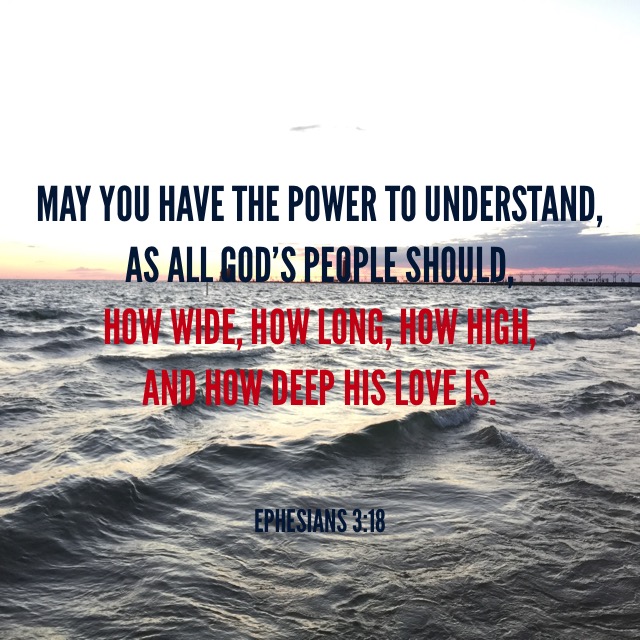
And I pray that you, being rooted and established in love, may have power, together with all the Lord’s holy people, to grasp how wide and long and high and deep is the love of Christ, and to know this love that surpasses knowledge—that you may be filled to the measure of all the fullness of God. (Ephesians 3:17-19)

God’s love is WIDER than we can cross in a lifetime…

LONGER than we can see with natural eyes…

HIGHER than we can scale on our own…

DEEPER than we can comprehend.

I love the last verse of Frederick M. Lehman’s hymn The Love Of God

Could we with ink the ocean fill,
And were the skies of parchment made,
Were every stalk on earth a quill,
And every man a scribe by trade;
To write the love of God above
Would drain the ocean dry;
Nor could the scroll contain the whole,
Though stretched from sky to sky.

Experiencing The Spirit (book review)

Years ago I read Henry Blackaby’s outstanding book Experiencing God, which helped me see God’s relationship with me in a whole new light. Now Henry and Melvin Blackaby have done the same thing with the role of the Holy Spirit in a Christian’s life in Experiencing The Spirit: The Power of Pentecost Every Day.

I’m a fourth-generation Pentecostal, so I’ve grown up with a solid understanding of the Holy Spirit. But Experiencing The Spirit created in me a longing for something more. I don’t want it to just be a head-only theology, but a heart-felt relationship. In fact, this question in the book hit me right between the eyes: Do you spend more time and effort honing your skills than you do seeking the Lord and deepening your relationship with Him?

I don’t want to just know about God, I want to know Him. And a deeper relationship with the Holy Spirit is what allows that to happen. The Apostle Paul prayed for the church at Ephesus, and I want to make that my prayer too…

I pray that out of His glorious riches the Father may strengthen me with power through His Holy Spirit in my innermost being, so that Christ may dwell in my heart through faith. And I pray that as I am being rooted and established in love, I may have power, together with all the saints, to grasp how wide and long and high and deep is the love of Christ, and to know this love that surpasses knowledge—that I may be filled to the measure of all the fullness of God.

For a more intimate relationship with the Spirit of God, I recommend checking out Experiencing The Spirit.

Everywhere And Everywhen

Wise words from G. Morgan Campbell:

“The Christian is to seek the upper things, setting his mind upon them, and everywhere and everywhen he is to be hoping for, and endeavoring after, the ultimate. That is the simple meaning of prayer: reaching forward, wishing forward, desiring forward, seeking the upper, the higher, the nobler.”

The Bible is clear, too, about us praying everywhere and everywhen for the very best:

  • We ought always to pray and not to turn coward, faint, lose heart, and give up (Luke 18:1)
  • God has seen how I never stop praying for you (Romans 1:9)
  • For I always pray to the God of our Lord Jesus Christ, the Father of glory, that He may grant you a spirit of wisdom and revelation (Ephesians 1:17)
  • In all my prayers for all of you, I always pray with joy (Philippians 1:4)
  • Our prayers for you are always spilling over into thanksgivings. We can’t quit thanking God our Father and Jesus our Messiah for you! (Colossians 1:3)
  • Epaphras always prays earnestly for you, asking God to make you strong and perfect, fully confident that you are following the whole will of God (Colossians 4:12)
  • We always thank God for all of you and pray for you constantly (1 Thessalonians 1:2)
  • We ought always to thank God for you, and rightly so, because your faith is growing more and more (2 Thessalonians 1:3)
  • I give thanks to my God for you always when I mention you in my prayers (Philemon 1:4)
  • Pray for us. We have no doubts about what we’re doing or why, but it’s hard going and we need your prayers (Hebrews 13:18)

Someone needs your prayers today.

Will you keep on praying for a friend that he or she will be able to

…reach forward

…wish forward

…desire forward

…seek the upper, the higher, the nobler!

Smile Away

Sometimes the shortest distance between two people is a simple smile.

I love a scene in The Bourne Identity where Jason and Marie are hatching this highly-detailed plan to get an invoice from a hotel. Marie walks into the hotel lobby to execute their well-designed scheme, and before spy/assassin Jason Bourne has time to walk her through it, Marie is back outside. “What happened? What went wrong?” Jason asks. Marie simply replies, “The man at the desk was smiling at me, so I thought I would simply ask him for the invoice.”

When I was a kid we used to sing a little ditty in Sunday School that went like this —

If you’re happy and you know it clap your hands.
If you’re happy and you know it then your face will surely show it,
If you’re happy and you know it clap your hands.

Here’s what the Bible says about smiling faces:

Smiling faces make you happy. (Proverbs 15:30)

What a relief to see your friendly smile. It is like seeing the face of God! (Genesis 33:10)

When I smiled at them, they could hardly believe it; their faces lit up, their troubles took wing! (Job 29:24)

Don’t just do what you have to do to get by, but work heartily, as Christ’s servants doing what God wants you to do. And work with a smile on your face. (Ephesians 6:6)

Why are you down in the dumps, dear soul? Why are you crying the blues? Fix my eyes on God—soon I’ll be praising again. He puts a smile on my face. He’s my God. (Psalm 42:5)

George Eliot said, “Wear a smile and have friends; wear a scowl and have wrinkles.”

So if people feel miles away from you, perhaps they’re just a SMILE AWAY.

Try it. Smile! You’ll feel better and others will feel better about you too.

Seeing Only The Best In Your Spouse

Researchers have found that the biological responses of your body and brain to being “in love” only last two years. So guess when most newlyweds begin experiencing problems in their marriage? Yep, you guessed it: about two years into marriage.

After the in love buzz wears off, what can you do to maintain a happy, fulfilling marriage? Quite simply you have to choose to see only the best in your spouse.

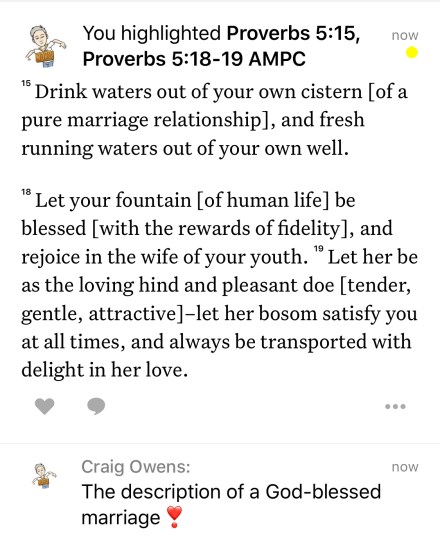
Solomon was so wise to write to us that our spouse should be the only one who captivates us … the only one who satisfies us … the only one who keeps making our hearts go pitter-pat! When we choose to see the best in our mate, we can keep that in love buzz going for the life of the marriage.

Check out this excerpt from a WebMD article (you can read the full article here)—

Most often, self-assessments are grounded in reality, the researchers write. The way we see ourselves is fairly accurate. The way we see others, they continue, is often shaped by hope. With that in mind, they took one partner’s self-assessment at face value and compared it to the other partner’s assessment, as well as that partner’s description of his/her ideal partner.

For example, John’s ideal mate is funny and warm. And that is how he chooses to see Jane, who he has just married, despite the fact that Jane describes herself as moody and distant. Will John change his tune over time and come to regret his marriage to Jane? Or will his positive—if skewed—view of his wife help maintain his happiness?

Fortunately for John, the researchers found the latter to be true. In tallying the data, they discovered that those who did not idealize their partners when they got married tended to be more dissatisfied with their marriage by the end of the study compared to those who had an unrealistically idealistic view of their partner. Those in the “idealistic” group tended to be happier and more satisfied with their marriage.

In other words: you will bring out of your spouse what you see in your spouse.

Do you want a fun-loving wife? See her as your favorite playmate.

Do you want a confident husband? See him as a strong, self-assured provider for your home.

I like how the Apostle Paul states this (especially in the Amplified Bible)—

However, let each man of you without exception love his wife as being in a sense his very own self; and let the wife see that she respects and reverences her husband—that she notices him, regards him, honors him, prefers him, venerates, and esteems him; and that she defers to him, praises him, and loves and admires him exceedingly.

Just as God sees the best in you and loves you for who He sees you becoming, love your spouse and see only the best in him/her.

Thursdays With Oswald—Yielded

This is a weekly series with things I’m reading and pondering from Oswald Chambers. You can read the original seed thought here, or type “Thursdays With Oswald” in the search box to read more entries.

Yielded

       There is a distinct period in our experience when we cease to say—“Lord, show me Thy will,” and the realization begins to dawn that we are God’s will, and He can do with us what He likes. We wake up to the knowledge that we have the privilege of giving ourselves over to God’s will. It is a question of being yielded to God.

From Facing Reality

For we are God’s workmanship, created in Christ Jesus to do good works, which God prepared in advance for us to do. (Ephesians 2:10)

Thank You for making me so wonderfully complex! Your workmanship is marvelous—how well I know it. (Psalm 139:14)

God has a plan for my life. He prepared me in advance to fulfill His will and plan for me. Will I yield to Him? Or will I continue to try to find my own way?

What a supreme privilege it is to yield to His will for my life!

Thinking About And

These are my “raw notes” from The And Conference. If anyone wants to add on, modify, or delete, please feel free.

Alan Hirsch

Cultural differences – imagine numbers 1-4 as barriers to even starting a conversation (m1-m4).

In western culture we’re pushing more toward m3 or m4. In fact, the gap between m0 and m1 is shrinking.

Our idea of church is 17 centuries old (tracing back to Constantine), so there is a HUGE assumption we’re making when we think “church.” From m0 to m1 is the church’s current domain. No cultural barriers have to be crossed. However, much of culture is in m3-m4.

If we act attractionally in a missional setting, we’ve extracted them from their “m” zone. New believers in 3-5 years after becoming a Christian will have no non-Christian friends. We’ve extracted them!

Most people feel good about God, Jesus, and spirituality. However, there are negative feelings about “church.” Most people remember or focus on only three things in their “perceived set.” Marketers try to get their product/service in that perceived set.

Jesus, yes; church, no. Kind of like iPhone, yes; AT&T, no. But now the Apple logo on the iPhone reminds people of AT&T.

The dechurched have been inoculated against the church.

Dream out-loud at high volume about what the church could be!

“As the Father sent Me, so I send you.” How did the Father send Jesus? He stepped into culture, He lived in the culture and spoke to people out of culture. Church should come out of mission, not mission out of church. Just like the Acts church didn’t require Gentile believers to adopt Jewish practices. So we don’t plant churches, we plant the Gospel and let the church grow out of that.

The Bible doesn’t know the difference between “clergy” & “laity.” Why do we persist in putting people in these categories?

————–

“Apostolic” is the Greek version of the Latin “missional.” We need an apostolic environment to take movements to a place of spontaneous expansion. The apostle is a catalyst to growth.

Paul starts churches which start churches = movement → expansion.

Paul then teaches. He is the custodian of the movement’s DNA. He is also the guardian of the purity of the DNA.

An “apostle” is not an apostle if it’s a top-down leadership. An apostle is a servant leader.

Ephesians 4

  • vv. 7-11  APEST = apostle, prophet, evangelist, shepherd, teacher.
  • vv. 12-16  maturity—cannot get to maturity without all of APEST. Most denominations focus just on S & T. “Shepherd” is only used once in the New Testament, and the New Testament says, “Not many of you should presume to be teachers.”

Leadership is a calling within a gifting. APEST gifts are given to everyone, but some are called to be leaders within their gifting.

APEST gifts carry more of a vocational weight. Gifts of the Spirit are more of empowerments for the moment. The gifts of Romans 12 are motivational/paradigmal gifts.

———-

Re-Jesus = a renewed focus on full Christology: most of our focus is on the Cross, resurrection & return. We need to include Incarnation & His life among humanity. We make Him Savior, but not Lord.

Re-mission = who God is must determine what the church does.

Re-organize = missional churches are responsive to the world around us. Our churches must be organized to be nimble.

Tim Stevens

Every new term that comes out tells us we’re doing church wrong. So Tim says “Missional schmissional!” and “Attractional schmactional!”

Most churches are defined as “Come to us.” But this only works for <40% of people. People are still “spiritual,” but they don’t like “church.”

Do we attract the unchurched 60% OR missionalize the churched 40%. How about BOTH-AND? We have to help the 40% reach their 60%.

We can still say “Come and see,” but emphasize “So that” = “Come and see what Jesus does so that you can tell others.”

There is no one-plan-for-all method for churches to do BOTH-AND. Each church must discover what works for them in their community.

Jason Miller

Linear thinking is how our brains process info. That’s why telling stories with a plot twist is so powerful. Like when Jesus said, “You have heard… but I tell you….” Twists get people’s attention.

People in the world have had their imaginations devastated by culture who says love is conditional. When we talk about God’s unconditional love, it’s a plot twist they never imagined.

We have a mandate to do something beautiful. Beauty awakens imaginations to see God’s love. Like sympathetic vibrations: God’s beauty begins to resonate and awaken imagination.

“The church is God’s imagination to the world.”

Dave Ferguson

What can we do for those who won’t come to church?

Missional people (micro level) + Multiplying churches (macro level) = Missional movement

How to create a missional culture: (1) Ordain every member; (2) Lead with a “Yes”; (3) Make heroes of everyday people.

Saying “Yes” doesn’t mean funding the project or even announcing the project. It just means giving people permission to reach out.

Business paradigm that makes money but not movements: say “No” to anything that you haven’t fully researched.

Matt Carter

We can’t have “professional Christians” that do ministry & those that only receive ministry.

Christianity today needs to look like what we see in Acts.

What if instead of attracting new people to church, we released current attendees to do ministry?

What if it wasn’t “come and see” but “go and do”?

Small group success = seeing & addressing a need in the community. “Nothing builds community better than mission. When we aim at community, we may get it. But when we aim at mission, we get that and community too.”

Need to share success stories and failure stories. This creates a culture that let’s everyone know that it’s okay to try.

Hugh Halter

We need to redefine “disciple” because now we define them as “church attendee.”

Two categories: missional and sojourners. Missional people prepare the way for sojourners to become missionals by making the Kingdom of God tangible.

A better definition of disciple is apprentice. An apprentice is learning by doing; they’re hands-on.

Second decision environment = people choose to get more involved. For example, Sunday morning attendance is a first decision; a small group is a second decision.

Barriers to discipleship: individualism, consumerism, materialism. To overcome these barriers, Jesus put people in a place of tension. This typically can’t take place in a first decision environment.

Other ways to address these barriers: modeling, confrontation, action/reflection.

Jesus wasn’t interested in followers, but in disciples.

Rob Wegner

“Every member is a minister.” —Mark Beeson

Attractional churches use centripetal force to bring people in. Missional churches use centrifugal force to send people out.

Attractional is embedded inside missional. Attractional is the seed for missional. As Hirsch said, it’s more “extractional.”

Attractional seeds → Missional community → Extractional movement

Do we have to see church as institution and church as movement as opposites? Or co-existing? Genius of BOTH-AND!

They’re Both Dissin’

Check out these opening paragraphs from an article on WebMD (if you wish, you can read the full article here):

     People over 50 get a self-esteem boost when they read negative news about young adults, a study shows.

     Researchers also say young people, when given the choice, would rather read about people their own age and aren’t very interested in stories about their elders, whether the articles are positive or negative.

     “Our results reflect that the younger readers did not perceive older people as all that relevant,” study researcher Silvia Knobloch-Westerwick, PhD, of Ohio State University, tells WebMD by email. “They’re more concerned with figuring out who they are and where they stand, and those in the same age group appear to provide the relevant comparisons for that.”

Okay, this disturbs me on several areas. Basically, each age group is dissin’ the other age group.

The senior citizens are projecting a snickering, see-I-told-you, father-knows-best, condescending attitude on youth. Why would anyone who is willing to learn and grow want to be around that kind of person?!

Then our youth have an I’ve-got-it-all-figured-out, I-don’t-need-you, you’re-out-of-touch attitude toward the senior citizens. Why would anyone who is willing to mentor someone ever want to be that kind of person?!

I think both of these generational groups could learn from this wise advice:

Children, do what your parents tell you. This is only right. “Honor your father and mother” is the first commandment that has a promise attached to it, namely, “so you will live well and have a long life.” Fathers, don’t exasperate your children by coming down hard on them. Take them by the hand and lead them in the way of the Master.