The Counselor Instructs Us

The life of Jesus“The Counselor” is the name Jesus gave to the Holy Spirit. Looking at the definition of the word Counselor, there are four main things the Holy Spirit will do in our lives which corresponds to another well-known passage of Scripture—

All Scripture is God-breathed and is useful for teaching, rebuking, correcting and training in righteousness, so that the man of God may be thoroughly equipped for every good work. (2 Timothy 3:16)

The Counselor teaches/instructs, rebukes, corrects, and trains. And He does this through The Word that He inspired.

The Bible is one huge “the Holy Spirit said” Book. Men wrote the words of Scripture as the Counselor Spirit inspired them (2 Peter 1:19-21). That same Counselor then helps us apply those inspired words to our lives.

Jesus is our Ultimate Example of One Who was baptized in the Holy Spirit, and fully controlled by the Holy Spirit (Luke 4:1). The Counselor helped Jesus the Man be able to apply the inspired Scripture:

Jesus told His followers to received the baptism in the Holy Spirit (Acts 1:4-5, 8), so we could be His witnesses in the world (see Acts 8:26-35 and 10:38-43).

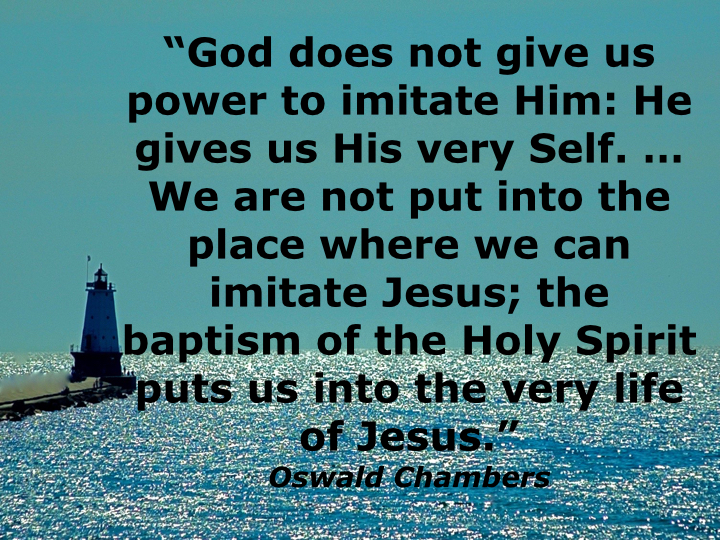
“God does not give us power to imitate Him: He gives us His very Self. … We are not put into the place where we can imitate Jesus; the baptism of the Holy Spirit puts us into the very life of Jesus.” —Oswald Chambers

This should be our normal life! But if we discount the Holy Spirit—or even discount our worthiness to commune with The Counselor—we begin to accept sub-normal as normal, and the normal become miraculous and only obtainable by a few “spiritual giants.”

The Father’s desire is for all of us to bear a strong, unmistakable family likeness to Jesus. Christ relied on The Counselor, so we must as well.

Next Sunday I will be continuing our series on the Holy Spirit called The Counselor. If you are in the Cedar Springs area, please join us.

Links & Quotes

link quote

Some good reading from today…

A good laugh— Al and Lois go to a counselor after fifteen years of marriage. The counselor asks them what the problem is. Lois goes into a tirade, listing every problem they’ve ever had in their years of marriage. She goes on and on and on. Finally, the counselor gets up, embraces the surprised Lois, and kisses her passionately. Lois shuts up and sits quietly in a daze. The counselor turns to Al and says, “That is what your wife needs at least three times a week. Can you do that?” Al thinks for a moment and replies, “Well, I can get her here Mondays and Wednesdays, but Fridays I play golf.”

“It becomes every man who purposes to give himself to the care of others, seriously to consider the four following things: First, that he must one day give an account to the Supreme Judge of all the lives entrusted to his care. Secondly, that all his skill, and knowledge, and energy as they have been given him by God, so they should be exercised for his glory, and the good of mankind, and not for mere gain or ambition. Thirdly, and not more beautifully than truly, let him reflect that he has undertaken the care of no mean creature, for, in order that he may estimate the value, the greatness of the human race, the only begotten Son of God became himself a man, and thus ennobled it with his divine dignity, and far more than this, died to redeem it. And fourthly, that the doctor being himself a mortal man, should be diligent and tender in relieving his suffering patients, inasmuch as he himself must one day be a like sufferer.” —Dr. Thomas Sydenham, known as the father of English medicine

“It is a poor thing to strike our colors to God when the ship is going down under us; a poor thing to come to Him as a last resort, to offer up ‘our own’ when it is no longer worth keeping. If God were proud He would hardly have us on such terms: but He is not proud, He stoops to conquer, He will have us even though we have shown that we prefer everything else to Him.” —C.S. Lewis

“Prayer is never an acceptable substitute for obedience. The sovereign Lord accepts no offering from His creatures that is not accompanied by obedience. To pray for revival while ignoring or actually flouting the plain precept laid down in the Scriptures is to waste a lot of words and get nothing for our trouble.” —A.W. Tozer

These articles aren’t just for coaches, but for anyone who works with youth: Jameis Winston & The Fine Art Of Enabling from Mark Atteberry, and The Secret To Hard Conversations With Today’s Athletes by Tim Elmore.

A great question: Where Do Others Fit In Your Schedule?

Links & Quotes

link quote

Some interesting reading and watching from today…

An open letter that needs to be read: What’s The Big Deal With Pornography?

All doubts are an attack of the enemy; the Holy Spirit never suggests them, never. He is the Comforter, not the accuser; and He never shows us our need without at the same time revealing the Divine supply.” —Hannah Whitall Smith

“The only way to have a fulfilling life is to stop relying on your own savvy and start relying on God to provide the necessary turn of affairs.” —John Piper


[VIDEO] Speaking of John Piper, I am so excited about his new project called Look At The Book! Check out this preview.

President Obama unleashes another assault on our religious liberties.

Dr. Tim Elmore gives parents and teachers Five Words Every Child Needs To Hear.

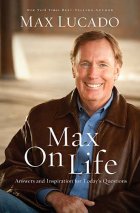
Max On Life (book review)

Have you ever wanted to have a conversation with Max Lucado? Just sit with him for awhile and pick his brain? With Max On Life you can do just that!

Max On Life is a compilation of 172 questions that Max has been asked. Some of his answers come from his previously written books, some are answers formed with brand new insights, but all of the answers come from his very pastoral heart.

The book is divided into seven sections – hope, hurt, help, him/her, home, have/have-nots, and hereafter. But even more helpful is the index of topics at the back of the book, as well as a listing of all of the scriptural references Max uses throughout Max On Life. I can imagine this book staying very close at hand, because I’m going to be referring to it often.

If you are a pastor or counselor, I think you will find a lot of helpful insights in this book to pass on to others. If you have a friend with lots of questions about the Christian faith, this book would make an excellent gift. Or if you just want to be a helpful friend when others are in need, this book will help prepare you to be a blessing to them.

I am a Thomas Nelson book reviewer.

Who Are You Talking To?

I love team leadership. I really enjoy getting a group of creative thinkers around me to do some serious brainstorming. I find it so beneficial to seek out the counsel of some wise people who have been around for a while.

But, let’s see, who have I left off this list?

Oh, yeah, I remember now—I didn’t consult God!

Be honest: have you ever done that? Have you ever consulted with a lot of wise—even God-fearing—people, but forgotten to consult with God Himself? If you have (and I certainly have), we’re in good company.

When King David got ready to move the ark of the covenant to Jerusalem, the Bible says,

David conferred with each of his officers….

How’d that work out for him? Not so good.

  • Uzzah died
  • David got mad at God
  • David got scared of God
  • The ark’s arrival in Jerusalem was delayed another three months

Then David had his “Oh yeah!” moment. When he got ready to try again, David said,

We did not inquire of God about how to do it in the prescribed manner….

So here’s my simple reminder to myself (and to you too): It’s fine to consult with others, but consult with God first.

The Doctor & The Pastor—Part I

Friends, I recently reviewed the manuscript for a new book Living Free In An Anxious World. This is an essential book for pastors, Christian counselors, psychologists, and medical doctors which deals with a problem that is only expanding: worry, stress, anxiety. Stay tuned to this blog for a chance to win a free copy of this book later this month.

In the meantime, I am absolutely thrilled that the co-authors of Living Free In An Anxious World have agreed to write to my blog readers! Today is the first installment from Rev. Victor Hunter.

Guest Author: Rev. Victor L. Hunter

Whether it was the Carter family’s version in the 1930s, Woody Guthrie’s in the 40s, the Kingston Trio’s in the 50’s, Ramblin’ Jack Elliott’s in the 60s, or Devo’s in the 70s and 80s, “Worried Man Blues” has been a ubiquitous presence in the bluegrass/folk song genre of cultural music throughout the “century of anxiety.” Its words and tune have provided a common background theme playing in our minds for decades:  “It takes a worried man to sing a worried song.” Most of us, men and women, have hummed along, literally and/or figuratively, with its sentiments.

During these decades, my brother and I have listened to the song’s lyrics and contemplated the reality of worry and anxiety both personally and professionally. He’s a physician. I’m a pastor. I can say without hyperbole that there hasn’t been a week go by in nearly a half-century of preaching, pastoral care and counseling, and teaching that worry and anxiety haven’t been at the forefront of conversations with people, young and old, men and women, who have said to me, “I need to talk with you about something.”

This is so because anxiety is part of what it means to be human beings. It’s part of our biological makeup and spiritual reality. It is essential to our survival, as well as being a core theological question. It can also be devastatingly paralyzing, keeping people from living free, living life fully alive.

During the past four decades, the doctor and the pastor, the brothers, have been in conversation about our disciplines of science and theology and our professions in medicine and religion. We have become increasingly sensitive to the many issues that meet at the intersection of biology and theology. It’s about being human before God. We share in Living Free in an Anxious World this conversation and our passion for a holistic understanding of our humanity in light of faith and science . . . as well as our hope for the healing and redemption of our lives. We affirm that while anxiety and worry are unavoidable, they can be our teachers rather than our masters. Our goal is to provide realistic, practical, and helpful guidance in understanding worry and facing our fears that we might travel the road of freedom and grace.

Check out the guest post from Dr. R. Lanny Hunter by clicking here

Let Me Give You A Piece Of Advice

How many times have you heard someone say you, “Let me give you a piece of advice”? Ah, yes, everyone has some advice to share. Everyone has an opinion. Everyone wants to give you a piece of their mind. Everyone is an expert in an area where they think you’re deficient.

I remember going through comment cards at the end of a long week of youth camp. I’d read one card that would say the food was excellent. Just a couple of cards later some “expert” would share how terrible the food was. One would say they loved the evangelist, another would give their “advice” on where the evangelist missed it.

Whom should I listen to? Who should get my ear?

In William Shakespeare’s Hamlet, Polonius gives this counsel to Laertes “Give every man thine ear, but few thy voice: Take each man’s censure, but reserve thy judgment.”

Nice prose, but how do we live it out?

I like the example I see from a man named Jethro in the Bible. Jethro is Moses’ father-in-law, and he really only appears on the scene in just one chapter (Exodus 18), but his method of giving advice should be a model for us all.

Credentials—Jethro was a God-fearing man. If you are a follower of Jesus Christ, weigh carefully the advice given to you by those who don’t have the same biblical foundation.

Relationship—Jethro had a personal relationship with Moses, he wasn’t just a business acquaintance. That means Jethro had a vested interest in Moses’ success or failure.

Firsthand—Jethro heard about what was happening, but he came to see it for himself. Beware of those “experts” who only have secondhand information about you or your situation.

Up-Close—Jethro spent an entire day right by Moses’ side just watching and listening. He saw what was going on from the front row.

Questions—Jethro led with questions, not with advice. Before giving Moses his opinion, Jethro asked clarifying questions.

Wisdom—Only after all of this did Jethro give his opinion to Moses. The words that he shared were then received by Moses as God-given wisdom.

Your counselors should earn the right to be heard. Just because someone has an opinion doesn’t make him an expert. And just because someone has been-there-done-that doesn’t mean that her way should be your way.

Screen out the clamoring voices by making sure they have credentials, a relationship with you, firsthand experience, and godly wisdom.

Wise Guys

I’m facing a big decision. I have an idea of the right way to go, but I’m taking some time to run my options by some wise guys. After all, even King Solomon—who was wiser than any other man, and probably could advise himself—wrote, “The more wise counsel you follow, the better your chances” (Proverbs 11:14, Message).

I also like what George Washington Carver said, “How much of God are we missing because we don’t stop to listen to the many voices God uses to speak to us?”

Of all the voices speaking to me, how am I choosing which wise guys to listen to?

Friendship—I have to know that my counselors are my friends. William Shakespeare asked the question, “Can he that speaks with the tongue of an enemy be a good counselor, or no?” I would answer “no.” I need wise guys that want me to be successful.

B.T.D.T.—I choose wise guys who have Been There Done That. Guys who have walked through the same scenario I’m facing now. Not a travel agent to point the way, but a tour guide who knows the path and will walk it with me.

Scarred—It’s hard to be helpful to someone else when you still have a gaping wound. I need wise guys who have been wounded in the past but now have the scars to show where they’ve been healed. It’s from this vantage point that they can be of the most help to me.

Successful—Finally, I choose to listen to wise guys who are successful. I don’t need some to tell me what should work—I want to hear what does work.

There’s an old attorney’s adage that says, “He who represents himself has a fool for a client.” If you have a decision to make I would modify this to say, “He who takes advice only from himself is taking counsel from a fool.”

What else would you look for in a wise guy?