Becoming Childlike

Listen to the podcast of this post by clicking on the player below, and you can also subscribe on AppleSpotify, or Audible. 

I hope you’ve noticed so far that the parts of Christ’s model prayer that we’ve looked at so far are both an acknowledgement of the holiness of God and the greatness of His Kingdom, and also a request for us to be empowered to live in a way that makes those things known to Earthlings. 

One of the ways we live to make these things seen is found in the next phrase: Your will be done on earth as it is in Heaven (Matthew 6:10). 

In A Christmas Carol, Charles Dickens shows us a scene where the Ghost of Christmas Present has taken Scrooge to his nephew’s home. After dinner, these young adults begin playing games. Dickens says, “For it is good to be children sometimes, and never better than at Christmas, when its mighty Founder was a child Himself.” 

Jesus loved children! Being around “the littles” lately at on our school campus, I have a whole new appreciation for this. Because Jesus loved children, their parents wanted them around Him, and He wanted them around too (see Matthew 19:13-15; Mark 10:14-16; Luke 18:15-17).

Children are loud, busy, adventurous, and easily distracted. But they are also loving, trusting, curious, innocent, and easily comforted. And Jesus loved to bless them!   

What does this have to do with “Your will be done on earth as it is in Heaven”? Jesus taught us to address our praying to “Our Father.” That means we are to interact with Him as His children.  

Jesus wants us to be childlike not childish. 

  • trusting not posturing—Matthew 6:7-8 
  • honest not hypocritical—Luke 18:9-14 
  • persistent not whining—Luke 11:9-13 
  • humbly dependent not scheming—Matthew 18:1-4 

[Check out these passages here] 

Children love to do the will of their parents. They’re not trying to earn their approval, but joyfully obeying out of innocence. When we obey God as loving children, we are doing His will on earth as it is done in Heaven! 

So once again, this is both an acknowledgement and a request. 

In Psalm 131, David uses this same picture of a contented child for us. 

Childlike is lovingly dependent. Childish is selfishly independent. Childlike is trusting someone wiser. Childish is believing I know best. 

Our prayer request should always be, “Father, may I trust You and obey You as an innocent child.” 

This is part 4 of our series on prayer called Kingdom Praying. You can check out all of the other messages in this series here. 

►► Would you please prayerfully consider supporting this ministry? My Patreon supporters get behind-the-scenes access to exclusive materials. Like some exclusive quotes from a book I just reviewed. ◀︎◀︎

Graceful Christians

Listen to the podcast of this post by clicking on the player below, and you can also subscribe on AppleSpotify, or Audible. 

Our Advent series this year has been called “People Will Talk,” but we have one more person to learn from who says nothing. We have none of her words inside quotation marks, and yet Luke was inspired by the Holy Spirit to share her story with us. Her wordless message speaks volumes, if we’re willing to listen. 

Anna, like Simeon, was one of the “Quiet in the Land.” Luke describes her as “very old.” The Greek phrase can either mean that she was a widow for 84 years after seven years of marriage, or simply that she was 84 years old. In either case, we don’t see her sitting withdrawn and inactive because of her old age, but we see her taking the initiative. She is the one who comes up to Joseph, Mary, and Jesus. 

Luke also calls her a “prophetess.” Not someone bitter about her widowhood, but someone who truthfully and lovingly spoke God’s Words. Throughout the Bible, we see that a prophet or prophetess is less foretelling the future than they are forth-telling the promises of God. Of course the “-ess” at then end of “prophet” reminds us that Anna is a woman. As a woman she was excluded from certain parts of the temple, but instead of picketing or making a scene Luke says she spends her time worshipping, fasting, praying, and waiting for the fulfillment of God’s promised Messiah.

I imagine that her mere presence must have changed the atmosphere wherever she went! 

I’m not sure if Charles Dickens had Anna in mind when he wrote A Christmas Carol, but the way the Ghost of Christmas Present added his blessing to busy people is what I imagine Anna’s role being in the temple—

“But soon the steeples called good people all, to church and chapel, and away they came, flocking through the streets in their best clothes, and with their gayest faces. And at the same time there emerged from scores of bye-streets, lanes, and nameless turnings, innumerable people, carrying their dinners to the bakers’ shops. The sight of these poor revelers appeared to interest the Spirit very much, for he stood with Scrooge beside him in a baker’s doorway, and taking off the covers as their bearers passed, sprinkled incense on their dinners from his torch. And it was a very uncommon kind of torch, for once or twice when there were angry words between some dinner-carriers who had jostled each other, he shed a few drops of water on them from it, and their good humor was restored directly. For they said, it was a shame to quarrel upon Christmas Day. And so it was! God love it, so it was!” 

Both Anna in the New Testament and Hannah in the Old Testament mean graceful. Or as I like to remember that word: someone full of grace. When she approaches Joseph, Mary, and Jesus, Luke says she “gave thanks.” This comes from a unique Greek word in the New Testament. The root word is usually translated confession, which means saying the same words as others. But the prefix Luke adds means “in place of.” This means that Anna was speaking thankful words in place of the other words being spoken around her. 

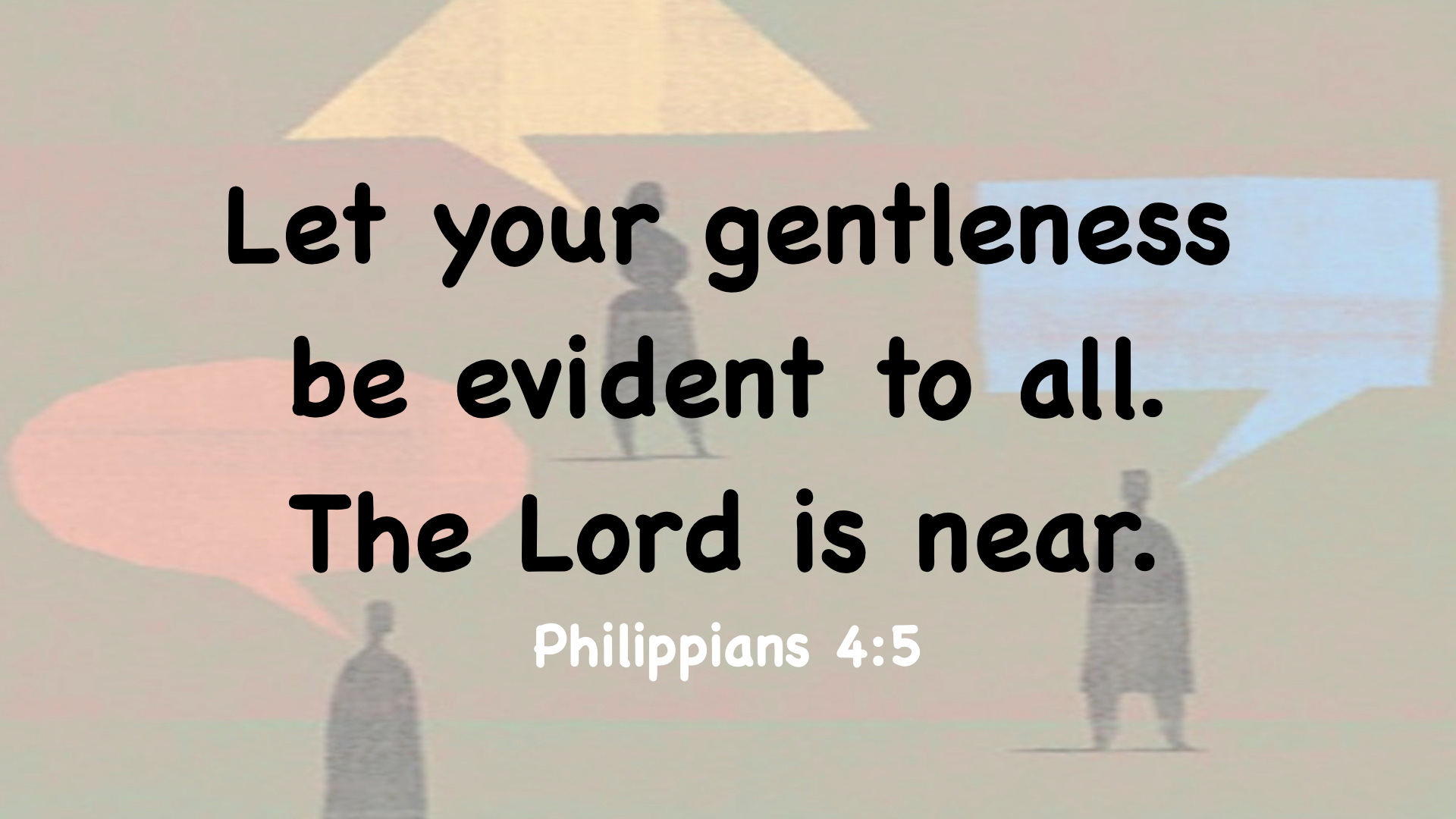
Anna spoke counter-culturally. Instead of being a cultural thermometer, she was serving as a thermostat to change the culture around her. This is the same kind of lifestyle that Jesus calls us to live. And it’s a lifestyle that Paul sums up in one succinct verse: “Let your gentleness [or we could say ‘grace-fullness’] be evident to all. The Lord is near” (Philippians 4:5). 

After Ebenezer Scrooge’s encounter with the three spirits, his life was transformed—

“Scrooge was better than his word. He did it all, and infinitely more.… He became as good a friend, as good a master, and as good a man, as the good old city knew, or any other good old city, town, or borough, in the good old world. 

“Some people laughed to see the alteration in him, but he let them laugh, and little heeded them; for he was wise enough to know that nothing ever happened on this globe, for good, at which some people did not have their fill of laughter in the outset; and knowing that such as these would be blind anyway, he thought it quite as well that they should wrinkle up their eyes in grins, as have the malady in less attractive forms. His own heart laughed: and that was quite enough for him. 

“…And it was always said of him, that he knew how to keep Christmas well, if any man alive possessed the knowledge. May that be truly said of us, and all of us! And so, as Tiny Tim observed, God bless Us, Every One!” 

As Christians, may both our actions and our reactions be so grace-filled, and may our gentleness be so evident to everyone all year long, and may we live so counter-culturally that people cannot help but see that we are grace-filled by the Spirit of Jesus Christ! 

If you’ve missed any of the messages in this Advent series, you can find the full list of messages by clicking here. 

►► Would you please prayerfully consider supporting this ministry? ◀︎◀︎

Humbug?!

In Longfellow’s classic I Heard The Bells On Christmas Day every stanza ends with the phrase “peace on earth, goodwill to men.” Unless you’ve been living someplace that doesn’t get the daily news, you might be saying, “Peace on earth? Really? I just don’t see it….” Or as Ebenezer Scrooge might say, “Peace on earth? Bah! Humbug!” 

A humbug is an imposter, or something empty of meaning. 

The third stanza of I Heard The Bells seems almost to slide into that Christmas humbug note: “And in despair I bowed my head: ‘There is no peace on earth,’ I said. ‘For hate is strong and mocks the song of peace on earth, goodwill to men.’” 

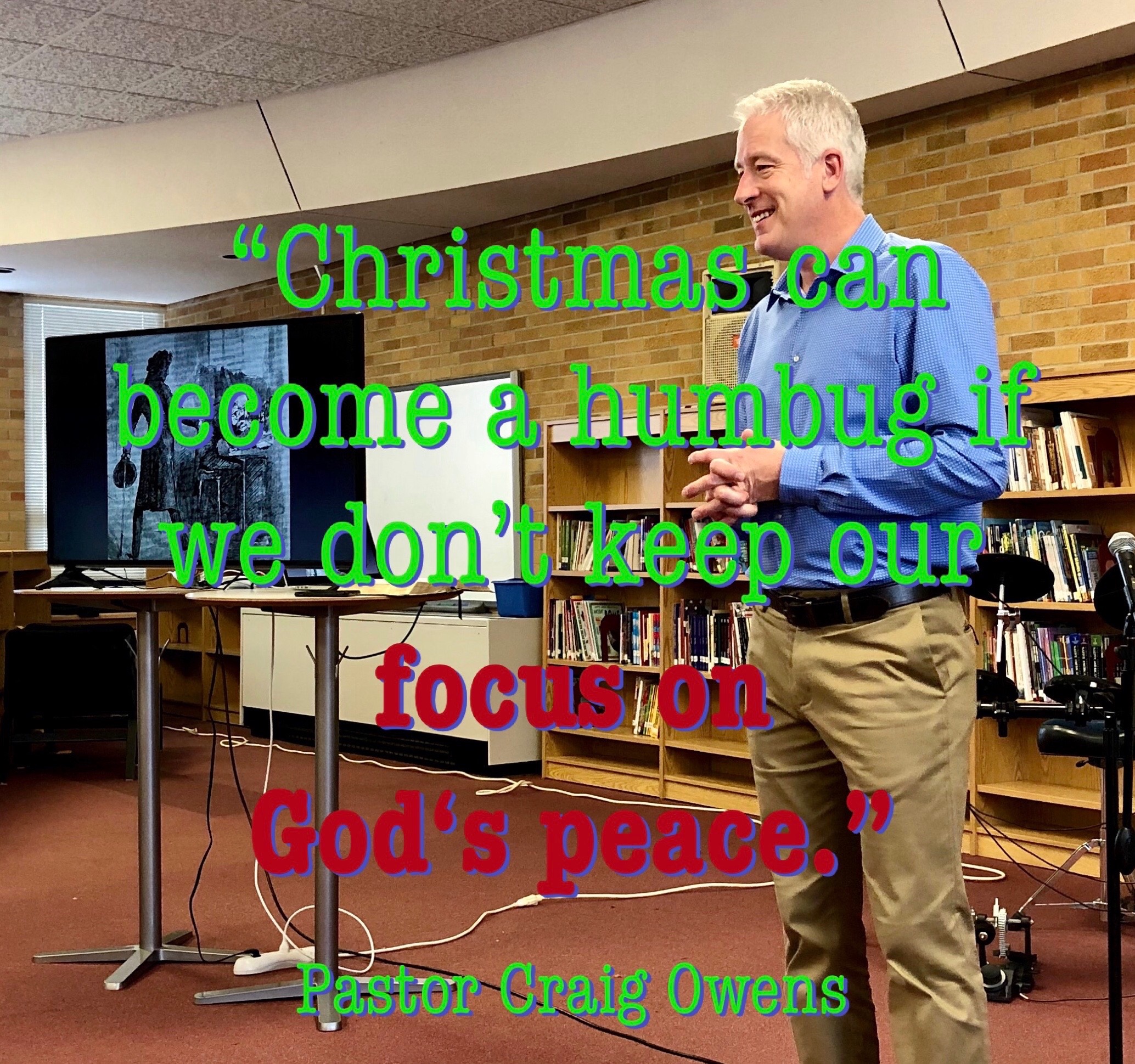
Indeed, even for those who call themselves a Christian, Christmas could become a humbug if…

  • … it’s all about busyness or just trying to “survive the holidays” 
  • … we get more excited about Santa Claus coming down the chimney to fill stockings than we do about Jesus coming down to Earth to be born in a manger 
  • … our main focus is on gifts—both what you’re giving and what you’re getting—and then we regret putting ourselves into debt 

Between Malachi (the last book of the Old Testament) and Matthew (the first book of the New Testament) is a time span of about 400 years that is called “the dark period.” God had promised through Jeremiah that He would restore the Israelites and rebuild Jerusalem. There were promises of the Messiah coming to set things right, but after 400 years of darkness, the mindset of most Israelites was probably, “Messiah? Peace? Bah! Humbug!!” 

What God really promised through Jeremiah was a peace that came about as a result of two things: (1) forgiveness of sins and (2) restoration of a perfect relationship with God. The Hebrew word for “peace” is shalom, which means one’s personal sense of wholeness and well-being, free from anxiety and fear, knowing that all is well between my soul and God. 

This is what God promises—I will cleanse them from ALL the sin they have committed against Me and will forgive ALL their sins of rebellion against Me (Jeremiah 33:8). 

This shalom is what comes through the First Advent of Jesus! As Longfellow observed, “Then pealed the bells more loud and deep: God is not dead nor doth He sleep; the wrong shall fail, the right prevail, with peace on earth, goodwill to men.” 

And this is what Jesus brought—

  • She will give birth to a Son, and you are to give Him the name Jesus, because He will save His people from their sins (Matthew 1:21 NIV). 
  • Now you have been united with Christ Jesus. Once you were far away from God, but now you have been brought near to Him through the blood of Christ. For Christ Himself has brought peace to us… (Ephesians 2:13-14 NLT) 
  • Therefore, since we are justified (acquitted, declared righteous, and given a right standing with God) through faith, let us grasp the fact that we have…peace with God through our Lord Jesus Christ (the Messiah, the Anointed One) (Romans 5:1 AMP). 

The bells and carols and remembrances of Christ’s First Advent should send our hearts soaring in anticipation of Christ’s Second Advent—when Christ shall return to take all of His own to be with Him forever, where He will wipe away every tear and where we live forever with Him in the New Jerusalem (see Jeremiah 33:9; John 14:3; Revelation 21:1-4). 

Let us guard against Christmas ever becoming a humbug—an imposter, something empty of meaning—but let’s make sure the rich meaning of Christ’s peace dwells richly in us! 

If you’ve missed any of the message in this series, you can check them out by clicking here.  

God Bless Christmas

I just finished my annual re-reading of Charles Dickens’ The Christmas Carol. What a masterful author he was! This year I was especially struck by the argument between Ebenezer Scrooge and his nephew Fred—

“A merry Christmas, uncle! God save you!” cried a cheerful voice. It was the voice of Scrooge’s nephew, who came upon him so quickly that this was the first intimation he had of his approach.

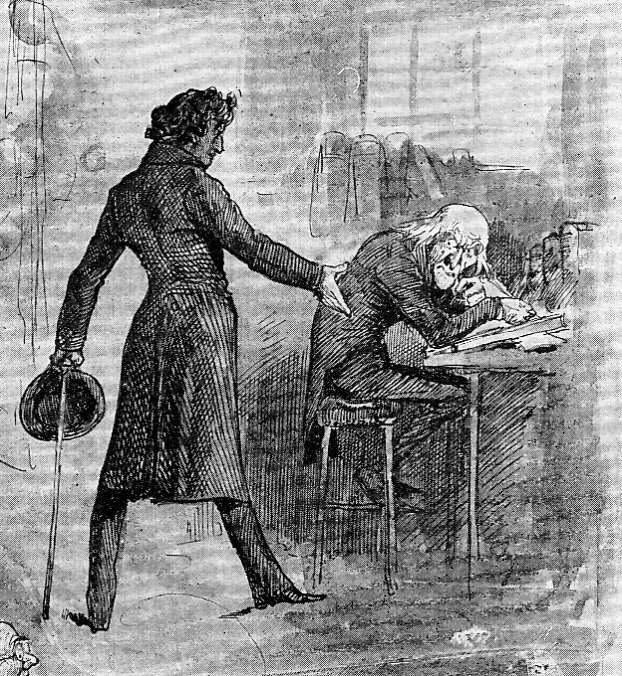
“Bah!” said Scrooge, “Humbug!”

He had so heated himself with rapid walking in the fog and frost, this nephew of Scrooge’s, that he was all in a glow; his face was ruddy and handsome; his eyes sparkled, and his breath smoked again.

“Christmas a humbug, uncle!” said Scrooge’s nephew. “You don’t mean that, I am sure?”

“I do,” said Scrooge. “Merry Christmas! What right have you to be merry? What reason have you to be merry? You’re poor enough.”

“Come, then,” returned the nephew gaily. “What right have you to be dismal? What reason have you to be morose? You’re rich enough.”

Scrooge having no better answer ready on the spur of the moment, said, “Bah!” again; and followed it up with “Humbug.”

“Don’t be cross, uncle!” said the nephew.

“What else can I be,” returned the uncle, “when I live in such a world of fools as this? Merry Christmas! Out upon merry Christmas! What’s Christmas time to you but a time for paying bills without money; a time for finding yourself a year older, but not an hour richer; a time for balancing your books and having every item in ’em through a round dozen of months presented dead against you? If I could work my will,” said Scrooge indignantly, “every idiot who goes about with ‘Merry Christmas’ on his lips, should be boiled with his own pudding, and buried with a stake of holly through his heart. He should!”

“Uncle!” pleaded the nephew.

“Nephew!” returned the uncle sternly, “keep Christmas in your own way, and let me keep it in mine.”
“Keep it!” repeated Scrooge’s nephew. “But you don’t keep it.”

“Let me leave it alone, then,” said Scrooge. “Much good may it do you! Much good it has ever done you!”

There are many things from which I might have derived good, by which I have not profited, I dare say,” returned the nephew. “Christmas among the rest. But I am sure I have always thought of Christmas time, when it has come round—apart from the veneration due to its sacred name and origin, if anything belonging to it can be apart from that—as a good time; a kind, forgiving, charitable, pleasant time; the only time I know of, in the long calendar of the year, when men and women seem by one consent to open their shut-up hearts freely, and to think of people below them as if they really were fellow-passengers to the grave, and not another race of creatures bound on other journeys. And therefore, uncle, though it has never put a scrap of gold or silver in my pocket, I believe that it has done me good, and will do me good; and I say, God bless it!”

There is something “special” about the Advent season. You can palpably sense it in the way people talk and act differently. Could it be that the celebration of Christmas—despite all the tinsel and consumerism that has sought to overwhelm it—sounds a familiar chord in people’s heart because the Story is true? God bless it!

Here are a few Christmas Carol observations I shared last year.

Christmas Wisdom From Ebenezer Scrooge

Scrooge and ghostI have been listening to an audio production of Charles Dickens’ Christmas Carol. The one I’m listening to is a podcast performed by Patrick Horgan (very well done!).

Two things have stood out to me—

(1) The genius of Charles Dickens. Check out this brilliant piece of wit.

“Marley was dead, to begin with. There is no doubt whatever about that. The register of his burial was signed by the clergyman, the clerk, the undertaker, and the chief mourner. Scrooge signed it. And Scrooge’s name was good upon change for anything he chose to put his hand to. Old Marley was as dead as a door-nail. Mind! I don’t mean to say that I know, of my own knowledge, what there is particularly dead about a door-nail. I might have been inclined, myself, to regard a coffin-nail as the deadest piece of ironmongery in the trade. But the wisdom of our ancestors is in the simile; and my unhallowed hand shall not disturb it, or the Country’s done for. You will, therefore, permit me to repeat, emphatically, that Marley was as dead as a door-nail.”

(2) The biblical message which comes through so vividly.

“But you were always a good man of business, Jacob,” faltered Scrooge, who now begin to apply this to himself.

“Business!” cried the Ghost, ringing its hands again. “Mankind was my business. The common welfare was my business; charity, mercy, forbearance, and benevolence were, all, my business. The dealings of my trade were but a drop of water in the comprehensive ocean of my business!”

It held up its chain at arm’s length, as if that were the cause of all its unavailing grief, and flung it heavily upon the ground again.

“At this time of the rolling year,” the spectre said, “I suffer most. Why did I walk through crowds of fellow-beings with my eyes turned down, and never raise them to that blessed Star which led the Wise Men to a poor abode? Were there no poor homes in which its light would have conducted me?” (emphasis mine)

Revelation Or Speculation

In answering questions that have been submitted for The Q Series, I noticed a recurring trend: How much of our “conventional thought” in church circles is not revelation, but speculation.

Yesterday I had some tough questions on Heaven, Hell, suicide, our resurrected bodies, the after-life, and so on. In answering these questions, I used many passages from the Bible, but I also quoted from Charles Spurgeon, Charles Dickens, and C.S. Lewis. There’s nothing wrong, per se, with quoting from extra-biblical sources, but we have to be very careful what we do with those.

I once heard renowned evangelist C.M. Ward say something like this:

“The Word of God is completely good; you can devour all of it. But reading anything else is like eating chicken. There is some meat that’s good, and there are some bones, and gristle, and fat that you should spit out. Be very careful of what you take in, unless it is the pure Word of God.”

The Bible reveals so much for our lives, and we put ourselves in a place God can bless us when we are obedient to the revelation of His Word. But we put ourselves on shaky ground when we live by speculation of what we think may be truth.

The Apostle Peter said it this way:

For no prophecy ever originated because some man willed it [to do so — it never came by human impulse], but men spoke from God who were borne along (moved and impelled) by the Holy Spirit. (2 Peter 1:21 AMP)

So whether you are looking for an answer yourself—or you are asking someone for an answer—make sure you are getting revelation from God’s Word, and not the speculation of man’s opinion.

Check out other questions in our Q Series by clicking here.