Your Greatest Stress Reliever

Stress relieverSadly our country is anxious and worried. Based on the number of anti-depressants that are prescribed each year, we are a people dealing with a lot of issues!

When worry or fear begin to interfere with normal thinking and functioning, doctors call it anxiety disorder―that is, disorder in our lives creates the anxiety, and more anxiety creates even more disorder.

What causes anxiety in the first place? One of the main culprits is chronic stress. Things like marital problems, financial pressures, relationship breakdowns, emotional traumas trigger the fight-or-flight responses in our bodies. This leads to increased blood pressure and heart rate, interrupted sleep patterns, digestion issues … and all of this leads to the chronic stress, which leads to anxiety, which leads to even more disorder!

But here’s the great news―Getting into God’s presence could be your greatest stress reliever!

There’s a story in 2 Kings of a woman who is clearly stressed out. Her husband has died, she’s exhausted all her resources trying to settle up with creditors, she has sold nearly everything in her home, and one creditor is ready to carry her sons off into slavery. Talk about anxiety!

Elisha asks this widow two questions:

  • How can I help you? Jesus said that our Heavenly Father knows our needs before we even ask Him, but in the very next verse Jesus says, “This then is how you should pray…” (Matthew 6:8-9).
  • What do you have? God will use even what we think is insignificant to show His superabundance in our lives!

God did meet this woman’s needs. He gave her enough to pay off her creditor. But that wasn’t all―God also gave this family enough to keep on living stress-free!

God Who, by the action of His power that is at work within us, is able to carry out His purpose and do superabundantly, far over and above all that we dare ask or think―infinitely beyond our highest prayers, desires, thoughts, hopes or dreams. (Ephesians 3:20, AMP)

Don’t try to carry all your stress yourself, cast ALL your anxiety on Him because He cares for you (1 Peter 5:7).

I’ll say it again―Getting into God’s presence could be your greatest stress reliever!

We are continuing our series on prayer next Sunday, and I hope you can join me!

Pray & Dig

Pray & DigThe fact is far too many of us get ourselves into hot water all on our own, and then we want to call on God like an insurance policy to bail us out. We usually have some reasonable-sounding excuses:

  • “It seemed like a good idea at the time”
  • “It was so practical and common sense I didn’t think I needed to pray about it”
  • “I’ve done this dozens of times before and never had any trouble.”

There’s a story in 2 Kings where three kings got together for a battle. To them it seemed like a pretty good idea―there were three of them going to war against just one king, they knew the terrain, so it would be an easy victory.

Except it wasn’t.

The Bible says that after a 7-day roundabout march, the three armies were out of food, out of water, stranded in the desert, and about to be defeated without the enemy ever firing an arrow or swinging a sword.

One king wanted to blame God. The king of Israel said, “Bad news! God has gotten us three kings out here to dump us into the hand of Moab.” (2 Kings 3:10, MSG). But fortunately the king of Judah thought to ask, “Isn’t there a prophet of God around that can call on God for us?” (v. 11).

Here’s one of the most amazing things: Elisha―the representative of God’s presence―was right there with them! Think about that … these kings hadn’t asked God for help, and hadn’t invited Elisha along, but there was the prophet right in their midst!

It’s a good reminder for us: God is ALWAYS with us. But it’s up to us to recognize Him and go to Him in prayer.

When these kings finally asked God for help with their water problem, Elisha said, “It’s an easy thing for God to provide water for you. You’ve prayed, now it’s time to prepare for His supply.” The armies were called on to dig lots and lots of ditches. God would send a supply of water without rain to take care of the troops. And if that wasn’t enough, God also said He would give them victory over their enemy. As Matthew Henry wrote, “God’s grants out-do our requests and expectations.”

Pray first. Pray continually. Pray always. And then when God tells you to dig ditches, get ready for His abundant blessings. But get the order right: Don’t dig and then pray; pray first, then dig!

If you’re in the Cedar Springs area, please join me next Sunday as we continue our series The Prayers Of Elisha.

Pray Like Jesus

Private prayerThere’s a really interesting story recorded in the gospels of Matthew, Mark and Luke. It’s the one where a father brings his demon-possessed boy to nine of Jesus’ disciples to ask for their help. But the father sadly reports back to Jesus, “But they could not help.”

Jesus calls His disciples out. He says that their faith is lacking. Even the boy’s father is short on faith. He says to Jesus, “If you can do anything, please help us.” To which Jesus says, “‘If you can’? Anything is possible if you believe.” Jesus rebukes the demon, which immediately comes out of the boy.

Now here’s the interesting part: His disciples asked Him, “Why couldn’t we do that?” Jesus says, “This kind comes out only by prayer.” Let’s review all the words Jesus said to the father and his boy:

  • “How long has he been like this?”
  • “‘If you can’? Anything is possible if you believe.”
  • “Demon, come out of him and never enter again.”

So here’s my question―Jesus said the demon was cast out by prayer. So when did Jesus pray? Look at those words He said again … which of those was His prayer?

Actually, if you look through all four gospels you won’t find Jesus laying His hands on people and saying, “Heavenly Father, will You please heal this leprosy?” Or, “Please bring life back into this little girl.” Instead He says, “Be clean” or “Little girl, get up.

So I ask again: When did Jesus pray? The answer is―He prayed all the time.

  • Very early in the morning, while it was still dark, Jesus got up, left the house and went off to a solitary place, where He prayed. (Mark 1:35)
  • After He had dismissed them, He went up on a mountainside by Himself to pray. When evening came, He was there alone. (Matthew 14:23)
  • But Jesus often withdrew to lonely places and prayed. (Luke 5:16)

Do you want to pray like Jesus? He prayed all the time. He had times of prayer with His Heavenly Father, but He was in unbroken communication with Him.

Private prayer leads to public power! 

That’s how we can pray like Jesus!

We will be learning more about prayer in our series The Prayers Of Elisha next Sunday. Please join us!

The Prayers Of Elisha

The Prayers Of ElishaElisha was a prophet whose name means “God is salvation.” And God did show His saving, healing, sustaining power through Elisha in 28 separate miracles.

But here’s the cool thing to me: Elisha is a regular guy. He comes from an average family, from one of the lesser known tribes of Israel. Elisha was a farmer, and had a few guys working for him. Other than that, we don’t know much about his background. Elisha truly was an Average Joe.

Elisha is a perfect guy for us Average Joes to learn more about the power of prayer. What God did through Elisha, He wants to do through all of us too. Please join me this Sunday as we kick-off a new series called The Prayers Of Elisha, and get ready to see your prayer life grow.

Come, Thou Long-Expected Jesus

AdventWe began our series on The Carols Of Christmas by looking at the poem written by Charles Wesley in 1744: Come, Thou Long-Expected Jesus. As far as I can find, Wesley never shared where he got his inspiration for this prose, but I have a hunch that it might be from a song in the Bible called The Benedictus.

Zechariah had been unable to speak for nearly a year because of his doubt over the message God sent him through the angel (see Luke 1:5-20). When his son was born and Zechariah named him John, his tongue was loosed and he “was filled with the Holy Spirit” and burst into song (Luke 1:67-79). The first word of his song in Latin is benedictus, from which the name is derived.

Here’s what I love about both Zechariah’s and Wesley’s songs—they both look forward to Christ’s First Advent and His Second Advent. Mary was still pregnant with Jesus when Zechariah sang his song, but his lyrics reflect the Redemption story that Jesus would fulfill as Emmanuel, God with us. Charles Wesley picks up this same theme, rejoicing over Christ’s birth and His imminent return.

In fact, that’s exactly the point! We aren’t celebrating Christmas as much as we are celebrating Advent. Jesus was born “when the time had fully come” for His First Advent (Galatians 4:4-5), and “this same Jesus, Who has been taken from you into Heaven, will come back in the same way you have seen Him go into Heaven” (Acts 1:11). That’s the message that should encourage us (see 1 Thessalonians 4:13-18).

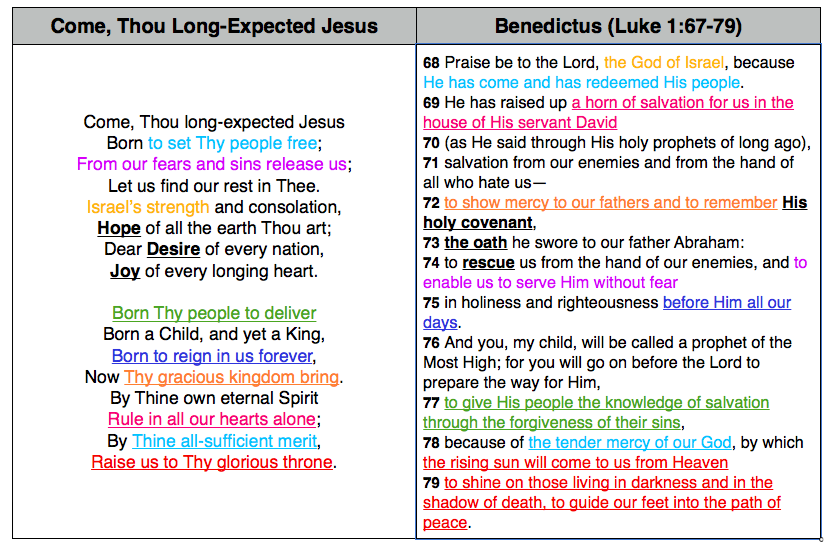
Check out the remarkable parallels between the Benedictus and Wesley’s hymn—

Come Thou Long-Expected Jesus & Benedictus

If you’d like to download a PDF of this side-by-side comparison, here it is → Come Thou Long-Expected Jesus & Benedictus ←

If you’ve missed any of the messages in this series, you may check them out by clicking here.

Living Nativity

We love presenting the message of Christ’s arrival in Bethlehem to our Cedar Springs community.

This slideshow requires JavaScript.

The Carols Of Christmas

Carols Of ChristmasI heard the bells on Christmas Day
Their old familiar carols play,
And wild and sweet the words repeat
Of peace on earth, goodwill to men. (Henry Wadsworth Longfellow)

How many “old familiar carols” have you heard Christmas after Christmas, until the words have almost lost their meaning? If we’re not careful, any song repeated too often can lose the richness of its original intent.

There are some amazing messages in many of our old familiar Christmas carols, because many of those messages are saturated with the old familiar story of Redemption that the Bible tells over and over again.

Please join me this Sunday as we take a new look at the old familiar messages in our Christmas carols. These messages will bring a new appreciation of God’s love that was sung at Christ’s Advent, and reawaken the sweetness of meaning for this Christmas Day.

If you’ve missed any messages in this series, check them out here:

Setting The Example For Us

FundraiserWhen Paul was writing to his young protege Timothy he said, “Don’t let anyone look down on you because you are young, but set an example for the believers in speech, in life, in love, in faith and in purity” (1 Timothy 4:12). I was so proud of a couple of young people who did this for us at Calvary Assembly of God yesterday!

Savannah has been raising money for childhood cancer research. She shared with us how this is the least-funded form of cancer research, and that every three minutes a child is diagnosed with cancer. “That is unacceptable,” Savannah said. So in an amazing example-setting move for all of us, Savannah and two of her coworkers worked to bring in over $3000 in donations for childhood cancer research, and they shaved their heads as a sign of solidarity with the children undergoing cancer treatments. By the way, you can still donate to this noble cause by clicking here.

Then Josh brought us a challenging message entitled Are You Growing? Taking his text from 1 Corinthians 3:6, Josh reminded us that God makes things grow, but we can put ourselves in a place for Him to do that. Just as with a plant, our spiritual growth requires:

  • Sunshine—basking in God’s presence.
  • Water—soaking up God’s Word.
  • Nutrients—surrounding ourselves with the people and things that encourage growth.
  • Time—the dedication and investment in God’s process.

I am so proud of Josh and Savannah for setting an example for us to follow!

From The Cutting Room Floor: The Love In The Law

Love In The LawWhenever I am working on a series of messages, I always end up with way more material than I could possibly share. But it’s still really good stuff! I remember a movie director once remarking that some of his best and favorite scenes ended up on the cutting room floor during the movie’s editing process. So here are some of the quotes and thoughts I really liked, recovered from “the cutting room floor” as I prepared our Love In The Law series.

“True obedience to God (not just to lists of laws) means more than outward performances which can be tallied in percentages (like 80 percent obeyed). Rather, true obedience is to be so transformed that we delight to do God’s will at multiple levels. We delight in His will as the excellent expression of His wisdom and justice and love. We delight in personal, close communion with Him as our guide, which we would lose, at least for a season, if we acted against His counsel. We delight in His gift of a clean conscience. We delight in the smile of His approval. We delight in God Himself whom we see and know more clearly when we walk in unbroken fellowship and obedience. We delight in the prospect of ongoing assurance and hope, which is jeopardized and weakened if we gradually slip away from Him in callous disobedience.” —John Piper

I delight to do Your will, O my God; yes, Your law is with in my heart. —Psalm 40:8

“To detect ourselves thus balancing a transgression here, against many observances there, ought at once to startle us into the conviction that the whole principle of our lives must be faulty. Our aim is, not to love God, or to obey Him, but to get to heaven, or at least escape hell, on the cheapest terms.” —Alfred Plummer

“Our will is morally and spiritually flawed. Nevertheless we are responsible to do the commandments of God. The moral corruption that cripples us does not relieve us of our responsibility to do what is right and good to do.” —John Piper

“I call the love to God the motion of the soul toward the enjoyment of God for His own sake, and the enjoyment of one’s self and of one’s neighbor for the sake of God.” —Augustine

“If thou neglect thy love to thy neighbor, in vain thou professest thy love to God; for by thy love to God, the love to thy neighbor is begotten, and by thy love to thy neighbor, thy love to God is nourished.” —Francis Quarles

“A pennyweight o’ love is worth a pound o’ law.” —Scottish Proverb

It pleased the Lord for the sake of His righteousness to make His law great and glorious. —Isaiah 42:21

Blessing Or Burden?

Blessing or burdenGod’s commandments aren’t a bunch of Don’ts. If we look at them through the perspective of a loving Lawgiver, they are really Dos that will keep us in a place that God can bless.

Take the 9th Commandment: You shall not give false testimony against your neighbor (Exodus 20:16; Deuteronomy 5:20). This is the first of two commandments that emphasize the damage that can be done to our neighbor if we violate the law. Speaking falsely against someone does real harm to our neighbor, so in a sense God says, “Don’t do it!

But God also tells us what to Do so that He can bless us—

  • How good and pleasant it is when brothers live together in unity! … For there the Lord bestows His blessing, even life forevermore (Psalm 133:1, 3).
  • Psalm 15 says that he who will live in God’s presence is the one who speaks the truth from his heart and has no slander on his tongue, who does his neighbor no wrong and casts no slur on his fellowman (vv. 1-3).

The word for false in this commandment can mean: (1) an untruth; (2) insincere or deceptive words (e.g. flattery); (3) being purposely vague; or (4) speaking words that are true but harmful. So we Don’t want to do those, but what should we Do?

Jesus said that the way we speak is an indication of what has been going on in our heart and mind (Luke 6:45), so the way to fulfill the Do part of the commandment starts inside. A good guide is Paul’s list in Philippians 4:8—are my thoughts about my neighbor focused on what’s true? noble? right? pure? lovely? admirable? excellent? and praiseworthy?

In the New Testament, the word “blessing” is a compound word that literally means good words. So here’s the question I’m asking myself: Are my words to and about my neighbor a burden to them or a blessing?

If you have missed any of the messages in our series The Love In The Law, you can find them all by clicking here.