A-to-Z Love

You probably have heard that Psalm 119 is the longest chapter in the Bible (176 verses). The anonymous author clearly loved God’s Word—everything about it from aleph to taw (that’s Hebrew for “from A to Z”).

The psalm’s 176 verses are divided into 22 sections, with eight verses in each section (the Hebrew alphabet has 22 letters). All of the verses except three mention God’s Word in some way (law, statutes, commands, etc.). In other words, this author loved God’s Word from start to finish, and everything in-between!

How about if we continue the A-to-Z love?

I love that God’s Word is…

A—An attitude adjustor

B—Bright hope

C—Comforting

D—Direction for life

E—Educational

F—Fulfilling my deepest longings

G—Good and good for me

H—Historically accurate

I—Illuminating

J—Just what I need, when I need it

K—Keeping me from sin’s grip

L—Liberating me from anxiety

M—Making me the God-fearing man I should be

N—Never condemning, always encouraging

O—Opening my understanding

P—Purifying my motives

Q—Quality time

R—Revealing God’s love for me

S—Strength for today

T—Temptation defeater

U—Unfailing truth

V—Visionary

W—Worth more than all my other books

X—Xenografted into my heart (James 1:21)

Y—Yahweh’s love letter to me

Z—Zoe (1 John 1:1)

Go ahead and add your A-to-Z love of God’s Word in the comments…

I also shared a series of 22 messages looking at each of the sections of Psalm 119. You can find the complete list of those messages by clicking here.

Anger That Crosses The Line

Last night in our Bible study we looked at some words that David penned when he was angry. He was on the run from his son Absalom, and it seemed like everywhere he turned people were after him, or slandering him, or just doing their best to make him miserable. Yet in two back-to-back Psalms David says, “I lay down every evening and get a great night of rest.”

His sweet sleep comes from a moment of reflection before dozing off. He says:

In your anger do not sin; when you are on your beds, search your hearts and be silent. Selah.

  • Did my anger today cross the line into sin?
  • Am I allowing the time for the Holy Spirit to search my heart?
  • When the Holy Spirit points out where my anger crossed the line, do I justify my anger, or am I silent?

How do we know if our anger has not crossed that line and become sin?

Aristotle wrote, “Anybody can become angry—that is easy; but to be angry with the right person, and to the right degree, and at the right time, and for the right purpose, and in the right way—that is not within everybody’s power and is not easy.”

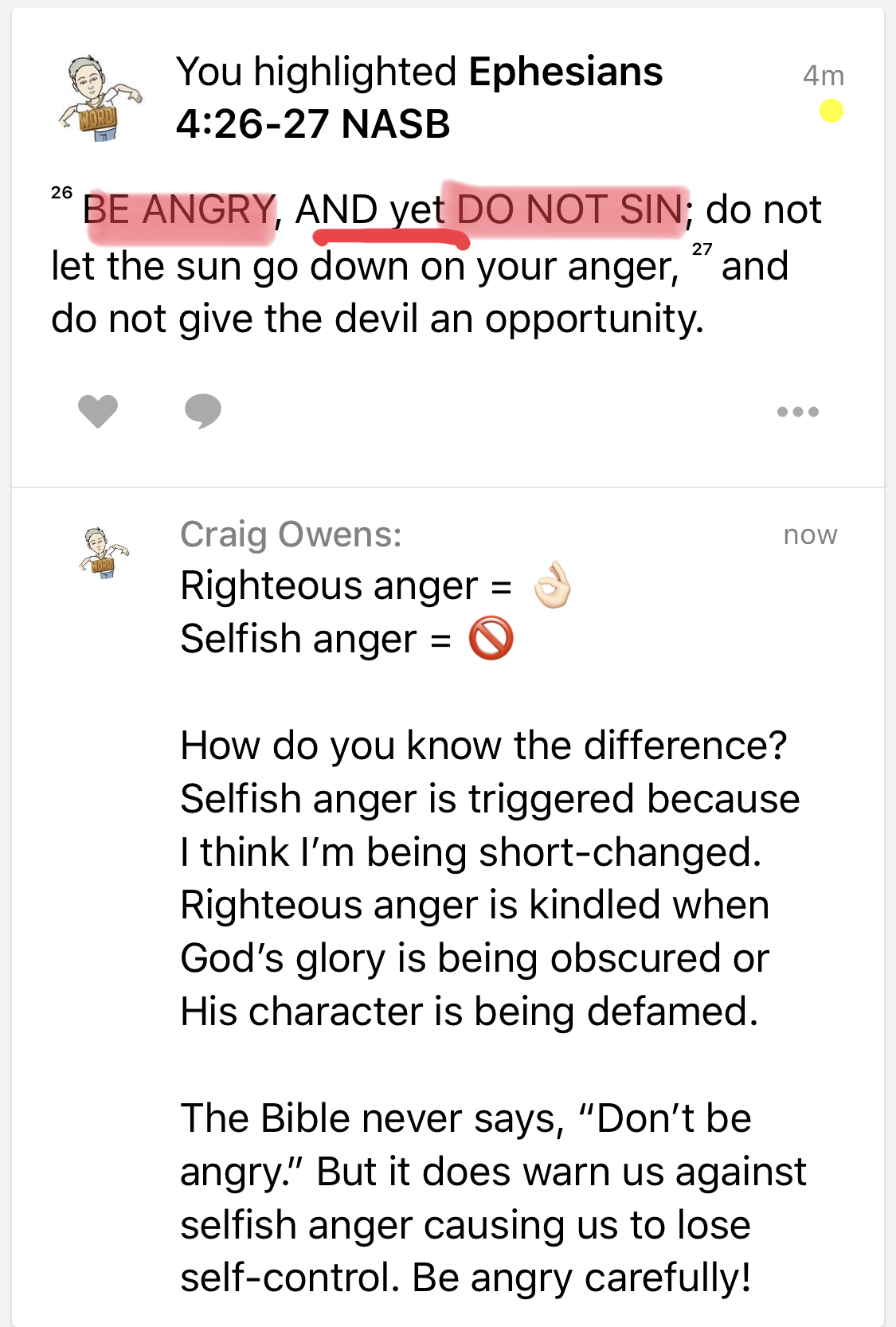
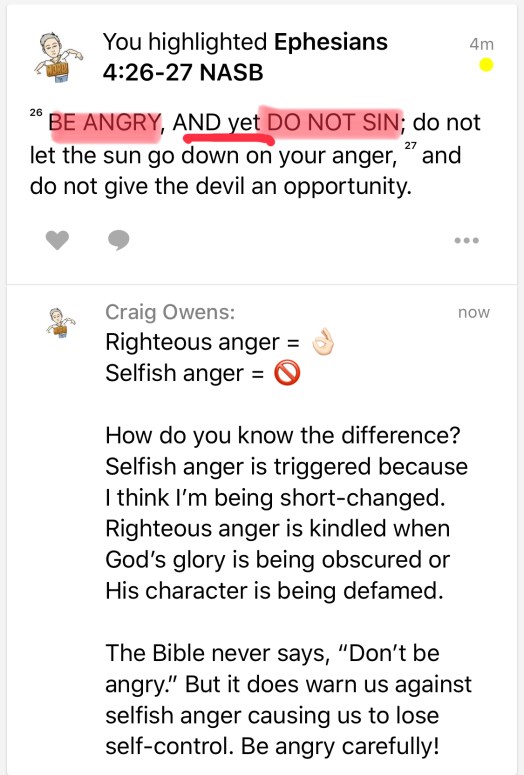
Being angry is not the issue. David said it (and Paul quoted it in Ephesians 4:26): “Be angry; just don’t sin.” God gets angry, but He does not sin. Jesus, in His public ministry, got angry, but He did not sin. We need to search our hearts to make sure our anger has not crossed the line to sin. We have to be angry in a godly way.

I see at least four ways to become angry without crossing the line into sin:

1.  Selfless Anger = anger at sin, but not angry at the sinner.

Love is not rude, it is not self-seeking, it is not easily angered, it keeps no record of wrongs. Love does not delight in evil but rejoices with the truth. (1 Corinthians 13:5, 6)

2.  Slow Anger = lengthen your fuse a bit.

Do not be quickly provoked in your spirit, for anger resides in the lap of fools. (Ecclesiastes 7:9)

My dear brothers, take note of this: Everyone should be quick to listen, slow to speak and slow to become angry, for man’s anger does not bring about the righteous life that God desires. (James 1:19, 20)

Good advice from Thomas Jefferson: “When angry, count to ten before you speak; if very angry, a hundred.”

3.  Protective Anger = when sinners entice others to join them in their sin. God is sad when people leave Him; He is angry at them when they take others with them.

But they put God to the test and rebelled against the Most High; they did not keep His statutes. Like their fathers they were disloyal and faithless, as unreliable as a faulty bow. They angered Him with their high places; they aroused His jealousy with their idols. When God heard them, He was very angry; He rejected Israel completely. (Psalm 78:56-59)

4.  Righteous Anger = against those who are keeping others from coming closer to God.

For I endure scorn for Your sake, and shame covers my face. I am a stranger to my brothers, an alien to my own mother’s sons; for zeal for Your house consumes me, and the insults of those who insult You fall on me. (Psalm 69:7-9)

This verse was recalled by Jesus’ disciples when they saw Him get angry and clear out the Temple in Jerusalem. Jesus was angry because of the religious clutter that was keeping God’s house from being a house of prayer for all nations.

I think everyone is familiar with the acrostic WWJD = What Would Jesus Do?

I’d like to propose something similar: WGGA = Would God Get Angry?

This is a great question to ask to make sure our anger does not cross that line into sin. Get angry—in a godly way—and do not sin.

Who’s Your Promoter?

Check out this verse where God speaks to Joshua:

Today I will begin to exalt you in the eyes of all Israel, so they may know I am with you as I was with Moses.

Self-promoted leadership requires that I know what the current whims of the people are, and then I cater to those special-interest whims. But people are fickle, so I have to be constantly reinventing myself. I have to wear the right mask for the right group. I have to become a slick politician, giving the right speech to the right special interest group, promising them what they want to hear. I have to pander for votes to stay in leadership.

God-promoted leadership requires that I have faith in God alone. No focus groups to find out what people want. No advisors whispering in my ear. No masks, no special interest speeches, no pandering for votes. God knows the hearts of the people, and if He has called me to be a leader, He will equip me to be His leader.

Joshua was a God-promoted leader. When he was on the eve of his first major campaign as the new leader of Israel, he gave just one speech: “Let’s get ready to go.” A self-promoting leader would have given one motivational speech to the priests, one pep talk to the generals, one persuasive speech to the troops, an encouraging speech to the stay-at-home moms, and possibly one more convincing speech to those who wanted to pursue an alternative strategy.

The results of God-promoted leadership?

  1. So the Israelites did just as Joshua commanded them (Joshua 4:8).
  2. That day the Lord exalted Joshua in the sight of all Israel; and they revered him all the days of his life (Joshua 4:14).

Who’s your promoter?

My prayer is that I always allow God to be my promoter and that the Holy Spirit will convict me anytime I try to promote myself.

A Voice Behind Me

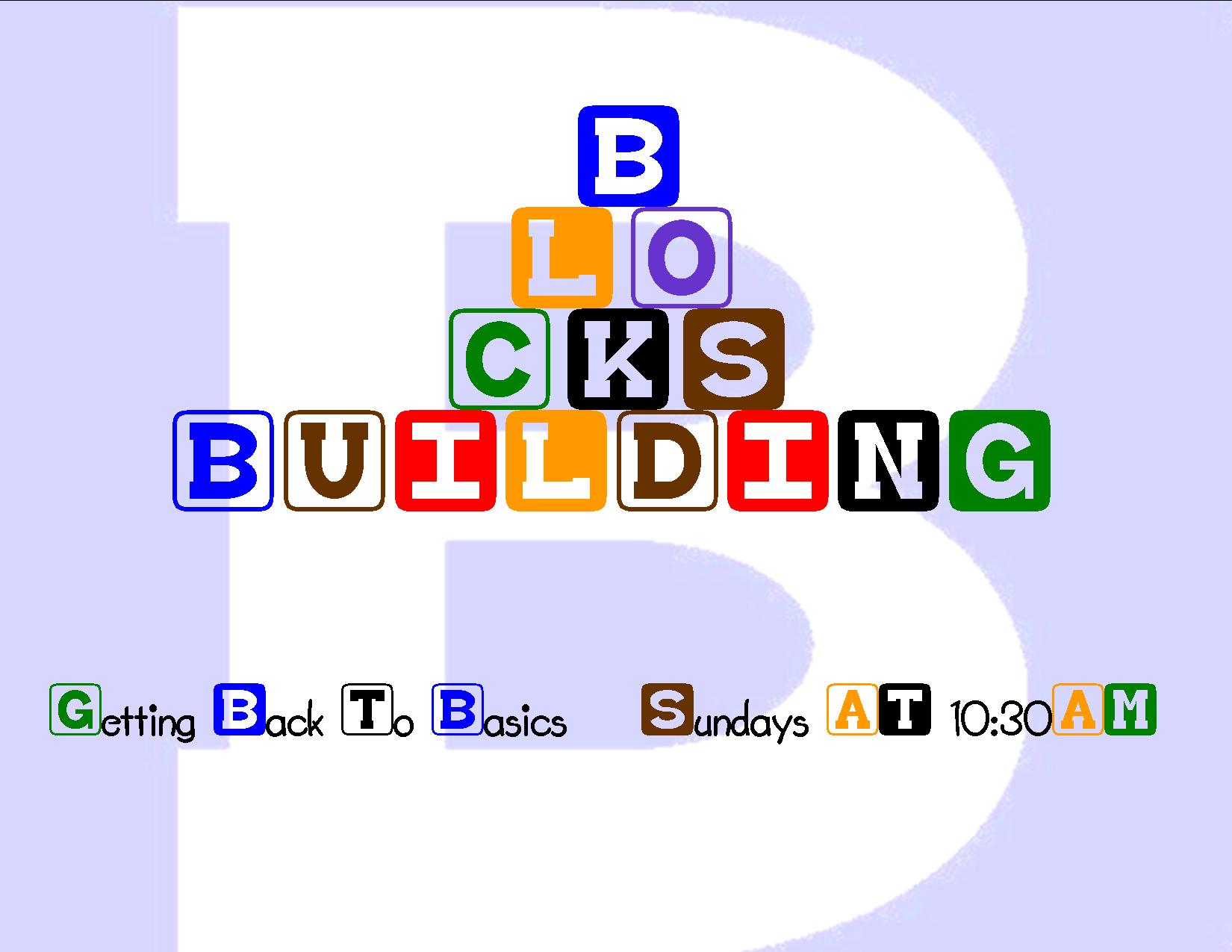
In our series on Building Blocks, I’ve been talking about the basics of a relationship with Jesus Christ. An obvious foundation for any relationship is meaningful conversation.

If you think about any close relationship you have, the closeness was developed through conversation. Gradually you began to know their voice and know their heart. Our meaningful conversation with God produces the same increased intimacy. We talk with Him through reading His Word and through prayer.

The more you read the Bible and the more you pray, the clearer His voice becomes. Isaiah said it this way:

Your own ears will hear Him. Right behind you a voice will say, “This is the way you should go,” whether to the right or to the left. (Isaiah 30:21)

Earlier this week I was on a long road trip, so I took our dog Grace with me. After grabbing some lunch, I wanted to find a place for Grace to run around and stretch her legs, but I was in a town I didn’t know. As I came to the end of the driveway, my next appointment would have been right, but I felt I should turn left instead.

I did, and two blocks away was a huge, grassy park where I could sit and eat my lunch and Grace could frolic to her heart’s content.

Did I actually hear a Voice? No, but I felt a Voice. His Voice. Yes, I believe God even cares about helping me find a place for my lunch and for my dog to run. He cares that much about me. And you too!

He’s speaking to you all the time. Are you listening to the Voice behind you?

Two Helpful Questions

Some people tell me that they don’t read the Bible for themselves because they don’t understand parts of what they read, or they don’t know what to do with the parts they do understand.

To which I reply, “That’s understandable.”

The Bible is filled with timeless principles given to us by an Eternal God. The principles may be timeless, but their application is not universal. For example, God’s timeless principle of, say, honoring your parents may be applied one way by someone living in the 12th century B.C. and applied completely differently by someone living today.

Same principle. Different application.

This is easy to say, but much harder to put into action. But I believe it is imperative that we continue to read God’s timeless principles in His Word and find daily application for our lives. So I’d like to suggest two questions to help you in this pursuit. They are the same two questions that people asked the day of Peter’s first sermon after the birth of the Christian church. Try these the next time you read your Bible:

  • What does this mean? (Acts 2:12)
  • What should I do? (Acts 2:37)

Don’t avoid reading the Bible. And don’t approach the Bible the way Søren Kierkegaard said some people do: “Many read the Bible the way a mouse tries to remove the cheese from a trap: trying not to get caught.”

I’m still learning too. Two things that help me immensely: (1) Pray before I read my Bible, asking the Holy Spirit to illuminate His inspired Word, and (2) Talk with other wise friends about the application questions I have.

If you have some strategies that are working for you, please share them in the comments below.

Building Blocks

Whether you have been a follower of Jesus for years, or you’ve just invited Him into your life, there are important building blocks that can help this relationship grow stronger. Join us as we discuss the basic building blocks of a relationship with God over the next four Sundays…

April 11—Relationships. A satisfying relationship with God shows up in satisfying relationships with others. How do we make all our relationships better?

April 18—Bible Reading. Just what is this big book and how can we use it to help us every day?

April 25—Prayer. Does talking to God sound scary? It doesn’t have to be. In fact, it can be the best conversation ever!

May 2—The Holy Spirit. His role is probably the least understood, but the most vital, for our day-to-day lives.

We’d love to see you on Sundays at 10:30am.

YouVersion

As readers of this blog know, I love to read. But hands-down, no-comparison, head-and-shoulders above any other book, my favorite book is the Bible.

One of the best apps I have added to my iPhone is YouVersion. I love being able to read the Scripture in different translations, but I especially love the daily reading plans. There are lots to choose from. Currently I am reading through the wisdom and insight of the “Psalms & Proverbs” reading plan.

Good news… even without an iPhone or other smart phone, you can still access YouVersion via your computer.

Better news… if you have a smart phone, your computer access and phone access are synced.

Best news… YouVersion is free! Thanks to the incredible folks at Lifechurch.tv who have made this available to anyone anywhere.

Go ahead, dive right into the Bible. Once you start reading it, I’m sure it will become your favorite book too.

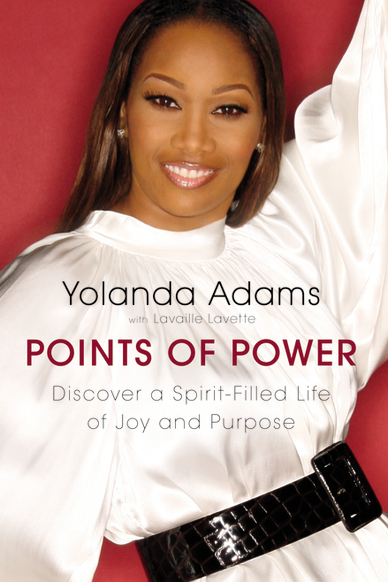
Points Of Power (book review)

Since you’re reading another book review from me, you probably know that I love to read. I’ve got wall-to-wall, floor-to-ceiling bookshelves in my office, just brimming full of books. Once someone asked me, “How do you read so many books?” To which I replied, “One page at a time.”

This is how most healthy growth takes place: one step at a time.

  • We lose weight one pound at a time.
  • We advance through school one class at a time.
  • We grow in our relationships one conversation at a time.
  • And we develop a greater love for God one principle at a time.

This is what I enjoyed about Yolanda Adams’ book Points Of Power. A total of 37 power points are spread out across 10 chapters. Each of the chapters zero-in on a different power point:

  • Faith
  • Love
  • Forgiveness
  • Confession
  • Praise
  • Confident Assurance
  • Prayer
  • Peace
  • Protection
  • Victory

In each power point, Yolanda deliberately leads us through the principle, a passage of Scripture, a prayer, and ten pensive points. I especially enjoyed the pensive points, as they challenged me to think more deeply about each power point.

This book would be excellent as an individual study, or as a group Bible study. One step at a time—one principle at a time—your reliance on God will grow.

I am a Faith Words book reviewer.

Living Life In The Zone (book review)

I’m frequently asked to recommend books for men for their devotional time, small group, or accountability groups, and I usually answer the same way: “I don’t know. Who’s in your group? Where are they now spiritually? What do they want to accomplish?”

But now, Living Life In The Zone by Kyle Rote, Jr. and Dr. Joe Pettigrew just may have given me my new standard answer. This book is applicable for almost any guy that is seeking a more energizing, more satisfying relationship with Jesus Christ.

Here’s what I like about this book—

  • Short chapters. Guys are busy, so just give us what we need and let’s get on with our day.
  • A “game plan” in each chapter that gives me the Scripture backing for each daily thought. I can read just the Scriptures listed here, or I can dig deeper.
  • Real-life “playmakers” help me see how this principle is being lived out in someone else’s life.
  • Discussion-stimulating questions. Guys don’t need questions that can be answered yes/no, but we need to have a reason to talk more.

This book is designed to take men on a 40-day journey. I suppose it could be done in 40 consecutive days, but I also see this book being used as a 40-week guide for men meeting together for accountability and spiritual growth.

For men who like to read and study, there is enough here for them to really dig into. For men who don’t particularly like to read, the short chapters will be appealing enough to engage their heart, mind, and soul.

I highly recommend this book to men seeking a deeper walk with God.

I am a Book Sneeze reviewer.

The iBible

Betsy finally relented and let me buy an iPhone. I’m absolutely lovin’ it!

Then, of course, news comes out yesterday about the iPad—whoa!

But have you seen the iBible?!? I’ve got to get me one of these!