Sometimes, instead of referring to the two major divisions of the Bible as the Old Testament and the New Testament, I prefer to use the First Testament and the Second Testament. This helps me remember that “Old” doesn’t mean outdated and “New” doesn’t mean forgetting what came before it.
I love how B.B. Warfield describes the First Testament as being like a mansion with richly-decorated, beautifully-ornate rooms, but which are dimly lit. With Christ’s Advent described in the Second Testament, the light is turned on and we can now appreciate the beauty that was always there!
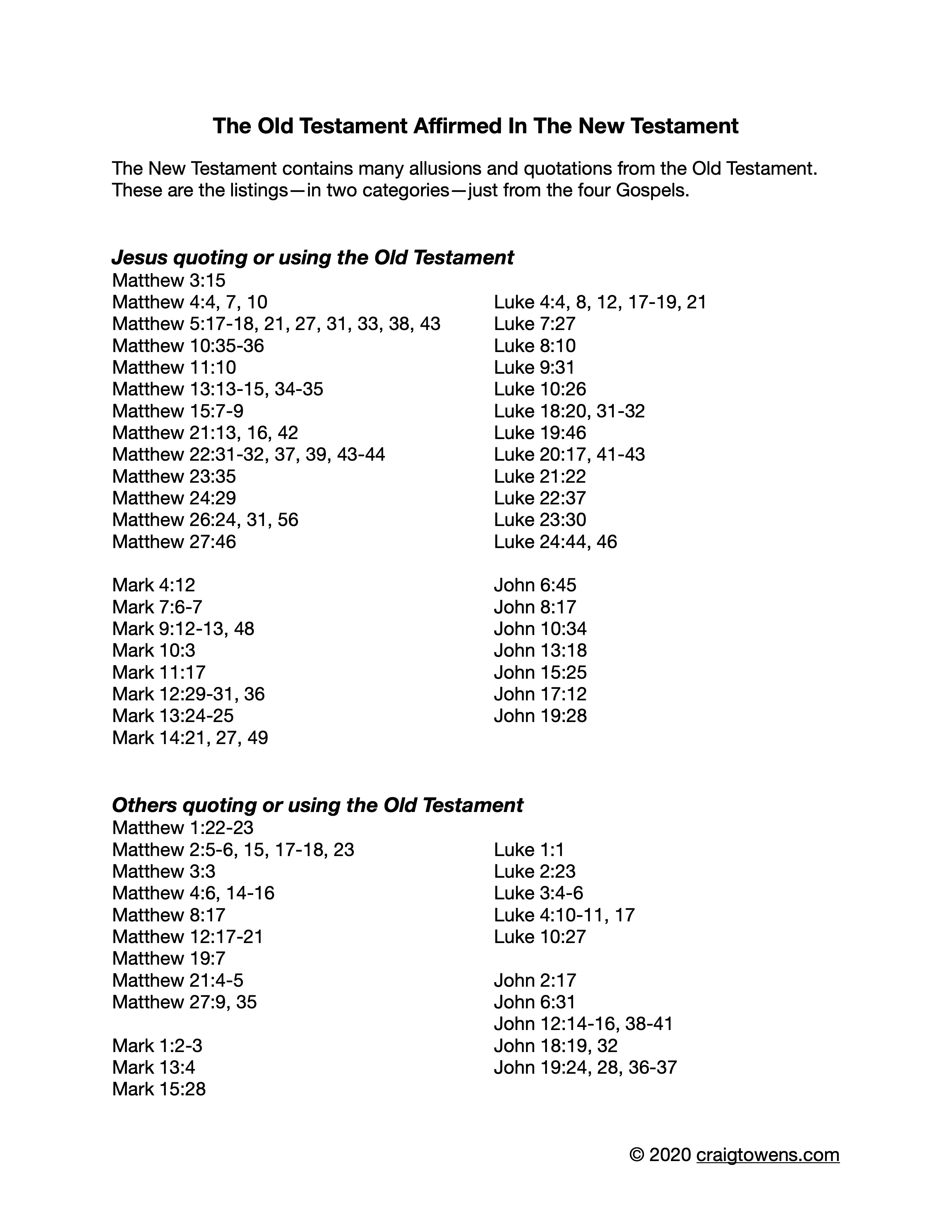
But let’s get even more obvious: In just the four Gospels there are at least 100 direct mentions or quotations of passages from the Old Testament. Clearly, both Jesus and the Gospel writers saw the First Testament as an integral part of Christ’s ministry.
Check out this list that I compiled and look up the references for yourself (a great place to look up Scriptures is on BibleGateway.com).
If you would like to download a PDF version of this list, click here → Old Testament affirmed in the New Testament ← If you would like to use this document in a teaching session, just be sure to mention that you downloaded it from craigtowens.com. Thanks!
“The worst form of ill association is ungodly marriage. I do not know anything that gives me more satisfaction than to see our brethren and sisters, who have walked in the faith of God, united in marriage—the husband and wife, both fearing and loving God. It is a delightful spectacle, and bids fair to be the means of building up the church with a generation which shall fear the Lord. But a very fruitful source of ruin to church members is that of a young man or a young woman choosing an ungodly partner in life. They never can expect God’s blessing upon it. They tell you sometimes they hope to be the means of their friend’s conversion. They have no right to hope such a thing; it so seldom occurs. The much more likely thing is that the ungodly one will drag the other down to his level, than that the godly one shall pull the other up.” —Charles Spurgeon
“If homosexuals are bullied, we need to protect them. If they’re unjustly discriminated against, we need to help them. If they’re treated with contempt, the person hurting them should be stopped. If a family member comes out as gay and then is belittled, harmed, or vilified, then the offending family needs to be corrected. If Christians ridicule people who identify as gay or lesbian, they need to admonished. If a church doesn’t welcome seekers of all stripes (including people who identify as gay, lesbian, or bisexual), then it needs to change. But none of these circumstances are reasons to reinterpret Scripture to affirm homosexuality.” This is from a fascinating article: Bad Reasons To Adopt Pro-Gay Theology.
“Prudence means practical common sense, taking the trouble to think out what you are doing and what is likely to come of it.” —C.S. Lewis
“Resentment simply cannot dwell in a loving heart. Before resentfulness can enter, love must take its flight and bitterness take over.” —A.W. Tozer
“No nation ancient or modern has ever lost the liberty of freely speaking, writing or publishing their sentiments, but forthwith lost their liberty in general and became slaves.” —John Peter Zenger (in 1735 after winning his case that established the precedent for our freedom of the press)
“Never leave growing till the life to come!” —Robert Browning
“Why should you turn from God when you turn to your books, or feel that you must turn from your books in order to turn to God? If learning and devotion are as antagonistic as that, then the intellectual life is in itself accursed and there can be no question of a religious life for a student, even of theology.” —B.B. Warfield
Sometimes people get bogged down in some of the Old Testament books because it seems so tedious. And, honestly, some of it can seem irrelevant to today’s Christian. B.B. Warfield described the Old Testament as a richly furnished but dimly lit house. Only when the lights are turned on can we appreciate the beauty that was there all along. In Jesus Christ the light is on, and we can see the beauty of the Old Testament!
In the first seven chapters of Leviticus the sacrifices are described in detail. There are some repeating phrases that we should note: without defect … without yeast … of the proper value. The sacrifices were to be of the best quality, without any “strings attached,” and well thought-out.
Sacrifices were not only physically given, but given emotionally and mentally too. They shouldn’t be given begrudgingly as a “have to” sacrifice, but joyfully as a “get to” sacrifice.
The Archeological Study Bible has an interesting commentary on the sacrifices: “The sacrificial system was not magical. Its efficacy depended not upon the offering of a particular animal… but on God Himself, Who ordained these sacrifices. Fully as important, without an attitude of repentance, perfunctory observation of sacrificial rituals was meaningless.”
Jesus was the once-for-all sacrifice. And if you have accepted Him as your Lord and Savior, the Bible says Christ is now in you and you are new creation. You are blameless in God’s sight!
So today the best sacrifice you can give God is: YOU. When you joyfully give God your life and talents as a living sacrifice with a grateful attitude, God sees Christ’s sacrifice in you as perfect—no defect, no hypocrisy, a sacrifice of inestimable value!
If Jesus Christ is in you, you are a perfect sacrifice, so don’t hesitate to give yourself to God.
Listen to the podcast of this post by clicking on the player below, and you can also subscribe on Apple, Spotify, or Audible.
One of the misconceptions about Jesus is that He first appears on the scene in a manger in Bethlehem. Nothing could be further from the truth! Jesus appears in the opening words of the Bible—In the beginning God created—and in the last words of the Bible—Yes, I am coming soon. And He appears in every word in between!
B.B. Warfield has a great picture of the Old Testament being a mansion with richly-decorated, beautifully-ornate rooms, but which are dimly lit. So with just the Old Testament by itself, it is hard to appreciate the magnificent beauty that’s there. In Jesus, the light is turned on, and we can now appreciate the glory and majesty that was always there!
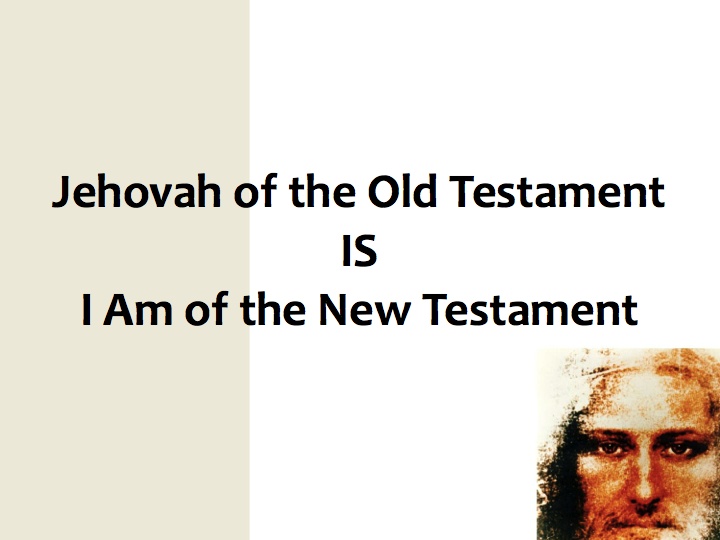
So notice how the “I Am” statements shine a bright light on the titles of “Jehovah”—
Jehovah Jireh (I Am Your Provider) → I am the Bread of Life (John 6:35)
Jehovah Rapha (I Am Your Healing) → I am the Resurrection and the Life (John 11:25-26)
Jehovah Nissi (I Am Your Source) → I am the Vine (John 15:5)
Jehovah Shalom (I Am Your Peace) → I am the Light of the world (John 8:12)
Jehovah Raah (I Am Your Shepherd) → I am the Good Shepherd (John 10:11)
Jehovah Sabaoth (I Am Your Wall Of Protection) → I am the Gate (John 10:9)
Jehovah Tsid-kenu (I Am Your Righteousness) → I am the Way, Truth, and Life (John 14:6)
Jehovah Shammah (I Am Here) → I am the Alpha and Omega (Revelation 1:8; 22:13).
In essence Jesus is saying “I Am Jehovah in all His fullness.” So what are we to make of that? What are we to make of Jesus Christ? Here’s how C.S. Lewis addressed that very question:
“This is a question which has, in a sense, a frantically comic side. For the real question is not what are we to make of Christ, but what is He to make of us? The picture of a fly sitting deciding what it is going to make of an elephant has comic elements about it. But perhaps the questioner meant what are we to make of Him in the sense of ‘How are we to solve the historical problem set us by the recorded sayings of this Man?’
“The problem is to reconcile two things. On the one hand you have got the almost generally admitted depth of sanity of His moral teaching, which is not very seriously questioned, even by those who are opposed to Christianity. In fact, I find when I am arguing with very anti-God people that they rather make a point of saying, ‘I am entirely in favor of the moral teaching of Christianity….’
“On the one side clear, definite moral teaching. On the other, claims which, if not true, are those of a megalomaniac, compared with whom Hitler was the most sane and humble of men. There is no halfway house and there is no parallel in other religions. If you had gone to Buddha and asked him, ‘Are you the son of Bramah?’ he would have said, ‘My son, you are still in the vale of illusion.’ If you had gone to Socrates and asked, ‘Are you Zeus?’ he would have laughed at you. If you had gone to Mohammed and asked, ‘Are you Allah?’ he would first have rent his clothes and then cut your head off. If you had asked Confucius, ‘Are you Heaven?’ I think he would have probably replied, ‘Remarks which are not in accordance with Nature are in bad taste.’
“The idea of a great moral teacher saying what Christ said is out of the question. In my opinion, the only person who can say that sort of thing is either God or a complete lunatic suffering from that form of delusion which undermines the whole mind of man.” (emphasis mine)
In this quote, C.S. Lewis gives us three choices about Jesus. We can either say (1) He is a liar, (2) He is a lunatic, or (3) He is who He says He is.







 Craig T. Owens