Time For A Self-Check

Listen to the podcast of this post by clicking on the player below, and you can also subscribe on AppleSpotify, or Audible. 

Have you ever heard this little saying: “To live above with saints we love, oh, that will be glory. But to live below with saints we know, well, that’s a different story”? I’ve found that it’s sometimes true! 

We love Psalm 133:1-3 when the saints are all together. What a great “selling point” to invite someone to be a part of the Christian community! But Psalm 41:7-9 is kind of embarrassing as David talks about former friends who have hurt him deeply. 

(Check out all of the Scriptures in this post by clicking here.)

But being bitten by a fellow sheep is a reality we all have experienced, and, sadly, we will probably have to deal with again in the future. There is a natural way we tend to react when we’ve been bitten, but there is also a supernatural response that the Bible consistently calls us to. This is the God-glorifying way we all need to strive for. 

In Acts 23, Paul is standing before the Sanhedrin. He opens his remarks by simply saying he has a clear conscience before God, and the high priest immediately orders that Paul be smacked on the mouth! That seems like a bit of an over-reaction on the part of the high priest, but maybe it was a bit of show of force to let Paul know who was really in charge. Paul responded with an immediate—and natural—reaction when he says, “God will slap you!” 

Paul is an old man by this time. He’s been through shipwrecks, beatings, imprisonments, gone without food, traveled more miles than he can count, and preached more sermons than he can remember. His body was giving out on him, and his eyesight was especially weak. Clearly, Paul didn’t realize to whom we was addressing his remarks. But when he became aware, he immediately owned up to his mistake. Paul offered no excuses or justifications, just a quick, simple, sincere apology. 

When you have been bitten (slapped) by another sheep, you should ask: 

  • Could I have provoked them by something I said or did? 
  • Could I have hurt them by something I didn’t say or do? 

David prayed a great prayer in Psalm 139:23. But this prayer is only effective if we are willing to accept that we may have been the agitator that led to the bite. In the last words that Job speaks in the Book of Job, he is very introspective. Check out all of the “If I have” statements throughout Job 31. 
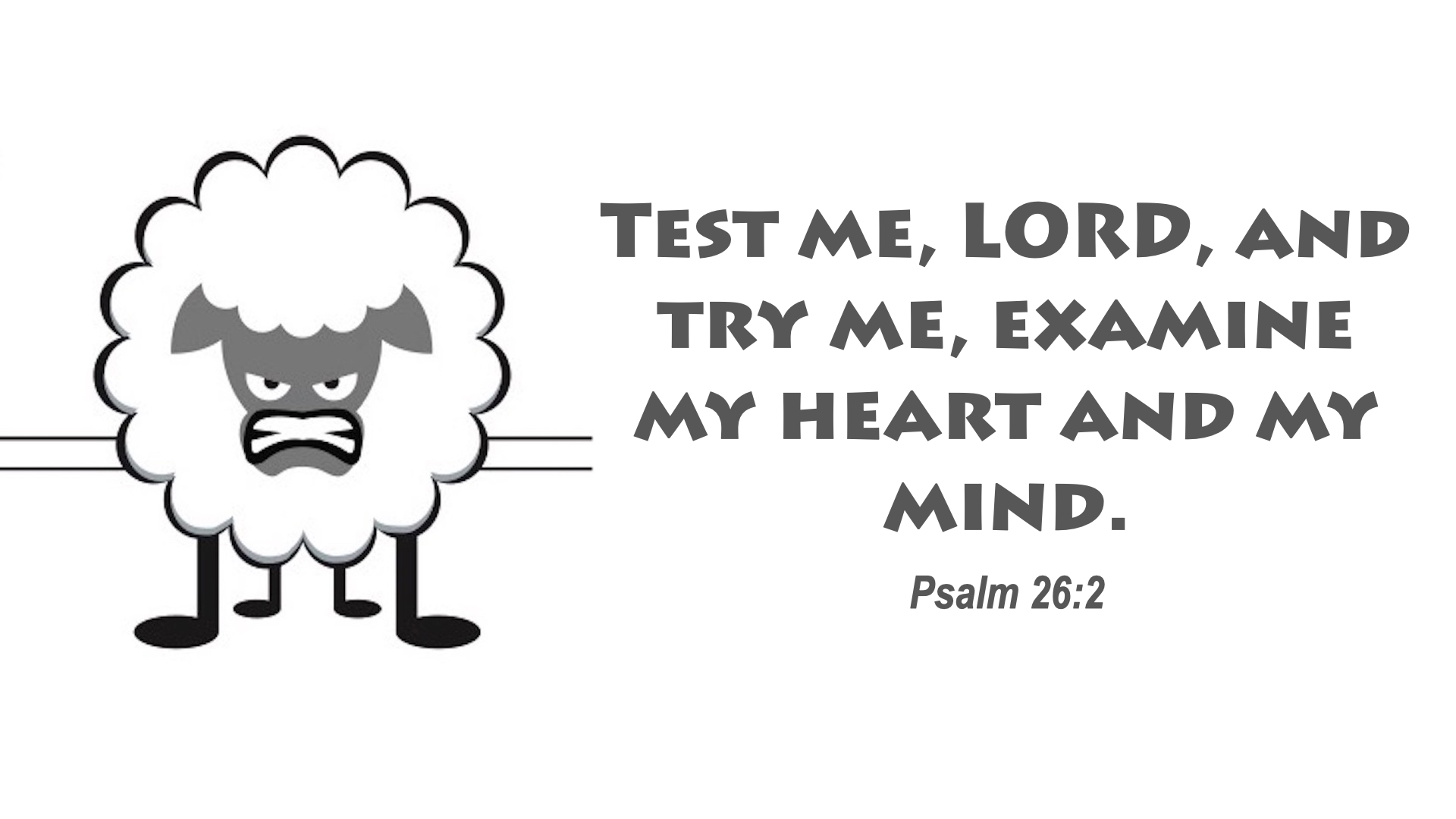
In Psalm 26:2, David invites the Holy Spirit to check him three times! 

  • test me = scrutinize me 
  • try me = assay me 
  • examine me = refine me in the fire 

When we are bitten, we should be open to the possiblity that God is using this bite to get my attention—to make me aware of a fault in my life or something that’s been in a blind spot. 

So we should consider the following: 

  1. Has this kind of bite happened more than once? From different sheep? 
  2. Has a spiritually wise person attempted to address this with me before? 
  3. Do I ever admit that I’m at fault, or is it always the other person’s fault? 
  4. Do I find myself making a list of why they should apologize to me? 
  5. When was the last time I apologized to someone else? 

If the Holy Spirit reveals something in us, He will also empower us to make the change and make amends. The natural response is to place all the blame on others. The supernatural response to pray Psalm 26:2 before responding. 

If we react only the natural way, it is a lose-lose for us and for the whole pasture. But if we learn to respond in a supernatural way, it becomes a win-win for everyone. Listen to the wise words of King Solomon—

He who heeds instruction and correction is not only himself in the way of life but also is a way of life for others. And he who neglects or refuses reproof not only himself goes astray but also causes to err and is a path toward ruin for others. (Proverbs 10:17 AMPC) 

Let’s all strive for the supernatural response that is a win-win for the whole Kingdom of God! 

Please follow along with all of the messages in this series by clicking here. 

P.S. If you are a pastor, you may want to check out my book When Sheep Bite.

►► Would you please prayerfully consider supporting this ministry? My Patreon supporters get behind-the-scenes access to exclusive materials. ◀︎◀︎

The Craig And Greg Show: Word Up

Listen to the audio-only version of this podcast by clicking on the player below, or scroll down to watch the video.

Words are incredibly powerful! With our tongues, we can elevate others to amazing heights, or tear them down completely. In this episode, Greg and I discuss how, as leaders, it is critical that we are mindful of our everyday words so that we ensure we are taking our team in the right direction.

  • [0:20] Sometimes leaders can forget how powerful their words can be. 
  • [1:00] Words need to be used strategically and carefully.
  • [2:05] “Words of affirmation” is one of the love languages, but everyone needs to hear words that affirm and encourage them.
  • [3:40] Some of the most meaningful words are our apologies and requests for forgiveness. When we do this well, it opens up the door for deeper communication.
  • [6:00] Leaders should be able to see a visible and immediate difference in their teammates when they are speaking the correct words to them. If not, we need to quickly adjust our words.
  • [6:50] People don’t care how much their leader knows (or says) until they know how much their leader cares about them.
  • [8:25] Negative words can sour relationships.
  • [9:08] Leaders need to pay close attention to what words work best with each teammate.
  • [10:15] What is the difference between efficient communication and effective communication?
  • [12:40] We share some insights from two noteworthy books: Leadership Jazz by Max DePree and Ten Powerful Phrases for Positive People by Rich DeVos.
  • [15:00] One of the most beautiful words anyone will ever hear a leader speak is their teammate’s name.
  • [19:02] Handwritten notes go the extra mile, but we need to slow down to think about who needs to hear an affirming word from us.
  • [21:20] Greg shares a memorable quote about the long-term results of our words.
  • [22:07] A good coach can give you more impactful insights than someone close to you.

Books referenced in this episode:

Check out this episode and subscribe on YouTube so you can watch all of the upcoming episodes. You can also listen to our podcast on Spotify and Apple.

10 Quotes From “Start With The Heart”

Kathy Koch has given parents, teachers, and anyone who works with younger children, and excellent resource to improve your relationship with your kiddos and empower them to greater success. Check out my full book review of Start With The Heart by clicking here. 

“For your children to want what you want for them, for changes to occur, and for improvements to remain, your hearts must be intertwined. Your motivational power and influence over their obedience comes out of the love you have for each other.” [see Proverbs 23:26] 

“Affirm your children when they do use the character qualities you’re emphasizing and correct them when they don’t. … Specifically, look for gratitude and joy. The lack of one or both of these emotions causes children (and adults) to use character qualities inconsistently.” 

“Here is my list of understandings that can secure children’s hearts and increase your influence so you’ll be able to motivate them to be responsible, brave, and so much more.

  • Parent by faith
  • Parent with grace and mercy
  • Forgive quickly and often
  • Ask to be forgiven quickly and often
  • Tell your children you are confident in God
  • Prioritize children, not their behavior
  • You can dislike what children do while you still like and love them
  • Be who you want your children to be
  • Raise the children you were given, not the children you wish you had
  • Remember needs and wants are different
  • Listen when children are little if you want them to talk with you when they’re older
  • When children have a problem, remember they are not the problem
  • Teach children to fail well
  • Prioritize progress, not perfection” 

“Children are even more susceptible to the influences around them. We should have and model solid character so our behavior, attitudes, and decisions glorify God. We should also prioritize our character so we don’t lead a child astray. Making every effort to use these qualities ourselves matters. And, of course, apologizing when we don’t is key to maintaining a positive relationship.” 

“The desire to develop self-control is birthed in self-respect. Self-control makes it possible to use other character qualities successfully.” 

“Do we choose to see our children’s circumstances and respond appropriately? Although consistency is usually appropriate when raising and motivating children, if we don’t have compassion and individualize our reactions and decisions when it’s appropriate, why would our children? Modeling this character quality matters tremendously.” 

“Initiative: Children may never develop this quality if you remind them of everything they must do. Rather, it’s birthed when you help them grow in appropriate independence. … Is it possible that your children may not be motivated as you’d like because you rescue them to early, too often? … I know you value the things you worked hard for. Don’t rob children of that same satisfaction. Allow them to persevere.” 

“Prayer is a powerful tool—use it! Your personal and specific prayers for your children communicate your deep love for them and your dependence on God. Your prayers are a significant way your children learn who you hope they’ll be and what you hope they’ll do. Pray they’ll develop a heart for Christ. Model and teach what they need for their heart to be transformed into His likeness. This will change their character and, therefore, their motivation and motives, too.” 

“Just making statements like these can be empowering:

  • I need to take off arguing and put on first-time obedience.
  • I need to take off bullying and put on kindness.
  • I need to take off distractions and put on focus.
  • I need to take off ‘I don’t want to’ and put on ‘do it anyway.’” 

“This might surprise you, but all children are motivated. … It doesn’t help to ask, ‘How do I get my kids motivated?’ Rather, we need to ask, ‘How can I redirect their motivation?’” 

Stay tuned: more quotes coming soon…

Bill Hybels’ 10 Rules Of Respect

My mind and heart were expanded once again at this year’s Global Leadership Summit! Bill Hybels opened the conference with a call to leaders to promote civility in our areas of influence. Here are a few notes I jotted down.

“The solution to incivility must begin with me.” —Bill Hybels

“Christians do not get to chose whom they will respect [1 Peter 2:17].” —Bill Hybels

Bill Hybels’ 10 rules of respect:

  1. Leaders must set the standard of how to disagree without demonizing the other person.
  2. Leaders must allow spirited conversations without it getting personal.
  3. Leaders must not interrupt others who are talking.
  4. Leaders must limit their volume level and eliminate belittling words.
  5. Leaders must set the example of being courteous.
  6. Leaders must never stereotype.
  7. Leaders must apologize immediately if they are wrong.
  8. Leaders must form opinions carefully.
  9. Leaders must set the example of showing up on time and doing what they say they will do.
  10. Leaders must set rules of respect for the organization and enforce them relentlessly.

Bill Hybels closed with this challenge—“When was the last time I reflected deeply on my own convictions about respecting others?”

No Apologies Needed

Listen to the podcast of this post by clicking on the player below, and you can also subscribe on AppleSpotify, or Audible. 

Jesus spoke.
A lot.
In fact,
He’s called the Word.
He told stories,
He quoted Scripture,
He used nursery rhymes.
He laughed,
He cried,
He thundered.
He spoke to the religious,
And the irreligious;
To Jews,
To Gentiles,
To Samaritans.
His words excited,
And angered,
Healed,
And restored.
But…
Not once did He misspeak,
Or stumble,
Or apologize.
How could He do this?
“I did not speak of My own accord,
But the Father who sent Me
Commanded Me what to say
And how to say it …
So whatever I say
Is just what the Father
Has told Me to say” (John 12:49-50)
You and I can speak like this too:
We, too, can slow down, listen, and then speak only those Holy Spirit-directed words. If we can do that, we won’t ever need to apologize.

Check out my video called Time To Check The Mirror where I talk about so-called Freudian slips, and my blog post A Leader’s Sincere Apology.

►► Would you please prayerfully consider supporting this ministry? My Patreon supporters get behind-the-scenes access to exclusive materials. ◀︎◀︎