Exponential Prayer

p3-logoExponential (ěk’spə-něn’shəl)  adj.  any positive constant raised to a power.

I met this morning with our P3 team—Pastor’s Prayer Partners—for an incredible time of challenge and prayer. These folks are awesome! They meet with me to pray before every one of our services, and they each take a day during the week to pray for me and my family. I can feel the effect of their prayers on my daily activities.

Prayer is the positive constant; my prayer partners raise prayer to a higher power—an exponential power! I cannot thank these prayer warriors enough!

Understanding Misunderstanding

huh

Miscommunication is nothing new. From the dawn of history, people have always struggled to understand exactly what the other person was saying to them. That’s because we all have our own “accents”—our own way of getting our message across.

This is hard enough when trying to discuss something like politics, relationship likes/dislikes, or even movie preferences. But what about when you’re trying to communicate something intangible? Like your personal faith.

Most Christ-followers communicate their faith with the same “style” that they communicate their menu preferences, political persuasions, or music choices. But there is an added element of misunderstanding built in to the spiritual dimension. Even Jesus’ own disciples said “Huh?” many times to Him.

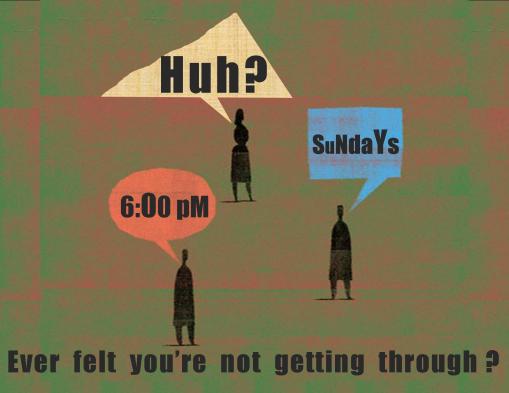
This Sunday, we begin a brand new series in our 6:00 PM service simply entitled Huh? We will be learning some very practical ways to communicate our faith to others by learning their unique communication style. If you have ever felt that you’re just not getting through, feel free to join us.

To Be Or To Do

Just pondering this quote from Oswald Chambers:

“God’s main concern is that we are more interested in Him than in work for Him. Once you are rooted and grounded in Christ the greatest thing you can do is to be.” (italics in original; I added bold)

God calls me not to do more for Him but to be more with Him. Being always trumps doing.

Now I ask myself: where do I need to do less so that I can be more?

My Big Three

three1Busy. Commute. Busy. Lesson prep. Busy. Kids’ schedules. Very busy. Meetings. Extremely busy. Household chores. Hectic busy. Hospital visits. Running-to-catch-myself busy.
In my busyness, something gets squeezed out of my life very easily. I don’t intend for this to happen, in fact it’s the last thing that should ever get squeezed out, but it does. I can tell when it does. Not right away, but soon it catches up with me and I’m running on vapors. I know that when I take the time to put it back into my life, the busyness doesn’t seem so busy anymore.

What is this power source? Consider the life of Jesus.

No one had more to accomplish in such a short period of time than Jesus. He only had three years to find, equip and launch the men who would take His message to all the world. No small task, and not a minute to lose. Yet instead of seeing Jesus run at the frantic pace I so easily slip into, I see these incredible pauses.

Very early in the morning, while it was still dark, Jesus got up, left the house and went off to a solitary place, where He prayed. (Mark 1:35)

How long did He pray? The Bible doesn’t say, but I suspect He was in prayer with His Heavenly Father until His conversation was concluded. It may have been a while, or it may have been somewhat shorter.

Then all throughout the day, Jesus was never rushed or pushed or running helter-skelter, but He seemed to move at just the right speed. This is because Jesus was taking His cues from His Father all day long:

For I did not speak of My own accord, but the Father who sent Me commanded Me what to say and how to say it. I know that His command leads to eternal life. So whatever I say is just what the Father has told Me to say. (John 12:49-50)

Sometimes when there were big decisions or momentous occasions facing Him, Jesus would spend an extended time in prayer. For example:

 One of those days Jesus went out to a mountainside to pray, and spent the night praying to God. When morning came, He called His disciples to Him and chose twelve of them, whom He also designated apostles. (Luke 6:12-13)

I’m trying to make Jesus’ big three my big three:

  1. An untimed conversation with God every morning.
  2. All-day sensitivity to the prompting of the Holy Spirit.
  3. Periodic prayer retreats before making big decisions.

This is taking all of the discipline I can muster, but I must make this my top priority!

Good Times & Rough

Dungy's "Quiet Strength" Is A Must Read!

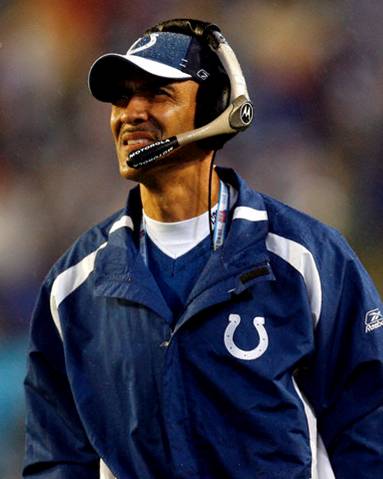
Consider this quote from Tony Dungy’s memoir Quiet Strength

“It’s easy to be gracious when you’re getting carried off the field in celebration. It’s more difficult when you’re asked to pack up your desk and your passcode doesn’t work anymore. I think people look more closely at our actions in the rough times, when the emotions are raw and our guard is down. That’s when our true character shows and we find out if our faith is real. If I’m going to call myself a Christian, I have to honor Jesus in the disappointments too.” (emphasis mine)

So we could use this definition for integrity: when I act the same in rough times as I do in good times. It’s easy to give God thanks, be on my best behavior and say all the right things when everything is going my way. But I need to be just as attentive in the rough times to still give God thanks and still do and say the right things—the things that honor Jesus.

Great challenge, coach! I’m trying to live this out in my life too.

Are You A Trustworthy “Enemy”?

Sticks and stones may break my bones but words will never hurt me, right? Wrong—words hurt!

At times you may think, “Well, I may have deserved that one.” Perhaps you did or said something inappropriate, and the other person responded out of their anger or frustration or embarrassment. But what about when you’ve done nothing wrong? Those sharp, wounding words seem to come out of the clear blue, from someone you never would have expected to be so hateful—angry, spiteful words deliberately hurled at you like stones.

David was forced to hide in Philistine territory to get away from Israelite King Saul. This was smart on David’s part because the Philistines had been ancient enemies of the Israelites, so Saul would never cross into Philistine territory to look for David. David asked King Achish for refuge in his territory, and Achish gave him the city of Ziklag in which to settle.

There’s a cliché that says, “The enemy of my enemy is my friend.” Achish was Saul’s enemy, so David could have assumed that Achish was his friend (the enemy of David’s enemy).

But here’s the important point—David didn’t consider Saul his enemy. Saul may have thought David was his enemy, but David didn’t reciprocate. David didn’t treat Saul as an enemy, but neither did David treat Achish as a friend.

Yet the Bible records an amazing statement: Achish trusted David (1 Samuel 27:12). Neither Saul nor Achish could ever claim that David slandered them, maligned their character, or did them any harm at all.

How could David do this? How could he keep from lashing out at the one who hurled insults at him (Saul) or the one who was his ancient foe (Achish)? David asked God to help him—

Fierce men conspire against me for no offence or sin of mine, O Lord.
I have done no wrong, yet they are ready to attack me.
Arise to help me; look on my plight!
(Psalm 59:3-4)

I see three great life applications when you are wrongly attacked or slandered:

  1. Don’t treat those who criticize and slander you as an enemy.
  2. Don’t find the enemy of your enemy and call him a friend.
  3. Do acknowledge your hurts and take them to God.

You don’t have to befriend your foes, but neither do you need to lash out at those who are falsely attacking you. Let God arise to help you, and may even your enemies find you trustworthy!

Piling On!

It just wasn’t going very well for David!

His boss, Saul, was jealous of him and was trying to kill him.
He had to leave his best friend behind when he ran for his life.
And his wife.
And his Mom & Dad.
And his brothers.
And his pastor.
Then his best friend is almost killed for standing up for David.

So David runs to enemy territory. After all “the enemy of my enemy is my friend,” right?

Um, not so much! The king of Gath was Saul’s enemy, but he wasn’t too fond of David either. How does David get out of this one? He starts drooling like an idiot, clawing weird symbols on the wooden doors and acting like a madman!

David runs away from Gath to Adullam Cave, which then quickly becomes the gathering spot for every distressed, bankrupt malcontent in the country. Some following David had!

Have you ever had one of those days? You know, where nothing is going right, and everywhere you turn is simply more trouble—out of the frying pan and into the fire! The problems just seem to keep piling on!

Yet there in Adullam Cave, David pens some of the most profound words. Read them carefully, and note the progression:

I will extol the LORD at all times; His praise will always be on my lips.
My soul will boast in the LORD; let the afflicted hear and rejoice.
Glorify the LORD with me; let us exalt His name together.
(Psalm 34:1-3)

Notice how David chooses to praise God as an act of his will—I will extol the Lord… I will praise Him with my lips.

And then this act of his will gets into his soul (his emotions), and as a result, the other distressed, bankrupt malcontents begin to see something different in David. He doesn’t break down when the problems pile on; he praises God!

And then these malcontents begin to glorify the Lord with David; they begin to exalt His name together.

Friends, how you choose to respond when the problems pile on is vital. Yes, misery loves company. If you are feeling miserable, other miserable people will flock to you. Don’t use this group to have a pity party, but see it as an incredible opportunity to use your will to praise God.

Remember, feelings follow actions. You may not feel like praising God because the problems are piled on so high, but when you act the feelings will follow. David went from “I will” to “my soul” in just one verse! And the same thing will happen for you too!

A distressed, malcontented world is watching you—what will you do when your problems pile on?

The Jonathan Experience

David tried to do the right thing.

His countrymen were under attack from their archenemies. David prayed, and God told him to go rescue his countrymen. But when David called his loyal teammates together, they weren’t as enthusiastic about this plan as David was. This must have made David second-guess if he heard from God correctly, so he prayed again. Once again God confirmed, “Go fight the bad guys.”

They fought, and God gave them the victory. And the newly-rescued town hailed their deliverer as a hero. They invited him into their town and gave him the best meal, the best place to stay, and the highest honors they could give. But people are extremely fickle. They heard there was a reward out for David, and they thought the money was worth more than this hero’s presence in their town, so they conspired to turn him in.

David prayed again, asking God’s guidance. God said, “Yes, it’s true, they are going to turn you in. Time to run!”

So David ran. Ran for his life. Day after day after day after lonely day David ran through the desert, dodging the men seeking his life. As you might expect, David got tired, his men became discouraged and probably started to grumble. David thought to himself, “I’ve only tried to do the right thing. I haven’t harmed anyone, in fact, I’ve liberated oppressed people. This shouldn’t be happening to me.”

David—the almost-constant pray-er—didn’t pray. It stands out so starkly compared to his previous pattern. Whenever he was in a tough spot, or needed guidance, or even needed reassurance, David prayed. But not here in the desert, on the run, pursued by a relentless foe, surrounded by grumbling “friends.” No, he just retreated from the field of victory, from the fickle crowds, from his enemies… and from his God.

And then these great words appear in the narrative: “Jonathan went to find David.”

Jonathan, David’s covenant friend, didn’t sympathize and say, “You have every right to be upset.” He didn’t counsel David to attack his pursuing enemy. Jonathan didn’t tell David, “If I were you here’s what I would do.”

“Jonathan helped David find strength in God.”

What a friend! No pep talks … no crying on shoulders … no strategy sessions. Jonathan helped David get back to what his typical lifestyle had been—find his strength, his guidance, his encouragement in his God.

“Firm, graceful, loving, faith-building friendships can change the world.” —Craig T. Owens

I am so very blessed to have “Jonathans” in my life. They have shown up in my deserts at just the right time and helped me find strength in my God—helped me get back to my roots.

I pray you have a Jonathan or two (or three!) in your life. They are extremely rare people, so diligently nourish those relationships. And even more, I pray that you will be a Jonathan to a friend who is on the run.

League Of Extraordinary Christians

Good friends of ours, Jeff & Becky Kennedy, were at church this morning. Jeff brought us a challenging word entitled “The League Of Extraordinary Christians.”

I love the narrative in Acts 4:13: When they saw the courage of Peter and John and realized that they were unschooled, ordinary men, they were astonished and they took note that these men had been with Jesus. Peter and John were ordinary men who walked with Jesus.

By ourselves, we are ordinary; Jesus is the extra.

Extra Time With Jesus + Ordinary Me =
Extraordinary Christian

Ordinary people don’t change their worlds. Ordinary churches don’t attract hungry, hurting people.

But extraordinary people and extraordinary churches are world changers!

I desire for 2009 to be an extraordinary year. I desire that people take note that I have been with Jesus.

Are you ready to spend that extra time with Jesus? Are you ready to be extraordinary this year?

The Apathy Of Blurry Eyes

eye-chart1My son, Harrison, had an extensive eye exam today. Now he is asleep in my office.

During his eye exam, his pupils were dilated, so now he has blurry vision. And, apparently blurry vision leads to sleepiness. It’s actually not the eye drops that led to his malaise, but the lack of the ability to see clearly. If he cannot see what’s happening around him, why would he even try to engage in his surroundings. Instead, he’s just accepted his condition as something which can’t change.

This reminds of a man named Bart—

Then they reached Jericho, and as Jesus and His disciples left town, a large crowd followed Him. A blind beggar named Bartimaeus (son of Timaeus) was sitting beside the road. When Bartimaeus heard that Jesus of Nazareth was nearby, he began to shout, “Jesus, Son of David, have mercy on me!”

“Be quiet!” many of the people yelled at him. But he only shouted louder, “Son of David, have mercy on me!”

When Jesus heard him, He stopped and said, “Tell him to come here.”

So they called the blind man. “Cheer up,” they said. “Come on, He’s calling you!” Bartimaeus threw aside his coat, jumped up, and came to Jesus.

“What do you want Me to do for you?” Jesus asked.

“My Rabbi,” the blind man said, “I want to see!”

And Jesus said to him, “Go, for your faith has healed you.” Instantly the man could see, and he followed Jesus down the road. (Mark 10:46-52, NLT)

Were there other blind people that heard Jesus? It’s almost certain there were. Were there other blind people in Jericho? Probably. But it appears that their blindness had caused them to slip into drowsiness and apathy, to simply accept their condition as something which couldn’t be changed.

Bart would not settle! He believed Jesus could change his condition! He called out to Jesus. He shouted even louder to get Jesus’ attention. He threw aside his coat, jumped up and ran to Jesus. He boldly stated his need to see, convinced that he was talking to the one Person who could change his condition.

Jesus said that Bart’s faith—his persistence, his unquenchable desire to see clearly, his belief that Jesus could do something for him—is what brought about his healing.

Have you become accepting of your condition? What’s holding you back from shouting out even louder to Jesus? What have you given up seeking? Don’t hold back—shout out to Jesus again today!