5 Quotes From “The Truth About Forgiveness”

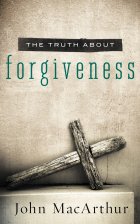
Yesterday I reviewed John MacArthur’s book The Truth About Forgiveness. Here are five of my favorite quotes from this book.

“These days everything wrong with humanity is likely to be explained as an illness. What we used to call sin is more easily diagnosed as a whole array of disabilities. All kinds of immorality and evil conduct are now identified as symptoms of this or that psychological illness. Criminal behavior, various perverse passions, and every imaginable addiction have all been made excusable by the crusade to label them medical afflictions. Even commonplace problems, such as emotional weakness, depression, and anxiety, are also almost universally defined as quasi-medical, rather than spiritual, afflictions. …In place of evil, therapeutic society has substituted ‘illness’; in place of consequences, it urges therapy and understanding; in place of responsibility, it argues for a personality driven by impulses. The illness excuse has become almost routine in cases of public misconduct.”

“The world’s wisdom: Guilt is a virtual mental defect. Don’t let it ruin your self-image. …Guilt functions in the spiritual realm like pain in the material realm. Pain tells us there is a physical problem that must be dealt with or the body will suffer harm. Guilt is a spiritual pain in the soul that tells us something is evil and needs to be confronted and cleansed.” 

“God does not love us ‘for what we are.’ He loves us in spite of what we are. … God loves us because He is love; love is essential to who He is. Rather than viewing His love as proof of something worthy in us, we ought to be humbled by it.”

“There can be no salvation for those who aren’t convinced of the seriousness of their sin. There can be no word of reconciliation for sinners who remain oblivious to their estrangement from God. True fear of God cannot grip those who are blind to the depth of their sinfulness. And no mercy is available for those who do not tremble at God’s holy threats. In other words, to attempt to eradicate the human conscience is one of the most spiritually destructive pursuits any individual or society can engage in.”

“You need to forsake your sin regularly, seeking not the pardon of an angry Judge but the forgiveness of your loving Father—displeased and grieved, yet loving all the same.”

No Puffiness, Please

Here’s a quick fill-in-the-blank statement:

Now about ______________________: We know that we all possess knowledge. Knowledge puffs up, but love builds up. (1 Corinthians 8:1)

Fill in this blank with something you consider (as Dr. Charles Ryrie calls them) a “morally indifferent” practice. In other words, something that is not a black-in-white, do-it-and-you’re-sinning issue. What goes in your blank?

  • …skipping church?
  • …drinking alcohol?
  • …smoking a cigar?
  • …dancing?

We all have knowledge about such things, but where’s the love?

Love builds up. Knowledge only benefits me; love benefits all. The Amplified Bible says it this way, “love edifies and builds up and encourages one to grow to his full stature.

The Greek word for builds up means “to promote growth in Christian wisdom, affection, grace, virtue, holiness, blessedness; to grow in wisdom and piety.”

The question, “Does this fill-in-the-blank item hinder a weaker brother?” is too puffy. The better question is, “Does this help my weaker brother grow?”

That’s the question love asks.

Love avoids the negative-growth items and even the neutral-growth items. Love seeks only those things which promote positive growth.

It’s too puffy to ask, “Does this hurt someone.”

It’s too puffy to say, “This is no big deal!”

We need to ask, “Does this help everyone?” If we can’t answer “yes,” leave it alone!

The Truth About Forgiveness (book review)

One of my favorite quotes about forgiveness comes from the pen of C.S. Lewis. He wrote: “We all agree that forgiveness is a beautiful idea until we have to practice it.” How true that is! In this short, but power-packed book, The Truth About Forgiveness, John MacArthur shares how beautiful and freeing true forgiveness is.

You may know John MacArthur as a preeminent Bible teacher. If so, you will not be disappointed in the content of this amazing book. Pastor MacArthur eloquently explains the need for forgiveness, how unworthy we are of God’s forgiveness, how unthinkable it is that God forgives us anyway, and how we should now live as people who regularly ask for forgiveness.

Pastor MacArthur’s Bible teaching skills are on full display as he digs deeply into well-known scriptural stories, and places us squarely in the middle of the character’s lives. In fact, one story he so beautifully portrays through the lens of forgiveness, but I had never seen it that way before!

This is not a long treatise on forgiveness, but it is a easy-to-read guide into new thinking about forgiveness. Trust me, after reading The Truth About Forgiveness, you will never look at forgiveness the same way again.

I am a Thomas Nelson book reviewer.

Strengths Formula

God wants you to be yourself, but not as you can make you. But to be the “you” He created you to be. Part of what He implanted in you was certain gifts, talents, and abilities. To the extent that you allow the Holy Spirit to (1) reveal these gifts to you, and (2) turn these gifts into strengths, you will find more joy in being “you” as your “you” builds up the Body of Christ.

Just before listing some of the innumerable spiritual gifts God reveals in humanity, the apostle Paul says this:

For by the grace given me I say to every one of you: Do not think of yourself more highly than you ought, but rather think of yourself with sober judgment, in accordance with the measure of faith God has given you. (Romans 12:3)

Does that sound contradictory at all: Do not think…but rather think?

The root word is the same in each usage (phroneo in the Greek), but the prefix is what sets them apart from each other.

  • The first has the prefix hyper-. That means it’s overly analyzed, overly concerned = self-focused. 
  • The second time the prefix is soph- (meaning “wise”). This is sound thinking, big-picture thinking = others-focused.

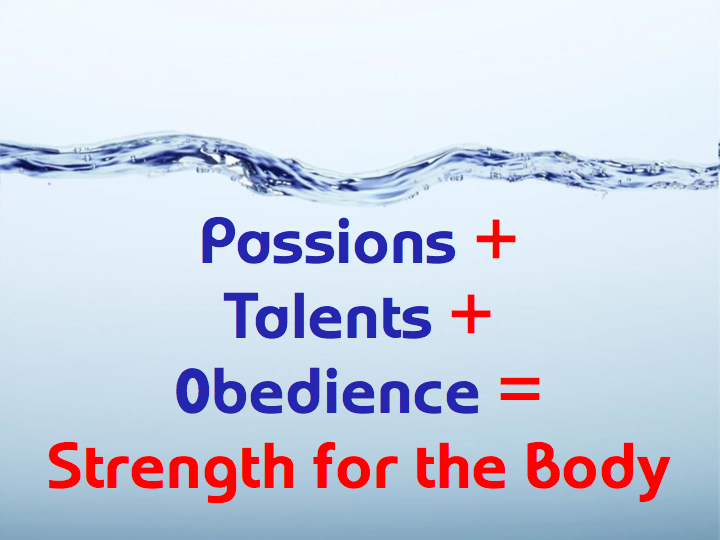
The Holy Spirit gives you sophroneo thinking to reveal your God-implanted gifts and talents to benefit others—to benefit the whole Body of Christ. He helps us turn our talents into strengths by using a formula like this:

Passions + Talents + Your Obedience = Strength for the Body

Pay attention to your passionate responses to situations, as they will reveal to you some of your gifts.

Listen to areas where others say you are talented. This will help you know how God has wired you.

Then you must be obedient to the prompting of the Holy Spirit in how to use your talents. If you let them sit on the shelf, they will never become strengths. Strengths develop when you passionately and obediently use your God-given talents for God’s glory.

The Holy Spirit wants to help you in all of these areas. Will you let Him?

If you’ve missed any of the messages in the Immersed series, you can find them all here.

What Would Jesus Read? (book review)

Many people are familiar with the phrase that goes with the acrostic WWJD: What Would Jesus Do. But I was very intrigued to see WWJR, which turns out to be an interesting book What Would Jesus Read? by Joe Amaral.

The premise behind the book is a historical setting. As the Jews were dispersed into captivity after Jerusalem fell, there was no longer a Temple to serve as the gathering place for religious worship, nor was there a central location for the storing and preservation of the scrolls which made up what we now refer to as the Old Testament of the Bible. The Jews themselves were now going to be the keepers of Scripture, and their homes would be the places of worship. So the Jewish rabbis divided up the biblical texts into daily reading portions, and distributed these among the scattering Jewish families. So each day of each week, a different portion of Scripture was read, and meditated on, and memorized so that it could be passed on to future generations.

So by following the reading plan in What Would Jesus Read you will be participating in a 2500-year-old tradition. It’s pretty cool to think of Bible reading that way!

Each day includes a portion of Old Testament scripture to read, and a brief devotional thought from Joe Amaral. It’s a great way to join your heart and thoughts to a tradition that started so long ago, and still continues today.

I am a FaithWords book reviewer.

Scriptural Surprises

Charles Spurgeon wrote:

“Scripture grows upon the student. It is full of surprises. Under the teaching of the Holy Spirit, to the searching eye it glows with splendor of revelation.”

I love this!

I cannot count how many times I read my Bible and do a double-take. I look again and think to myself, “I don’t think that was there the last time I read that passage!” That’s probably because I wasn’t ready for it earlier.

In the comments below, share something surprising you’ve read in the Bible recently.

God’s Truth, Not Your Comfort

Some time ago I was asked to speak in a church setting outside of my church. The audience was a blend of people from all different church backgrounds, and perhaps even some without any church background. I talked about the hopelessness of trying to pay-off our sin debt on our own, and the amazing love that Jesus showed when He paid our debt in full.

After the service, a couple of pastors in the audience wanted to speak with me about my message. They were moved by what they called “the impact” of the message, and especially about the way I called sin “sin.” As I spoke with them further, I discovered that they were somewhat hesitant to speak so openly and plainly about sin, because it unsettled some people in their congregations.

But here is the sober reality—

The Word of God IS unsettling because we cannot read it or hear it and remain unchanged.

Our job as pastors or preachers is to speak the Word. When we do, the Holy Spirit will bring the necessary conviction and pull hearts toward repentance. Here’s what Oswald Chambers wrote about this:

“When we preach, we are not simply proclaiming how people can be saved from Hell and be made moral and pure; we are conveying good news about God.

“In the teachings of Jesus Christ the element of judgment is always brought out—it is the sign of the love of God. Never sympathize with someone who finds it difficult to get to God; God is not to blame. It is not for us to figure out the reason for the difficulty, but only to present the truth of God so that the Spirit of God will reveal what is wrong. The greatest test of the quality of our preaching is whether or not it brings everyone to judgment. When the truth is preached, the Spirit of God brings each person face to face with God Himself.”

Pastor, just speak the truth. You’re not trying to win a popularity contest, but to share with people how to step into a deeper relationship with God Almighty!

One final thought from Chambers: “Never water down the truth of God. Let it have its way and never apologize for it.

Thursdays With Oswald—Practice, Practice, Practice

This is a weekly series with things I’m reading and pondering from Oswald Chambers. You can read the original seed thought here, or type “Thursdays With Oswald” in the search box to read more entries.

Practice, Practice, Practice 

     If we do not go on practicing day by day and week by week, working out what God has worked in, when a crisis comes God’s grace is there right enough, but our nature is not. Our nature has not been brought into line by practice and consequently does not stand by us, and down we go and then we blame God. We must bring our bodily life into line by practicing day by day, hour by hour, moment by moment, then when the crisis comes we shall find not only God’s grace but our own nature will stand by us, and the crisis will pass without any disaster at all, but exactly the opposite will happen, the soul will be built up into a stronger attitude towards God. 

From Biblical Psychology

Allen Iverson (in)famously said, “We’re talking practice. Not a game, not a game, not a game. We’re talking practice.”

Guess what? As Christians, we cannot skip practice.

If we want to be victorious in the big things, we have to practice doing the little, moment-by-moment things right. We cannot just flip a switch and win a victory.

Do you want to be successful? You’ve got to practice!

Do you not know that in a race all the runners run, but only one gets the prize? Run in such a way as to get the prize. Everyone who competes in the games goes into strict training. They do it to get a crown that will not last; but we do it to get a crown that will last forever. Therefore I do not run like a man running aimlessly; I do not fight like a man beating the air. No, I beat my body and make it my slave so that after I have preached to others, I myself will not be disqualified for the prize. (1 Corinthians 9:24-27)

The Land Of Gospel Gall

Guest Blogger Dick Brogden

This Saturday Jenn and I took the boys to the dollar theatre to see the claymation film Pirates: Band of Misfits. A half-hour in I was in so much pain (could have been the British humor). I left the theatre and walked around the parking lot, vomiting a few times. I tried to tough it out but the pain got worse so I went back in and asked Jenn to take me to the hospital. Dignity seems to be an optional thing. I was writhing in the car and karate kicking the air until the medics could get some pain medicine into me. My gall bladder had declared war. I was admitted to the hospital, and Sunday morning the surgeons went in and Mr. Gall is gone.

Being wheeled on the stretcher to my room, exposed and vulnerable, I noticed my attendant was from the Middle East. His name was Mohammed and he is from Cairo. I told him I loved his country, loved Muslims, loved Jesus, and wanted him to go to Heaven. We had a nice little conversation about the Gospel and Jesus the only sin bearer. I dug him no well, I gave him no water, I taught him no English—he in fact was serving me kindly and gently, but I was able to tell him about Jesus. Who knows, maybe for the first time.

A YWAM friend of mine in Egypt some years ago, decided to take the Gospel literally by not taking anything. He made an exception for a toothbrush which he stuck in his pocket and then he began to walk through the desert, from village to village. Some villages were distant and he would stumble into them hot, thirsty, dirty, and fatigued. The Muslims would take him in, feed him, host him, give him a white robe, wash his clothes, and care for him. He had nothing to give them, nothing to offer back—except everything. He sat with them in their living rooms and shared with them the Gospel—what God has done in Christ.

I am not the gospel. You are not the gospel. The gospel is what God has done, is doing, and will do in Christ. We (in the West) increasingly believe in the Gospel plus. Embarrassed of the exclusive claims of Christ, some of our action (not all) is because we want to self-adorn the gospel. Truth is, God is true and the gospel stands whether or not I am false or laid out on a stretcher. The gall of the Gospel is that it is not about me, it’s not about what I do—the Gospel is all about what God has done in Christ.

Do not read this as a call to license, to falsehood, or to removal from the world. We attack evil wherever we find it, we minister in word, sign, and deed to body, soul, and spirit—but let’s remember that we and what we do is not the gospel. Let’s proclaim the good news about what God has done in Christ. Let’s do it from weakness—Gospel Gall—it really is not about us or what we can give. God gave His only Son. What can we possibly add to that?

Filled To Be Emptied

This is a post especially for my pastor friends. 

Dear Friend,

I know you have a lot on your mind. You’re probably reviewing how Sunday went and thinking about what you’re going to share next Sunday. You’ve probably got a pretty full agenda this week: staff meetings, board meetings, maybe a counseling appointment or two, and a hospital visit. There’s lots happening (there always is, right?).

Can I break into your week to ask you a simple question: What did you read in your Bible this morning for you? You know, your personal devotional time—what was God’s Word saying just to you?

Dietrich Bonhoeffer wrote this:

“We are reading the Word of God as God’s Word for us. Therefore, we do not ask what this text has to say to other people. For those of us who are preachers that means we will not ask how we would preach or teach on this text, but what it has to say to us personally.”

Here’s a simple principle: You cannot give to others what you have not received yourself. So you need to be filled up so that you can be emptied out.

Although your week may be busy, please, please, please take the time to read God’s Word for yourself. It will help you and your congregation as well.

May God fill you and then empty you, my friend, for His glory!

Cheering you on, I am your friend,

Craig