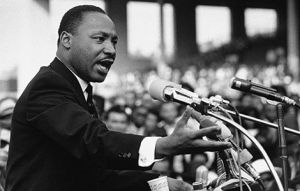
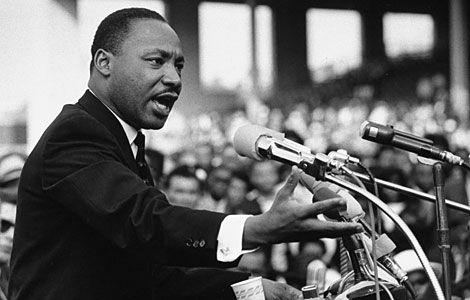
 In preparing for a recent book review, I re-read Dr. Martin Luther King’s amazing Letter From A Birmingham Jail. Dr. King was addressing some pastors who had advised him to slow down in his push to abolish segregation.
I believe there are some amazing parallels to what Dr. King wrote about abolishing segregation, and what many are writing and speaking about today in abolishing abortion.
Below are a few quotes from Dr. King’s Letter that I think are appropriate in the context of calling the church to not slow down in her push to abolish abortion. Just as Dr. King spoke up for the people whose voices were not being heard, we need to speak up for those children in the womb whose voices are not being heard.
I have taken the liberty to make a couple of changes in Dr. King’s original letter, to clarify how I believe he would have addressed the abortion issue. My changes are in brackets.
“You express a great deal of anxiety over our willingness to break laws. This is certainly a legitimate concern. Since [many] so diligently urge people to obey the Supreme Court’s decision of [1973 ‘legalizing’ abortion], at first glance it may seem rather paradoxical for us consciously to break laws. One may well ask: ‘How can you advocate breaking some laws and obeying others?’ The answer lies in the fact that there are two types of laws: just and unjust. I would be the first to advocate obeying just laws. One has not only a legal but a moral responsibility to obey just laws. Conversely, one has a moral responsibility to disobey unjust laws. I would agree with St. Augustine that ‘an unjust law is no law at all.’
“Now, what is the difference between the two? How does one determine whether a law is just or unjust? A just law is a man-made code that squares with the moral law or the law of God. An unjust law is a code that is out of harmony with the moral law. To put it in the terms of St. Thomas Aquinas: An unjust law is a human law that is not rooted in eternal law and natural law. Any law that uplifts human personality is just. Any law that degrades the human personality is unjust. All [abortion] statutes are unjust because [abortion kills an unborn] soul and [destroys a] personality. It gives the [abortionist and those who advocate for abortion] a false sense of superiority and the [aborted human baby] a false sense of inferiority. …
“An unjust law is a code that a numerical or power majority group compels a minority group to obey but does not make binding on itself. This is a difference made legal. By the same token, a just law is a code that a majority compels a minority to follow and that it is willing to follow itself. This is sameness made it legal. Let me give another explanation. A law is unjust if it is inflicted on a minority that, as a result of being denied the right to [live], had no part in enacting or devising the law. …
“One who breaks an unjust law must do so openly, lovingly, and with a willingness to accept the penalty. I submit that an individual who breaks a law that conscience tells him is unjust, and who willingly accepts the penalty of imprisonment in order to arouse the conscience of the community over its injustice, is in reality expressing the highest respect for law.”
“We will have to repent in this generation not merely for the [murder of innocent human beings] but for the appalling silence of the good people. Human progress never rolls in on wheels of inevitability; it comes through the tireless efforts of men willing to be co-workers with God, and without this hard work, time itself becomes an ally of the forces of social stagnation. We must use time creatively, in the knowledge that the time is always ripe to do right.”
“So the question is not whether we will be extremists, but what kind of extremists we will be. Will we be extremist for hate or for love? Will we be extremist for the preservation of [abortion laws] or for the [saving] of [life]?”
“I have heard many ministers say: ‘Those are social issues, with which the gospel has no real concern.’ And I have watched many churches commit themselves to a completely other-worldly religion which makes a strange, un-Biblical distinction between body and soul, between the sacred and secular.”
“Yes, I see the church as the body of Christ. But, oh! how we have blemished and scarred that body through social neglect and through fear of being nonconformists.”
“There was a time when the church was very powerful—in that time when the early Christians rejoiced at being deemed worthy to suffer for what they believed. In those days the church was not merely a thermometer that recorded the ideas and principles of popular opinion; it was a thermostat that transformed the mores of society. Whenever the early Christians entered a town, the people in power became disturbed and immediately sought to convict the Christians for being ‘disturbers of the peace’ and ‘outside agitators.’ But the Christians pressed on, in the conviction that they were ‘a colony of heaven,’ called to obey God rather than man. Small in number, they were big in commitment. They were too God intoxicated to be ‘astronomically intimidated.’ By their effort and example they brought an end to such ancient evils as infanticide and gladiatorial contests.
“Things are different now. So often the contemporary church is a weak, ineffectual voice with an uncertain sound. So often it is an arch-defender of the status quo. Far from being disturbed by the presence of the church, the power structure of the average community is consoled by the church’s silent—and often even the vocal—sanction of things as they are.
“But the judgment of God is upon the church as never before. If today’s church does not recapture the sacrificial spirit of the early church, it will lose its authenticity, forfeit the loyalty of millions, and be dismissed as an irrelevant social club with no meaning for the [twenty-first] century.”
“Over the past few years I have consistently preached that nonviolence demands that the means we use must be as pure as the ends we seek. I have tried to make clear that it is wrong to use immoral means to attain moral ends. But now I must affirm that it is just as wrong, or perhaps even more so, to use moral means to preserve immoral ends.”



 All men live in one of two tents: Content or Discontent




 Craig T. Owens