Choice Four-Letter Words

Listen to the podcast of this post by clicking on the player below, and you can also subscribe on AppleSpotify, or Audible.

Have you ever been “cursed out” by someone? I mean had a stream of four-letter obscenities hurled at you? What happens inside you? Isn’t your natural reaction to strike back? To begin to a counter-attack with a few choice four-letter words of your own?

It’s natural to feel this way; it’s a very human response.

On the other hand, have you ever been “blessed out” by someone? Had someone shower you with niceties and accolades and compliments? What happens inside you this time? Isn’t your natural reaction the complete opposite? Don’t you want to say, “Well, I think you’re pretty special, too”?

It’s natural to feel this way; it’s a very human response.

But Jesus commanded us to do something counter-cultural, something which requires a spiritual response: “Bless those who curse you” (Luke 6:28). Paul amplified this thought: “Bless those who persecute you; bless and do not curse” (Romans 12:14).

These words curse and bless are challenging for me. Curse means to hope for someone’s downfall; bless means to say good words to or about someone. Cursing can be done internally or verbally; blessing has to be done verbally. Eugene Peterson captures the essence of this in his paraphrase of Romans 12:14: “Bless your enemies; no cursing under your breath.”

If my natural response is to match curse for curse, obscenity for obscenity, then to respond in a Christ-like fashion is going to take a change of character. To respond with the right four-letter words, I have to do the opposite of my natural response.

In the Old Testament, the Hebrew word for bless carried the understanding that it all hinged on God—He is the focal point. All of the definitions of this word involve a close relationship with God: (a) bless God; (b) bless men in the name of God; (c) ask for divine favor for persons or things created by God; or (d) salute someone because we know God has saluted us.

In the New Testament, the Greek word for bless makes it clear that this has to be done verbally, out loud. It is impossible to bless under your breath. In the Greek, bless is the compound word eulogeo = eu- (good) + –logos (words): saying good words out loud.

Only God is good, so only a closer relationship with our good God will help us say good words to others. Especially to those who curse us.

The right four-letter words to use—the un-natural words to use—are: Good words.

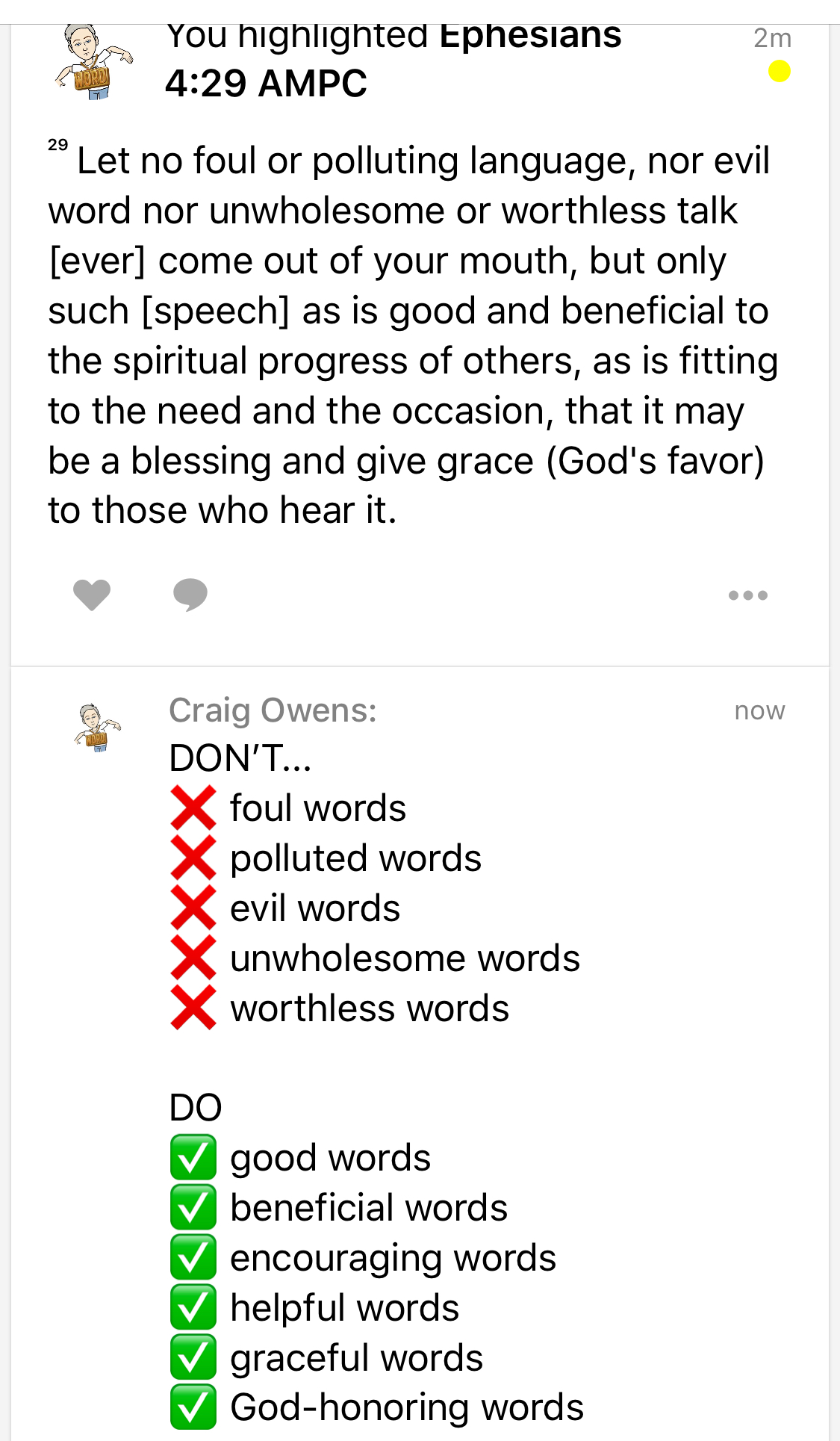
I’m challenging myself today to bless others, especially those who curse me. I only want to say good to and about others today. I’m attempting to live out Ephesians 4:29—

  • Do not let any unwholesome talk come out of your mouths, but only what is helpful for building others up (New International Version)
  • Let no foul or polluting language, nor evil word nor unwholesome or worthless talk ever come out of your mouth, but only such speech as is good and beneficial to the spiritual progress of others (Amplified Bible)
  • Watch the way you talk. Let nothing foul or dirty come out of your mouth. Say only what helps, each word a gift (The Message)
  • When you talk, do not say harmful things, but say what people need—words that will help others become stronger (New Century Version).

So let me ask you: How will you say the right four-letter words to others today?

►► Would you please prayerfully consider supporting this ministry? My Patreon supporters get behind-the-scenes access to exclusive materials. ◀︎◀︎

Moderate Back Thrusts

How would you like to have this written on your tombstone—

Appointed by God to be king
Caused all Israel to sin against God
Doomed my family line to extinction

That is exactly the epitaph of King Jeroboam (see 1 Kings 13-14). In God’s indictment of Jeroboam He says, “Because of the sins you have committed, and the sins you have caused Israel to commit, you have provoked Me to anger and thrust Me behind your back.”

I find that phrase—thrust Me behind your back—intriguing. The word thrust means to throw something away. How exactly does one go about throwing God away? Can you crumple Him up like a piece of paper and toss Him in a garbage can? Can you grab Him and shove Him behind you? Is He like a stack of old newspapers thrown in a recycling bin? Clearly not!

One only thrusts God behind one’s back little by little. Just moderate back thrusts.

John Maxwell was exactly right when he said that whatever good things a leader does in excess, those following will do in moderation. Whatever poor things the leader does in moderation, those following will do in excess. The “moderate” ways in which Jeroboam thrust God behind his back caused all of Israel to sin excessively. And that became Jeroboam’s eternal legacy!

People are watching me—my kids, my neighbors, my friends, the baristas at Starbucks—what example am I setting for them? There are only two examples I can set: (1) Pursue God with all my heart, all my soul, all my mind, and all my strength; in other words, love God to excess. Or (2) Moderately thrust God behind my back little by little by little.

Search me, O God, see if there is ANY moderate back thrusting in me and lead me in the way everlasting (see Psalm 139:23-24).

Justifying Myself

One of my favorite prayers is recorded in Psalm 139. It is such an intimate prayer of how well God knows us. I‘m frequently struck by the two thoughts that seem to contradict themselves in the opening and closing verses.

David begins his prayer, “O Lord, You have searched me and You know me. … You perceive my thoughts from afar.” But then he ends his prayer with these words, “Search me, O God, and know my heart; test me and know my anxious thoughts. See if there is any offensive way in me, and lead me in the way everlasting.”

Now why would David ask God to search his heart and his thoughts after he said God had already searched him? I think it‘s because our natural tendency is to justify ourselves. It goes like this: God searches us → He shows us things that need to be changed → We justify why we don‘t need to change those things → We try to forget what God had pointed out to us and move on.

When the Holy Spirit points out an anxious thought or an offensive way, our natural response is to quickly say, “Yes, but…

  • …I know I shouldn‘t have said that to her, but you don‘t know how she pushes my buttons!”
  • …I know it‘s wrong of me to desire that, but having it won‘t really hurt anything.”
  • …I know I should make that change in my behavior, but it‘s just not realistic in my current situation.”
  • …I know I should have talked to him about Christ, but it wasn‘t the right time.”
  • …I know my I‘ve been battling anxiety over this, but I‘m scared to make any changes because things might get worse!”

I echo Augustine‘s prayer: “O Lord, deliver me from this lust of always vindicating myself.”

David sets an example for me that I‘m trying to make a consistent practice in my life: Regularly allowing the Holy Spirit to search me for any anxious thoughts or offensive ways, and then addressing those without trying to justify or vindicate myself (no “yes-but‘s”). Because if I justify myself, I‘m really saying I know better than God what’s best for my life.

And all the while, God is simply trying to lead me in the way everlasting. He‘s trying to occupy more of my life with His presence.

If thou couldst empty all thyself of self.
Like to a shell dishabited,
Then might He find thee on the Ocean shelf,
And say, “This is not dead,”
And fill thee with Himself instead.
But thou art all replete with very thou,
And hast such shrewd activity,
That, when He comes, He says, “This is enow
Unto itself—‘Twere better let it be:
It is so small and full, there is no room for Me.“ —T.E. Brown

Are you making room for Him today? Or are you justifying the anxious thoughts and offensive ways the Holy Spirit is trying to reveal to you? 

Christ In The Passover

seder-meal

Last night Douglas Carmel (from Rock Of Israel ministries) led our congregation through a ceremonial Seder meal. It was absolutely fascinating!

First of all, to share in a meal that our Jewish brothers have been faithfully observing for thousands of years was very cool. I felt such a connection with my spiritual heritage.

Then to see how Jesus Christ can be seen as the once-for-all Passover Lamb was so eye-opening. As Douglas taught, images from Scripture came flooding back to my memory, but all in a new light: Like when John says, “Look! The Lamb of God which takes away the sins of the world.”

Finally, to see how Jesus instituted a new covenant for us by His broken body and spilt blood was humbling. He became everything the Seder meal had been pointing to for thousands of years. As we remember this in our Communion services, I will be thinking differently about the cup and the bread.

I’m looking forward to celebrating Christ’s passion, His death, and resurrection in just a couple of weeks, even more so now that I’ll be seeing these events and these Scriptures through different eyes. Thank you, Douglas, for making the Scriptures come alive for us!

Puppy Love

Three weeks ago I had come to the end of a particularly rough week, so when I got home I told my family I was declaring the next day to be “National Be Kind To Craig Owens Day.” I figured that was one way to get some love!

That day was so wonderful I decided to extend NBKTCO Day through the weekend, and I talked Betsy into letting us buy a puppy. And so Grace became a part of our family.

Since I didn’t want to leave her home alone, I started bringing Grace with me to my office. While I’ve been trying to potty train her, she has been training me in a few areas too. Here are some of the lessons I’m rediscovering—

  • Always greet people warmly. Even if they only left the room a couple of minutes ago. It always makes people smile when they are greeted so warmly.
  • Treat everyone like a friend. It doesn’t matter if they are the one who feeds you or a perfect stranger, everyone deserves to be treated like they are the nicest person alive.
  • Genuine puppy “kisses” makes anyone’s day!

The Apostle Paul had a friend like Grace—someone always so welcoming and encouraging to others. Paul wrote to Philemon, “Friend, you have no idea how good your love makes me feel, doubly so when I see your hospitality to fellow believers.” (Philemon 1:7, The Message).

Thanks, Grace, for the lessons. I’m learning how to show some puppy love to everyone.

Do I Know Too Much?

Thomas Huxley wrote, “I object to Christians: they know too much about God.”

When Job was going through his trials, his “friends” showed up with all kind of knowledge about God. They knew that God would never allow the innocent to go through difficulty. They knew Job had sinned somewhere along the way. They knew that God always answers a righteous man‘s prayers exactly as he had prayed it.

They knew too much about God.

They put God in their box, telling Him how to behave the way they knew He should.

They became their own god.

Job didn’t know all that God was doing, but he did know, “He does great things too marvelous to understand” (Job 9:10). The Apostle Paul echoed the same thought: “Oh, how great are God‘s riches and wisdom and knowledge! How impossible it is for us to understand His decisions and His ways!” (Romans 11:33).

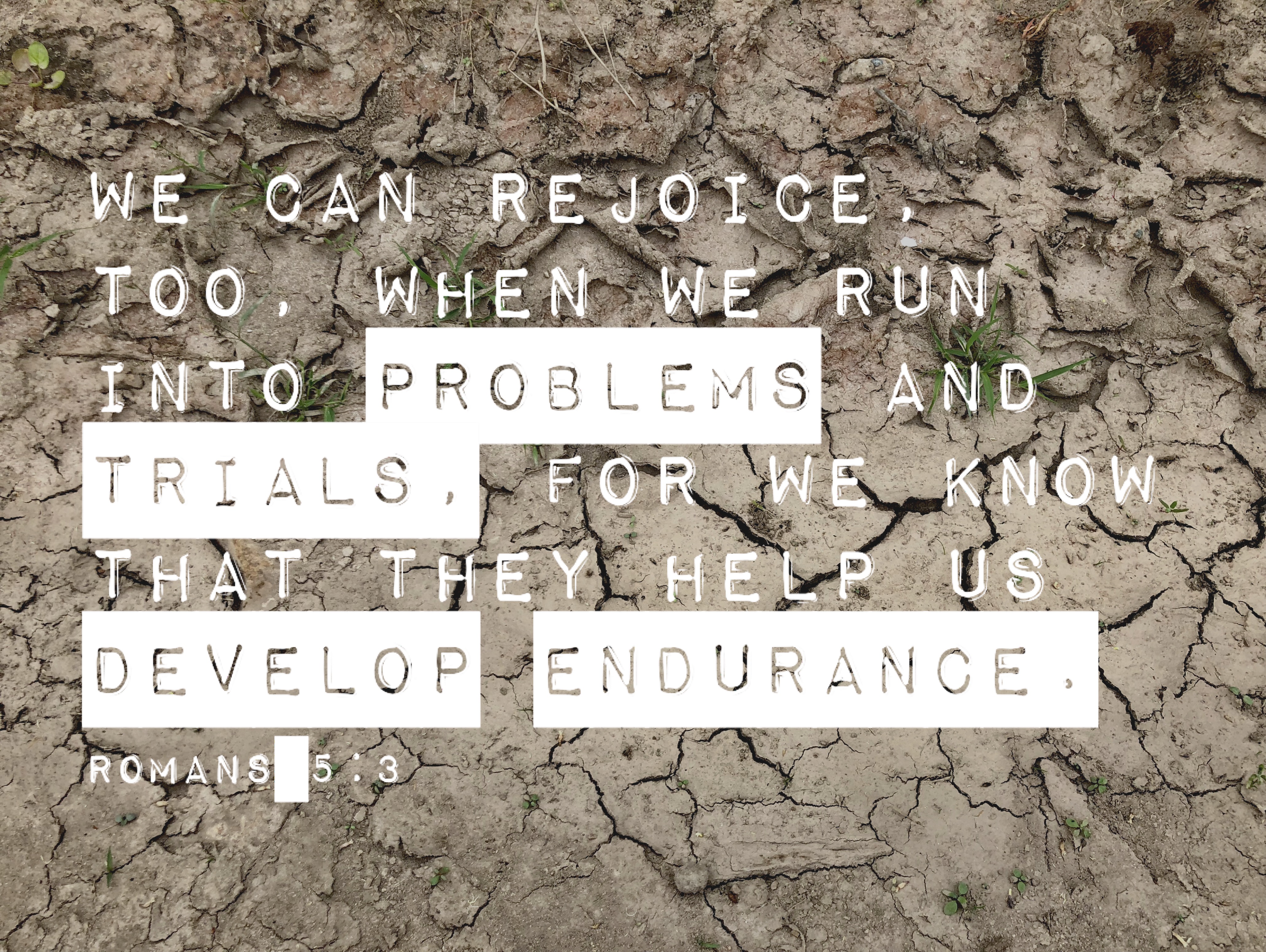
As I go through my own trials, I‘m learning a little more about the depths of God‘s love for me everyday—“We can rejoice, too, when we run into problems and trials, for we know that they help us develop endurance. And endurance develops strength of character, and character strengthens our confident hope of salvation. And this hope will not lead to disappointment. For we know how dearly God loves us, because He has given us the Holy Spirit to fill our hearts with His love” (Romans 5:3-5).

How about you: Do you know too much about God? Or are you still open to learn more?

Getting Away With Evil?

I’ve had some particularly mean and untrue words fired at me recently.

It hurts.

Especially because so many of these barbs have no redemptive quality to them—there is no attempt at even trying to bring about restoration. The statements are intended merely to harm me, not to help me.

During these times I’m especially drawn to the psalms; even more specifically to the psalms written by David.

Psalm 10 captures the emotion I sometimes struggle with when these unwarranted attacks come in. David asks, “Why do these people get away with evil? God, don’t You see what they’re doing? Don’t You hear what they’re saying? How can You let them spew such venom and not bring them to account for it?”

My feelings exactly!

Psalm 10 ends with, “God hears, He is aware, He will defend.”

But I find myself wanting more than that!

Then I noticed the footnote in my NIV Bible. It says that Psalm 9 and 10 form one psalm in the Septuagint (Greek) Bible; that they were originally written as a single poem.

Ah hah!

In Psalm 9, David tells us why he can praise God and rejoice in Him and sing praises to Him:
• God turns back David’s enemies
• God upholds David’s cause
• God judges righteously
• God completely uproots the wicked
• God is a refuge for the oppressed
• God never forsakes those who seek Him
• God avenges
• God does not ignore the cries of the afflicted
• God is known by His justice
• God makes sure the hope of the afflicted never perishes
• God lets men know He is God and they are just men

The wicked may seem to gain the upper hand, but it’s only for a moment. God’s righteousness will always prevail. What a comfort to know God is my Defender!

Why do I need to go through these tough times? Because when (not if!) God delivers me, I can praise Him with even greater zeal! He is exalted even more highly when people see His justice and righteousness.

My friend, if you are going through a battle right now, run to God. Don’t attack your enemies. Let God be God and let Him deal with men in His righteous justice. Praise Him for He will prevail mightily!

Land Of Angels

My cousin ministers in Sudan—a country and a people ravaged by war and persecution. But there is hope for hopeless people! For when we pray, hope is boundless! This poem was recently written by my cousin:

Three angels stood before the throne
Two together, one alone
Each in turn petitions brought
Each a favor meekly sought

The first was young, was fair, was bright
With little hands, with gentle light
This angel pled for child and wife
Who bore the brunt of Darfur strife

The second angel, scarred but brave
Represented knight and knave
Who in Darfur did Gospel tell
Who gave out food, who dug up well

The third before the throne stood grim
Yet, O what love there was for him
He cried for rapist, victor, thug
He asked for them Mercy above

All angels knelt, all angels paused
All three had answers kindly caused
All three sped back with burning story
All of Darfur shall fill with glory

Please pray with me for God’s glory and God’s grace to flood Darfur and the devastated people there.

The Passion Of Pessimism

I’m reading Oswald Chambers’ challenging book Baffled To Fight Better. In this book, Chambers is commenting on the life of Job as portrayed in the Bible. His thesis is that we can fight better when we‘re totally baffled on how to fight on our own—when we‘re baffled, we can only turn to God.

Today I read Chambers‘ statement, “Real suffering comes when a man‘s statement of his belief in God is divorced from his personal relationship to God.”

This reminded me of what this important principle: “The man with an experience is never at the mercy of the man with an argument.” Or I would paraphrase this, “The man with an intimate relationship with Jesus is never baffled when things don‘t turn out as he planned.”

I‘ve been going through some baffling times—circumstances aren‘t coming together the way I would have planned them. But during this trying time, my relationship with Jesus is growing more and more precious to me.

Where pessimism could reign I am finding greater passion.

What have you discovered in your baffling times?

UPDATE: One of the things that came out of this baffling time I mentioned here was the healed scars that became the basis for my book When Sheep BitePlease check this out!

The One Who Is To Come

the-one-who-is-to-come

We just started a new Bible study on Wednesday nights, and it’s revolutionizing my thinking about Jesus the Messiah.

In this series we’re looking at prophesies given in the Old Testament book of Isaiah, and then looking at the New Testament to see how Jesus Christ fulfilled those prophesies 700 years later when He came to earth. Then we’re also looking even further ahead at the prophesies that Jesus will fulfill when He comes back to earth again.

The more I study the life of Jesus, the more deeply I fall in love with Him!