Coasting

When I was in the 6th grade my school was at the end of a dead-end street, which was at the top of a not-too-steep hill. Coming home from school we would try to see how far we could coast on our bikes before we had to start pedaling. We’d pedal really hard across the parking lot, and then start coasting as we hit the top of the hill. I think my record was nearly four blocks!

Coasting is so much fun! It’s easy and exciting, and involves no work at all. Your legs are never tired at the end of a long coasting spree.

But you can only coast downhill. (Well, okay, I guess you might be able to coast for a short distance on level ground, but not nearly as far.)

Downhill might be fun on a bike, but it’s a lousy way to live. Solomon wrote:

The path of life leads upward for the wise to keep him from going down to the grave. (Proverbs 15:24)

Coasting is easy, but it’s taking you in the wrong direction.

Coasting doesn’t cause any muscle pain, but it doesn’t build any muscle strength either.

Coasting is fun for awhile, but the longer you coast, the harder the journey back.

Save coasting for your bike rides, but in your life be very cautious of coasting too long.

Instead…

  • Keep learning new things
  • Keep reading challenging things
  • Keep growing in new areas
  • Keep setting stretching goals
  • Keep forgiving
  • Keep strengthening relationships
  • Keep climbing higher and higher

It may be work to climb to the top, but the view is incredible!

Sharp Enough?

Long before Stephen Covey wrote about Habit 7: Sharpening The Saw, Solomon saw the value of taking time to sharpen the saw.

Using a dull ax requires great strength, so sharpen the blade. That’s the value of wisdom; it helps you succeed. (Ecclesiastes 10:10)

What are you doing TODAY to gain wisdom?

J. Wilbur Chapman asked F.B. Meyer, “What is the matter with me? So many times I fail, so many times I am powerless.”

Dr. Meyer responded, “Have you ever tried breathing out three times without breathing in once?”

What are you doing TODAY to breathe in?

Look at the mower in the summer’s day, with so much to cut down ere the sun sets. He pauses in his labor—is he a sluggard? He looks for his stone, and begins to draw it up and down his scythe, with rink-atink, rink-atink, rink-atink. Is that idle music—is he wasting precious moments? How much he might have mowed while he has been ringing out those notes on his scythe! But he is sharpening his tool. And he will do far more when once again he gives his strength to those long sweeps which lay the grass prostrate in rows before him. —Charles Spurgeon

What are you doing TODAY to sharpen yourself?

Wishing

Another gem from Ella Wheeler Wilcox—

Do you wish the world were better?
Let me tell you what to do.
Set a watch upon your actions,
Keep them always straight and true.
Rid your mind of selfish motives,
Let your thoughts be clean and high.
You can make a little Eden
Of the sphere you occupy.

Do you wish the world were wiser?
Well, suppose you make a start,
By accumulating wisdom
In the scrapbook of your heart;
Do not waste one page on folly;
Live to learn, and learn to live
If you want to give men knowledge
You must get, ere you give.

Do you wish the world were happy?
Then remember day by day
Just to scatter seeds of kindness
As you pass along the way,
For the pleasures of the many
May be ofttimes traced to one,
As the hand that plants an acorn
Shelters armies from the sun.

What Is Valid Criticism?

Okay, I’ll need some help on this one.

Solomon, the wisest king ever, said in Proverbs 25:12:

To one who listens, valid criticism is like a gold earring or other gold jewelry. (New Living Translation)

I don’t really like criticism of any kind, but it says it right there in the Bible that valid criticism is good for me. So what is “valid criticism”? Look at this same verse in two other versions:

Like an earring of gold or an ornament of fine gold is a wise man’s rebuke to a listening ear. (NIV)

A wise friend’s timely reprimand is like a gold ring slipped on your finger. (The Message)

I’ll start…

Valid criticism comes from someone with wisdom and experience in the area they are critiquing.

Valid criticism is intended to help me get better.

Valid criticism comes in measured, well-thought-out words.

Now it’s your turn. In the comments below, please share with us how you define “valid criticism.”

Also check out 20 Helpful Thoughts On Criticism for some insights from other wise people.

Books I Read In 2010

Who Are You Talking To?

I love team leadership. I really enjoy getting a group of creative thinkers around me to do some serious brainstorming. I find it so beneficial to seek out the counsel of some wise people who have been around for a while.

But, let’s see, who have I left off this list?

Oh, yeah, I remember now—I didn’t consult God!

Be honest: have you ever done that? Have you ever consulted with a lot of wise—even God-fearing—people, but forgotten to consult with God Himself? If you have (and I certainly have), we’re in good company.

When King David got ready to move the ark of the covenant to Jerusalem, the Bible says,

David conferred with each of his officers….

How’d that work out for him? Not so good.

  • Uzzah died
  • David got mad at God
  • David got scared of God
  • The ark’s arrival in Jerusalem was delayed another three months

Then David had his “Oh yeah!” moment. When he got ready to try again, David said,

We did not inquire of God about how to do it in the prescribed manner….

So here’s my simple reminder to myself (and to you too): It’s fine to consult with others, but consult with God first.

Pray Now

Listen to the podcast of this post by clicking on the player below, and you can also subscribe on AppleSpotify, or Audible.

The Gibeonites had a great strategy. They had heard about the advancing Israelite army, they knew how God had given them victory at every step of the way, and they knew that the Israelites weren’t going to make a peace treaty with anyone living even remotely close to them. So the Bible says the Gibeonites resorted to a ruse (v. 4).

They put on worn-out shoes and clothes and packed moldy bread. That way they would have all of the appearances of a delegation that traveled a long, long distance. And it worked. The Israelites examined their clothing and food and said, “Yep, it sure looks like you made a long journey to get here. We’re convinced.”

The Bible records an important footnote—

The men of Israel sampled their provisions but did not inquire of the Lord (v. 14).

How many times do I do this…

  • …I use my five senses, but not the wisdom of the Holy Spirit?
  • …I use my logical brain, but not the supernatural resources of God?
  • …I use my experiences, but not the insight of an All-Knowing God?

I have to make it a habit to pray about EVERY decision. It might only be a 5-second prayer, but I must inquire of the Lord.

►► Would you please prayerfully consider supporting this ministry? My Patreon supporters get behind-the-scenes access to exclusive materials. ◀︎◀︎

Classic Wisdom For The Professional Life (book review)


Bryan Curtis has compiled a collection of quotes that are targeted for the business professional. In Classic Wisdom for the Professional Life, you will find sage wisdom from a variety of different perspectives.

Winston Churchill once said, Every uneducated man should read a book of quotes.” I love reading the wisdom of people who have been-there-done-that, and this book is full of those kinds of people. I enjoy letting their hindsight educate me and become my foresight. Normally I speed-read my way through books, but I found myself going rather slowly through this book, trying to absorb the wisdom in each of the quotes.

My only frustration with this book is that the quotes are not grouped together in any apparent categories. I would have liked a section on planning, a section on overcoming failure, a section on people skills, etc. So I just took the quotes most meaningful to me and retyped them in my computer into the categories where I would have grouped them. Other than that, there is much wisdom to be found in these pages.

I am a book reviewer for Thomas Nelson.

Let Me Give You A Piece Of Advice

How many times have you heard someone say you, “Let me give you a piece of advice”? Ah, yes, everyone has some advice to share. Everyone has an opinion. Everyone wants to give you a piece of their mind. Everyone is an expert in an area where they think you’re deficient.

I remember going through comment cards at the end of a long week of youth camp. I’d read one card that would say the food was excellent. Just a couple of cards later some “expert” would share how terrible the food was. One would say they loved the evangelist, another would give their “advice” on where the evangelist missed it.

Whom should I listen to? Who should get my ear?

In William Shakespeare’s Hamlet, Polonius gives this counsel to Laertes “Give every man thine ear, but few thy voice: Take each man’s censure, but reserve thy judgment.”

Nice prose, but how do we live it out?

I like the example I see from a man named Jethro in the Bible. Jethro is Moses’ father-in-law, and he really only appears on the scene in just one chapter (Exodus 18), but his method of giving advice should be a model for us all.

Credentials—Jethro was a God-fearing man. If you are a follower of Jesus Christ, weigh carefully the advice given to you by those who don’t have the same biblical foundation.

Relationship—Jethro had a personal relationship with Moses, he wasn’t just a business acquaintance. That means Jethro had a vested interest in Moses’ success or failure.

Firsthand—Jethro heard about what was happening, but he came to see it for himself. Beware of those “experts” who only have secondhand information about you or your situation.

Up-Close—Jethro spent an entire day right by Moses’ side just watching and listening. He saw what was going on from the front row.

Questions—Jethro led with questions, not with advice. Before giving Moses his opinion, Jethro asked clarifying questions.

Wisdom—Only after all of this did Jethro give his opinion to Moses. The words that he shared were then received by Moses as God-given wisdom.

Your counselors should earn the right to be heard. Just because someone has an opinion doesn’t make him an expert. And just because someone has been-there-done-that doesn’t mean that her way should be your way.

Screen out the clamoring voices by making sure they have credentials, a relationship with you, firsthand experience, and godly wisdom.

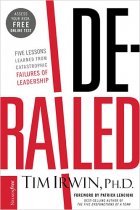
Derailed (book review)

Derailed

As I read Dr. Tim Irwin’s latest book, Derailed, I thought about a quote from John Maxwell: “A wise man learns from his mistakes. A wiser man learns from others’ mistakes. The wisest man learns from others’ successes.”

The subtitle of this book is “Five lessons learned from catastrophic failures of leadership.” In this, we learn from others’ mistakes. But then Dr. Irwin goes on to show us successes that we can learn from as well. Combining the insight from successful—or should I say “non-derailed” leaders—with his own discernment, Dr. Irwin shows us how to stay on the rails.

When I first noticed that the examples in the book were all high-profile CEOs, I thought, “What could I learn from them? After all, I’m not the CEO of a Fortune 500 company.” But Dr. Irwin does an excellent job of bringing the four qualities of character—authenticity, self-management, humility, and courage—down to a pedestrian level where even we non-CEO-types can benefit from his wisdom.

Although the principles in Derailed can benefit anyone in leadership, or aspiring to a leadership position, this book still might not be for everyone. The six case studies in the book are all derailed CEOs, and unless you have a penchant for the business world, you might not find them very enjoyable reading. However, for those of you who enjoy business history, there is much to gain from a careful reading of Derailed.

I am a Thomas Nelson book reviewer.