For though I caused you sorrow by my letter, I do not regret it; though I did regret it—for I see that that letter caused you sorrow, though only for a while—I now rejoice, not that you were made sorrowful, but that you were made sorrowful to the point of repentance; for you were made sorrowful according to the will of God, so that you might not suffer loss in anything through us. For the sorrow that is according to the will of God produces a repentance without regret, leading to salvation, but the sorrow of the world produces death. (2 Corinthians 7:8-10 NASB)
Is it okay for you to hurt your friend’s feelings?
I think it is acceptable if those painful words save your friend from a world of hurt.
We must not hold back from speaking a painful truth, but if we do have to share that word, we must ensure that we are speaking that truth in love (Ephesians 4:15). Remember that people don’t care what you know until they know that you care. The goal of truth-telling is not to hurt a friend’s feelings, but to spare that friend a greater pain or to see that friend get stronger.
If you have to speak these words, be sure to water your lovingly truthful words in tears before you share them. As Jesus said, “Remove the plank in your own eye first” (Matthew 7:5).
If you are on the receiving end of painful words, ask yourself, “Is this a friend who loves me and wants the best for me? If so, is there truth in these words?” Even if the words were delivered clumsily, see the love behind the words and find the truth that can help you make a change for the better (Proverbs 27:6, 17).
To dive a little deeper into this topic, check out my video on The Podcast called Speak the truth in love.
Listen to the podcast of this post by clicking on the player below, and you can also subscribe on Apple, Spotify, or Audible.
Wounds from a sincere friend are better than many kisses from an enemy (Proverbs 27:6 NLT).
Proverbs 27 may have more wisdom about our friends than any other chapter in this book. But sprinkled throughout the entire book of Proverbs is outstanding wisdom about our closest relationships. Allow me to share just a few observations with you.
Friends love me through my worst moments (17:17) because they have committed to stick closer than a brother to me (18:24).
I must be careful not to make friends with a hot-tempered person (22:24), and to be cautious of people who want to be friends with me only for what I can give them (19:4).
My true friends will wound me in love to help me become the best that God intended me to be (27:5-6, 9, 17), so I must never forsake these friends (27:10).
False friends will gossip to me and about me, but my true friends will guard my secrets and guard my reputation (16:28; 17:9).
In order to have true friends, I first have to be a true friend.
David was the gold standard for every king of Israel who followed him. Numerous times throughout the history of Israel, we will see a note that a certain king either followed God like David, or turned from God unlike David. Yet there exists a wart on David’s portrait: an adulterous affair with the wife of a man in his inner circle, and then subsequent lies and a murder to cover up the affair. “The thing David had done displeased the Lord” (see 2 Samuel 11).
But I’d like to turn your attention to when this affair occurred: “In the spring, at the time when kings go off to war…David remained in Jerusalem” (2 Samuel 11:1). He was without his usual comrades. The men who knew David best, who could probably sense if something was amiss, weren’t around to warn him. When David tried to find out the identity of the bathing beauty on the roof next door to his palace, an unnamed attendant tried to remind him, “Isn’t that Bathsheba, the wife of Uriah?” but David dismissed him.
Elijah was arguably the most forceful and fearless prophet in Israel’s history. Not only did he stand up to the evil kings of Israel, but he spoke out against the kings of surrounding nations, too. In answer to Elijah’s prayer, God brought a drought on the land, and again in answer to Elijah’s prayer, God sent rain. Elijah challenged the 450 prophets of the god Baal and the 400 prophets of the goddess Asherah to a duel to the death, which ended up in a decisive victory for Yahweh. Yet, shortly after this massive victory, Elijah was depressed to the point that he wanted to die.
What led to Elijah’s depression? Something very similar to David’s slide into adultery: He was alone. Elijah ran away from Queen Jezebel’s death threat, left his servant behind, and proceeded all by himself into the desert. It was when he was without a comrade that he prayed to God, “I’ve had enough. Take my life” (see 2 Kings 17–19).
And what about Peter? He boldly claimed his loyalty to Jesus, even to the point of wielding a sword at the guards who came to arrest his Master. But when Peter was alone, after the other disciples fled, he denied three times that he knew Jesus (Matthew 26:33, 51, 69–75).
God designed us to be in relationship with others. His statement to Adam in some of the earliest words of the Bible—“It is not good for you to be alone”—are words for us still today. —from the chapter “Going Farther”
We need true, God-fearing friends close to us. Ask God to bring those friends around you, and ask the Holy Spirit to make you into that kind of friend for those He does bring around you.
Dr. Les Parrott dives into the loving life of Jesus and takes us with him to discover the five was Jesus loved. Check out my full book review by clicking here, and then enjoy some of the quotes I especially liked.
“The great hindrance to true enjoyment is our willingness to settle for pitiful pleasures.”
“What keeps us from being mindful? I can answer this question with one word: agendas. … Every one of us has the capacity to set aside our self-interest, temporarily. We have the ability at any time to press the pause button on what we want. … That’s the moment we become mindful.”
“Loving like Jesus is not efficient. It takes time away from our own agenda-driven pace.”
“Jesus was shockingly accessible to anyone who felt undesirable or unwanted—lepers, Gentiles, tax collectors, the poor and persecuted, pagans and sinners. He wasn’t like other ‘holy men’ in Judea. His fellow rabbis operated on the principles of exclusion and isolation.”
“If you want to love like Jesus, you can’t limit your love to people who deserve it.”
“God is happy to give unconditional acceptance and unmerited grace to all who will receive it.”
“We can’t give grace to others when we are aren’t receiving it ourselves. When we’re busy earning acceptance from God, we start to think everyone else should earn it too. Judgmentalism creeps in. Self-righteousness appears. … When we aren’t cognizant of God’s unconditional acceptance in our own lives, we can’t give it to others.”
“If you want to love like Jesus, you can’t shy away from what you know is right and true. You can’t remain silent just to go unnoticed. Loving like Jesus is not for the chickenhearted. It requires a fierce commitment to being authentic. It requires a bold commitment to being a truth-teller. … No one accused Jesus of being a pushover—or winsome.”
“Self-giving is selfishness in reverse. It is not concerned with benefits, and it expects nothing in return. … It comes down to motive. You can be a giver and still expect something in return. … True self-giving is offering the best of who you are to others, and it comes with no strings attached.”
“The long and short of it is that we love like Jesus when we allow Jesus to love through us. It’s not about our effort. We are not trying to imitate Jesus. It’s an inside job. It’s about being a channel for His love.”
“Loving like Jesus isn’t achieved as much as it is received.”
“The word intuition comes from the Latin word intueri, which is roughly translated as meaning ‘to contemplate.’ You see, our intuition stems from what we are considering, what we are sensitive to or attuned to do. … So, if you want to hear from God, you’ve got to slow down enough to clear your head and be attuned to His Spirit. That’s when the sacred gift of God’s whisper is heard—when you become accustomed to His voice.”



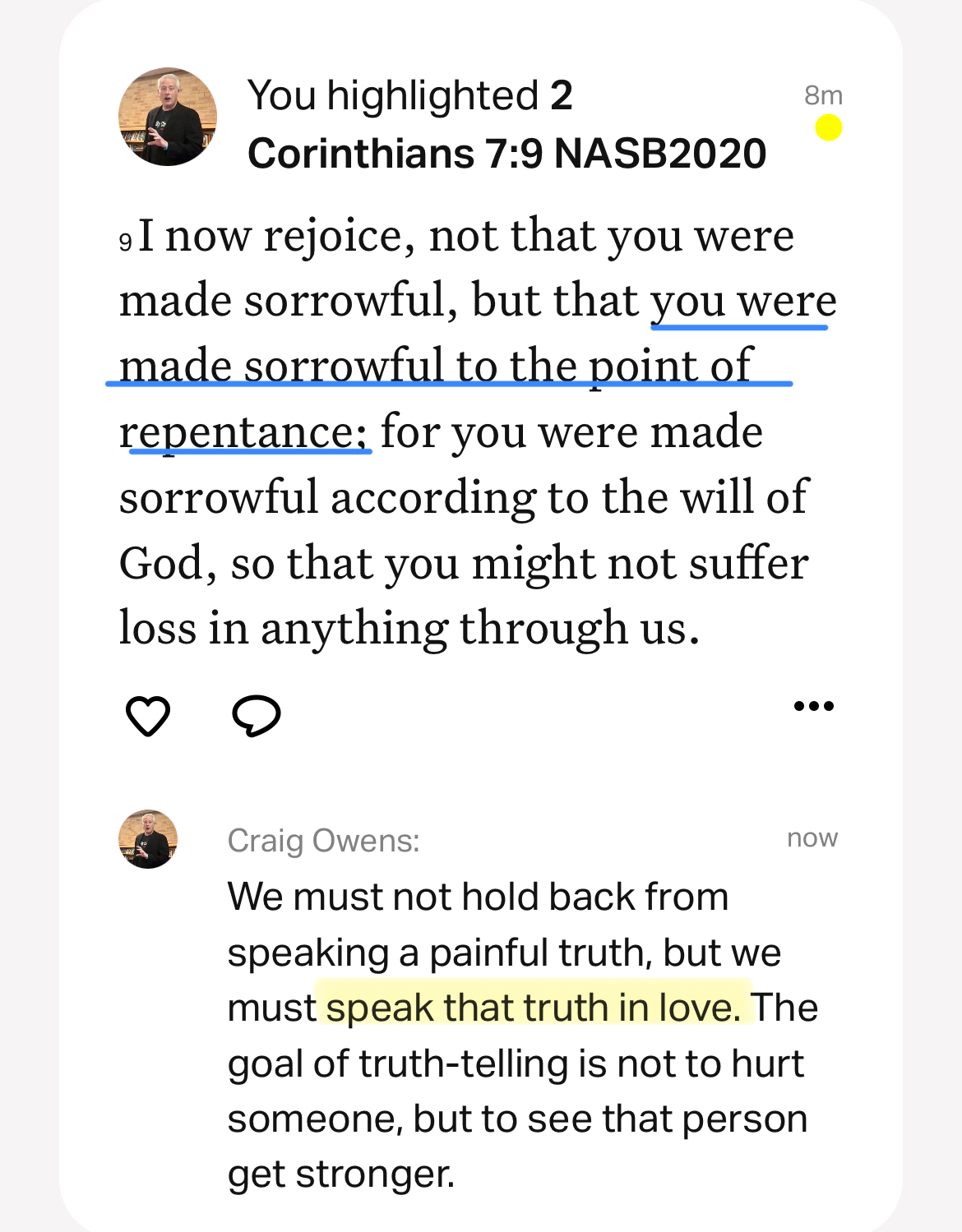 For though I caused you sorrow by my letter, I do not regret it; though I did regret it—for I see that that letter caused you sorrow, though only for a while—I now rejoice, not that you were made sorrowful, but that you were made sorrowful to the point of repentance; for you were made sorrowful according to the will of God, so that you might not suffer loss in anything through us. For the sorrow that is according to the will of God produces a repentance without regret, leading to salvation, but the sorrow of the world produces death. (2 Corinthians 7:8-10 NASB)





 Craig T. Owens