Triumphant King

Listen to the podcast of this post by clicking on the player below, and you can also subscribe on AppleSpotify, or Audible. 

Have you ever noticed how many of our Christmas carols celebrate the dark night giving way to the bright light? For instance, the hymn O Holy Night contains the line, “long lay the world in sin and error pining until He appeared.” 

English historian and theologian Thomas Fuller was the first to put into print what has now become a cliché that so many people use: “It is always darkest just before the Day dawneth.” Indeed, Micah paints a very dark scene just before the Messiah makes His First Advent (Micah 5:1). 

The Light of Jesus that burst onto planet Earth in a Bethlehem stable revealed Him as our Great Shepherd, our Prince of Peace, and our Mighty Deliverer. And there is also one more title that Micah foretells: our Triumphant King! 

What does our Triumphant King do? He confronts and defeats the darkest foes. Check out the words in Micah 5:9-15: destroy (5x), demolish (2x), tear down, uproot, take vengeance. 

Christ’s birth in Bethlehem is our proof that God’s plan prevails. God always gets the final word, the decisive word, and the best word! 

Most of the Old Testament prophets foresaw both the first and second advents of Jesus simultaneously. The mountains of prophecy look like they are on top of each other, so it’s very common for the prophets to see events of both advents happening simultaneously. So Micah sees both the coming of Jesus in Bethlehem and His coming at the end of time as King.

There is a spiritual battle that has been raging since before Time began (Ephesians 6:12). It started when Lucifer became satan by his rebellion against God, and then he began his agenda of the destruction of God’s people (Ezekiel 28:12-17; Revelation 12:7-9, 13, 17). 

Into this dark battle, Jesus enters the scene. The reason the Son of God was made manifest (visible) was to undo—destroy, loosen, and dissolve—the works the devil has done (1 John 3:8 AMP). 

I already talked about how the death of Jesus on the Cross meant the death of Death, and Jesus became our Mighty Deliverer! The resurrection of Jesus means satan’s time is nearing an end. It may be dark now, but the darkness has to give way to the Light of the King of kings (check out these verses in Revelation). 

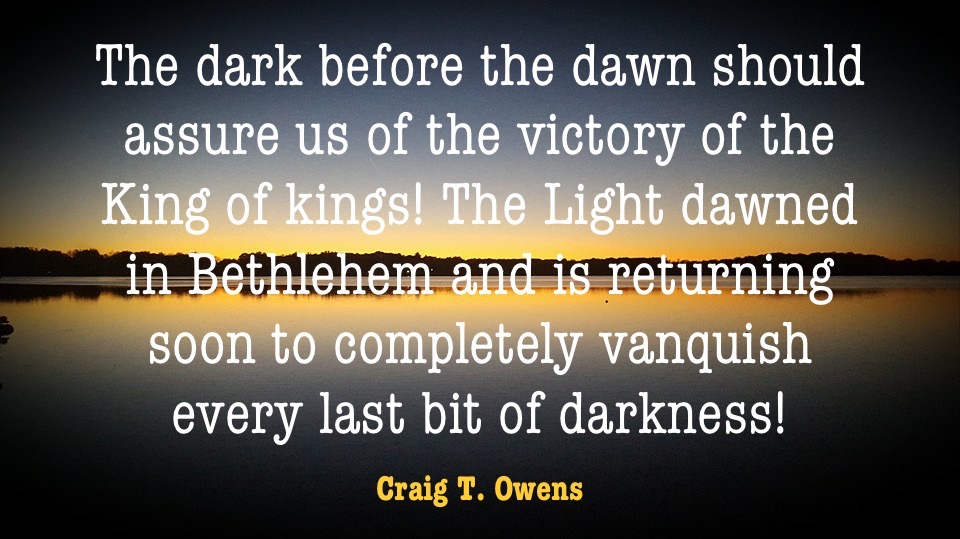
“It is always darkest just before the Day dawneth” should assure us of the victory of the King of kings! Jesus assured us that darkness is only afforded an hour, and then the Light will completely overwhelm it. The Light dawned in Bethlehem and is returning soon to completely vanquish every last bit of darkness!

If you missed any of the messages in our Advent series, you can find a list of all of those messages by clicking here. 

►► Would you please prayerfully consider supporting this ministry? My Patreon supporters get behind-the-scenes access to exclusive materials. ◀︎◀︎
Noble Revenge

Noble revengePerhaps one of the most counter culture things a Christian will ever do is to forgive. More specifically, to forgive God’s way in which the offending party is forgiven and the offense is no longer counter against him.

But this isn’t what today’s culture teaches us. Instead they say things like—

  • “I’ll forgive them only if they’re really, really, REALLY sorry for what they did….
  • …and I’ll forgive them only if they ask for forgiveness…
  • …and then only I’ll only forgive them a certain number of times…
  • …and most importantly, I may forgive, but I’ll never forget.

Why do we feel this way?

  • We buy into the old line: “Hurt me once, shame on you; hurt me twice, shame on me,” and we don’t want to feel shame.
  • We like to be in control. If we hold on to slights and injuries, then we have a trump card we can play later—“You owe me” or “This is why I don’t trust you.”
  • We mistakenly think that forgiveness makes us appear weak, like our offender won and we lost. And we certainly don’t want them to think they can take advantage of us again.
  • Because if they take advantage of us again it’s right back to, “Hurt me once…” so I’m going to make a preemptive strike and not forgive them.

Yes, forgiveness could make us appear vulnerable. Yes, we could be hurt again by the same offender. And, yes, we could be viewed as weak. But—The foolish thing that has its source in God is wiser than men, and the weak thing that springs from God is stronger than men (1 Corinthians 1:25, AMP). Total forgiveness is foolish looking in the natural, but it has God’s blessing on it.

With this in mind, the Apostle Paul wrote—

But Jesus said to me, “My grace is sufficient for you, for My power is made perfect in weakness.” Therefore I will boast all the more gladly about my weaknesses, so that Christ’s power may rest on me. That is why, for Christ’s sake, I delight in weaknesses, in insults, in hardships, in persecutions, in difficulties. For when I am weak, then I am strong. (2 Corinthians 12:9-10)

When we are totally reliant on Christ, that’s when His power rests on us. When we say, “I’m going to do this my way,” we block ourselves off from Christ’s grace and power and strength.

We need to remember HOW MUCH God has forgiven in us—He forgave ALL my sins and He no longer counts any of my treachery and rebellion against me. With this in mind, how dare I hold on to the comparatively small injuries others have inflicted on me (see Matthew 18:21-35).

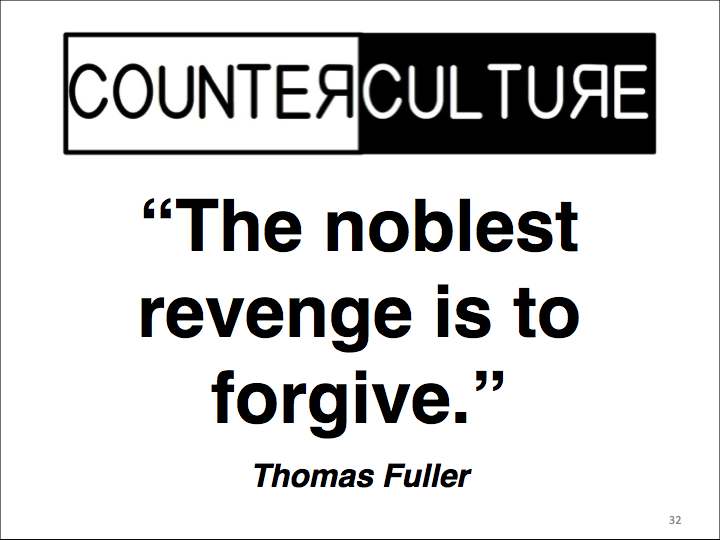
“The noblest revenge is to forgive.” —Thomas Fuller


Forgiveness gives me a nobility.
Forgiveness sets me free from the hurt.
Forgiveness makes me a child of God.
Forgiveness gives me God-sent strength.
Forgiveness is counter culture.
Because forgiveness glorifies God, and not my wound.

What are you waiting for? Get free today by giving and receiving forgiveness.

Weekend Quotes

“quotes”

Some challenging quotes from this weekend:

“A wise man will make haste to forgive, because he knows the true value of time, and will not suffer it to pass away in unnecessary pain.”  —Samuel Johnson

“The noblest revenge is to forgive.” —Thomas Fuller

“Being deeply loved by someone gives you strength, while loving someone deeply gives you courage.” —Lao-tzu

“Love keeps no records of wrongs. … It always protects, always trusts, always hopes, always perseveres.” —Apostle Paul (1 Corinthians 13:6-7)

And for my pastor friends: “There will always be new ways to do good works and speak good words which are not presently in our experience or repertoire. So in all our studies, let us study to acquire new insights and visions of how we can serve others through good works. And in all our teaching and preaching, let us not grow negligent in exhorting the people of God to do likewise.” —T.M. Moore