No Contention, No Compromise

Listen to the podcast of this post by clicking on the player below, and you can also subscribe on AppleSpotify, or Audible. 

As we continue our look at the Book of Jude, let me remind you that Jude calls Christians to contend for the faith with a servant’s attitude and with an all-in attitude that will not give in even when the going gets tough. 

What exactly are we contending for? Jude calls it the faith once for all entrusted to the saints” (Jude 3). 

(Check out all of the Scriptures in this post by clicking here.) 

It might be helpful to look at this phrase in the AMPC: “…to contend for the faith which was once for all handed down to the saints—the faith which is that sum of Christian belief which was delivered verbally to the holy people of God.” 

During the Reformation there was a phrase that became prominent: “Sola Scriptura” which means the Bible is our authoritative guide for everything in our lives. Jesus addressed the religious leaders who added to the Scripture (Mark 7:8-9, 13), and here Jude is now addressing those who took away from Scripture (Jude 4).   

We have to be so careful here. Contending doesn’t meet fighting for our traditions, nor does it mean compromising with the whims of culture. Jesus told us to preach the Gospel, not to argue nor give in to avoid problems. Jude says this Gospel message have been entrusted to us. 

Ronald Reagan was talking about the freedoms in the United States of America, but his warning sounds like it originated with Jude: “Freedom is never more than one generation away from extinction. We didn’t pass it to our children in the bloodstream. It must be fought for, protected, and handed on for them to do the same, or one day we will spend our sunset years telling our children and our children’s children what it was once like in the United States where men were free.” 

We don’t want to spend our sunset years telling our children and grandchildren how it used to be when we contended for the faith that was entrusted to us, but we want to tell them how we are still winsomely and consistently contending for this faith still to this day! 

So how do we contend for this faith the right way?  

(1) Study God’s Word and then study it some more. I like what Charles Spurgeon said of John Bunyan,  “Why, this man is a living Bible! Prick him anywhere—his blood is Bibline, the very essence of the Bible flows from him. He cannot speak without quoting a text, for his very soul is full of the Word of God. I commend his example to you, beloved.” May that be said of us! 

James encourages Christians to receive God’s Word in their hearts. The Amplified Bible says it this way: “the Word which [is] implanted and rooted in your hearts.” But I really love the KJV rendering that calls it “the engrafted word.” We study God’s Word to us so that it can become a living, breathing part of who we are—the very fabric of our thoughts and attitudes. 

(2) Wrestle with the whole counsel of Scripture. This is hard work, but it is the most rewarding work of all! Don’t stick with only passages of the Bible that are enjoyable to read, but consider the whole counsel of God’s Word. Ask yourself things like: What did it mean then? What does it mean now? What does it mean for me? Where can I cross-reference this with another place in Scripture? 

(3) Make your “No” merciful, peaceful, and loving. This is how Jude calls us to live in v. 2, and the apostle Peter said something very similar in 1 Peter 4:1-5. 

(4) Make your “Yes” compelling and attractive. Remember that we want to be known more for what we’re for, not for what we’re against. Again, Peter sounds this same note in 1 Peter 3:13-16. 

As saints entrusted with the faith, we have to learn to contend for this faith without becoming contentious and without compromising the truth. 

If you’ve missed any of the other messages in this series Earnestly Contend, you can find them all here. 

►► Would you please prayerfully consider supporting this ministry? My Patreon supporters get behind-the-scenes access to exclusive materials. ◀︎◀︎
There Is Only One

Why should I fear when evil days come, when wicked deceivers surround me—those who trust in their wealth and boast of their great riches? No one can redeem the life of another or give to God a ransom for them—the ransom for a life is costly, no payment is ever enough—so that they should live on forever and not see decay. (Psalm 49:5-9)

There is only One who can ransom me from my death sentence. Jesus tasted death for me that I may live. Jesus became my sin and imputed to me His righteousness. It is only to Him that I look for my rescue! 

It is…

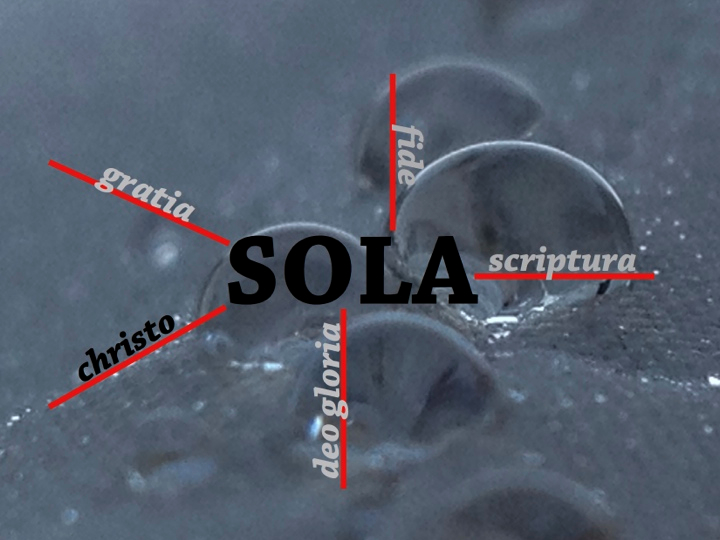
Sola Scriptura tells me the truth

Sola Christo fulfills the promises

Sola fide in Christ’s finished work 

Sola gratia that God’s favor is imparted to me

Sola Deo gloria that all of this is done

But God will redeem me from the power of Sheol (the place of the dead); for He will receive me. Selah—pause, and calmly think of that! (Psalm 49:15 AMPC)

Thursdays With Spurgeon—The Final, Authoritative Word

This is a weekly series with things I’m reading and pondering from Charles Spurgeon. You can read the original seed thought here, or type “Thursdays With Spurgeon” in the search box to read more entries.

Listen to the podcast of this post by clicking on the player below, and you can also subscribe on AppleSpotify, or Audible. 

The Final, Authoritative Word

…For the mouth of the Lord has spoken (Isaiah 1:20).

     It would not be worth our while to speak what Isaiah had spoken if in it there was nothing more than Isaiah’s thought—neither should we care to meditate hour after hour upon the writings of Paul, if there was nothing more than Paul in them. … 

     It is not mine to amend or adapt the gospel. What? Shall we attempt to improve upon what God has revealed? The Infinitely Wise to be corrected by creatures of a day? Is the infallible revelation of the infallible Jehovah to be shaped, moderated, and toned down to the fashions and fancies of the hour? God forgive us if we have ever altered His Word unwittingly. … 

     One Word of God is worth more than libraries of human lore. ‘It is written’ is the great gun which silences all the batteries of man’s thought.

From The Infallibility Of Scripture

As Solomon neared the end of his writings in the Book of Ecclesiastes, he made this observation, “Of making many books there is no end, and much study wearies the body” (12:12). How true that is. Have you walked through a bookstore lately?! There is no end to the opinions that people want to share with you. 

But there is one thing that all of the books in all of the bookstores and all of the libraries have in common: not one of them is given to us by “the mouth of the Lord.” 

There are certainly many, many books that are saturated in Scripture, but they are still the opinions of man. We need to make sure that everything we read, or every wise person that we listen to, or even every conversation that we have with ourselves are all proven to be true or false based on what God has spoken.

Jesus told us that the Holy Spirit would remind us of everything God’s mouth had spoken to us (John 14:26), and that He would guide us into all truth (John 16:13). 

So go ahead and search out wise, godly books and wise, godly counselors. But remember that their word is not the final word—only the words that come from the mouth of the Lord are the authoritative words you should apply to your life.

►► Would you please prayerfully consider supporting this ministry? My Patreon supporters get behind-the-scenes access to exclusive materials. ◀︎◀︎

Links & Quotes

link quote

“True servants of God demand to see for all church ordinances and doctrines the express authority of the church’s only Teacher and Lord. They remember that the Lord Jesus bade the apostles to teach believers to observe all things whatsoever He had commanded them. The Holy Spirit revealed much of precious truth and holy precept by the apostles, and to His teaching we would give earnest heed; but when men cite the authority of fathers, and councils, and bishops, we give place for subjection, no, not for an hour. They may quote Irenaeus or Cyprian, Augustine or Chrysostom; they may remind us of the dogmas of Luther or Calvin; they may find authority in Simeon, or Wesley, or Gill. We will listen to the opinions of these great men with the respect they deserve as men, but having so done, we deny that we have anything to do with these men as authorities in the church of God, for there nothing has authority, but ‘Thus saith the Lord of hosts.’” —Charles Spurgeon

“Beyond simply confronting cultural abuse and misuse, Christians must make a conscientious effort to restore culture so that it serves as a means and end to the glory of God by demonstrating the love He intends all people to know. … Principally, as we’ve seen, God intends to bring His glory to light through those He has redeemed and come to indwell by His Spirit. Thus, in every aspect of our lives, and in all our cultural activities, we must be diligent to allow the glory of God to show through in us, so that the love God has for humankind and the world can be plainly seen by all.” —T.M. Moore

Fight The New Drug lists 3 types of pornography viewers, and how pornography affects them. If you are affected by pornography, here is some help.

[VIDEO] J. Warner Wallace talks about the best explanation for moral laws—

“It is true that we must be personally bold and afraid of no man but courageous as we contend for the truth. If we are simply nice, concerned, genuinely curious, attentive, supportive, and affirming, we may win a hearing with suffering people, but we will never lead them to life. Grace means courage and clarity. But it is just as true that our boldness must be brokenhearted boldness, that our courage must be a contrite and lowly courage, and that we must be tender contenders for the truth. If we are brash and harsh and cocky and clever, we may win a hearing with angry and pugnacious people, but we will drive away those who suffer. Paul makes it so clear that we are laid low and given comfort ‘so that we will be able to comfort those who are in any affliction with the comfort with which we ourselves are comforted by God’ (2 Corinthians 1:4). Those we counsel must feel that we are utterly dependent in our lives on the merciful comfort of God to make it through our days.” —John Piper

[VIDEO] The danger of radical Islamism—

Sunday Recap

I know we covered a lot of ground today in part 5 of the Sola series. Several folks have asked me to make available the resources I shared this morning, so here they are. Enjoy!

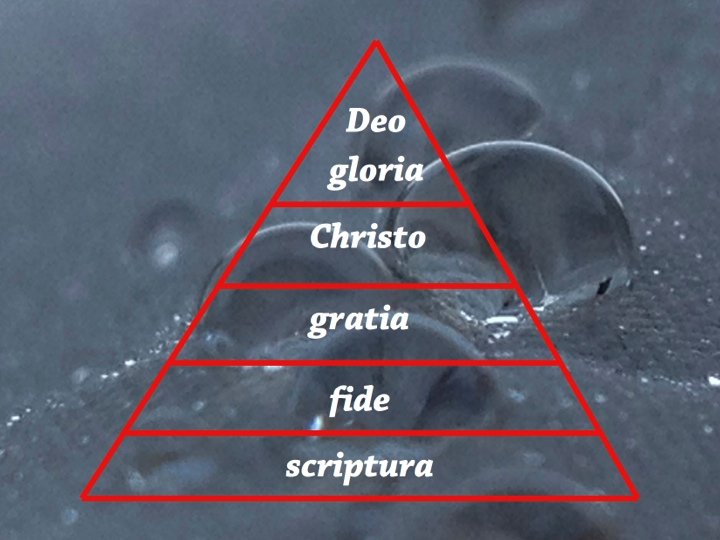
The “Sola pyramid” shows how each of the sola statements build on each other, pointing to the apex of God’s glory.

  • Sola scriptura is the foundation because it gives us the authority of God’s Word on which we build all the other statements.
  • Faith comes by hearing the Word (sola scriptura) and so it leads to the understanding of sola fide.
  • God’s mercy is extended to us in justification, but then his grace is the amazing, above-and-beyond gift to us in sola gratia.
  • We remember grace with this acrostic: God’s Riches At Christ’s Expense. So grace is possible sola Christo—only through the work of Jesus Christ.
  • Jesus Himself said that all He did was to bring glory to the Father, so sola Deo gloria becomes the penultimate focal point of everything else.

Here are the quotes I shared:

“We were made to know and treasure the glory of God above all things; but when we trade that treasure for images, everything is disordered. The sun of God’s glory was made to shine at the center of the solar system of our soul. When it does, all the planets of our life are held in their proper orbit. But when the sun is displaced, everything flies apart. The healing of the soul begins by restoring the glory of God to its flaming, all-attracting place at the center.” —John Piper

“The shop, the barn, the scullery, and the smithy become temples when men and women do all to the glory of God! Then divine service is not a thing of a few hours and a few places, but all life becomes holiness unto the Lord, and every place and thing, as consecrated as the tabernacle and its golden candlestick.” —Charles Spurgeon

“If God’s glory is the only all-satisfying reality in the universe, then to try to do good for people, without aiming to show them the glory of God and ignite in them a delight in God, would be like treating fever with cold packs when you have penicillin.” —John Piper

Let your light so shine before men that they may see your moral excellence and your praiseworthy, noble, and good deeds and recognize and honor and praise and glorify your Father Who is in heaven. (Matthew 5:16, Amplified Bible)

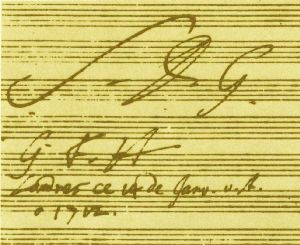
And, finally, here is the picture of George Friederic Handel’s signature on all his music. “S.D.G.” is Sola Deo gloria, which appears before the initials “G.F.H.” of his own name.