Blessing Or Burden?

Blessing or burdenGod’s commandments aren’t a bunch of Don’ts. If we look at them through the perspective of a loving Lawgiver, they are really Dos that will keep us in a place that God can bless.

Take the 9th Commandment: You shall not give false testimony against your neighbor (Exodus 20:16; Deuteronomy 5:20). This is the first of two commandments that emphasize the damage that can be done to our neighbor if we violate the law. Speaking falsely against someone does real harm to our neighbor, so in a sense God says, “Don’t do it!

But God also tells us what to Do so that He can bless us—

  • How good and pleasant it is when brothers live together in unity! … For there the Lord bestows His blessing, even life forevermore (Psalm 133:1, 3).
  • Psalm 15 says that he who will live in God’s presence is the one who speaks the truth from his heart and has no slander on his tongue, who does his neighbor no wrong and casts no slur on his fellowman (vv. 1-3).

The word for false in this commandment can mean: (1) an untruth; (2) insincere or deceptive words (e.g. flattery); (3) being purposely vague; or (4) speaking words that are true but harmful. So we Don’t want to do those, but what should we Do?

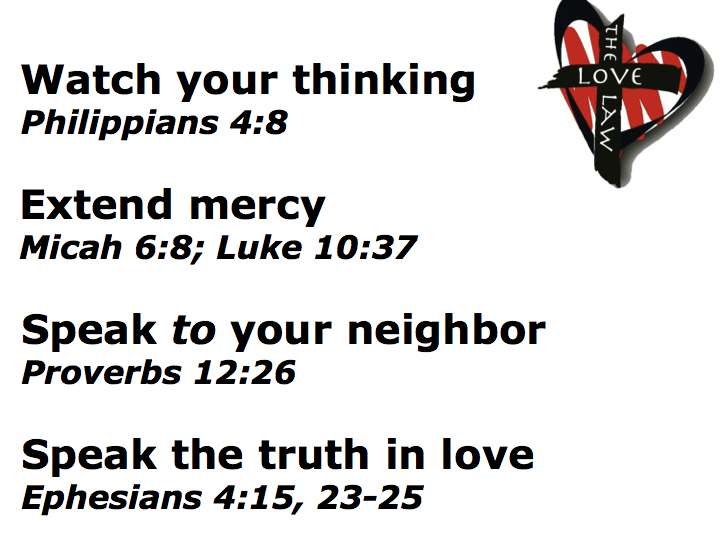
Jesus said that the way we speak is an indication of what has been going on in our heart and mind (Luke 6:45), so the way to fulfill the Do part of the commandment starts inside. A good guide is Paul’s list in Philippians 4:8—are my thoughts about my neighbor focused on what’s true? noble? right? pure? lovely? admirable? excellent? and praiseworthy?

In the New Testament, the word “blessing” is a compound word that literally means good words. So here’s the question I’m asking myself: Are my words to and about my neighbor a burden to them or a blessing?

If you have missed any of the messages in our series The Love In The Law, you can find them all by clicking here.
Keeping The Ninth Commandment

4 ways to give true testimonySome folks asked that I post a couple of things I shared in my message this morning about the ninth commandment: You shall not give false testimony against your neighbor.

Here are 4 ways to observe the positive side of this 9th commandment:

Good name in man and woman, dear my lord,
Is the immediate jewel of their souls.
Who steals my purse steals trash; ‘tis something, nothing;
‘Twas mine, ‘tis his, and has been slave to thousands;
But he that filches from me my good name
Robs me of that which not enriches him,
And makes me poor indeed. —Iago, in William Shakespeare’s Othello

7 Ways To Avoid Becoming An Adulterer

DisciplineGod said quite simple, “You shall not commit adultery” (Exodus 20:14; Deuteronomy 5:18). This entire verse is just one word in the Hebrew language—na’aph—but it packs quite a punch.

Na’aph has two dimensions to it: physical and spiritual. Physically it prohibits sexual relations between a married person and someone not their spouse. Closely related to adultery is fornication, which is unmarried people engaging in sexual activity outside the covenant of marriage. Spiritually na’aph prohibits worship of anything other than Jehovah God.

This means that an inappropriate intimate relationship on the physical level affects our spiritual relationship with God, and vice versa. That is why immoral sexual acts are almost always incorporated into the worship of false gods. But which came first? Did someone leave behind God’s design for sexuality and begin a downward slide away from Him, or did someone’s heart stray from God and the evidence was the illicit sexual acts? It starts when we leave God’s love behind (see Romans 1:21-32).

Adultery and fornication are fueled by lust. Lust is rooted in selfishness. And by it’s very definition, selfishness kills love. Adulterers and fornicators cannot truly love each other; they are only using each other to satisfy their own selfish cravings, and in so doing, they are actually abusing each other.

So here are 7 ways to avoid becoming an adulterer:

  1. Love God passionately—Mark 12:30.
  2. If you’re married, invest in your marriage—emotionally, physically, mentally, spiritually.
  3. If you’re single, develop discipline. I define discipline as choosing what you want most over what you want now.
  4. Guard your eyes—Job 31:1.
  5. Avoid tempting places—Proverbs 5:8.
  6. Fill your mind with God’s Word—Proverbs 6:20-24.
  7. Have an accountability friend—Proverbs 7:6-9.

Any sexual relationship outside of God’s prescription—one man married to one woman for life—short-circuits God’s design, so it can never fully satisfy. Adultery and fornication break God’s heart because of the damage it does to our relationship with Him and to our relationships with each other.

If you have missed any of the messages in our series The Love In The Law, you can find them all by clicking here.

10 Ways Children Can Honor Their Parents

Honor your parentsThe Bible is fairly clear on a child’s relationship with his or her parents:

The Bible also gives some directives for parents:

So children are to honor their parents, and their parents are to behave honorably. This can be a virtuous cycle, if both parent and child are doing this correctly. But what if a parent is not behaving honorably? Does the child still have to honor that parent?

In a word: Yes. The Bible doesn’t give children an option on this command. Nowhere do we read, “Only obey your Christian parents,” or “Honor your father only if he’s godly,” or “Respect your mother only if she is virtuous.” Children are simply called upon to honor and obey.

I like what Dr. Laura Schlessinger wrote—

“Honor does not mean unquestioned obedience, we truly honor our parents when we hold them accountable to God’s law. If my parents abandon me, I will honor them by seeking, though not forcing, reconciliation. If my parents abuse me, I will honor them by praying for them, so that they might see their error – and by escaping, if possible, so that they cannot continue to sin upon me. If my parents are unfaithful, I will honor them by calling for righteousness and by being willing to forgive them when they repent. If they are breaking the law, I will honor them by calling the police. Making them accountable to the highest moral order is honoring them in that I esteem them capable of responsible action.

So here are 10 biblical ways children can honor their parents—

  1. Guard your thoughts about them.
  2. Obey their lawful commands.
  3. Submit to their correction.
  4. Hold them accountable to the moral law.
  5. Show appreciation for what they have given you.
  6. Keep them connected to the family (socially, emotionally, financially, physically).
  7. Don’t expect too much of them.
  8. Don’t resent them for what they aren’t, or for what they didn’t do.
  9. Forgive them and seek reconciliation.
  10. Emulate their virtues and reverse their shortcomings.

Not only does this please God, but it opens us up to the blessing He wants to give to children who honor their parents (Deuteronomy 5:16 and Ephesians 6:2-3).

If you have missed any of the messages in our series The Love In The Law, you can find them all by clicking here.
6 Quotes From “Lincoln’s Battle With God”

Lincoln's Battle With GodStephen Mansfield has given us a unique view of the life of Abraham Lincoln, through his struggle with coming to grips with who God was to him. It’s truly an amazing read! You can read my full book review of Lincoln’s Battle With God by clicking here. Below are a few quotes I highlighted in this book.

“A schoolteacher who knew him during these years recalled, ‘Abraham Lincoln was the most studious, diligent strait forward young man in the pursuit of a knowledge of literature than any among the five thousand I have taught in the school.’” —Stephen Mansfield 

“Through all, I groped my way until I found a stronger and higher grasp of thought, one that reached beyond this life with a clearness and satisfaction I had never known before. The Scriptures unfolded before me with a deeper and more logical appeal, through these new experiences, than anything else I could find to turn to, or ever before had found in them.” —Abraham Lincoln

“The fundamental truths reported in the four gospels as from the lips of Jesus Christ, and that I first heard from the lips of my mother, are settled and fixed moral precepts with me. I have concluded to dismiss from my mind the debatable wrangles that once perplexed me with distractions that stirred up, but never absolutely settled anything. I have tossed them aside with the doubtful differences which divide denominations—sweeping them all out of my mind among the nonessentials. I have ceased to follow such discussions or be interested in them. I cannot without mental reservations assent to long and complicated creeds and catechisms. If the church would ask simply for assent to the Savior’s statements of the substance of the law: ‘Thou shalt love the Lord thy God with all thy heart, and with all thy soul, and with all thy mind, and thy neighbor as thyself,’ that church would I gladly unite with.” —Abraham Lincoln

“The fact is, I don’t like to hear cut and dried sermons. No, when I hear a man preach, I like to see him act as if he were fighting bees!” —Abraham Lincoln

“On Thursday of last week two ladies from Tennessee came before the President asking the release of their husbands held as prisoners of war at Johnson’s Island. … At each of the interviews one of the ladies urged that her husband was a religious man. On Saturday the President ordered the release of the prisoners, and then said to this lady, ‘You say your husband is a religious man; tell him when you meet him, that I say I am not much of a judge of religion, but that, in my opinion, the religion that sets men to rebel and fight against their government, because, as they think, that government does not sufficiently help some men to eat their bread on the sweat of other men’s faces, is not the sort of religion upon which people can get to heaven!’”  —From a newspaper article entitled “The President’s Last, Shortest and Best Speech”

“If I were not sustained by the prayers of God’s people, I could not endure this constant pressure. … It has pleased Almighty God to place me in my present position and looking up to Him for wisdom and divine guidance I must work my destiny as best I can.” —Abraham Lincoln

Make A Holy Rest

Sabbath = do somethingWe are an on-the-go-all-the-time society. It seems to be a status symbol to be always “on.” If not a status symbol, maybe there’s a fear of what we might miss, “If I don’t keep up on the latest TV shows [sports team, books, music, Dancing With The Stars], I’ll feel out of place when my friends are talking about it.”

Even when we do slow down, often what we call a “rest” really isn’t. (Have you ever needed a vacation to recover from your vacation?)

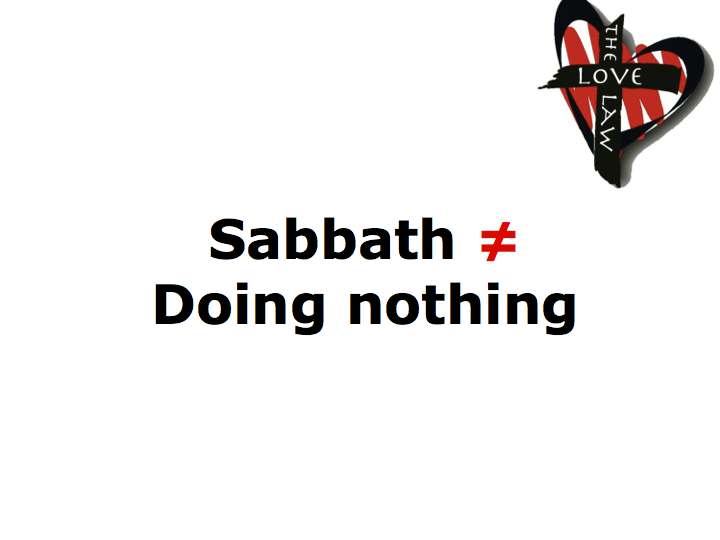
This all-go, never-stop lifestyle is not only unsustainable and unhealthy, it’s also displeasing to God. In His love for us, God says we need to take a Sabbath rest (see Exodus 20:8 and Deuteronomy 5:12). The problem is: we think “Sabbath” means doing nothing, and we feel guilty for doing nothing when there is still so much to do.

Here’s the good news: Sabbath ≠ doing nothing.

Take a look at the origin of the Sabbath—And on the seventh day God ended His work which He had made; and He rested on the seventh day from all His work which He had made. (Genesis 2:2 KJV)

That’s an unusual phrase—His work which He had made—which is repeated twice, so let’s dig into two specific words: work and made.

The verb tense for work is imperfect, which means God still had work to do. But the verb tense for made is perfect. So instead of trying to find more time in His week, God made His “To Do” list fit the timeframe. Then far from doing nothing on the Sabbath day, God reviewed His work, appreciated the beauty of Creation, and celebrated all that had been made.

This is what He calls us to do as well. Genesis 2:3, Exodus 20:8 and Deuteronomy 5:12 all tell us the Sabbath is to be holy = special, withdrawn from the usual … unique. God doesn’t want us to do nothing on the Sabbath, but to do what we don’t normally have the time to do the rest of the week.

Our modern cliché says, “You never appreciate what you have until it’s gone.” But the Sabbath says, “Stop, appreciate God’s blessings, and celebrate them while you can still enjoy them.”

God doesn’t ask you to take a rest. Instead He asks you to make your “To Do” list fit into six days, so that there can be a unique day of appreciation and celebration.

So … how are you doing on making a Sabbath?

If you have missed any of the messages in our series The Love In The Law, you can find them all by clicking here.

Smashing Idols

Puny idolsWhen looking at God’s commandments, we must look at them through a lens of love. If God—the Lawgiver—is love, then all of His laws must be saturated in His love.

So what happens when we look at the Second Commandment through this lens? The wording is simple: “You shall not make for yourself an idol…” (Exodus 20:4-6). If the First Commandment says, “I love you so much that I want to be the One and Only God you have a relationship with” then the Second Commandment says, “Because of this loving relationship, don’t try to make Me smaller to fit your worldview, but let Me by fully Me!

This idolatry starts in our minds, long before we ever create anything with our hands. Idolatry is a mental state that says, “I can define the Creator. I can figure out all of His dimensions. I can predict what He’s going to do. God operates just as I expect Him to.”

But God says, “My thoughts are nothing like your thoughts. And My ways are far beyond anything you could imagine” (Isaiah 55:8).

The Apostle Paul warned us of exchanging God’s uncontainable glory and majesty for something that we can neatly contain in our box: …they exchanged the glory of the immortal God for images … they exchanged the truth of God for a lie, and worshiped and served created things rather than the Creator… (Romans 1:21-25).

William Barclay offers this commentary about the flimsiness of idols: “In Greek the word idol has in it the sense of unreality. Plato used it for the illusions of this world as opposed to the unchangeable realities of eternity.” Our puny thoughts about God can create the idols that keep us from the reality of God. 

So how do we avoid this idolatry? Quite simply: we smash every mental idol!

…We refute arguments and theories and reasonings and every proud and lofty thing that sets itself up against the true knowledge of God; and we lead every thought and purpose away captive into the obedience of Christ… (2 Corinthians 10:5).

So… what idols do you need to smash?

If you have missed any of the messages in our series The Love In The Law, you can find them all by clicking here.
Loving Obedience

Love and obeySuppose you had to do a secret project on a remote island. In fact, the island is so remote that it doesn’t even have a name or show up on a map. I am your only point of contact, and the only one with the latitude and longitude coordinates to come get you. You have a satellite phone to use. If I truly cared about you, I would give you the precise sequence of digits to reach me. If I didn’t care about you, I’d let you call any number you wanted to call: perhaps you would eventually reach someone who could help you.

The most loving thing I could do for you is to make sure you knew the one number to call in order to get the help you needed. 

This is exactly how God starts the Ten CommandmentsAnd God spoke all these words: “I am the LORD your God, who brought you out of Egypt, out of the land of slavery. You shall have no other gods before Me.”

How confusing and utterly unloving it would be if God said, “Call any number you want to see if you can find the help you need.” Instead, in His great love for us God says, “I am the only One you will ever need!”

Notice the wording here: “…I am the LORD your God…”

  • I AM—all that you need.
  • the—not one among many, but the One and Only.
  • LORD—God’s covenant name: Jehovah, His name of personal relationship.
  • your—this is a you-Me relationship, not a you-it relationship.
  • God—the All-Powerful, All-Loving One.

This First Commandment is the orientating commandment. When we see all of God’s commandments are rooted in His love (by the way, God uses the phrase the LORD your God five times in the Ten Commandments), everything else in our lives and attitudes is properly aligned.

Jesus demonstrated this for us. He said He loved His Father and therefore obeyed all of His commands (John 14:31). Christ’s obedience was motivated and aligned by love. The Apostle John said this loving obedience is to be the distinguishing characteristic for us too:

This is love for God: to keep His commands. And His commands are not burdensome. (1 John 5:3)

We honor God and obey the First Commandment best when we know He is the One Who loves us enough to say, “I am the only One you need. Don’t look to anyone or anything else, but just come to Me!”

If you have missed any of the messages in our series The Love In The Law, you can find them all by clicking here.
Guardrails

GuardrailWe need a different way of thinking about God’s laws. We can’t think of them as a bunch of Thou-shalt-nots, because—as I blogged last week—that would mean we would have to look at The Lawgiver in an unbiblical way.

So let’s try this…

Suppose you are out for a drive on a crisp fall afternoon in a brand new sports car. You are really excited to see what this car can do! I’ll bet as you drive along the straight stretches of road, you will see very few guardrails along the sides. The guardrails you do see on the straight stretches usually protect us from things like rivers, roads passing underneath us, or perhaps a steep drop-off.

When you come into a tight turn, in addition to seeing a curved-arrow sign and perhaps a sign cautioning you to reduce speed, you are very likely to see guardrails along the turns.

Do those guardrails make you feel ripped off? Do they rob you of driving enjoyment? Have you ever felt like, “I really wish those guardrails were gone, because I’d love to get a couple of my tires off the side of the road”? Of course not!

We all know that those guardrails are there to protect us. In fact, the guardrails actually increase our driving enjoyment, because the dangerous places have been identified, and the metal guardrails will keep us from going somewhere that could be fatal.

This is a good way to think of God’s laws.

Abundant lifeJesus told us that He had come not to remove the guardrails, but to fulfill them through His life, death and resurrection (see Matthew 5:17-20 and Luke 22:20). Jesus didn’t come to rob us of life!

So if the Son sets you free, you will be free indeed. (John 8:36)

I am come that they might have life, and that they might have it more abundantly. (John 10:10).

Far from ripping us off and saying “No!” to us, Jesus came to show us that God’s laws were rooted in God’s love. He came for us to see that God’s laws are His guardrails to keep us away from the places that are dangerous, and perhaps even fatal.

If God didn’t love us, He would let us do whatever we wanted to do. But He does love us, and so He gives us His guardrails to keep us safe. Instead of looking at His laws as something which is robbing you of life, see them as protections that are giving you more abundant life!

If you have missed any of the messages in our series The Love In The Law, you can find them all by clicking here.
The Love In The Law

Love In The LawWhen I say “Law” what sort of words come to your mind. Do you think of words like: restrictive? killjoy? barriers? hindrances? no fun?

If you’re a Christian, perhaps the same descriptive words come to mind when you think of biblical commandments. Maybe you think, “Don’t do that” (or for those of you who think in King James English: Thou shalt not).

But if we think of the law/commandments that way, that also means we have to think of the Lawgiver that way. In other words, God becomes a Policeman. He is closely watching to see who will break His laws so that He can dispense the appropriate punishment. After all, if the laws are a bunch of no-nos, then Someone has to be watching for law-breakers and handing out the penalties.

If that’s the case, what do we do with the Bible’s description of God that says “God is love”? If the Lawgiver is Love, how does that change our view of the laws themselves?

It must mean that God’s laws are an expression of His love. It must mean that His love is in the laws He has given us.

It must mean that God’s laws are NOT no-nos, BUT yes-yeses. 

Join us this Sunday at Calvary Assembly of God as we talk about The Love In The Law. We’ll be working our way through the Ten Commandments, especially looking at God’s love that make each commandment a giant YES for our lives. Prayerfully, this series will completely change how we view God’s laws and commands.

If you have missed any of the messages in this series, check them out here: