Deadly Viper Character Assassins

The dictionary defines an assassin as “one who murders by surprise attack.” No assassin worth his/her salt sends you an announcement to say, “I’ll be stopping by your office tomorrow morning to kill you. If that’s not a convenient time for you, please let me know.” Of course not! Assassins never tell you that they’re coming.

Theodore Roosevelt said, “Character, in the long run, is the decisive factor in the life of an individual and of nations alike.”

So a “character assassin” is something that sneaks up and takes out the essential factor that could have made us successful and effective in life. This is why Deadly Viper Character Assassins is such a vital resource.

Here are the two pulls in my life:

Be self-controlled and alert. Your enemy the devil prowls around like a roaring lion looking for someone to devour [assassinate]. (1 Peter 5:8)

You, therefore, must be perfect [growing into complete maturity of godliness in mind and character, having reached the proper height of virtue and integrity], as your heavenly Father is perfect. (Matthew 5:48)

If I keep our character intact, I’ve developed a foundation that will sustain me for the long haul. In my experience, here’s what I’ve done to keep developing my character:

  1. Be more concerned about my character than my popularity.
  2. Regularly look myself in the mirror of God’s Word to see chinks in my armor.
  3. Make myself accountable to godly friends.

Don’t wait until the assassin has already taken a shot at your character, but begin to protect yourself now. Continue to grow in the character Jesus Christ exhibited for us.

Tick, Tock! Drip, Drop!

Tick, Tock! “There just is never enough time in my day!”

Tick, Tock! “Wow, this day has just flown by and I got nothing done!”

Tick, Tock! “Why do I always have so much To Do List left at the end of my week?”

May I suggest that instead of Tick, Tock! you focus on Drip, Drop!

(The data compiling website Flowing Data has a fascinating look at how men and women of all ages spend their time throughout the day.)

I’ve gotten some great insight on time usage from Paul Meyer. Check it out:

“Most time is wasted, not in hours, but in minutes. A bucket with a small hole in the bottom gets just as empty as a bucket that is deliberately emptied.”

Usually our time doesn’t just Tick! by, it Drips! by. In other words, it’s really easy to spot the huge time-wasters; it’s much more difficult to find the time-leakers. But they can be found and plugged. Listen to more good advice from Dr. Meyer:

“Time is usually wasted in the same way every day.”

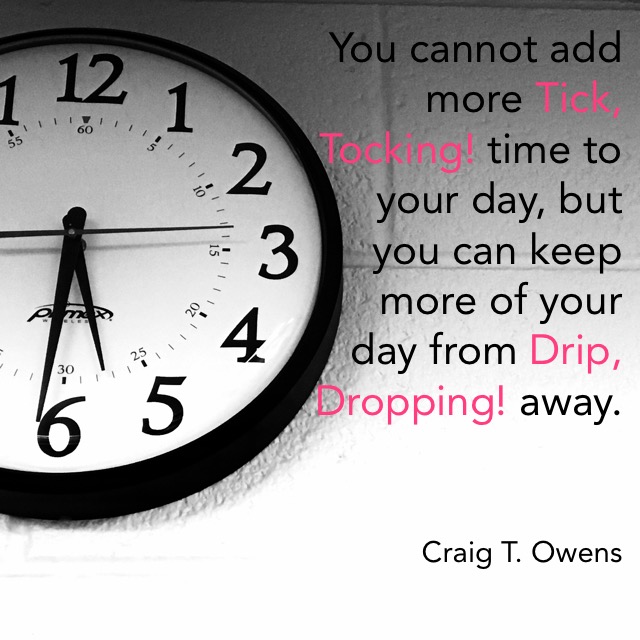
You cannot add more Tick, Tocking! time to your day, but you can keep more of your day from Drip, Dropping! away. Here are two things I’ve done which have really helped me:

  1. For one week (7 full days) I kept a log of how I spent every 15-minute increment. This might sound like a Drip, Drop! thing to do, but I was amazed at how many leaks I discovered after a week of doing this.
  2. Then I prayed the same prayer Moses prayed, “Give me wisdom to use my days the right way.”

If you can identify the time leaks, God can give you the wisdom to help you plug them. When you can control the Drip, Drop! you’ll get more out of your Tick, Tock! each day.

UPDATE: The thoughts in this chapter became a whole chapter in my book Shepherd Leadership. The chapter is called ‘Can’t, Won’t, or Don’t,’ and it addresses the three attitudes that hold us back from stewarding our time.

Big, Big World

Bigger Than Me“The smallest package in the world is a person who is all wrapped up in himself.” —Billy Graham
We have a tendency to get so wrapped up in ourselves. If we are feeling down, no one is happy. If we don’t like our job, everyone has a lousy job. If we have a toothache, the whole world is hurting. But as John Maxwell says, “The whole world—with one minor exception—is made up of other people.”

On Wednesday in our Impact youth service, we’re beginning a new series called Bigger Than Me. It’s a reminder, a wake-up call, an eye-opener to remind our students that the world is big. Bigger than them. And in need of someone who is not all wrapped up in himself.

Smarter Work

I met this morning with my teaching team. These are some great leaders-in-training who are helping me both think through what we need to talk about with our students in our youth group, and they help teach some of these points as well. This morning we refined the next series that we want to deliver. I had a pretty good idea going in, but my teaching team made it so much better!

I love leadership teams. The New Testament frequently uses the phrase one another to show that “all of us” is a lot better than “one of us.”

  • My team helps me think of things I may have missed on my own
  • My team challenges me to clarify my words
  • My team gives me perspectives that I wouldn’t have caught
  • My team makes my good ideas better
  • My team gives me a chance to invest in and train up the next generation of leaders

Do you have a good team around you? Do you have people challenging you to think in new ways? Do you have people who can sharpen you? Do you have people around you that pour into your life, and allow you to invest in them too?

Two great team quotes from some coaches who knew what they were talking about:

“The freedom to do your own thing ends when you have obligations and responsibilities. If you want to fail yourself, you can, but you cannot do your own thing if you want to have responsibilities to your team members.” —Lou Holtz

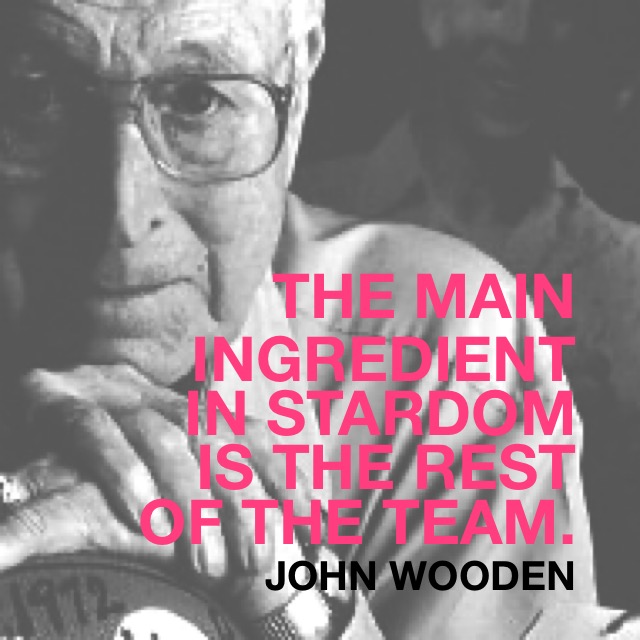
“The main ingredient in stardom is the rest of the team.” —John Wooden

I promise you “all of us” makes you look a whole lot smarter than just “one of us”! If you’re not already, start developing a team—you’ll be glad you did.

Fall Down Attitude

Fall

This Sunday at Calvary Assembly of God we start a brand new series called Fall: We all fall, but falling doesn’t have to be fatal. If we have the right attitude about it, the times that we fall can be some of the most instructional times of our lives.

A man with a great fall down attitude was Thomas Alva Edison. Check out these snippets from this inventor’s life:

“If I find 10,000 ways something won’t work, I haven’t failed.” —Edison’s answer to a newspaper reporter’s question about how he felt about his 10,000 failed attempts to perfect the incandescent light bulb

“Son, there’s great value in disaster. All our mistakes are burnt up. Thank God we can start all over again.” —Edison, at age 67, speaking to his son Charles while they were watching his laboratory being destroyed by fire

“I’ve had a lot of success with failure.”

Falling down doesn’t have to be fatal. With the right attitude, falling down can be one of the most instructional times of our lives. Come join me on Sunday morning at 10:30am to hear more about the attitude that makes success out of failure.

Pursuing

“They followed worthless idols and became worthless themselves” (Jeremiah 2:5).

Simple principle: I become what I pursue.

Pursuing things that will not last into eternity is worthless, and the pursuit of them will make my life worthless too. Allow me to elaborate with a few modified quotes:

“For where your [pursuit] is, there your heart will be also” (Jesus).

“All [pursuits] that are not eternal are eternally useless” (C.S. Lewis).

“But more than anything else, put God’s [pursuits] first and do what He wants” (Jesus).

“The impulse to [pursue] God originates with God, but the outworking of that impulse is our following hard after Him; and all the time we are [pursuing] Him we are already in His hand” (A.W. Tozer).

“But on the judgment day, fire will reveal what kind of work each of us has [pursued]. The fire will show if a person’s [pursuit] had any value” (Paul).

“The true worth of a man is to be measured by the objects he [pursues]” (Marcus Aurelius Antoninus).

“I love those who love Me, and those who [pursue] Me always catch Me” (God).

“‘Tis the business of little minds to shrink; but he whose heart is firm, and whose conscience approves his conduct, will [pursue] his principles unto death” (Thomas Paine).

As each week wraps up, I’m trying to remember to ask myself, “Did I pursue the right things this week? Were my pursuits eternal and God-honoring?” Good questions. Perhaps you could take some time to assess your pursuits too.

Remember, you will become what you pursue, so pursue wisely.

Burn, Baby, Burn

It’s been a debate around golfing circles for years as to which PGA pro gets credit for responding to a fan who quipped, “That was a lucky shot!” The famous reply (variously attributed to either Gary Player, Arnold Palmer or Lee Trevino) is, “You know, the more I practice, the luckier I seem to get.”

Regardless of who said it, there’s so much truth in that statement. Here’s what I’ve learned about success:

NO ONE is an over-night success. “The heights of great men reached and kept // Were not attained by sudden flight // But they, while their companions slept // Were toiling upwards in the night.” —Henry Wadsworth Longfellow

NO ONE is a half-hearted success. “Success is the maximum utilization of the ability that you have.” —Zig Ziglar

NO ONE is successful on their own. “Leaders will not experience long-term success unless a lot of people want them to.” —John Maxwell

SUCCESS requires a high price. “Achievers choose what losers won’t and pay the price that others don’t.” —Anonymous

SUCCESS takes dedicated time. Malcolm Gladwell in his book Outliers quotes the 10,000 Hour Rule. He writes, “The biggest misconception about success is that we do it solely on our smarts, ambition, hustle and hard work.” Instead, he says that highly successful people have put in a minimum of 10,000 hours in a single area (think the Beatles with their music or Bill Gates with his computer programming).

SUCCESS starts with personal initiative. “Success isn’t a result of spontaneous combustion. You must set yourself on fire.” —Arnold H. Glasow

John Wesley explained how he drew such large crowds in the First Great Awakening by stating, I set myself on fire, and the people come to see me burn.” If you want to be successful, you must set yourself on fire, pay the price, and do the time.

Are you ready? If so, then burn, baby, burn!

Good And Angry

When was the last time you got good and angry? Be careful how you answer because I want you to notice that important conjunction AND. So maybe I should ask the question this way: when was the last time you got angry and were still good?

Aristotle correctly pointed out, “Anybody can become angry—that is easy; but to be angry with the right person, and to the right degree, and at the right time, and for the right purpose, and in the right way—that is not within everybody’s power and is not easy.”

Over the past week, I’ve been studying the life and leadership of Nehemiah, an incredible leader who rebuilt the walls of Jerusalem. But when I got to the final chapter of his account, I noticed quite a bit of anger coming from Nehemiah. As a kid, I used to have to really battle against my temper, so this aspect of Nehemiah’s life intrigued me. Can someone be good AND angry?

I think that the deeper I love someone or something, the greater my anger will be towards anyone or anything that violates what I love.

Nehemiah loved God and he was passionate to see God’s holiness magnified. All of his anger is directed at those people or things that violated or detracted from God’s holiness. Look how he got good AND angry

  • Towards Tobiah, who moved his personal belongings into God’s temple, a place reserved exclusively for the worship of God. “I was angry, really angry, and threw everything in the room out into the street, all of Tobiah’s stuff” (v. 8).
  • Towards the people who stopped financially supporting the priests, forcing the priests to leave the temple and work as farmers. “I immediately confronted the leaders and demanded, ‘Why has the Temple of God been neglected?’” (v. 11).
  • Towards those who violated the regulations of the Sabbath Day. “I got angry and said to the leaders of Judah, ‘This evil you are doing is an insult to the Sabbath!’” (v. 17).
  • Towards those tried to get around Nehemiah’s new Sabbath Day regulations. “I spoke sharply to them and said, ‘What are you doing out here, camping around the wall? If you do this again, I will arrest you!’” (v. 21).
  • Towards those who had intermarried with false-god-worshipping people. “I rebuked them and called curses down on them. I beat some of the men and pulled out their hair” (v. 25).
  • Towards Joiada, a priest who married a non-God-fearing woman. “I banished him from my presence” (v. 28).

After each of these incidents, you might expect Nehemiah to regret what he had done and think to himself, “Perhaps I overdid it. Maybe I was too zealous, or maybe I went a little overboard.” But instead, each time Nehemiah was righteously angry he prayed this to God, “Remember me for this, O my God. Remember me with favor because of what I have done” (vv. 14, 22, 29, 31). He was unashamed that he got good AND angry.

The Bible says, “Go ahead and be angry. You do well to be angrybut don’t use your anger as fuel for revenge. And don’t stay angry.”

Can you be good AND angry? Yes! In fact, I think being good helps us be angry with the right person or thing, in the right way, for the right purpose, and for the right length of time. 

My Injured Thumb

I sliced my thumb open yesterday. Okay, maybe “sliced” is a little too dramatic. But I did cut my thumb, and it did bleed. True, it didn’t gush blood—more like oozed blood—but blood was escaping my body. It was a small cut; perhaps a ¼-inch long.

I pressed a tissue on it until it stopped bleeding. I washed my thumb thoroughly with antibacterial soap and water. I applied some Neosporin ointment. And I wrapped the injury in a fresh Band-aid.

All of this care and concern for a small cut on my thumb.

Do you realize how much one uses their thumb in the course of a day?

  • Trying to rinse dishes in the sink I couldn’t hold the plate or the dish scrubber without my thumb being involved
  • My thumb was involved when I turned the doorknob of the front door
  • When I was opening a package of fruit snacks for my son, my thumb was needed for either the holding or the ripping
  • Ditto when I attempted to open the lid of the 2-liter bottle

That small cut on the thumb on my non-dominant hand was affecting my entire day. One little cut and my entire body was adversely affected!

A friend called me the other day. His heart was ripped open. Okay, maybe “ripped” is a little too dramatic. But he was emotionally damaged. True, he didn’t need a trip to the emergency room and he probably won’t have to start taking anti-depressants, but emotional “blood” was escaping his heart.

He called me, and I responded. One little wound in my friend’s heart and I was affected! Do you realize how much one’s emotions are involved in the course of a day?

Dr. Paul Brand was a renowned hand surgeon and missionary who worked with leprosy patients in India for years. He learned that leprosy doesn’t mangle a person’s foot or hand, but their lack of ability to feel pain does. They don’t feel the cut on their pinky toe or left thumb, and so they never attend to it. The injury becomes infected, and still no pain registers to tell them to take care of it. Eventually serious, irreversible damage is done.

Listen to what Dr. Brand wrote in his book In His Image

“A body only possesses unity to the degree that it possess pain…. We must develop a lower threshold of pain by listening, truly listening, to those who suffer. The word compassion itself comes from Latin words cum and pati; together meaning ‘to suffer with.’ … The body protects poorly what it does not feel.”

“Management of pain requires a delicate balance between proper sensitivity, to determine its cause and mobilize a response, and enough inner strength to keep the pain from dominating the whole person. For the Body of Christ, the balance is every bit as delicate and as imperative.”

We must develop a lower threshold of pain by listening, truly listening. … The body protects poorly what it does not feel. Are you listening, truly listening to those who are hurting around you today? You are connected to them. If one person hurts, we all hurt.

Truly listen. If they are hurting, it does affect you … and me. Let’s find them, bandage them, apply ointment to their wounds, and protect them from further injury. Let’s feel their pain so we can protect them from further pain.

Feeding Jesus

Even before reading The Hole In Our Gospel, this thought has been haunting me: Am I doing all that I can to help the last and the least?

  • Am I speaking up for the one with no voice?
  • Am I looking out for the one who’s been ignored?
  • Am I feeding the physically hungry?
  • Am I feeding the spiritually hungry?
  • Am I representing the cause of the marginalized and ignored?
  • Am I doing this everywhere I can?

Jesus made it quite clear: after my brief life here is over, He’s going to say one of two things to me. Either I took care of the least and the last, or I didn’t. There’s no middle ground. The conversation either sounds like this…

“I was hungry and you fed Me,
I was thirsty and you gave Me a drink,
I was homeless and you gave Me a room,
I was shivering and you gave Me clothes,
I was sick and you stopped to visit,
I was in prison and you came to Me,” Jesus will say.

“Master,” I will answer, “what are You talking about? When did I ever see You hungry and feed You, thirsty and give You a drink? And when did I ever see You sick or in prison and come to You?”

“Whenever you did one of these things to someone overlooked or ignored, that was Me—you did it to Me.”

Or like this…

“I was hungry and you gave Me no meal,
I was thirsty and you gave Me no drink,
I was homeless and you gave Me no bed,
I was shivering and you gave Me no clothes,
Sick and in prison, and you never visited,” Jesus will say.

“Master,” I will answer, “what are You talking about? When did I ever see You hungry or thirsty or homeless or shivering or sick or in prison and didn’t help?”

“Whenever you failed to do one of these things to someone who was being overlooked or ignored, that was Me—you failed to do it to Me.” (My paraphrase of Matthew 25:31-46)

Mother Teresa said that in the faces of the poor whom she served she saw “Christ, in His most distressing disguise.” My prayer is that God will open my eyes. I need to see the poor, the marginalized, the hungry, and the suffering through their disguises. That’s Jesus who is poor, ignored, and suffering, and it’s up to me to do something about it.

“Let my heart be broken by the things that break the heart of God.” —Bob Pierce, founder of World Vision