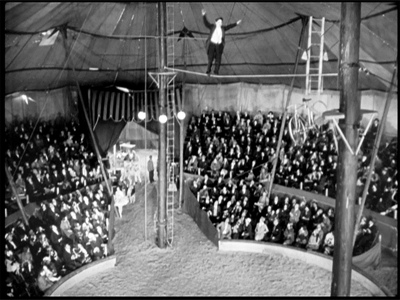
“Ladies and gentleman, come see the amazing high wire act! Watch closely as he crosses the chasm on a tightrope without a net!” Well, at least that’s what it feels like for me.
On September 8 and September 15 we will be doing our annual Q Series at Calvary Assembly of God. These are Sundays where I don’t prepare a sermon, but I prepare myself to answer questions that are thrown at me on any topic. And I feel a little like the man walking on a tightrope without a net.
Here we go!
If you’d like to submit a question, you can do so in the comments below. You can always send questions to me via Twitter or email. If you won’t be able to attend the services, we’ll make an audio link available with my answer to your question.
If you can attend in person (each of these Sundays at 10:30am), we will have a text number available so you can anonymously text your question to the computer techs.
It’s always fun and educational, so I hope you will be able to join us.
I like to keep asking myself and my leadership team this question: How do we know if our church is successful?
The apostle Paul uses two words to help answer these questions: Quality and Faithfulness.
But each one’s work will be shown for what it is; the Day will disclose it, because it will be revealed by fire—the fire will test the quality of each one’s work. (1 Corinthians 3:13)
Now it is required that those who have been given a trust must prove faithful. (1 Corinthians 4:2)
So here are two important questions we need to ask ourselves:
Am I doing quality work?
Am I faithfully doing my work?
To help answer those questions, I like this thought from Leonard Sweet’s book I Am A Follower:
“The most important metrics we must rely on, the crucial ‘deliverables’ we can present, must focus on the newly formed lives of the disciples we are making, the followers who are following Christ into a place of serving Him by serving others. The most important measure of our faithfulness to Christ must be the extent of transformation into the living image of Christ Himself. …
The quantifiable fruit of our church is not found in the number of people we can gather on a weekly basis. What counts is what is happening in the lives of those who have gathered. …It is quite possible to have a ‘successful’ life—and a ‘successful’ church—without God. But it is absolutely impossible to have a truly fruitful one.”
Again, Paul’s advice here is invaluable:
My conscience is clear, but that does not make me innocent. It is the Lord who judges me. Therefore judge nothing before the appointed time; wait till the Lord comes…. (1 Corinthians 4:4, 5)
Pastor, you need to think about these questions about “success.” But they should be questions framed around your quality and faithfulness of work as revealed to you by the Holy Spirit, not by some “expert” or anyone else.
(By the way, if you’re interested in exploring this further, I framed this question a different way in this post.)
Do you think they’re some of the greatest people on earth?
If you didn’t pastor your church, would you attend your church?
Do you enjoy recreating with your church family?
This is an important principle: You cannot treat someone differently than you think about them.
Listen to what Paul said about the church in Rome:
I myself am convinced, my brothers, that you yourselves are full of goodness, complete in knowledge and competent to instruct one another. (Romans 15:14)
Do you hear what high regard Paul had for them? He told them that they were good people, growing in their relationship with Christ, and were competent to be teachers themselves!
Not only did Paul write this to them, but he bragged about them to others too:
Everyone has heard about your obedience, so I am full of joy over you. (Romans 16:19)
“You must ‘work out your own salvation’ which God has worked in you already (Philippians 2:12). Are your speech, your thinking, and your emotions evidence that you are working it ‘out’? If you are still the same miserable, grouchy person, set on having your own way, then it is a lie to say that God has saved and sanctified you.”
We finished The Q Series yesterday morning, but I hope the questions keep on coming. I always love answering questions, and doing it in the open forum like we did was both challenging and fun (at least I had a good time!).
But I also encouraged the Calvary Assembly of God family to keep on asking questions. It’s fine if the questions are directed to me, but the most important questions are the ones we ask of ourselves.
The Holy Spirit makes all of our lives a work-in-progress. This is what is called sanctification. That word really means to make a saint out of us (think of it as saint-ification).
That means He will constantly challenge us with questions that we are wise to answer. Things like:
Why are you thinking that?
What does the Bible say about that?
Is doing that for your comfort or for God’s glory?
Is that the wise thing to do?
How would Jesus handle that situation?
Over time the answers to these questions will change, as we should all be growing up in our relationship with God (1 Corinthians 13:11; Ephesians 4:15).
The Apostle Paul tells us that we should take every thought captive (2 Corinthians 10:5), because our minds will either be set on natural desires or set on spiritual truths (Romans 8:5).
So don’t tune out the Holy Spirit. Don’t stop asking those maturing questions. Don’t stop growing in your relationship with your Heavenly Father.
“Ladies and gentleman, high above you, balanced precariously on the tightrope high over your heads—and performing it all without a net—is your pastor!”
Well, that’s sorta what it feels like to me!
Last year, I took a couple of Sundays to field questions from our congregation. My hope was that lots of people would turn in their questions early, to give me a little time to prepare (that’s like performing with a net). But instead, most of the questions came as I was standing at the front of the church with the microphone in my hand. That’s definitely performing without a net!
But it was very well received, so we’re trying this high wire act again. Beginning next Sunday The Q Series allows anyone in attendance to ask their questions about the Bible, God, or anything else that’s on their mind about spiritual matters. People can either ask their question verbally, or they can text their question anonymously to the techs in our sound booth.
Of course, if you’d like to help me perform with a net, please ask a question or two (or three, or four…) in the comments below. If you’d like to see me perform without a net, join us at 10:30am this Sunday morning.
On Sunday I was answering questions that our congregation submitted, but we ran out of time. So I’m attempting to answer all of the questions. I thought this one might be worthy of some further conversation.
Another question that we didn’t get to in Sunday’s Q Series: Does it matter the genre of Christian music to be considered glorifying God?
I think music has been one of the most dividing factors in our churches. I think this is so because satan knows the power of music. (I believe that lucifer may have been the “worship leader” in Heaven before he rebelled and was cast out, but that’s a topic to cover another time.)
We don’t really know what the music in the Bible sounded like. We don’t have any of David’s musical scores, but we do have his lyrics preserved for us in the Psalms. And what heart-moving, God-focusing lyrics they are!
The bottom line is that musical notes or musical instruments are not “Christian” or “non-Christian.” They are tools. And those tools can be used to either glorify God or detract from God. The lyrics, on the other hand, are easy to hold up to a biblical standard. So although a style/genre of music may not be my favorite, I need to look through that to two things: (1) the lyrics—do they glorify God? and (2) the attitude of the singers/musicians—are they merely performing or are they exalting God?
I can speak personally for the worship team at Calvary Assembly of God. These talented musicians and singers truly have a heart for God. They only want Jesus to be seen every single time they are on the platform. So we carefully pick our music with the goal of only exalting our King. Sometimes they are modern choruses, sometimes they are traditional hymns, sometimes they are hymns slightly rearranged with a more modern feel. Whatever the genre, we only want God to be seen and heard and exalted in our musical selections.
I love questions! Jesus seemed to love them too. Take a quick scan through the four Gospels of Matthew, Mark, Luke and John and you will see ?s all throughout the biblical text.
Over the next two Sundays, I am turning over the decision of what topics to cover on Sunday mornings to my Calvary Assembly of God family. In The Q Series, they get to submit the questions. I hope you can join us.
If not, feel free to submit your question(s) on Twitter, via email, or in the comment section below. I will be sure to answer it here, and—who knows—I may even use it in The Q Series too!
What happens when you read the Bible? Do you just read it, or do you ask questions of it? Some people seem hesitant to ask any questions, but the Bible itself is full of questions.
Zechariah was a prophet in the Old testament. If anyone would have been familiar with God’s Law, it would have been this guy. He grew up as a P.K. (priest’s kid), with several generations of religious leaders in his family tree. Yet as he was being shown the word of the Lord, he realizes how special it is, and wants to make sure he fully grasps it. So he fires away with the questions:



 “Ladies and gentleman, come see the amazing high wire act! Watch closely as he crosses the chasm on a tightrope without a net!” Well, at least that’s what it feels like for me.





 Craig T. Owens