No Fast Food Prayers

If there is one thing the Holy Spirit has been speaking to me during our week of prayer, it’s this: I need to spend more time praying for people.
Not more time studying for Sunday morning messages. Not more time reading. Not even more time hanging out with people. But praying for them.

Not more time talking to them. Not more time thinking about them. But more time talking to God about them.

There is nothing better I can do.

And not just a “fast food” prayer, either, but deliberate, personalized prayer. Look what David wrote:

Don’t they know anything, all these impostors? Don’t they know they can’t get away with this—Treating people like a fast-food meal over which they’re too busy to pray? (Psalm 14:4, The Message)

Bull’s-eye!

Time to get back to praying…

The Only Thing Missing

Last night we kicked off our week of pray by focusing our prayers on missionaries. We had a special missionary guest with us, and I was moved by his prayer. In essence, he prayed:

With all of the millions and millions of Christians in our churches, and with all of the millions and millions of dollars in resources we have, the only that is keeping us from reaching the 6900 unreached people groups is a “Yes.”

Wow!

I pray more people will say…

  • Yes, I will pray for missionaries.
  • Yes, I will give to missions.
  • Yes, I will go.

The only thing missing is a “Yes.” Can you be a part of that “Yes”?

My New Year’s Theme

In my daily Bible reading time this morning, I read this psalm/prayer/song from David. It so resonated in me, that I’m making it my declaration for 2011…

I’ve thrown myself headlong into God’s arms—I’m celebrating His rescue. I’m singing at the top of my lungs, I’m so full of answered prayers.

I’m calling my 2011 The Year Of Fully Answered Prayers. That means, of course, I’m going to be spending more time in prayer. And that’s a pretty awesome thing!

What are you going to call your 2011?

Unhappiness Makes Me Happy

I’m not a sadist. Nor am I a pessimist.

But I am a child that is still learning that I cannot always get my way.

We’re getting ready to start 2011 with a week of prayer, and I’m going to open 2011 with a series of Sunday messages on prayer: The Perfect Prayer. But in studying more about prayer, I’m always confronted by this: Why are some prayers unanswered.

As I pondered that today, I thought about saying “No” to my kids. I love my children and I want them to be happy. They love pop (or “soda” for some of you, or “Coke” for others), and would drink it all the time if I said “Yes.”

Saying “Yes” to this beverage choice may make them happy now, but it would make them very unhappy later in life when they developed osteoporosis (from a lack of calcium), or had skin and eye disease (from a lack of vitamin D), or were losing teeth (from too much carbonation), or had developed diabetes (from too much sugar).

Our Heavenly Father sees my future even more clearly than I can see it for my children. He wants me to be blessed, which is why He must say “No” at times. I’m a child who doesn’t know what is best for me.

“Getting all you want would bring incalculable damage and grief to you. Be thankful for unanswered prayer. It may be a sign of God’s favor.” —R.T. Kendall

So as I’m growing in God I can say, “Father, I’m willing to trust you with the ‘No’ now, because I believe you have a better ‘Yes’ for me in the future.”

My temporary unhappiness with unanswered prayer makes me happy because I know God has something better for me. I’m going to keep on asking, seeking, and knocking, but I’m also going to keep on trusting my Heavenly Father for His very best.

Who Are You Talking To?

I love team leadership. I really enjoy getting a group of creative thinkers around me to do some serious brainstorming. I find it so beneficial to seek out the counsel of some wise people who have been around for a while.

But, let’s see, who have I left off this list?

Oh, yeah, I remember now—I didn’t consult God!

Be honest: have you ever done that? Have you ever consulted with a lot of wise—even God-fearing—people, but forgotten to consult with God Himself? If you have (and I certainly have), we’re in good company.

When King David got ready to move the ark of the covenant to Jerusalem, the Bible says,

David conferred with each of his officers….

How’d that work out for him? Not so good.

  • Uzzah died
  • David got mad at God
  • David got scared of God
  • The ark’s arrival in Jerusalem was delayed another three months

Then David had his “Oh yeah!” moment. When he got ready to try again, David said,

We did not inquire of God about how to do it in the prescribed manner….

So here’s my simple reminder to myself (and to you too): It’s fine to consult with others, but consult with God first.

A Name Change

I was reading the biography of Jabez this morning. His whole life is told in just two verses, but what an insightful snapshot we get.

Here’s the part that stood out to me today: Jabez means one who causes pain or causes others to grieve. How would you like to go through life with a name like that? The Bible doesn’t give us the details as to why his mother gave him this name, but he seemed stuck with it. Everywhere he went throughout his life, people said,

“Hey, here comes Pain-In-The-Neck!” or

“You remind me of something bad!” or even

“Why don’t you do us all a favor and leave!”

Jabez wanted a name change, and God granted his request.

I wonder…

You can try to run from your reputation, you can try to change the way you think, you can try to act differently to see if people will treat you differently, or you can ask God to change your name.

God is in the name-changing business. And when He changes your name, it’s so much more powerful than when you try to do it.

When the Bible says, “Jabez cried out to God,” the root word means to encounter. Jabez encountered God. Jabez went face-to-face with God, and God granted his request.

If you want a new name, a new reputation, a new outlook, get face-to-face with God and He WILL grant your request.

(For some other significant name changes recorded in the Bible, check out this list.)

The Gratitude Cycle

There are only two ways to take people: You can take people for granted or you can take people with gratitude.

If you take people for granted, you will probably end up losing that relationship, or at the very least that relationship won’t be very fulfilling.

But when you take people with gratitude, you can bring out the best in them, in you, and in your relationship.

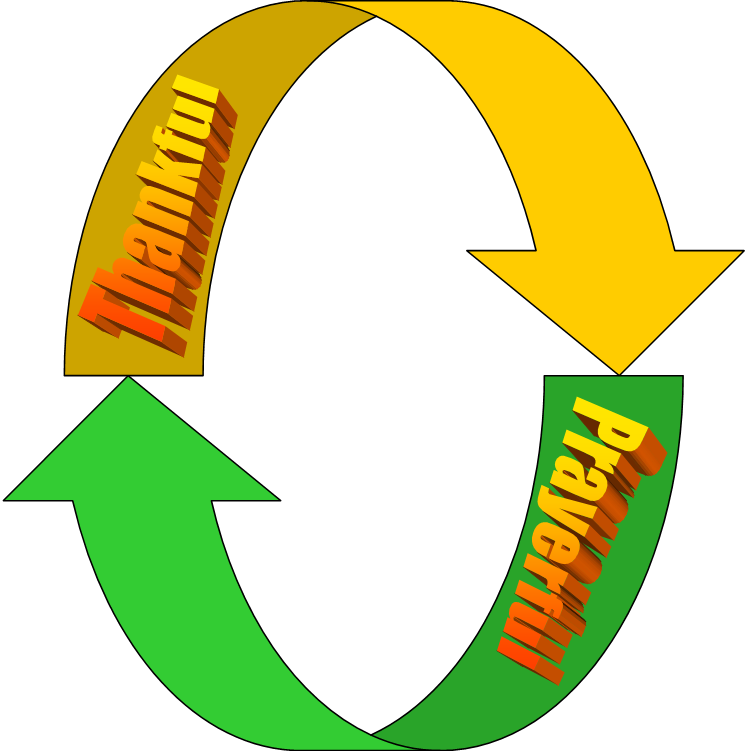
Paul wrote to the Colossian church that every time he thought of them, he was grateful for them and he prayed for them. This is The Gratitude Cycle: being thankful for someone prompts prayers for them, and those prayers make us even more grateful for them, which fires up the Gratitude Cycle all over again.

In case you need help knowing what to pray for the people for whom you are thankful, check out Paul’s prayer in Colossians 1:9-12. He prayed…

…for knowledge, wisdom & understanding of God’s will for their lives, and the power to live out that new knowledge of Him.

…for endurance—a virtue that never loses patience with, belief in, or hope for others.

…for patience—the ability to turn tough things into glorious things.

…with gratitude for them—especially with gratitude for who they were: God’s holy people.

Any time is a good time for us to be full of thanks, so make sure you are full of thanks for the people God has placed in your life. And when you feel thankful for them, be sure you are prayerful for them too.

Spread It Out

What do you do when you get bad news? Scientists know that when we hear bad news, our stress hormone cortisol immediately surges into our bloodstream. This hormone unleashes a bunch of other things in our bodies: blood pressure goes up, heart rate increases, pupils dilate, sugar stores are released. In other words, your body prepares for action.

What about your brain? What does it do? Immediately your brain starts searching for a way to cope with the stress of the bad news. And the typical response is to return to well-worn pathways. In other words, do what I’ve always done before.

So perhaps the question is better stated: What have you done before when you got bad news?

  • Did you sulk?
  • Did you cry or get angry?
  • Did you get paralyzed, not knowing what to do?
  • Did you call a friend?
  • Did you just shake your head and try to ignore it?
  • Did you spread it out before God?

Huh? Judah’s King Hezekiah got some very bad news from a very mean general named Sennacherib. What did he do? He did what he had done before…

Hezekiah received the letter from the messengers and read it. Then he went up to the temple of the LORD and spread it out before the LORD…. “Give ear, LORD, and hear; open Your eyes, LORD, and see; listen to the words Sennacherib has sent to ridicule the living God.”

Hezekiah had the same physiological and psychological responses that you and I would have when facing such a huge threat. But his first response was his well-worn response. He did what he had always done before with bad news: he spread it out before the Lord.

We can start making a new pathway for our brain to follow. Instead of fight-or-flight, or ignoring, or paralysis, or calling a friend—take it to God and spread it out there. He knows your situation better than anyone else and He wants to help you.

Start making new neural pathways in your brain today by taking everything to God—even the so-called “little” things—so that when the really bad news comes, your brain will tell you to do what you always do: spread it out before the Lord.

Will You Make A Difference Today?

Moses shared a great prayer with us: Teach us to use wisely all the time we have (Psalm 90:12).

How will use your time wisely today? What does that look like in your world?

Let me today do something that shall take
A little sadness from the world’s vast store,
And may I be so favored as to make
Of joy’s too scanty sum a little more.
Let me not hurt, by any selfish deed
Or thoughtless word, the heart of foe or friend;
Nor would I pass, unseeing, worthy need,
Or sin by silence when I should defend.
However meager be my worldly wealth,
Let me give something that shall aid my kind—
A word of courage, or a thought of health,
Dropped as I pass for troubled hearts to find.
Let me tonight look back across the span
‘Twixt dawn and dark, and to my conscience say—
Because of some good act to beast or man—
“The world is better that I lived today.” (Ella Wheeler Wilcox, Morning Prayer)

Make your world a better place because you passed through it today.

The Refinement Of Pain

I was recently invited to join a bunch of guys—mostly staff in the Cedar Springs schools—for some early morning basketball. I love playing basketball, I’m a morning guy, and getting to know new people in Cedar Springs made this an invitation I couldn’t refuse. So I started hoopin’ this week. It was nice to get back on the hardwood floor!

Yesterday morning, I jumped in my car to come home to shower. It’s a mile from the school to my house, but by the time I got home, my back muscles had seized up and I was barely able to stand up to get out of the car. I’ve had this happen to me once before, and it’s a whole lot of no fun!

So all day yesterday my schedule had to be modified, as it hurt to move, it hurt to stand for too long, and it hurt to sit for too long. I couldn’t get in the car. In fact, I couldn’t even bend over far enough to put my own socks on! All my plans for the day were shot.

But here’s what I learned: my day wasn’t shot. My plans may not have worked out, but it was still a good day. Pain has a tendency to refine what’s really important out of all the trivial stuff.

  • A day in pain and immobility reminded me of just how blessed I am to normally have good health.
  • It prompted me to pray for others who are confined to a wheelchair or their beds.
  • It gave me greater empathy for those who live in chronic pain.
  • It made me more thankful that I have access to medicines and caregivers, things that some people have access to only rarely.
  • It let me see more clearly the love my family and friends have for me.
  • It gave me more time to pray.

Now here’s the tricky part: to live with these things on my mind even when I’m not in pain.

Here’s what C.S. Lewis wrote in The Problem Of Pain:

I am progressing along the path of life in my ordinary contentedly fallen and godless condition, absorbed in a merry meeting with my friends for the morrow or a bit of work that tickles my vanity today, a holiday or a new book, when suddenly a stab of abdominal [or back] pain that threatens serious disease, or a headline in the newspapers that threatens us all with destruction, send this whole pack of cards tumbling down. At first I am overwhelmed, and all my little happinesses look like broken toys. Then, slowly and reluctantly, bit by bit, I try to bring myself into the frame of mind that I should be in at all times. I remind myself that these toys were never intended to possess my heart, that my true good is in another world and my own real treasure is in Christ. And perhaps, by God’s grace, I succeed, and for a day or two become a creature consciously dependent on God and drawing strength from the right sources. But the moment the threat is withdrawn, my whole nature leaps back to the toys: I am even anxious, God forgive me, to banish from my mind the only thing that supported me under the threat because it is now associated with the misery of those few days. Thus the terrible necessity of tribulation is only too clear. God has had me for but forty-eight hours and then only by dint of taking everything else away from me. Let Him but sheathe that sword for a moment and I behave like a puppy when the hated bath is over—I shake myself as dry as I can and race off to reacquire my comfortable dirtiness, if not in the nearest manure heap, at least in the nearest flower bed. And that is why tribulations cannot cease until God either sees us remade or sees that our remaking is now hopeless.

With God’s help, I’m going to avoid running back to my “toys” today. I’m trying to keep the most important thing in the forefront of my thoughts today.

What lessons have you learned from pain?