Working It Out

Ah, yes, Oswald Chambers always gets me thinking…

“You must ‘work out your own salvation’ which God has worked in you already (Philippians 2:12). Are your speech, your thinking, and your emotions evidence that you are working it ‘out’? If you are still the same miserable, grouchy person, set on having your own way, then it is a lie to say that God has saved and sanctified you.”

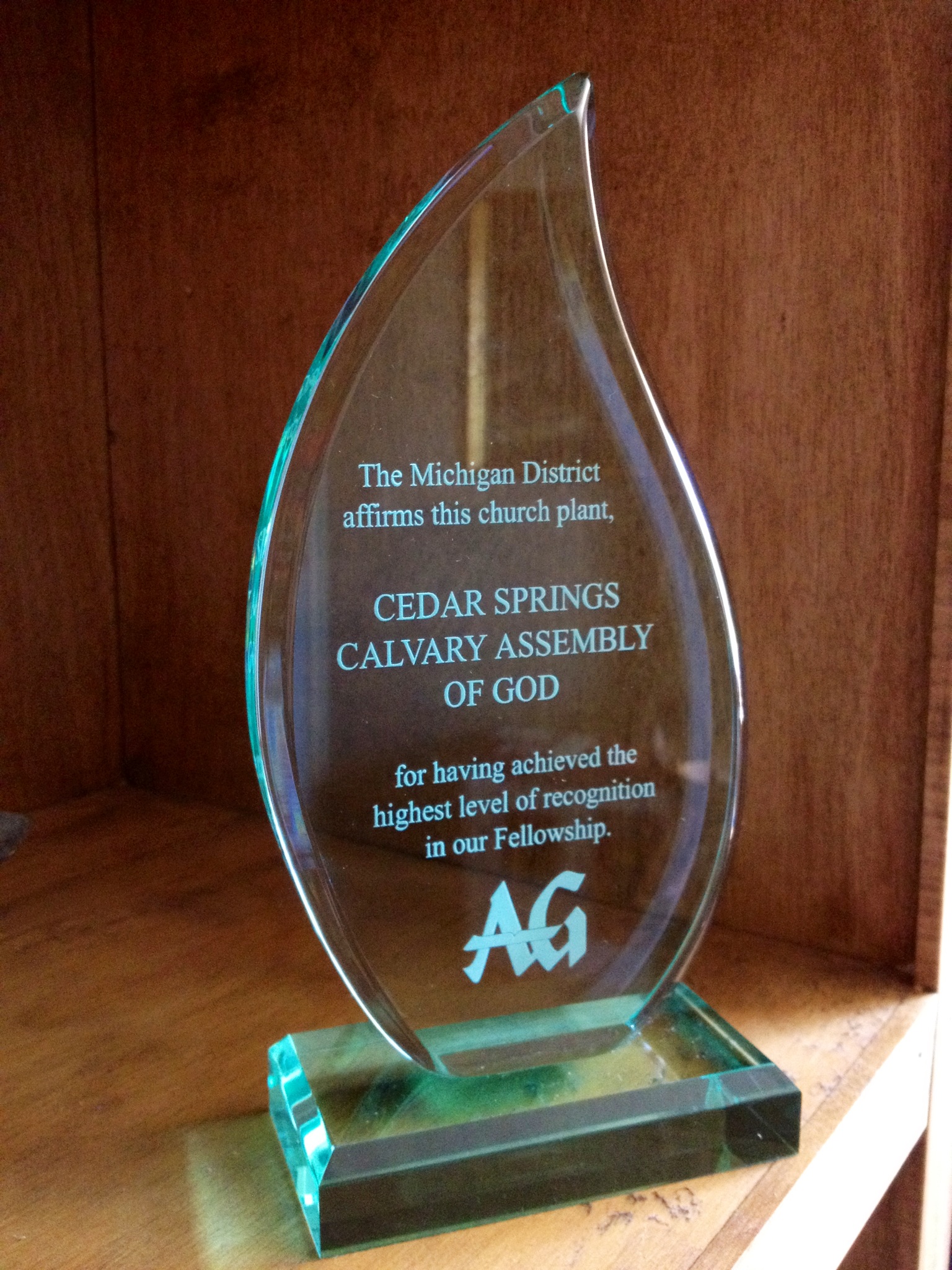
Flame Award

This award is recognition from our fellowship that Calvary Assembly of God is growing up. The award says that we have achieved the highest level of recognition in our fellowship.

While we are extremely honored to have come this far, we recognize that we haven’t “arrived” yet. Not by a long shot! If we could paraphrase what Paul wrote to the church in Philippi, we would say,

Brothers, we do not consider ourselves yet to have taken hold of it. But one thing we do: Forgetting what is behind and straining toward what is ahead, we press on toward the goal to win the prize for which God has called us heavenward in Christ Jesus. (Philippians 3:13-14).

So we humbly accepted this recognition, but we are pressing on for all that God has for Calvary Assembly of God!

Thursdays With Oswald—In Christ I Can

This is a weekly series with things I’m reading and pondering from Oswald Chambers. You can read the original seed thought here, or type “Thursdays With Oswald” in the search box to read more entries.

In Christ I Can

     We are made sons and daughters of God through the Atonement and we have a tremendous dignity to maintain; we have no business to bow our necks to any yoke saving the yoke of the Lord Jesus Christ [Matthew 11:28-30]. …

     Every detail of our physical life is to be absolutely under the control of the new disposition which God planted in us by means of identification with Jesus Christ, and we shall no longer be allowed to murmur ‘can’t.’ There is no such word as ‘can’t’ in a Christian’s vocabulary if he is rightly related to God; there is only one word and that is ‘can.’

From Biblical Psychology

Sometimes Christians are known more for what we’re against than what we’re for. I think Oswald Chambers would say that is because we don’t really understand the full power of the Atonement.

We can better understand that word by saying it “at one-ment.” We have been made one with Christ. You hear this in Jesus’ prayer for us in John 17, I in them and You in Me, in order that they may become one and perfectly united, that the world may know and definitely recognize that You sent Me and that You have loved them even as You have loved Me.”

When we are in this sort of relationship, we don’t even say can’t to sin. Instead, we say I can live a holy life because of Christ in me!

As Paul said, we can say:

I CAN do everything through Christ Who gives me strength. (Philippians 4:13)

Harmless

When a story from the past is so well known, we can easily insert ourselves into it with a certain bias. When we do this, we read things into the story because of the facts we know now.

For instance, we know Judas betrays Jesus. So when we see his name in any story in the Bible, we immediately associate the word traitor with him, and we can only view him through that lens. Therefore, it’s easy for us to put ourselves in the place of one of the other eleven disciples of Jesus, and assume that they too knew Judas was a traitor.

Except they didn’t.

Look at this verse after Jesus says, “One of you will betray Me”—

His disciples stared at one another, at a loss to know which of them He meant. (John 13:22)

The Eleven were not suspicious of Judas. They didn’t say, “Well, I just knew it was him,” or “I kinda expected that from Judas.”

One of the things Jesus taught His followers was for them to be gentle as doves. I like how the King James Version says it: harmless as doves (Matthew 10:16).

Pastor, I know you especially have been hurt by people in your church. They have betrayed you, gossiped about you, turned on you. If people did that to Jesus, why would you expect anything less? And yet we are still to remain harmless as doves.

The Eleven never suspected a traitor. They were innocent. I think they were so focused on Jesus, they didn’t have time to be cynical about others. We view Judas cynically; they didn’t.

What a testimony to others when we are harmless:

That ye may be blameless and harmless, the sons of God, without rebuke, in the midst of a crooked and depraved nation, among whom ye shine as lights in the world. (Philippians 2:15)

You may have been hurt many (many, many, many…) times in the past. But being harmless means that, like the disciples, we are “at a loss” as to whom it could be when someone tells us there is a traitor in our midst.

  • Stay focused on Jesus, so you may love others as He loves them.
  • Allow God to heal the wounds others have inflicted on you.
  • Ask the Holy Spirit to reveal any cynicism in your heart.
  • Repent of your suspicion of people.
  • Be harmless toward everyone.
  • Grieve over the traitor.
  • Then stay focused on Jesus, not the traitor and not your wound.

Thursdays With Oswald—Not Self-Conscious, But God-Conscious

This is a weekly series with things I’m reading and pondering from Oswald Chambers. You can read the original seed thought here, or type “Thursdays With Oswald” in the search box to read more entries.

Not Self-Conscious, But God-Conscious

     When I am lifted by the Atonement into oneness with God I do not lose my personal identity, my identity becomes that of conscious union with God. Man’s relationship with God in the beginning was such that the consciousness of union with Him was a delight: as soon as sin entered that went and man became self-conscious: he realized he was no longer in union with God and tried to hide himself from His presence.

From Biblical Ethics

For to me, to live is Christ… I have been crucified with Christ and I no longer live, but Christ lives in me. The life I live in the body, I live by faith in the Son of God, Who loved me and gave Himself for me. (Philippians 1:21; Galatians 2:20)

A great way to remember the meaning of the word Atonement is like this: At one-ment. Jesus paid the price for me to be at one-ment with the Father. He did not die so I could become more aware of myself, but so I could become more aware of God.

Christ’s Atonement makes me dead to me, and alive to Him; dead to trying to figure out myself, and alive to learn more of Him; dead to self-consciousness, and alive to God-consciousness.

And I would much rather be more aware of Him than I am of me!

My Mediator

If anyone ever felt his pain was undeserved, it was Job! His life is so invaluable for us to be able to answer the question, “Where’s God in the midst of my dark times?”

Job tried to makes sense of what was happening to him. Sometimes he thought God was so awesome and so powerful that He was completely unknowable. God was a faceless, unapproachable Being. At other times Job thought God was so righteous that He would have nothing to do with him. So in the depth of his despair he called out for someone to be his mediator (see Job 9:33-35).

An effective mediator has to be someone who can understand and relate to both parties. He cannot be partial to one side, nor unsympathetic to one side. He has to be able to relate to both parties. In this case, he would have to be able to relate to both God and man—he would have to be able to be able to understand this Indefinable Power and this Supreme Morality and man’s struggle to come to grips with both of these views of God. Jesus is that Mediator.

[Jesus] gave up His divine privileges; He took the humble position of a slave and was born as a human being. (Philippians 2:7)

God Himself chose to step into all of our pain!!

The Bible describes Jesus as a Man of sorrows, One familiar with suffering, One acquainted with grief.

Jesus knows your pain even more acutely than you know it yourself. He wants to take all of your pain, and bear it for you. Jesus is not some faceless, unknowable Entity; He’s not aloof, He’s not unapproachable, He’s not unmoved by your pain. Will you let Him carry your pain?

He wants you to know Him as your Mediator:

Jesus understands every weakness of ours, because He was tempted in every way that we are. But He did not sin! So whenever we are in need, we should come bravely before the throne of our merciful God. There we will be treated with undeserved kindness, and we will find help. (Hebrews 4:15-16)

What a Friend we have in Jesus

All our sins and griefs to bear

What a privilege to carry

Everything to God in prayer

Thursdays With Oswald—Serving Like Christ

This is a weekly series with things I’m reading and pondering from Oswald Chambers. You can read the original seed thought here, or type “Thursdays With Oswald” in the search box to read more entries.

Am I Serving Like Christ?

The Son of Man did not come to be served, but to serve… (Matthew 20:28)

     Jesus also said, ‘Yet I am among you as the One who serves’ (Luke 22:27). Paul’s idea of service was the same as our Lord’s—‘…ourselves your bondservants for Jesus’ sake’ (2 Corinthians 4:5). We somehow have the idea that a person called to the ministry is called to be different and above other people. But according to Jesus Christ, he is called to be a ‘doormat’ for others—called to be their spiritual leader, but never their superior. Paul said, ‘I know how to be abased…’ (Philippians 4:12). Paul’s idea of service was to pour his life out to the last drop for others. And whether he received praise or blame made no difference. As long as there was one human being who did not know Jesus, Paul felt a debt of service to that person until he did come to know Him. But the chief motivation behind Paul’s service was not love for others but love for his Lord.

     …The institutional church’s idea of a servant of God is not at all like Jesus Christ’s idea. His idea is that we serve Him by being the servants of others. Jesus Christ actually ‘out-socialized’ the socialists. He said that in His kingdom the greatest one would be the servant of all (see Matthew 23:11). The real test of a saint is not one’s willingness to preach the gospel, but one’s willingness to do something like washing the disciples’ feet—that is, being willing to do those things that seem unimportant in human estimation but count as everything to God.

From My Utmost For His Highest

I cannot add anything to this brilliant observation. But I can tell you the parts that the Holy Spirit is really working in my heart:

  • “…called to be a ‘doormat’ for others—called to be their spiritual leader, but never their superior.” God, help me to keep my pride in check.
  • “The real test of a saint is not one’s willingness to preach the gospel, but one’s willingness to do something like washing the disciples’ feet.” May I never shrink back from willingly serving at the lowest level of society.

UPDATE: This idea of servant-leaders plays prominently in my book Shepherd Leadership: The Metrics That Really Matter.

Don’t Get Pulled Back Down

We wrapped up our series on The Danger Of Prayerlessness by looking at a very innocent thing: just doing what seems the natural thing to do.

In Luke 18, Jesus told a story about a persistent widow who would not stop approaching a judge to get justice. She had been wronged, but she didn’t take matters into her own hands, nor did she get tired of asking the judge for help. Either of these responses would have been very natural responses. But that’s the point: they would be natural, and not spiritual; they would depend on us, and not on God.

Luke introduces this story like this: Jesus told His disciples a parable to show them that they should always pray and not give up (Luke 18:1).

The word for give up is one that means to slide back to the natural way of doing, feeling or acting. In other words, to handle things like we always have before. But Jesus said there was a better way: keep taking your request to our Heavenly Father.

Prayer overcomes the “gravitational pull” of my natural tendencies to do things on my own. Prayer is the rocket fuel to help me break free!

Do not fret or have any anxiety about anything, but in EVERY circumstance and in EVERYthing, by prayer and petition (definite requests), with thanksgiving, continue to make your wants known to God. (Philippians 4:6 AMP)

Don’t get pulled back down. Instead always pray and never, ever give up! Let your prayers take you higher and higher!

The Blessing Of Fullness

Thanksgiving Day 2011 is over, but the days for giving thanks should never be over. Although that sounds humorous, for many of us it is an important reminder. We need to remind ourselves because it is so easy for us to go from overflowing with thankfulness, to feeling depleted and empty.

This is exactly what Paul reminded the Colossians in part 3 of our Overflowing With Thanks series—

Devote yourselves to prayer, being watchful and thankful. (Colossians 4:2)

Here’s how the cycle works:

  • When we are thank-full to God for His blessings, we enthrone Christ in our hearts.
  • When we are Christ-full, He brings with Him all of the peace we will need.
  • When we are peace-full, the peace of God, which transcends all understanding, will guard your hearts and minds in Christ Jesus (Philippians 4:7).
  • When our hearts and minds are clear, we can better see the blessings for which we can thank God.
  • And when we are thank-full to God for His blessings, we start the cycle all over again.

We don’t have to run dry, or become depleted, or lose our joy, or be robbed of our peace. If we will remain watch-full to be thank-full, we will remain Christ-full, which will keep us peace-full.

May we never lose the blessing of fullness!

Thursdays With Oswald—You Must Say, “You Must”

This is a weekly series with things I’m reading and pondering from Oswald Chambers. You can read the original seed thought here, or type “Thursdays With Oswald” in the search box to read more entries.

You Must Say, “You Must”

     If we do not fit ourselves by practice when there is no crisis, we shall find that our nature will fail us when the crisis comes. The grace of God never fails, but we may fail the grace of God. Unless our nervous system is made the ally of the new life from God it becomes a humiliation to us, and we sit down under a tyranny of nerves. Once we receive the Holy Spirit we must sit down to nothing. … When your nervous system, which has been ruled by the wrong disposition, is inclined to say “I can’t,” you must say, “You must,” and to your amazement you find you can!

From Biblical Ethics

The time to learn how to do the God-honoring thing is when there is no crisis in my life. That’s my training time, to prepare me for when the heat is on. The apostle Paul learned this too. As a result of his training, he learned to tell himself, “You must,” in every circumstance:

I have learned to be content whatever the circumstances. I know what it is to be in need, and I know what it is to have plenty. I have learned the secret of being content in any and every situation, whether well fed or hungry, whether living in plenty or in want. I can [I must!] do everything through Him who gives me strength. (Philippians 4:11-13)

Don’t waste your non-crisis times. Learn from them how God wants to help you in the midst of your crisis.