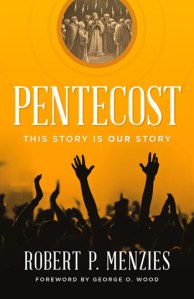
14 Quotes From “Pentecost”

Pentecost

I thoroughly enjoyed reading Pentecost by Robert P. Menzies, and learned quite a bit. You can read my full book review by clicking here. Here are a few quotes that stood out to me.

“It’s because Pentecostals fuse the biblical and contemporary horizons that we link baptism in the Holy Spirit with speaking in tongues, since that’s what Acts 2 does. It’s why we associate Spirit-baptism with empowerment for mission rather than with spiritual regeneration. And it’s why we expect God to perform ‘signs and wonders’ and to manifest spiritual gifts in worship services. All these things happened in the first Pentecostal community, and their story is our story.” 

“At its heart, the Pentecostal movement is not Spirit-centered but Christ-centered. The work of the Spirit, as Pentecostals understand it, centers on exalting and bearing witness to the Lordship of Christ.”

“Pentecostals are ‘people of the Book.’ Although Pentecostals certainly encourage spiritual experience, they do so with a constant eye to Scripture.”

“So, the stories of Acts are our stories, and we read them with expectation and eagerness: stories of the Holy Spirit’s power, enabling ordinary disciples to do extraordinary things for God. … The hermeneutic of the typical Pentecostal believer is straightforward and simple: the stories in Acts are my stories—stories that were written to serve as models for shaping my life and experience.”

“In Luke’s view, every member of the church is called (Luke 24:45–49; Acts 1:4–8/Isaiah 49:6) and empowered (Acts 2:17–21; cf. 4:31) to be a prophet. Far from being unique and unrepeatable, Luke emphasizes that the prophetic enabling experienced by the disciples at Pentecost is available to all of God’s people. … Through his two-volume work, Luke declares that the church, by virtue of its reception of the Pentecostal gift, is nothing less than a community of prophets. It matters not whether we are young or old, male or female, rich or poor, black or white; the Spirit of Pentecost comes to enable every member of the church, each one of us, to fulfill our prophetic call to be a light to the nations.” 

“Not long ago a Chinese house church leader commented, ‘When Western Christians read the book of Acts, they see in it inspiring stories; when Chinese believers read the book of Acts, we see in it our lives.’”

“Luke’s theology of the Spirit is different from that of Paul. Unlike Paul, who frequently speaks of the soteriological dimension of the Spirit’s work, Luke consistently portrays the Spirit as a charismatic or, more precisely, a prophetic gift, the source of power for service.” 

“Luke crafts his narrative so that the parallels between Jesus’ experience of the Spirit (Luke 3–4) and that of the disciples on the day of Pentecost (Acts 1–2) cannot be missed. Both accounts: 1. Are placed at the outset of Luke’s Gospel on the one hand, and the book of Acts on the other; 2. Associate the reception of the Spirit with prayer; 3. Record visible and audible manifestations; 4. Offer explanations of the event in the form of a sermon that alludes to the fulfillment of Old Testament prophecy.”

“Luke’s understanding of baptism in the Holy Spirit, I have argued, is different from that of Paul. It is missiological rather than soteriological in nature. … The tendency in Protestant churches has been to read Luke in the light of Paul. Paul addresses pastoral concerns in the church; Luke writes a missionary manifesto.” 

“Bold witness for Jesus is recognized as our primary calling and the central purpose of our experience of the Spirit’s power. Missions is woven into the fabric of our DNA.”

“I do not wish to minimize in any way the significance of the great doctrinal truths of Paul’s writings. I merely point out that since Paul was, for the most part, addressing specific needs in various churches, his writings tend to feature the inner life of the Christian community. His writings, with some significant exceptions, do not focus on the mission of the church to the world. … It is probably fair to say that while Paul features the ‘interior’ work of the Spirit (e.g., the fruit of the Spirit, Gal. 5:22–23); Luke features His ‘expressive’ work (Acts 1:8). Thus, by appropriating in a unique way the significant contributions of Luke-Acts, Pentecostals have developed a piety with a uniquely outward or missiological thrust.”

“The clarity of the Pentecostal message flows from the simple, straightforward manner in which we read the Bible. As I have noted, Pentecostals love the stories of the Bible. We identify with the stories that fill the pages of the Gospels and Acts, and the lessons gleaned from these stories are easily grasped and applied in our lives. For Pentecostals, the New Testament presents models that are to be emulated and guidelines that are to be followed. It should be noted that our approach to doing theology is not dependent on mastering a particular set of writings, say, the works of Luther; or coming to terms with a highly complex theological system. Pentecostals also do not worry much about cultural distance or theological diversity within the canon. We do not lose sleep over how we should understand the miracle stories of the Bible or how we might resolve apparent contradictions in the Bible. Our commitment to the Bible as the Word of God enables us to face these questions with a sense of confidence.”

“We must remember that whatever we do, God is measuring the work we do for Him in a qualitative, not quantitative way. … Only the work which is done by the power of the Holy Spirit can be acceptable in the Kingdom of God.” —David Yonggi Cho

“Some will still remain skeptical. They will ask: Is not this approach to church life, with its emphasis on ecstatic experience, emotional response, and spiritual power, filled with inherent dangers? Might it not encourage us to feature emotionally manipulative methods and to focus on superficial matters? Yes, undoubtedly, there are dangers. However, there is more danger in an approach that fails to make room for the full range of human experience, including the emotions, in our encounter with God.”

8 Statistics From “The Global War On Christians”

The Global War On ChristiansI found some of the statistics reported in The Global War On Christians by John L. Allen, Jr., to be quite eye-opening. You can read my full book review by clicking here, but these are some of the stats that caught my attention—

“Open Doors… estimates that one hundred million Christians worldwide presently face interrogation, arrest, torture, or even death because of their religious convictions.” 

“Two of the world’s leading demographers of religion, David B. Barrett and Todd Johnson, have performed an exhaustive statistical analysis of Christian martyrdom, reaching the conclusion that there have been 70 million martyrs since the time of Christ. Of that total, fully half, or 45 million, went to their deaths in the twentieth century, most of them falling victim to either Communism or National Socialism. More Christians were killed because of their faith in the twentieth century than in all previous entries combined. … Christians today are, by some order of magnitude, the most persecuted religious body on the planet, suffering not just martyrdom but all the forms of intimidation and depression mentioned above in record numbers. That’s not a hunch, or a theory, or in anecdotal impression, but an undisputed empirical fact of life.”

“In 1919, just 9 percent of Africa was Christian. As of early 2013 it was 63 percent, for a grand total of 380 million Christians on the continent. These folks are scattered across a stunning 552,000 congregations and 11,500 denominations…. Most of this growth has occurred since the last quarter of the twentieth century and is the result of indigenous African evangelizing efforts rather than Western missionaries.”

The top five most hazardous nations on earth in which to be a Christian:

  1. North Korea
  2. Afghanistan
  3. Saudi Arabia
  4. Somalia
  5. Iran

“One estimate is that there are 47 million Pentecostals in China alone, despite the best efforts of the officially atheistic government to rein in their expansion. … The Center for the Study of Global Christianity, which issues the much-consulted World Christian Database, says there are 111 million Christians in China, roughly 90 percent Protestant. That would make China the third largest Christian country on earth, following only the United States and Brazil.” 

“Open Doors… estimates the total number of Christians in North Korea to range from 200,000 to half a million, with at least a quarter of those believers currently behind bars in prison camps.”

“In the 1990s… conversions from Catholicism to Protestantism in Latin America during the twentieth century actually surpassed the Protestant Reformation in Europe in the sixteenth century.”

“A September 2012 report by the Pew Forum concluded that ‘a rising tide of restrictions on religion [has] spread around the world.’ Among other points, the study found that 37 percent of nations in the world have high or very high restrictions on religion, up from 31 percent a year ago, a six-point spike in just 12 months, and that three-quarters of the world’s population of 7 billion, meaning 5.25 billion people, live in countries with high or very high restrictions on religion. That’s up from 70 percent from the previous year.”

You can also read some quotes from this amazing book by clicking here.

12 Quotes From “Pouring Holy Water On Strange Fire”

Pouring Holy Water On Strange FireIn Pouring Holy Water On Strange Fire, Frank Viola uses an extensive array of sources, both ancient and contemporary, in his critique of John MacArthur’s book Strange Fire. You can read my full book review by clicking here. I hope you will enjoy these quotes as much as I did.

“For some do certainly drive out devils, so that those who have thus been cleansed from evil spirits frequently both believe, and join themselves to the church. Others have foreknowledge of things to come: they see visions, and utter prophetic utterances. Others still, heal the sick by laying their hands upon them, and they are made whole. Yea, moreover, as I have said, the dead even have been raised up, and remained among us for many years. And what shall I more say? It is not possible to name the number of the gifts which the church throughout the whole world has received from God, in the name of the Jesus Christ (2.32.4) … For this reason does the apostle declare, who speak wisdom among them that are perfect, terming those persons perfect who have received the Spirit of God, and who through the Spirit of God do speak in all tongues, as he used himself also to speak. In like manner we do also hear many brethren in the church, who possess prophetic gifts, and who through the Spirit speak all kinds of tongues, and bring to light for the general benefit the hidden things of God, whom also the apostle terms spiritual, they being spiritual because they partake of the Spirit (5.6.1).” —Irenaeus, Against Heresies

“Now was absolutely fulfilled that promise of the Spirit which was given by the word of Joel: ‘In the last days will I pour out My Spirit upon all flesh, and their sons and their daughters shall prophesy; and upon My servants and upon My handmaids will I pour out of my Spirit.’ Since then the Creator promised the gifts of His Spirit in the latter days; and since Christ has in these last days appeared as the dispenser of spiritual gifts … it evidently follows in connection with this prediction of the last days, that this gift of the Spirit belongs to Him who is the Christ of the predictors … Let Marcion then exhibit, as gifts of his god, some prophets, such as have not spoken by human sense, but with the Spirit of God, such as have both predicted things to come, and have made manifest the secrets of the heart; let him produce a psalm, a vision, a prayer—only let it be by the Spirit, in an ecstasy, that is, in a rapture, whenever an interpretation of tongues has occurred to him; let him show to me also, that any woman of boastful tongue in his community has ever prophesied from amongst those specially holy sisters of his. Now all these signs of spiritual gifts are forthcoming from my side without any difficulty, and they agree, too, with the rules, and the dispensations, and the instructions of the Creator; therefore without doubt the Christ, and the Spirit, and the apostle, belong severally to my God. Here, then, is my frank avowal for any one who cares to require it (Bk. 5, Ch. 8).” —Tertullian, Against Marcion

“Anyone who cuts out portions of Scripture is guilty of very grievous sin … I say once more, there, that to hold such a view [cessationism] is simply to quench the Spirit.” —D. Martin Lloyd-Jones

“Therefore to say that because we now have all the writings of Scripture complete we no longer need the miraculous inspiration of the Spirit among men as in former days is a degree of blindness as great as any that can be charged upon the scribes and the Pharisees. … There is no degree of delusion higher than that which is evidenced by those who profess to teach from the divinely inspired Scriptures that the immediate, continual illumination and working of the Spirit in men’s hearts ceased when the canon of Scripture was complete. To deny the present prophetic gift in the church is to deny also that very manifestation of Christ today to His own which the Scriptures teach is the only means to the reality of Gospel Christianity.” —William Law

“But He has left to us the same power He possess. This [the indwelling Holy Spirit to continue Jesus’s life and ministry and to perpetuate miracles] is the mighty gift of our ascended Lord. This is the supreme need of the church today … the constitution of the church is identical with the twelfth chapter of First Corinthians. … We cannot leave out any part of the gospel without weakening the rest; and if there ever was an age when the world needed the witness of God’s supernatural working, it is the day of unbelief and satanic power.” —A.B. Simpson

“The devil only bothers to counterfeit that which is real and a threat to his kingdom.” —Frank Viola

“A Bible-based sermon can be equal in truth if rooted in Scripture, but not equal in authority to the Bible.” —Frank Viola

“Spirit can embrace intellect, but human intellect won’t comprehend Spirit.” —A.W. Tozer

“We need to learn that truth consists not in correct doctrine, but correct doctrine plus the inward enlightenment of the Holy Spirit.” —A.W. Tozer 

“We cannot make too much of this matter of revelation, illumination, seeing. It is basic in salvation (Acts 26:18). It is essential to effective ministry (2 Corinthians 4:6) and it is indispensable to full knowledge and full growth (Ephesians 1:17)…. The kind of seeing to which we refer is an epoch, an encounter, a revelation, a crisis. There is no power on this earth which could have changed that rabid, fanatical, bigoted Saul of Tarsus, a ‘Pharisee of the Pharisees,’ into ‘the apostle of the Gentiles’ (Romans 11:13)…. Argument would not have done it. Neither persuasion nor persecution nor martyrdom would have effected it. But it was done! That ‘conversion’ stood the test of all persecutions, sufferings, and adversities possible to man for the rest of his life…. Indeed, a fundamental and preeminent work of the Holy Spirit has to do with spiritual enlightenment and supremely as to the significance of God’s Son, Jesus Christ. It is all in the Scriptures, but still our eyes may be holden…. We can be governed by objective truth. It can be ‘the truth’—orthodox, sound, Bible truth. We can be governed by that simply because it is taught; we do it objectively. But there is something more than that. There is such a thing as the Holy Spirit taking hold of the truth of God and making it something that lives in us…. Many Christians are just Christians: that is, after they are saved, their Christian life consists in doing as they are told by the minister because it is presented to them as the thing they should do. But there is a much higher level of life than that. The thing is right, but it is altogether transformed when the Holy Spirit brings it home to us in an inward way, and adjusts us to it. We no longer do it because it has got to be done: we do it because the Lord has done something in us, and shown us that that is the thing that He wants done… it is no more mechanical, it is vital!” —T. Austin Sparks

“To downplay and criticize a genuine desire to know our Lord in greater capacity and to receive clear direction from God’s Spirit in greater measure is contrary to the exhortation and examples found in Scripture. Certainly, spiritual contentment and complacency would have drawn from Paul the strongest reproof. And it did so from Jesus in the book of Revelation.” —Frank Viola

“One thing the charismatic movement has been sent to do, I believe, is to alert us all to the fact that God, when trusted, will show His hand in many thrilling ways, and we should be expecting Him to do that, though without dictating to Him what He must do in particular situations.” —J.I. Packer

Pouring Holy Water On Strange Fire (book review)

Pouring Holy Water On Strange FireI fully admit that I’m a little biased on this one. After all, what would you expect from a fourth generation Pentecostal? But even with that disclaimer, I thought Frank Viola did a masterful job in his critique called Pouring Holy Water On Strange Fire.

Viola’s book is a critique of John MacArthur’s book Strange Fire, in which MacArthur attempts to make the case that the way Pentecostals and Charismatics advocate and practice their faith is unscriptural. MacArthur would fall into the camp of the cessationists, who claim that all of the operational gifts of the Holy Spirit enumerated in the New Testament ceased when the apostles died, or when the canon of Scripture was closed. I’ve always found this a strained argument at best, or as Mark Driscoll says, one needs to do “exegetical origami” to reach the cessationists’ conclusion.

Frank Viola systematically critiques Strange Fire thought-by-thought, section-by-section. He does so fairly and academically, using respected Bible commentators, the writings of Church fathers, logic, personal examples, as well as other respected contemporary voices who express similar concerns against MacArthur’s arguments.

This is a good book for any student of the Bible to read. It’s not a lengthy tome, so you will not get bogged down in reams of academia, but you will be able to weigh the evidence that both cessationists and Pentecostals use. You can download the ebook version by clicking here.

Filled Or Baptized?

Filled or Baptized.028Imagine I took a trip to the eastern seaboard of the United States, and I spent much of my time there walking along the shore in awe of the majesty of the Atlantic Ocean. When it came time for me to head home, I wanted to find something that would be a lasting memento of my time at the beach, so I took a glass bottle out into the surf and filled it with salty Atlantic Ocean water.

I now have the ocean in a bottle.

But showing my small bottle to a friend who had never seen the Atlantic Ocean for himself and trying to convey to him the majesty and splendor of this powerful ocean would be a pitiful experience.

Yes, my bottle contains some of the Atlantic Ocean. But it is limited, while the ocean is nearly limitless. The water in my bottle is tame, compared to the wild strength of the pounding Atlantic surf. The water in my bottle is stagnant, while the Atlantic is constantly moving and churning.

My bottle contains the ocean. But what if the ocean contained my bottle? 

This is an good example of someone who is merely filled with the Holy Spirit (the Spirit in their bottle) versus someone who is baptized with the Holy Spirit (their life immersed in the ocean of the Spirit). 

At the moment of salvation, the Holy Spirit enters the bottle of our lives as a deposit of our assurance of salvation and eternal life. But it is limited and tame, and can become stagnant if we’re not careful. But when someone is baptized in the Holy Spirit—when the bottle of their life is plunged into the limitless resources of the Spirit—a new power and effectiveness is released.

After His resurrection Jesus breathed on His disciples and said, “Receive the Holy Spirit.” But before His ascension, Jesus instructed them to wait in Jerusalem for the baptism of the Holy Spirit. Jesus wanted more for them … and He wants more for you too!

The baptism in the Holy Spirit is not a luxury; it is a necessity. Christ intended for it to be the normal state of a healthy Christian! Are you baptized in the Spirit, or are you content with merely being filled with the Spirit? I pray that you will allow your bottle to be plunged deep!

I am continuing my series called Come Holy Spirit next Sunday. Please join me!

Come Holy Spirit

Come Holy Spirit [web]The Bible is so full of the amazing promises that come when we allow the Holy Spirit to move in our lives. Things like…

  • Anointing for service
  • Empowerment for telling other about Jesus
  • Answering those who criticize the gospel
  • Praying more intimately
  • Wisdom
  • Growing in Christlike character
  • Insight into difficult situations
  • Discernment
  • Creativity where there was stagnation
  • And on and on and on

With all of the blessings that come with the Holy Spirit’s move in our lives, why wouldn’t we pray more frequently, “Come Holy Spirit”?

Beginning this Sunday I will be talking about some of the roles the Holy Spirit plays in the lives of Christians. I hope you can join me each week at Calvary Assembly of God.

The Baptism With The Holy Spirit (book review)

Baptism with the Holy SpiritR.A. Torrey was successful as an evangelist, a pastor, a theologian, and an author. In The Baptism With The Holy Spirit he brings all four of these disciplines to bear on this major theological doctrine.

This book is fairly short, but if you take time to read all of the Scriptures that Rev. Torrey references, and if you take the time to contemplate all of his profound reasoning, there is enough here to keep you occupied for quite some time. I am a fourth generation Pentecostal (which means I grew up with these doctrines of the Holy Spirit being adhered to throughout my lifetime) and I still found quite a bit on which to think and search more deeply.

I sincerely appreciated the academic approach that Rev. Torrey brought to this book, and I would encourage anyone who wants to grow deeper in their relationship with God to take the time to really digest the material he has presented us.

Keep On Keeping On

I was challenged by the message “Grandpa George” (also known as Tom Amrozowicz) shared with our church yesterday morning. This coming from a man who is a third-generation Pentecostal, and has walked with Jesus for over 70 years. The Bible text he shared was:

O God, You have taught me from my earliest childhood, and I constantly tell others about the wonderful things You do. Now that I am old and gray, do not abandon me, O God. Let me proclaim Your power to this new generation, your mighty miracles to all who come after me. (Psalm 71:17-18)

I am also a fourth-generational Pentecostal, and I have walked with Jesus for over 40 years (I know, I’m a rookie compared to Tom!). Tom’s words and God’s Word challenged me.

O God, You have taught me from my earliest childhood. I never want to take this for granted!

I constantly tell others about the wonderful things You do. Constantly? I hope my life is always showing how I am grateful for God’s blessings, but I know I needed that reminder to also be telling others how grateful I am.

Now that I am old and gray. Gray? Yes. Old? Well, let’s just say older.

Do not abandon me, O God. I don’t believe God would abandon me, but I need to ask myself, “Am I more attentive to following Him as I was a year ago?” You might ask, “Why ‘more attentive’? Don’t you just need to be as attentive?” When I was a teenager, there were things I ate that I never gave a second thought to, but I would never consider eating those things now because I know they aren’t the healthiest diet choices. In others words, as I’ve gotten older, I’m paying more attention to my physical health. Shouldn’t I pay more attention to my spiritual health too?

Let me proclaim Your power to this new generation. I want to make sure my kids, who are fourth-generation Pentecostals, know about the power of God that can be theirs.

Let me proclaim… Your mighty miracles to all who come after me. I also want to find relevant ways to tell younger generations about all that God has done for me, and all He wants to do for them too.

So if I were to sum up what the Holy Spirit was saying to me yesterday morning, it would be this:

I need to keep on keeping on. Don’t rest on the past, but use the past as a launching pad for even greater things in the future!

Immersed

What happens when we truly let the Holy Spirit have His way in our lives?

Could we experience today the things that are recorded in the Book of Acts?

Is it possible that God wants to do so much more through our lives than we are allowing Him to do now?

That last question, I believe is the most important one. One of the apostle Paul’s prayers went like this:

And I pray that you, being rooted and established in love, may have power, together with all the saints, to grasp how wide and long and high and deep is the love of Christ, and to know this love that surpasses knowledge — that you may be filled to the measure of all the fullness of God. Now to Him who is able to do immeasurably more than all we ask or imagine, according to His power that is at work within us, to Him be glory in the church and in Christ Jesus throughout all generations, for ever and ever! Amen. (Ephesians 3:17-21)

This is an expansive prayer … a mind-blowing prayer … a prayer that is asking God to go beyond our ability to contain all that He has for us.

The only way we can get to this place (and I want all of us to get to this place) is if we let go. In other words, if we will let the Holy Spirit totally immerse us in His presence, if we will not try to box Him up, or shut Him out of any area of our lives.

We’ll be learning more about Immersed this Sunday at Calvary Assembly of God. If you’ve missed any of the messages in this series, you can check them out here:

Forgotten God (book review)

I grew up in a Pentecostal family (in fact, I’m a third-generation Pentecostal), so talk about the Holy Spirit was almost second nature to me. But even with my background, sometimes it’s easier to have discussions about God the Father or God the Son, than it is God the Spirit. The Holy Spirit has, in many circles, become the “forgotten God.” That’s why Forgotten God: Reversing Our Tragic Neglect of the Holy Spirit by Francis Chan is such a timely book.

“If I were satan and my ultimate goal was to thwart God’s kingdom and purposes, one of my main strategies would be to get churchgoers to ignore the Holy Spirit.” (Francis Chan)

I think part of our forgetfulness is that it’s hard to know where to put the Holy Spirit cognitively. We can understand the concepts of the Father and the Son, but it’s hard to have a mental “place” for the Spirit. And since we can find places for the Father and the Son, we can keep them in their places. But the Holy Spirit doesn’t have a “box,” and so we cannot contain Him.

Nor should we try. But, sadly, far too many people do. Again, Francis Chan writes:

“The reality is that the early church knew less about the Holy Spirit than most of us in the church today, at least in the intellectual sense. But they came to know the Spirit intimately and powerfully as He worked in and through their lives. All throughout the New Testament, we read of the apostles whose lives were led by the Spirit and lived out by His power.”

When I read what happened in the Book of Acts, my cry is always, “Do it again! Do it today!” I believe the Holy Spirit is also desirous of operating in us and through us, just as He did in the First Century Church. The question is: Will we let Him?

Forgotten God is a great introduction course for those curious about Who the Holy Spirit is, or what His role is in our lives today. This book is also a great reminder course for those of us who have grown up with the theology, but perhaps are lacking the full operational force of the Spirit in our lives. In either case, Forgotten God is an eye-opening book.