The Tabernacle Of Israel (book review)

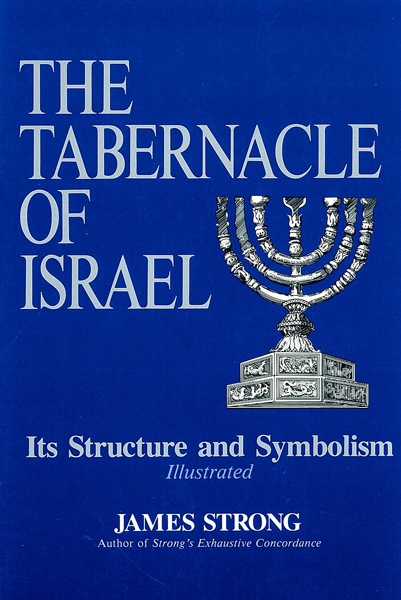
the-tabernacle-of-israelIf you have ever used the Strong’s Exhaustive Concordance Of The Bible, you are probably familiar with the work of Dr. James Strong. By the way, if you haven’t used this concordance, it is 1500+ pages listing every word in the Bible and their Hebrew or Greek word and definition. By contrast, Dr. Strong’s book on The Tabernacle Of Israel is only 170 pages, but it’s just as jam-packed with helpful information.

I was recently reading through the books of the Bible where God gives Moses highly specific instructions for the portable Tabernacle that is to be used for the Hebrews to conduct their worship services. This temporary Tabernacle not only served them while they sojourned in the wilderness for 40 years, but it became the pattern for the brick-and-mortar Temple that King Solomon built years later, and its pattern is referred to again in the New Testament book of Hebrews as being a pattern of the worship in heaven. Obviously this is a significant thing!

Dr. Strong uses his extraordinary skills to compile an easy-to-follow study of the design guidelines, building materials, and exact layout of this Tabernacle. He uses not only the biblical accounts, but also augments his work with extensive archeological discoveries.

Then to wrap up the book, Dr. Strong talks about the significance of the layout, colors, materials, and even mathematical significance of the Tabernacle’s design, showing how it still impacts the New Testament Christian to this day.

This is an academic book, but it is well worth your time if you would like to get a more in-depth knowledge of the Tabernacle which God commanded Moses to build.
One Word

RedemptionWhen it comes right down to it, there is really just one word that makes Christians peculiar. Just one word changes our citizenship from Earth to Heaven. One word took us from a path where our sins had us headed toward an eternity in Hell.

Jesus stepped in where He didn’t have to go. Jesus became our sin to pay-off our sin debt. Jesus took us back from satan’s possession, and made us a part of His Father’s family.

Jesus redeemed us! 

I wonder if we truly understand that word redemption?

Peter is speaking to us as “strangers here in reverent fear” on Earth, and he calls us to live up to God’s call—Be holy, because I am holy (1 Peter 1:16; Leviticus 11:44-45). He asks us to obediently follow God’s Word (1:22), to get rid of Earth-bound things (2:1), and instead taste that the Lord is good (2:3).

Why? Because we’ve been “redeemed from the empty way of life…by the precious blood of Christ” (1:18-19) We don’t live holy lives to try to earn redemption, but because we have been redeemed we are now capable of living holy lives!

To help illustrate his point, Peter quotes a couple of verses from Isaiah 40. In this chapter, we are invited to weigh the greatness and love and knowledge and power of God against the things we can provide for ourselves on Earth. Please check out the video below, where I go through this 40th chapter of Isaiah.

If you’ve missed any messages in this series, you may find the complete list by clicking here.

If … But If … If … But If …

IfNo, I’m not repeating myself; I’m just quoting the pattern in the Bible (specifically Leviticus 26).

God’s laws are inviolate. No conditions will be made, nor any exceptions allowed. The conditions in Leviticus 26 apply as much to the Israelites in 1400 BC as they do to us in the United States of America today.

IF we obey God’s Word, He will bless us with His favor (verses 3-13).

BUT IF we disobey, He will set His face against us (verses 14-17).

IF we continue to harden our hearts and remain unrepentant, God’s punishments will grow increasingly more severe (verses 18-39).

BUT IF we repent wholeheartedly, God will again restore us (verses 40-45).

It’s time for us in America to wake up to this reality! If God held His chosen people, the Israelites, to this, how much more so will He not hold us to it.

We in America have violated God’s principles for too long. We have clearly moved through the first IF and BUT IF stages. I believe we are now in the second IF stage. But the hopeful news is that there is still another BUT IF stage for us to obtain, if only we will repent and ask God’s forgiveness.

It starts with me and with you. Will you join me in asking for repentance and praying for God’s favor to visit us once again?

Distinguishing

DistinguishingA week ago I blogged about why some people avoid reading some of the Old Testament books because they seem tedious, or even out-of-date. But if you look at the Old Testament through the light of Jesus, you will find a rich beauty in its pages.

In Leviticus 11 God lists all kinds of food that is considered clean or unclean, and the proper ways to prepare and eat certain foods so as to not become unclean.

I believe one of the reasons God gave the commands for clean and unclean food was to cause His people to pause. Instead of just gobbling up what was in front of them, without any thought as to what it was, they would have to slow down to distinguish. God even said, “You must distinguish” (Leviticus 11:47).

Slowing down gives time for thankfulness too. How many times do I grab whatever is close by when I’m hungry? I shove anything in my mouth just to satisfy an immediate hunger, but there is no distinguishing, no thought, and no gratitude.

If I were to pause long enough to distinguish, how much healthier and grateful might I be?

What Are Rules For?

Listen to the podcast of this post by clicking on the player below, and you can also subscribe on AppleSpotify, or Audible. 

David is on the run from Saul. He leaves town so quickly that he didn’t have time to kiss his wife goodbye. He didn’t even have enough time to grab a weapon, a change of clothes, companions, or food. So he stops by Ahimelech’s house to see if this priest has any food.

Remember this old nursery rhyme?

Old Mother Hubbard
Went to the cupboard,
To give the poor dog a bone:
When she came there,
The cupboard was bare,
And so the poor dog had none.

That’s just about what happened here. Ahimelech said, “The only bread I have is the holy showbread.” This consecrated bread was 12 loaves laid out each Sabbath in God’s presence. When this bread was replaced each week, it became food for the priests. Ahimelech recognized he had a moral obligation to save David’s life which superseded the ceremonial rules.

Jesus used this incident as an example when the Pharisees accused Him of breaking the law concerning the Sabbath day. Jesus and His followers had been walking through a wheat field, plucking some pieces of grain on which they could munch. The rule-keeping Pharisees said this amounted to work, and a violation of Sabbath rules.

I think sometimes we get so caught up in keeping the rules (or following tradition, or preserving decorum) that we forget the meaning behind the rule. Or, more accurately, we forget God’s design behind the rule.

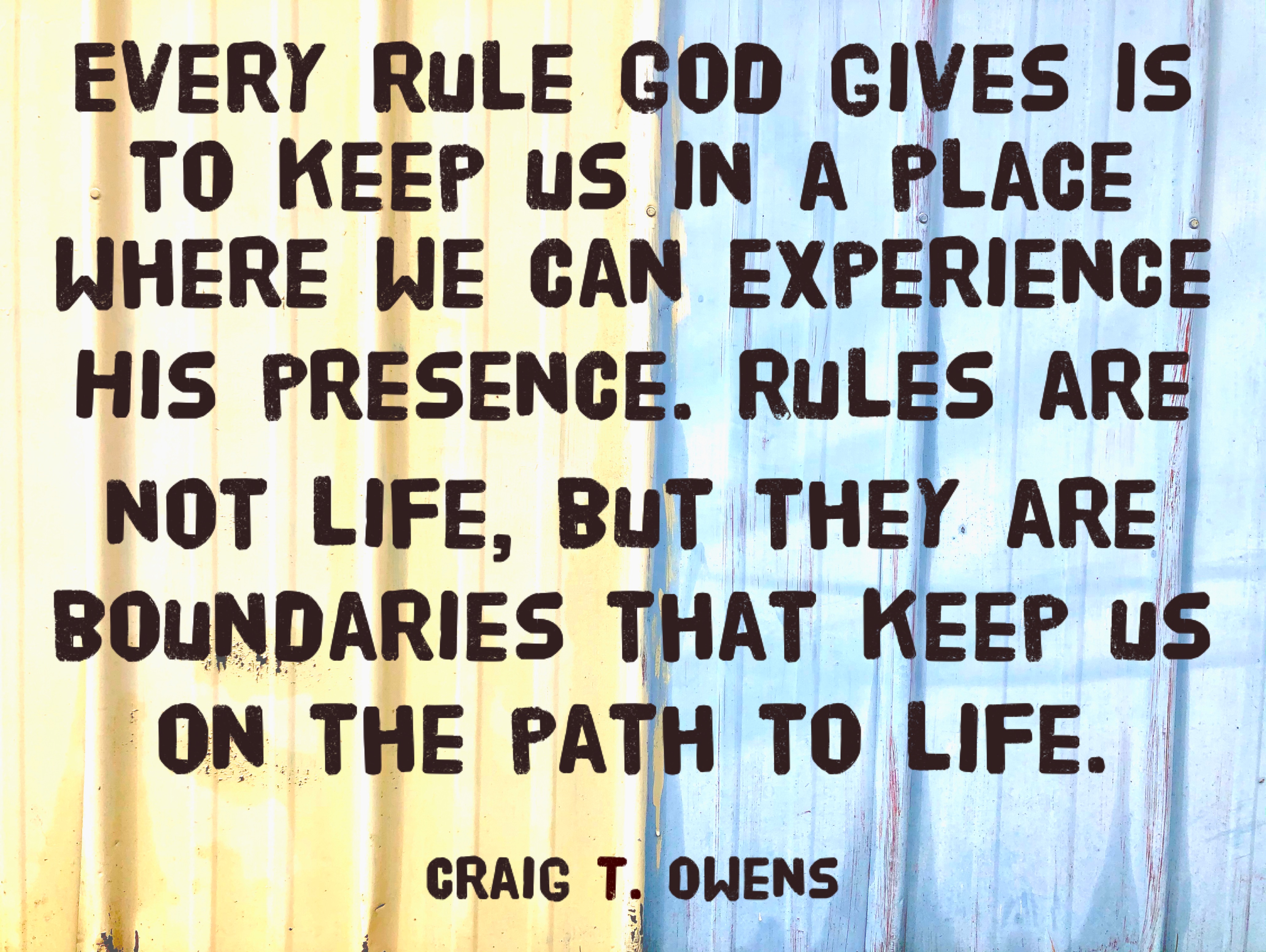
Every rule God gives is to keep us in a place where we can experience His presence. Rules are not life, but they are boundaries that keep us on the path to life.

Ahimelech kept David alive with showbread. Jesus and His disciples sustained themselves with wheat kernels. Jesus healed the sick on the Sabbath to bring life and wholeness.

Following rules just to follow rules misses the point. What is the point? Following God’s rules to find God’s heart is THE point.

So let me ask you: Do you get the point?

You may also want to check out series on God’s rules called The Love In The Law, or the post called Rules Are Overbearing—Love Never Is.

►► Would you please prayerfully consider supporting this ministry? My Patreon supporters get behind-the-scenes access to exclusive materials. ◀︎◀︎

Necessary Or Additional?

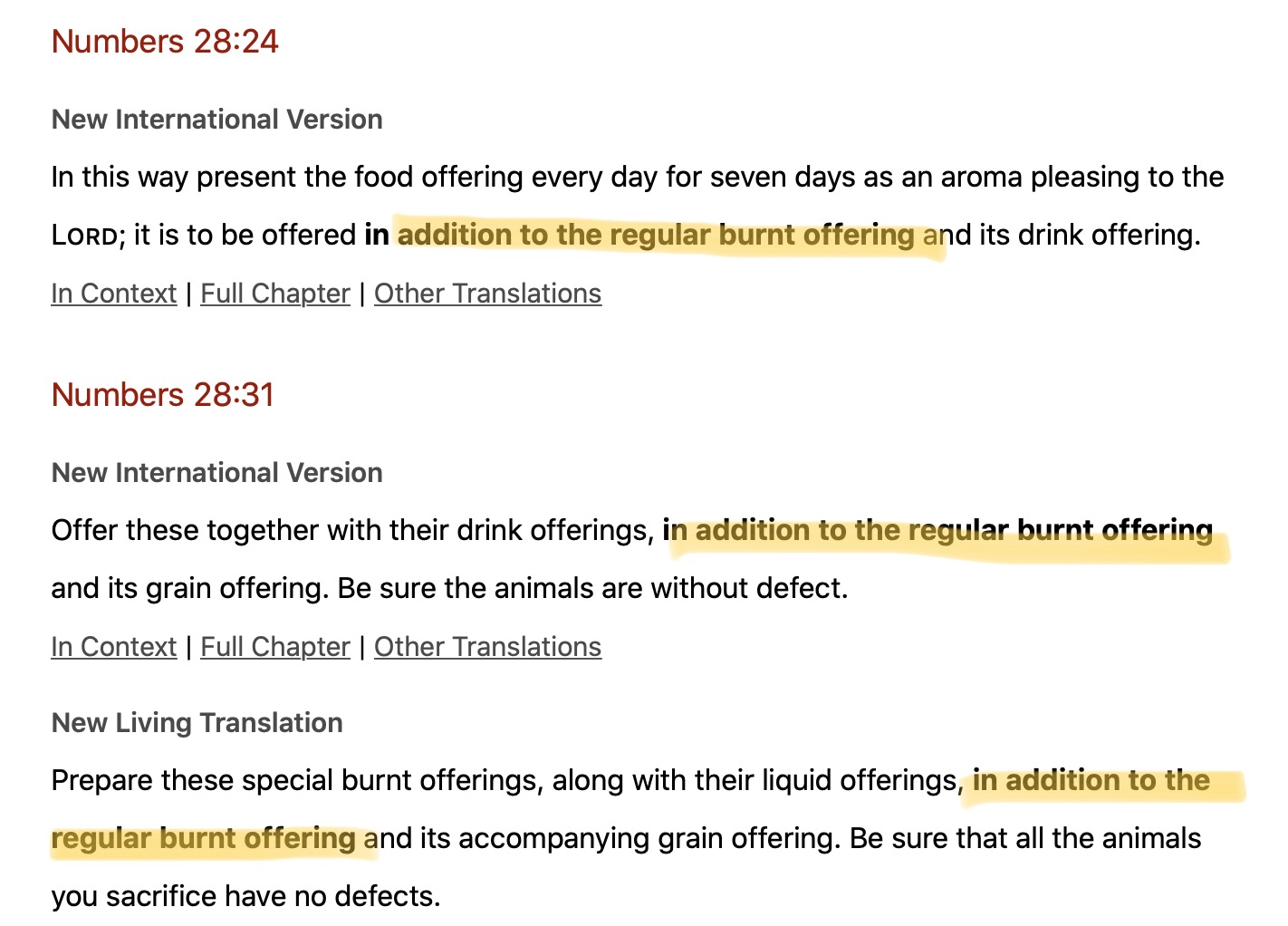
In listing the sacrifices that the Israelites were to bring to the tabernacle, a repeated phrase kept jumping out at me:

…in addition to the regular burnt offering…

There was one daily offering that was necessary every day, then there were other offerings that were additional.

Here’s the principle:

The additional should never take the place of the necessary if the additional is crowding out the necessary.

There are some things that are necessary for me every day: my devotional time, my personal prayer life, time with my wife, time with my kids, and a few other necessaries.

There are some things that are additional for me: a church project, a community event, a committee or club. You get the idea.

There is nothing wrong with the additional UNLESS the additional is crowding out the necessary.

What is necessary for you? What are the additional things you have added?

Always remember: The additional should never take the place of the necessary. If your additional is crowding out your necessary, it’s time to make some changes.

Synergy

The dictionary defines synergy as the combined action of two items, where their output is greater than the sum of their individual efforts. I like the Bible’s definition better:

Five of you will chase a hundred, and a hundred of you will chase ten thousand, and your enemies will fall by the sword before you (Leviticus 26:8).

God’s synergy has an “if” attached to it. A few verses earlier God says, “If you follow Me and obey My principles, then this is what you can expect from Me.”

So God’s synergistic math looks like this:

5 = 102 = 104

Five people motivated by their devotion to God and trusting Him for victory = 100 enemies defeated.

One hundred people doing the exact same thing = 10,000 enemies defeated.

The first synergy is a 20-fold increase, while the second synergy is a 100-fold increase! The more people that buy into this truth, the greater the synergy.

Imagine if you could get just four other people to join you in prayer and in seeking God for…

  • …the lost in your city
  • …the healing of an “incurable” diseases
  • …the alleviation of poverty
  • …the strengthening of marriages
  • …the end of abortion

Imagine!

God’s synergy is an amazing thing! Be a part of it!

Stopping More Than Enough

There’s a well-known line from the movie Wall Street in which the up-and-coming Bud Fox asks his rich mentor Gordon Gekko, “How much is enough?” By his words and actions, Gordon answers, “It’s never enough, pal!”

The pursuit of More Than Enough is beyond greed. It’s what both the Bible and the Greeks called Mammon: the relentless pursuit of More. It’s an easy trap in which anyone—young or old, rich or poor—can get caught. But God gave us a way out:

When you reap the harvest of your land, do not reap to the very edges of your field or gather the gleanings of your harvest. Leave them for the poor and the alien. I am the LORD your God.

God wants us to acknowledge that He is Provider by deliberately leaving something behind.

Let me state that another way: God provides our daily bread, if I have anything that is More Than Enough, it’s not for me—it’s for others.

This is yet another work-in-progress for my life: I am thinking about how I can deliberately leave the More Than Enough behind for someone else? I have a couple of thoughts, but would love you to expand on this list:

  • Leave a larger tip for my server at the restaurant.
  • Pay for the people in the car behind me in line at the drive-thru.
  • Continue to be a proud member of the Junky Car Club, so I can use my car payment money to help others.
  • Find out what one day of work really earns me, and then give up just one day a month to help others (see One Day’s Wages).
  • Order less food at McDonald’s and giving a donation to The Ronald McDonald House.
  • When I have a buy-one-get-one-free coupon, give the free one away to someone in need.

That’s just the start of my list.

I want to honor God and I want to defeat the More Than Enough monster. I can do both by deliberately leaving something behind. Will you join me?

(And feel free to continue to add to the list of ways we can all deliberately leave something behind.)

Learning To Distinguish

In Moses’ instructions to the priests, he said, “You must distinguish between the holy and common, between the unclean and the clean.”

Why? Because these men were to be leaders. He went on to say, “You must teach the Israelites all the decrees.”

If I’m going to be a leader, I must be able to distinguish.

Here’s where the Holy Spirit is challenging me. I am working on distinguishing between…

Good and Best

Acceptable and Excellent

Common and Holy

Ordinary and Extraordinary

Want and Need

Present and Participant

Quantity and Quality

I am certain that this list is just a start, and that it’s going to be a lifetime pursuit.

Mmmm, You Smell Good

Smell is one of the most potent of our five senses. It is strongly tied to memory and emotion. Maybe that’s why a “smelly phrase” appears so often in God’s requirements for the sacrifices the Israelites would offer Him:

An offering made by fire, an aroma pleasing to the Lord….

As a New Testament follower of Christ, instead of bulls or sheep or goats or birds, I have something more valuable to sacrifice to God: myself.

When I offer myself to God, it’s a powerful aroma that is pleasing to the Lord. Check this out:

Therefore, I urge you, brothers, in view of God’s mercy, to offer your bodies as living sacrifices, holy and pleasing to God—this is your spiritual act of worship. (Romans 12:1)

But thanks be to God, who always leads us in triumphal procession in Christ and through us spreads everywhere the fragrance of the knowledge of Him. For we are to God the aroma of Christ…. (2 Corinthians 2:14-15)

Offer your entire self to God and you’ll smell really good to Him.

WARNING: In order for a sacrifice to release its full fragrance it has to go through the fire. It’s especially true in the tough times that you can release the best aroma of Christ. So don’t run away from the challenging times—stay in them and release your God-pleasing aroma.

You are the pleasing aroma, so go smell good today!