Listen to the podcast of this post by clicking on the player below, and you can also subscribe on Apple, Spotify, or Audible.
“…the Jews there tried to stone You, and yet You are going back?” (John 11:8).
The disciples were sitting around Jesus contemplating the next steps when they heard the news that Jesus’ friend Lazarus was sick and on death’s doorstep.
This statement seems to be a very logical thought. At least it is logical from a human perspective. But God sees wider, farther, and deeper than we ever will, so His logic is both perfect and limitless.
Yes, the Jews had tried to stone Jesus (8:59; 10:31, 39), and for mere men operating and thinking as men, staying away from danger is a logical conclusion.
But Jesus was on-mission from His Father (5:19). He had to go to Bethany because the sickness of Lazarus “will not end in death. No, it is for God’s glory so that God’s Son may be glorified through it” (11:4). Later, at the tomb of Lazarus, Jesus prayed, “This is for the benefit of the people standing here, that they may believe that You sent Me” (v. 42). When the dead Lazarus was returned to life and came out of the grave, God indeed was glorified!
Jesus declares that when we walk with Him, we always walk in the light (v. 9). This is because He IS the light of the world (8:12; 9:5). And as we walk with Him, we too bear the light wherever He calls us to walk (Matthew 5:14).
To walk in our own logic is to stumble in the darkness (John 11:10). We calculate and plan from a place of scarcity and fear. As a result, we stumble right past—or we sit still out of fear—and miss the opportunities for God’s glory to be displayed.
My logic always has a dark edge that I cannot see past. But the logic of God has no dark places because He can see from beginning to end perfectly.
I must daily walk in His light, even into those places where my limited logic would tell me to avoid. It is there that I will be able to witness God’s glory that I wouldn’t have seen had I sat still in my “safe” place.
Listen to the podcast of this post by clicking on the player below, and you can also subscribe on Apple, Spotify, or Audible.
We’ve all heard people make some audacious claims. But the real power is in being able to back up those claims. Without any proof, it’s all talk! As things were coming to a conclusion for Christ’s ministry—at least in the world’s eyes—there were some bold claims being made. Some were made by Jesus Himself, some by His rivals, and some by His supporters.
The first bold claim we’re going to consider was made by the high priest: a man named Joseph Caiaphas.
The Sanhedrin was the highest court in the land and was made up of 70 + 1 men. This comes from Numbers 11:16-17 (seventy leaders) plus Moses. After Moses, another person was always appointed to serve as the leader, which was usually the high priest.
By the time of Jesus, this ruling body had become more political than religious. Very frequently, leadership would change because of the whims of the Romans or their puppet leaders (someone like a King Herod). The high priest in Christ’s early years was a man named Annas, who served from AD 6-15. During all of the public ministry of Jesus, the high priesthood had transferred to Caiaphas (AD 18-36), who was Annas’ son-in-law. Yet both of them still shared considerable influence (see Luke 3:2; John 18:13, 24; Acts 4:6).
Caiaphas and his family were Sadducees. They didn’t hold to any beliefs of the supernatural—no angels or demons, no resurrection, no afterlife. Partly because of these unscriptural beliefs, the Jewish Qumran, who safeguarded the careful copying of the Scriptures, called Caiaphas “the wicked priest.”
Annas, Caiaphas, and their family member were the ruling party that wanted to stay in power. So their activities were always a balancing act: Trying to keep the Jewish community happy on one hand, while not offending the Romans or other political leaders on the other hand.
It’s with this backdrop that we read the story of Lazarus’ resurrection in John 11. Jesus knew this miracle would validate His ministry, and sure enough, after the resurrection of Lazarus, more and more people put their faith in Jesus. So much so that the religious leaders wanted to kill both Jesus and Lazarus (11:53; 12:9-11).
Ironically, these same religious leaders had previously asked Jesus for a sign to prove He was who He made the bold claim to be. To this demand, Jesus said that He would give them “the sign of Jonah” who was considered dead in the belly of the fish before he was “resurrected” to complete his mission (Matthew 12:38-40, 16:1-4).
Since the religious leaders viewed everything through a political lens, they thought Jesus was also going to instigate a political or military uprising. The following that Jesus would gather would challenge the Sanhedrin’s hold on power, so Caiaphas proposed a political solution disguised as a prophecy (John 11:49-53).
Caiaphas meant it like this: “We’re trying to keep the balance between the Jewish people and the powerful Romans. If we kill one Man (Jesus) in time, we may be a little out of favor with the Jews but we will save our position with the Romans. Later on, we’ll make things right with the common people.”
Even to this day, people are trying to balance, juggle, control, appease, and bargain their way to get or keep the life they want to live. They will use religious dressing to do political things, thinking they will “make it right” later on.
Caiaphas made this bold claim: “If Jesus dies, our position will be saved for us and our children.” But he had no power to back up his bold claim, so it was just talk.
But Jesus made this bold claim: “I will die so that your souls can be saved for eternity.” He, on the other hand, had the power to back up His bold claim (John 10:17-18).
Caiaphas’ plan sounded like it would be the end of Jesus and His mission, but “the end” was really just another step in fulfilling what God had already planned!
Let me say it again: God’s plan always prevails. The bold claims of powerful evil people may make it seem like the end is near, but don’t fret because their “end” is only fulfilling God’s plan!
Listen to the podcast of this post by clicking on the player below, and you can also subscribe on Apple, Spotify, or Audible.
Have you ever heard this truism: The person with an experience is never at the mercy of the person with an argument?
There are, sadly, many who deny the reality of God’s divine healing for today. They may say God healed in the past, but that age has passed, or they may simply deny all supernatural activity. I have the best reply to these skeptics or deniers—and you may have this same reply: God does heal today; I know this is true because He has healed me!
Our truth statement about this says: “Divine healing is an integral part of the gospel. Deliverance from sickness is provided for in the atonement, and is the privilege of all believers.” Let me break this down into three parts.
(1) “Divine healing is an integral part of the gospel.” After that word “integral” I’d like to insert the word “indisputable.” When God does the miraculous, it is an undeniable proof of His love and power. A great story to prove this point is when Jesus healed a paralytic after He forgave him of his sins (Luke 5:17-26).
Notice how the people responded: Everyone was amazed and gave praise to God. This glory to God has always been the reason God performs miracles (see Mark 6:7-13; Acts 2:43; Acts 3:9-12).
(2) “Deliverance from sickness is provided for in the atonement.” I like to remember that the word atonement means “at-onement” and stands opposed to disease which I like to say as “dis-ease.” Sin is our ultimate dis-ease—the ultimate separator—so Jesus took care of both our spiritual dis-ease and our physical dis-ease when He died on the Cross for us, just as Isaiah prophesied. That’s why the New Testament also shows us salvation and healing frequently being linked together (Acts 10:38; 8:4-8).
(3) “And is the privilege of all believers.”ALL believers, not just a select few and not just those who lived at the time of the first apostles.
Divine healing has been—and always will be—an integral and indisputable part of the gospel precisely because it exalts God as THE Healer.
Many people today still believe what the disciples of Jesus believed: Disease is a consequence of personal sin. In addressing this misunderstanding, Jesus said that disease was “so that the work of God might be displayed” in the life of the one about to be healed. He said something similar while at the graveside of Lazarus, before he raised that dead man back to life (John 9:1-38; 11:4-45).
Sometimes God heals us now, but ALWAYS He heals us in our glorified bodies (2 Corinthians 12:9-10; 5:1-9; Revelation 21:4). Our patience and hope in our future, ultimate healing glorifies God in the present.
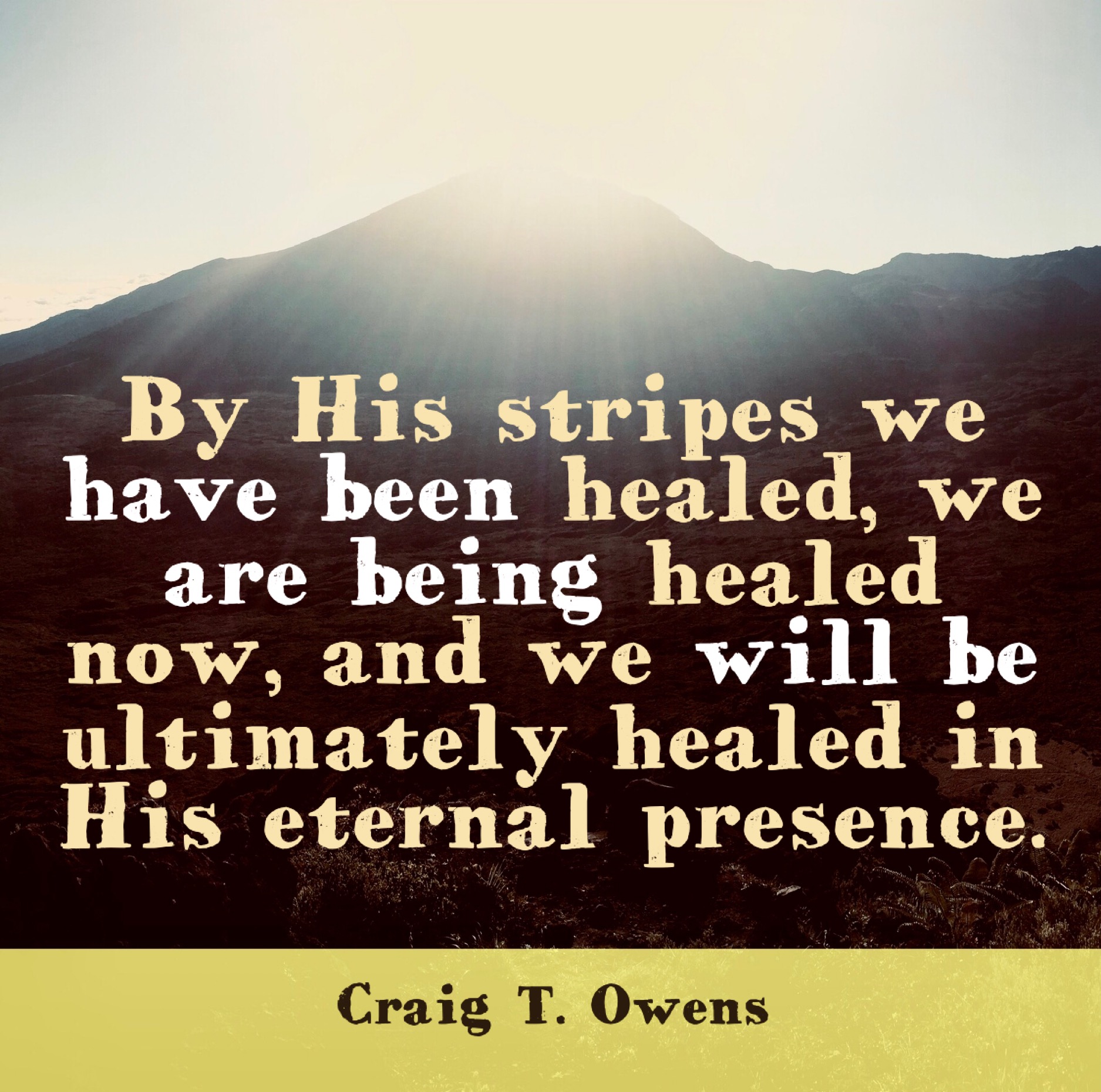
By faith in Jesus we can claim that “by His stripes we have been healed” (1 Peter 2:24). The verb tense Peter uses means we have been healed, we are being healed now, and we will be ultimately healed in Christ’s eternal presence. Whether we are healed here or not, we can live knowing that His healing power always brings Him glory and always draws people to Him, so don’t hesitate to keep on asking Him for His healing touch on your body and soul.
Did you know among Americans the fear of death is only #2 on the list? Yep, 68% of people list this as their top fear. What could be more fearful than death?! Believe it or not, the #1 fear—listed by 74% of people—is public speaking! (Followed in a distant third place by the fear of spiders by only 30% of people).
Why would people fear speaking more than death? Maybe because they don’t think they have anything to say.
But if you almost died, or had a near-death experience, or even temporarily crossed over to the other side, don’t you think you’d have a story to tell? And don’t you think lots of people would want to hear your story? And wouldn’t you want to tell it to as many people as you could?
In other words, if you could stare down death and come back from the brink, you would not only overcome your fear of death, but your fear of public speaking too!
In John 11 there is the story of a man who not only had a near-death experience, but he actually died. In fact, he was dead for over four days! Lazarus was a part of a family that loved Jesus, and the Bible says that Jesus loved them dearly too.
Prior to this account of Lazarus’ death, there is no mention in Scripture of him speaking at all. He was clearly one who suffered from the fear of public speaking, and quite possibly the fear of death too. But after Jesus raised him from the dead, the Bible says large crowds came to Lazarus’ hometown of Bethany to hear his amazing back-from-the-dead story. And not only that, they began to put their faith in Jesus because of his story! (see John 12:9-11).
We have a back-from-the-dead story to tell too.All of us have sinned against God (Romans 3:23), and because of that we are under a death sentence for our sins (Romans 6:23). But when we put our faith in what Jesus did on the Cross for us, and we ask God to forgive us of our sins, we have been brought back to life!
We have looked death square in the eyes and laughed!
Death is swallowed up in victory.O death, where is your victory? O death, where is your sting? (1 Corinthians 15:54-55)
Now our darkest valleys—even our valleys of death—have no fear for us. The Lord is our Shepherd … His goodness and mercy follow us all the days of our lives AND we shall dwell in the house of the Lord forever!
Not only should you not fear death, you shouldn’t fear public speaking. If you have been forgiven of your sins, you have a back-from-the-dead story to tell.
People need to hear your story! Why? Because they’re scared of death! So tell them about the love of a Savior that rescued you from death.
I invite you to join me next Sunday as we continue to celebrate Jesus Christ’s victory over death!
I loved this book! Please read my full book review of God’s Favorite Place On Earth by Frank Viola by clickinghere, but my one-word review is: Wow!
Here are a few quotes that especially caught my attention—
“Jesus talked a lot about losing, taking up our cross, denying ourselves, and laying down our lives. These are the fruits of brokenness before God. It’s not hard to spot a Christian in ministry who isn’t broken. Unbroken people don’t know how to lay their lives down and lose. They only know how to try to win. If they’re criticized they retaliate. If they’re attacked, they return fire. If misunderstood, they defend in anger. They are capable of doing all sorts of damage to others in order to save their own ministries and keep their reputations.
“On the contrary, people who have been broken by the hand of God know how to turn the other cheek. They know how to go the second mile. They know how to give their coats when asked for their shirts. They know how to speak well of those who misrepresent them. They know how to return good for evil. They know how to lose. And in so doing, they exhibit the Spirit of the Lamb and allow God to win.”
“All service must flow out of a razor-sharp desire to please God rather than a desire to get noticed by others. If it does not, it will lead to either complaint or criticism.”
“As high as God is going to elevate you is as deep as He digs to lay the foundation. Sometimes the brightest light comes from the darkest places. And what doesn’t destroy you ends up defining you in some significant way.”
“Suffering is worldwide and neck deep. But for the Christian, suffering has a special purpose. It’s the chiseling of God designed to transform you into the image of His Son.”
“A Spirit-led man or woman is someone who has faced tragedy, faced loss, looked unbearable and exquisite pain in the face … and has stood his or her ground. With their garments still smoking, these men and women have said before God, mortals, and angels: ‘It is well with my soul. God’s enemy has thrown his best at me, and I’m still here. I’m still on the Rock. I’ve not sunk. I’m still standing. I’ve not been destroyed, and I’ve not gone under. I will continue to follow my Lord, come hell or high water, He is still on the throne!’”
“Christ saves as the Son of God, but He feels as the Son of man.”
“Faith often takes a nosedive when we are on the brink of tragedy. At such times, we forget the Lord’s words. Sometimes confessions and creeds, as important as they are, are not enough to move God to act. Only falling at His feel and weeping will suffice.”
“Every crisis in our lives is an opportunity to broaden, deepen, and heighten our revelation of Christ.”
“Basing your faith on God’s performance—what you think He should do according to what you’ve been taught about His promises—is a profound mistake. … Thus the only solid basis for unwavering faith and an unshakable devotion is to believe that God is … and that He does ‘all things well,’ no matter what takes place.”
“Christians aren’t saved from troubles or delivered from problems. We have been given an ascendant life to rise above them.”
“Sharing what one has with others is what keeps our hearts detached from earthly treasures.”
God’s Favorite Place On Earth by Frank Viola is one of those rare books that I could hardly put down! This is easily one of the most interesting looks at the earthly life of Jesus Christ that I have read in quite awhile.
This book focuses on the visits that Jesus made to the village of Bethany, and the family that lived there with whom Jesus spent considerable time. In fact, some of the most loved stories from Christ’s public ministry took place in Bethany; specifically, the raising of Lazarus from the dead, and the pre-crucifixion anointing of Jesus by Mary.
God’s Favorite Place On Earth doesn’t fit neatly into one literary genre. Each visit Jesus made to Bethany is told in first-person narrative form through the eyes of Lazarus. Although none of his words are recorded in Scripture, the way he “speaks” in this book makes the scriptural text come alive in a very tangible way.
After Lazarus tells his story, Frank Viola then steps in to help us apply that visit of Jesus to our lives. He makes the connection between the historical village of Bethany, and our hearts becoming a modern-day, present-tense Bethany for Jesus to visit and to minister.
So the book was simultaneously enlightening, inspiring, and immediately applicable. To help further the conversation, there are some great discussion questions included at the back of the book.
For a unique look at the ministry of Christ both in historical Israel and in your life in present-day, I believe you too will thoroughly enjoy this book!



 “…the Jews there tried to stone You, and yet You are going back?” (John 11:8).



 Craig T. Owens