Jesus gave us ample evidence of His bodily resurrection. This is a recreation of a chart found in The Quest Study Bible:I also previously shared an infographic from The Infographic Bible. The historicity of the life, death, and resurrection of Jesus is firmly established making it a historically verifiable event.
Jonah is the only narrative in the minor prophets. He was a prophet during the reign of Jeroboam II when Israel was temporarily growing in strength. He is the first of Israel’s prophets to be sent to a non-Jewish population.
Critics have raised questions about this book. Questions like: Did Jonah write this book himself or is it just a story about him? Is this book historical or allegorical?
The five biggest objections that are raised to Jonah’s historicity are:
The hyper-nationalistic feel is more like when Ezra and Nehemiah led people back to Jerusalem after their captivity in Babylon, and not during the time of Jeroboam II.
Parts of Jonah appear copied from the prophet Joel.
There are no (or incorrect) details about the major city of Nineveh that Jonah visited.
There are no extra-biblical historical records of a revival in Nineveh.
Jonah was swallowed by a fish?!
I think there are very good reasons to believe that Jonah was both autobiographical and historically accurate.
First, there was a revival of sorts (although not religiously) in Israel during the time of Jeroboam II. This was a time that Israel felt like it could flex its muscles again, so Jonah would not be acting out of character to be so pro-Israel.
Second, Jonah 3:9 and Joel 2:14 sound similar, but scholars cannot tell which was written first. Couldn’t God amplify a message? Consider how many parts of the Gospel of Mark are used in the Gospels of Matthew and Luke. And it’s a regular practice for authors even today to directly quote other sources.
Third, regarding the lack of details about Nineveh, the biblical writers give very few details of any places outside of Israel or Judah. The only “incorrect” detail skeptics point to is Jonah 3:3 stating that the city was so big that it would take three days to walk around it. Nineveh was a city of about 120,000 inhabitants, so it could easily take three days of walking and preaching in order to get the message to everyone.
Fourth, the revival in Nineveh was clearly short-lived. Jonah was probably in Nineveh around 760 BC. Assyria was rising politically and militarily during that time and defeated Israel just 40 years after Jonah’s preaching. Assyria itself was then defeated in 605 BC.
Finally, Jonah was swallowed by a fish?! The root word for fish in Hebrew means something that has grown to such an enormous size that it overshadows everything else. But notice that what caused the sailors to be in awe of God was not the whale/fish swallowing Jonah, but the immediate calming of the ocean when Jonah was thrown overboard (Jonah 1:15-16). Miracles appear throughout this book. And throughout the entire Bible!
Why should the appearance of miracles surprise us? Some people have a bias against the supernatural, where they wrongly believe that we can know everything through naturalistic means. C.S. Lewis pointed out, “I use the word Miracle to mean an interference with Nature by supernatural power. … Nature as a whole is herself one huge result of the Supernatural: God created her.”
I don’t think this story is a parable or an allegory because nowhere else in the Bible are such details given in the form of a parable.
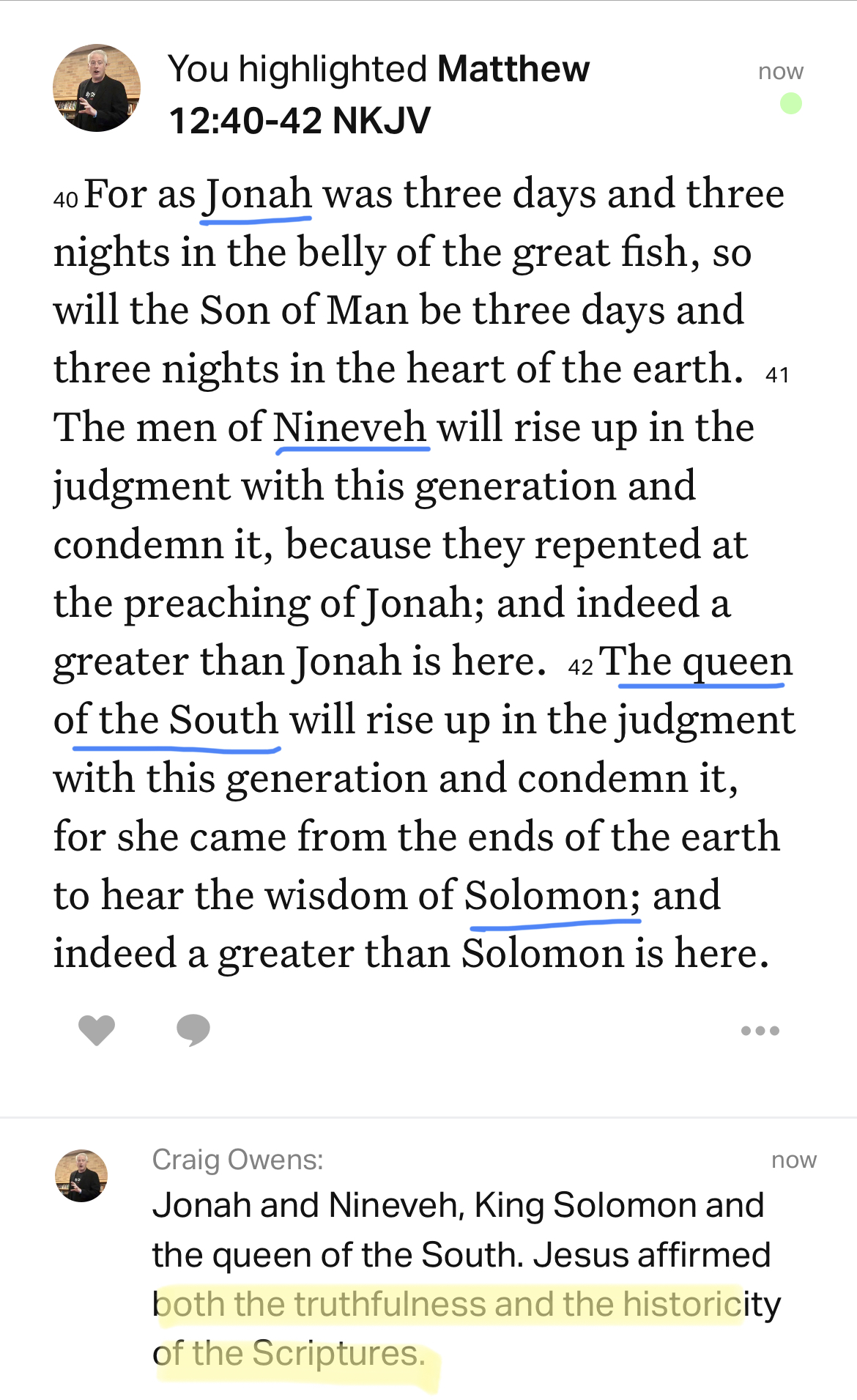
I believe this story is historical because Jesus talked about the historicity of Jonah in the same breath as He talked about other historical people: the Queen of the South and Solomon (Matthew 12:38-42). Jesus clearly viewed Jonah as historically reliable and accurate. To call Jonah into question is to call into question the truthfulness of Jesus Himself!
History matters because all of History is God’s story!
Our belief in the message of the Bible is not based upon “once upon a time” or “a long time ago in a galaxy far, far away.” It’s based upon real people in real places, especially the historicity of Jesus (notice all of the historical details Luke lists in the birth account of Jesus).
Jonah was clearly one of those historical people, in an historic place, and at a precise moment in world history that tells the story of Jesus and our redemption which He purchased!
If you want to check out all of the messages in our series on the major lessons from the minor prophets, you can find that list by clicking here.
I believe Halley’s Bible Handbook may have been the first Bible study resource I got my hands on when I was a pre-teen. It was a slender book but packed with insights that even this third-generation Pentecostal boy hadn’t heard before. So I was quite intrigued when I heard about Halley’s Study Bible.
Let me get something out of the way right upfront. I’m a blogger for the BibleGateway Blogger Grid (sometimes called #bgbg2 on Twitter), so I’m occasionally offered a free book in exchange for my honest book review. However, there are more books that I pass on than books I agree to review. Since I am already working my way through the Faithlife Illustrated Study Bible, I wasn’t too eager to dive into another study Bible just yet. But I’m so glad I did!
Reading Henry Halley’s concise overview of each book of the Bible was nostalgic for me, reminding me of what initially intrigued about his handbook: taking voluminous information and giving such a clear, concise overview.
The study notes on each page offer fascinating insights, and the unique perspective Halley offers of the people, places, and practices chronicled in the pages of Scripture are unparalleled. And what I especially appreciate is Halley’s whole-Bible approach. By that, I mean his ability to show you a theme that originates in the Old Testament and finds its fulfillment in the New Testament, showing how all of the Bible is interconnected.
If you are looking for a new way to study your Bible, I highly recommend Halley’s Study Bible to you.
One of my favorite stories in the Bible shows God’s role in world events, and how the obedience of His people fits into God’s plan. Yet this story doesn’t even mention God by name!
It’s an important reminder that we don’t have to say, “God’s at work here” for God to be at work here. We don’t have to say, “I’m a Christian” to live in a Christlike way.
Have you ever read the story of Queen Esther and her cousin Mordecai? Let me tell you, this is a real page-turner of a story! If you already know the story, skip to the four lessons below. Here’s a quick recap (but you really should read this for yourself)…
King Xerxes is the ruler of the most powerful nation on earth
Queen Vashti (Xerxes’ wife) defies him and is deposed
When the king is looking for a new queen, a young lady named Hadassah catches his eye
Hadassah went by her Persian name of Esther, so the king didn’t know he married a Jewess
Mordecai was Esther’s cousin, her legal guardian, and a palace worker
Mordecai uncovered a plot to assassinate Xerxes, which he shared with Queen Esther, who told the king, who investigated and had the plotters killed
King Xerxes had a prime minister named Haman, who was really full of himself
Mordecai wouldn’t bow down to Haman because Haman thought of himself as a deity
Haman wanted to show Mordecai, and all the other Jews like him, who was boss so he deceived King Xerxes into signing a law that would allow for all the Jews to be killed on a set date
Mordecai again told Queen Esther about the plot, but the queen was scared to go before the king unsummoned (where the penalty for doing so could be death)
Esther finally had the courage to approach Xerxes and invite him and Haman to dinner
At dinner, the king asked Esther why she really invited him to dinner, and Esther said, “Come back to dinner tomorrow night and I’ll tell you then”
King Xerxes couldn’t sleep that night so he asked for the royal chronicles to be read to him
The king discovered that Mordecai had never been rewarded for uncovering the assassination attempt
Xerxes asked Haman what he should do for a man he wanted to honor; Haman thought the king was talking about him, so he gave an elaborate plan of recognition, to which the king replied, “Excellent! Go do all that for Mordecai!”
Haman was so ticked off that he built a 75-foot tall gallows on which to hang Mordecai
At the second dinner, Esther asked for her life to be spared; the king wanted to know who would presume to attack her and the Jews, and she called out Haman
The king stormed from the room while Haman stayed to beg for his life
As the king returned, Haman was pawing at the queen in desperation, so the king’s bodyguards grabbed him
The king found out about the gallows built for Mordecai and gave orders for Haman to be hanged on those very same gallows
Mordecai became prime minister and wrote another law to help save the Jews from annihilation
4 BIG Lessons From Esther for Christians living in a pagan culture today
All of History is His Story. God’s timing to bring all of the key players on the scene at just the right moment is obvious. Even giving the king insomnia at just the right time was a part of God’s plan!
This is a weekly series with things I’m reading and pondering from Oswald Chambers. You can read the original seed thought here, or type “Thursdays With Oswald” in the search box to read more entries.
The Historicity Of The Cross
It is essential to have an historic basis for our Christian faith: our faith must be centered in the Life and Death of the historic Jesus. Why is it that that Life and Death have an importance out of all proportion to every other historic fact? Because there the Redemption is brought to a focus.
Jesus Christ was not a Man who twenty centuries ago lived on this earth for thirty-three years and was crucified; He was God Incarnate, manifested at one point of history. All before look forward to that point; all since look back to it. The presentation of this fact produces what no other fact in the whole of history ever could produce, viz.: the miracle of God at work in human souls. The death of Jesus was not the death of a martyr, it was the revelation of the Eternal heart of God. That is why the Cross is God’s last word.
For God loved the world so much that He gave His One and Only Son, so that everyone who believes in Him will not perish but have eternal life. God sent His Son into the world not to judge the world, but to save the world through Him. (John 3:16-17)



 I also previously shared an infographic from The Infographic Bible. The historicity of the life, death, and resurrection of Jesus is firmly established making it a historically verifiable event.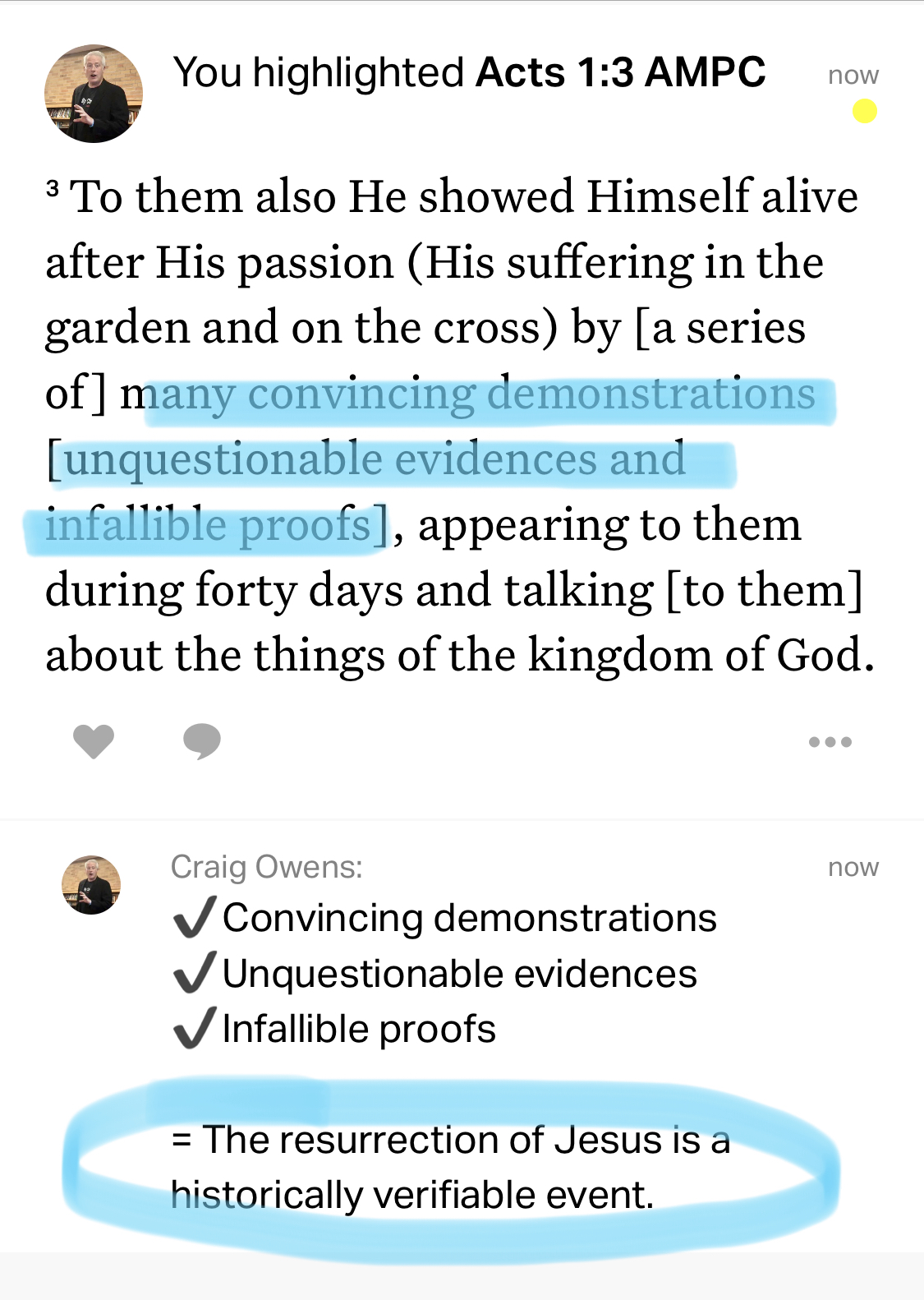




 Craig T. Owens