Caring For Your Soul

Thomas a KempisThe spiritual man puts the care of his soul before all else; and whoever diligently attends to his own affairs is ready to keep silence about others. You will never become interior and devout unless you refrain from criticism of others, and pay attention to yourself. If you are wholly intent on God and yourself, you will be little affected by anything outside this.” —Thomas á Kempis

My dear pastor, by the very nature of our position we are constantly giving out. We are ministering to the needs of others and it is physically, spiritually, emotionally and intellectually draining.

It’s a pretty simple statement: You cannot give what you do not have. You have physical, spiritual, emotional and intellectual limits.

So some simple questions for you to ponder this weekend:

  • What are you doing to care for your own soul?
  • How are you replenishing yourself?
  • After you have emptied yourself in ministry, how are you being re-filled?

If you’d like to share some thoughts in the comments, please feel free to do so.

Do You Like That Feeling?

How do you feel this morning? Are you still feeling good from your day yesterday? I sure hope you are!

Did you know those good feelings are more from your thoughts than they are from anything else? Check out this insight from Jon Gordon—

“Research shows that grateful people are happier and more likely to maintain good friendships. A state of gratitude, according to research by the Institute of HeartMath, also improves the heart’s rhythmic functioning, which helps us to reduce stress, think more clearly under pressure and heal physically. It’s actually physiologically impossible to be stressed and thankful at the same time. When you are grateful you flood your body and brain with emotions and endorphins that uplift and energize you rather than the stress hormones that drain you.”

Let’s see…

  • Happier
  • Better friendships
  • Less stress
  • More creativity
  • Better health
  • More energy

Those sound like great reasons to make every day a day of givingthanksgiving!

Organizational Health

I’m still working through the pages of notes I took during the Willow Creek Leadership Summit a couple of weeks ago. Another speak whom I really appreciated was Patrick Lencioni. I’ve read many of his books, and I think he has such a knack for explaining business principles in a way that seem so easy to process and apply.

Patrick talked about the two needed ingredients for organizational success: things that are smart and things that are healthy. He said that most of the time we cannot do the smart things because we are not healthy enough to do them.

So, how do we make our organization healthy? Here are four disciplines he encouraged us to pursue:

1.  Build and maintain a cohesive team at the top. [This is behavioral alignment.]

2.  Create clarity by asking these questions:

  • Why do we exist? [core purpose]
  • How do we behave? [core values]

These need to be core values, not our aspirational values.

There should only be one or two endemic values.

Core values are those that we will stick to even if we don’t get rewarded for it.

  • What do we actually do?
  • How will we succeed? [strategy]

These are the myriad of intentional decisions we make that help us be successful.

As an example, consider the three strategic anchors for Southwest Airlines: (1) make the customer happy; (2) keep the plane on time; (3) keep fares low.

  • What is most important in our organization right now?
  • Who must do what?

3.  Over-communicate the answer to the above six questions. I love this: Patrick said, “If your people cannot do a good impression of you, you’re not communicating enough.”

4.  Reinforce the system through creative ideas.

The bottom line: “Organizational health provides significant advantages for organizational success.”

I’m working on the application of these thoughts for the organizations I help lead, and I’m really excited to encourage some conversations around these great thoughts from Patrick Lencioni.

Praying For Your Healthy Friends

When do people typically ask you to pray for them? My guess it’s when things aren’t going so well for them.

How about you? When do you usually ask others to pray for you? When things are going well, or when you’re in a tough spot.

Why is it that we usually only think about prayer for sick friends or for friends in desperate need?

The apostle Paul wrote a letter to the Christians at Ephesus to encourage them. This church, as far as we know, wasn’t asking Paul for advice, and they weren’t facing intense persecution. They were mostly a spiritually healthy group.

So Paul wrote this to his healthy friends—

I have not stopped thanking God for you. I pray for you constantly. (Ephesians 1:16)

Paul went on to share with us his prayer for strong, spiritually healthy people (vv. 17-22). He asked God to make his healthy friends even stronger. He asked God to give them:

  • a super-abundance of the Holy Spirit
  • more wisdom and revelation
  • deeper intimacy with God
  • greater hope
  • greater power
  • and more strength

I’m not suggesting we stop praying for people in need. We definitely need to keep doing that. But perhaps it’s time to make a list of your healthy friends, and ask God to give them even more of Himself!

Upside (book review)

Have you ever heard how a TV news producer decides what the lead story will be? Or how a managing editor decides which stories get the front page of the newspaper? It comes down to this: “If it bleeds, it leads.” Sad, but too often true. With all of this negative news leading, Dr. Bradley R.E. Wright’s book Upside: Surprising Good News About the State of Our World is indeed surprisingly good news!

Dr. Wright notes that sociologist Joel Best “classifies the different types of bad statistics as follows: some numbers are bad to begin with; some numbers get bad as they are passed along; and some numbers are chosen because they are bad.” In other words, there’s just a lot of bad news out there!

But despite all of this negative press, people around the world are surprisingly upbeat. That’s because when a sociologist like Dr. Wright gets a hold of all of these statistics, he can put them into the proper perspective. He looks at the data on a variety of topics:

  • Personal finances
  • Education
  • Health
  • Crime and war
  • Marriage and divorce
  • The environment

“The trouble with this country is that there are too many people going about saying ‘the trouble with this country is….’” —Sinclair Lewis

Do bad things happen? Yes. Are there some issues that still need to be addressed? Absolutely. Is the world ready to collapse all around us? It doesn’t appear so. Christians should have the clearest and keenest worldview because it’s a biblical worldview. Dr. Wright does an excellent job of helping the reader find the perspective that is realistic, yet balanced.

Economist professor Julian Simons summarized it this way—

Almost every economic and social change or trend points in the positive direction, as long as we view the matter over a reasonably long period of time. That is, all aspects of material human welfare are improving in the aggregate.

I am a Bethany House book reviewer.

Miracle Breaths

In the midst of his despair, Job uttered this amazing truth about God:

He performs wonders that cannot be fathomed, miracles that cannot be counted. When He passes me, I cannot see Him; when He goes by, I cannot perceive Him.

The wonders of God are all around me, His miracles occurring moment by moment; breath by breath.

Reflect for a moment on the miracle of your next breath…

  • Your brain coordinates nerves and muscles to aid in breathing in oxygen.
  • Both atriums and ventricles in your heart squeeze in perfect rhythm to circulate blood.
  • The valves between atriums and ventricles open and shut at the precise moment to allow blood to move forward, but not backward.
  • Red blood cells supercharged with hemoglobin bind to freshly inhaled oxygen molecules.
  • More red blood cells carrying carbon dioxide move toward the lungs, and release their passengers at the perfect time and place to be exhaled from your body.
  • Your brain coordinates nerves and muscles to aid in breathing out carbon dioxide.

If I’m exercising, this whole process accelerates. If I’m sleeping, this whole process slows.

This goes on breath by breath by breath throughout your entire life, all without your conscious effort.

It’s a wonder that cannot be fathomed, a miracle that cannot be counted!

This seemingly “little” miracle keeps me alive, yet when was the last time I stopped to praise God for it? I am a man of pitiful praise. I need to be more aware of God’s miracles and wonders around me. I need to become a man of perpetual praise.

Codependent?

Modern psychologists have coined the term codependent to mean someone who allows their life to be controlled by another person, much like the moon controls the tides on the earth’s oceans. Almost always this relationship ends up being a lose-lose relationship: both the person being controlled and the person doing the controlling are headed the wrong way.

Codependent is not a biblical term.

But there is a concept in Scripture that is the anti-codependent. I would call it interdependent. Here’s a couple of verses to back it up…

Dear brothers and sisters, if another believer is overcome by some sin, you who are godly should gently and humbly help that person back onto the right path. And be careful not to fall into the same temptation yourself. Share each other’s burdens, and in this way obey the law of Christ. (Galatians 6:1-2)

Wounds from a friend can be trusted, but an enemy multiplies kisses. (Proverbs 27:6)

It is absolutely clear that God has called you to a free life. Just make sure that you don’t use this freedom as an excuse to do whatever you want to do and destroy your freedom. Rather, use your freedom to serve one another in love; that’s how freedom grows. (Galatians 5:13)

God has given each of you a gift from His great variety of spiritual gifts. Use them well to serve one another. (1 Peter 4:10)

This isn’t excusing bad behavior, or winking at poor choices, or rescuing someone from the consequences of sin. Excusing, winking, and rescuing are symptoms of codependency.

Interdependency is saying, “I need you to be stronger—to be healthy—because I may need to lean on you someday.”

Christians try to get stronger and develop their own spiritual gifts so that they can help a friend-in-need get stronger and develop his/her spiritual gifts.

The Body of Christ needs you to be interdependent, which completely trumps codependent.

Get Up And Do

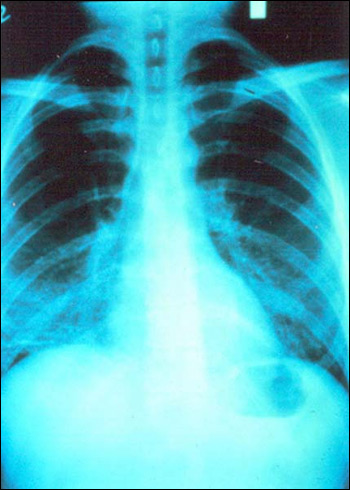
I was reading an article posted on WebMD about how much damage we can do to our hearts by spending more time in front of the TV or computer than we do exercising. You’re probably thinking, “Well, duh!, isn’t that obvious?!” It should be, and yet we still have a tendency to just sit there. (By the way, you can read the article here.)

One quote from this article especially stood out to me:

“It’s not even about the exercise. It’s about not sitting,” says Suzanne Steinbaum, DO, a preventive cardiologist at Lenox Hill Hospital in New York City. “I think that sort of points us in a little different direction. In order for you not to cause harm to yourself, you really need to focus on getting up and moving.”

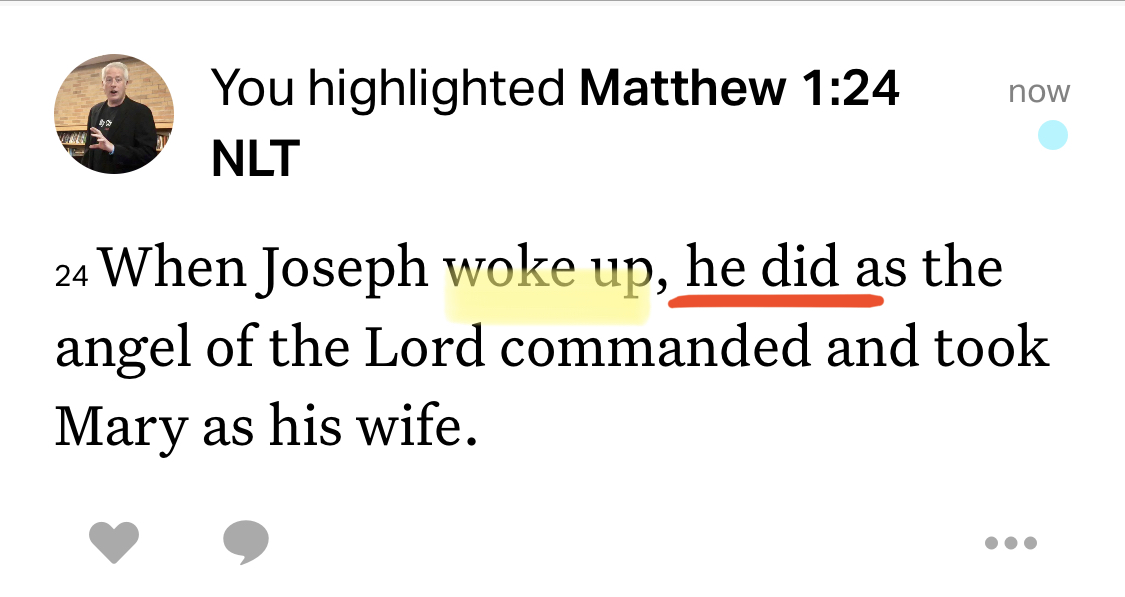
This reminds me of Joseph (Mary’s husband) in the Bible. God seemed to speak to him quite often in dreams. Instead of just sitting there contemplating the vision, there’s a phrase that shows up after every vision…

“Joseph got up and did.”

Has God given you a vision for your life? If so, just sitting there may do damage to your heart. So follow Joseph’s example and Get up and do!

Can You Have Too Much Blessing?

I seldom turn on religious TV shows, because when I do I typically hear the same two messages: (1) God wants you to be rich; (2) God wants you to be healthy. I believe God is good all the time, but that doesn’t mean those who follow Him always get wealth and health.

Consider this:

After Rehoboam’s position as king was established and he had become strong, he and all of Israel with him abandoned the law of the Lord.

Notice: When Rehoboam was healthy and wealthy, he abandoned God. When things looked bleak—when the future for Rehoboam was very much in doubt—Rehoboam was “walking in the ways of David and Solomon” (2 Chronicles 11:17). When the Egyptians attacked, Rehoboam and his court officials “humbled themselves before God” (12:6).

Health and wealth derailed Rehoboam, but difficulties kept him close to God.

Maybe a better prayer than “Bless me” would be “Build Your character in me.” Or as it says in Proverbs:

Give me neither poverty nor riches, but give me only my daily bread. Otherwise, I may have too much and disown You and say “Who is the Lord?” Or I may become poor and steal, and so dishonor the name of my God.

The prayer that Jesus taught us to pray is perfect: Give us today our daily bread—no more, no less. That keeps me focused on my Heavenly Father.

Responding For Those Who Can’t

Do you know what empathy is? It’s not the same thing as sympathy. Sympathy is just wallowing with someone who is hurting, but empathy goes beyond that. Empathy is a compound word:

em- + -pathos = joined + feeling 

I feel what you feel, but I can respond like you should even when you think you can’t.

Sometimes people get paralyzed by their deep hurts, or crushing depression, or infuriating anger. Someone in sympathy feels the pain, the depression, the anger, but their involvement stops at the feeling stage.

Someone in empathy feels the hurt AND responds in an appropriately healthy way.

Check out what Paul wrote:

Who is weak without my feeling that weakness? Who is led astray, and I do not burn with anger? (New Living Translation)

When someone gets to the end of his rope, I feel the desperation in my bones. When someone is duped into sin, an angry fire burns in my gut. (The Message)

Paul took those feelings his friends and loved ones were experiencing and he turned them into positive action. This is challenging and desperately needed.

Sympathy is easy; empathy is hard work.

Sympathy keeps people paralyzed; empathy helps them move forward.

Sympathy enables people to remain unchanged; empathy gives people a healthy way to respond.

If you want to help your hurting, discouraged, or angry friend, don’t sympathize with her hurt, empathize to help her heal. By responding in a healthy way—a way she isn’t able to yet—and you will help her move to a place of wholeness.