Lifter Or Leaner

It’s a pretty simple question:

…but it requires some serious in-the-mirror introspection to answer.

Honestly:

…when times are tough,

…when it’s inconvenient for you,

…when it’s out of your comfort zone,

…when you’ve had a hard day yourself,

…can others count on you to come through?

It really boils down to this:

…are you a lifter or a leaner?

“There are two kinds of people on earth today;
Just two kinds of people, no more, I say.
 
Not the sinner and saint, for it’s well understood
That the good are half-bad and the bad half-good.
 
Not the rich and the poor, for to rate a man’s wealth,
You must first know the state of his conscience and health.
 
Not the humble and the proud, for in life’s little span,
Who puts on vain airs, is not counted a man.
 
Not the happy and sad, for the swift flying years
Bring each man his laughter and each man his tears.
 
No; the two kinds of people on earth I mean,
Are the people who lift and the people who lean.
 
Wherever you go, you will find the earth’s masses,
Are always divided in just these two classes.
 
And oddly enough, you will find too, I ween,
There’s only one lifter to twenty who lean.
 
In which class are you? Are you easing the load,
Of overtaxed lifters, who toil down the road?
Or are you a leaner, who lets others share
Your portion of labor, and worry and care?”
—Ella Wheeler Wilcox, Which Are You? 

Gentle Restoration

I’m struggling with this one. I have a dear friend who is perplexed by an ongoing drug addiction. He appeared to have it under control until things in his life started spiraling out of his control, and he gave in to his old habit again.

So the Bible says that if one of my brothers slips up I’m supposed to restore him gently. How exactly does one do that? I bounced between so many emotions during the last 48 hours: anger at this addiction, sorrow for what my friend is going through, heaviness at what he’s doing to himself and his family, hatred at the devil for his evil tricks, and a passion to see him whole and healthy and free again. Then my own thoughts have baffled me: “How do I gently restore my brother? What does restoration look like?”

Restoration is an interesting Greek word. It can mean setting a broken bone; mending torn fishing nets; manning a fleet of ships; or supplying an army with its provisions.

Restoration is NOT canceling a debt or removing the consequence for someone’s actions. I like what Dave Anderson wrote, “One of the best lessons you can teach your people is that when they choose a behavior they choose the consequences for that behavior.”

Restoration is feeling the pain of what’s been broken or defeated, learning the lesson from that, and then repairing the break or deficiency in such a way that it won’t break or be defeated again. I have the responsibility and the privilege of doing some mending for my friend.

What about gentle? Over time this word has come to mean something like wishy-washy, no backbone, no guts. Gentle originates from the Latin word gentilis which means belonging to the same family or clan. To be gentle is to be strong enough to respond in a controlled manner to someone who is just like me. Gentleness is strength under control.

I hope I’m gentle enough to restore my friend, to mend what is broken in him so he never has to be defeated by this addiction again. He has some consequences to face. But I am committed to helping him carry this heavy load all the way to the finish line.

Check it out—

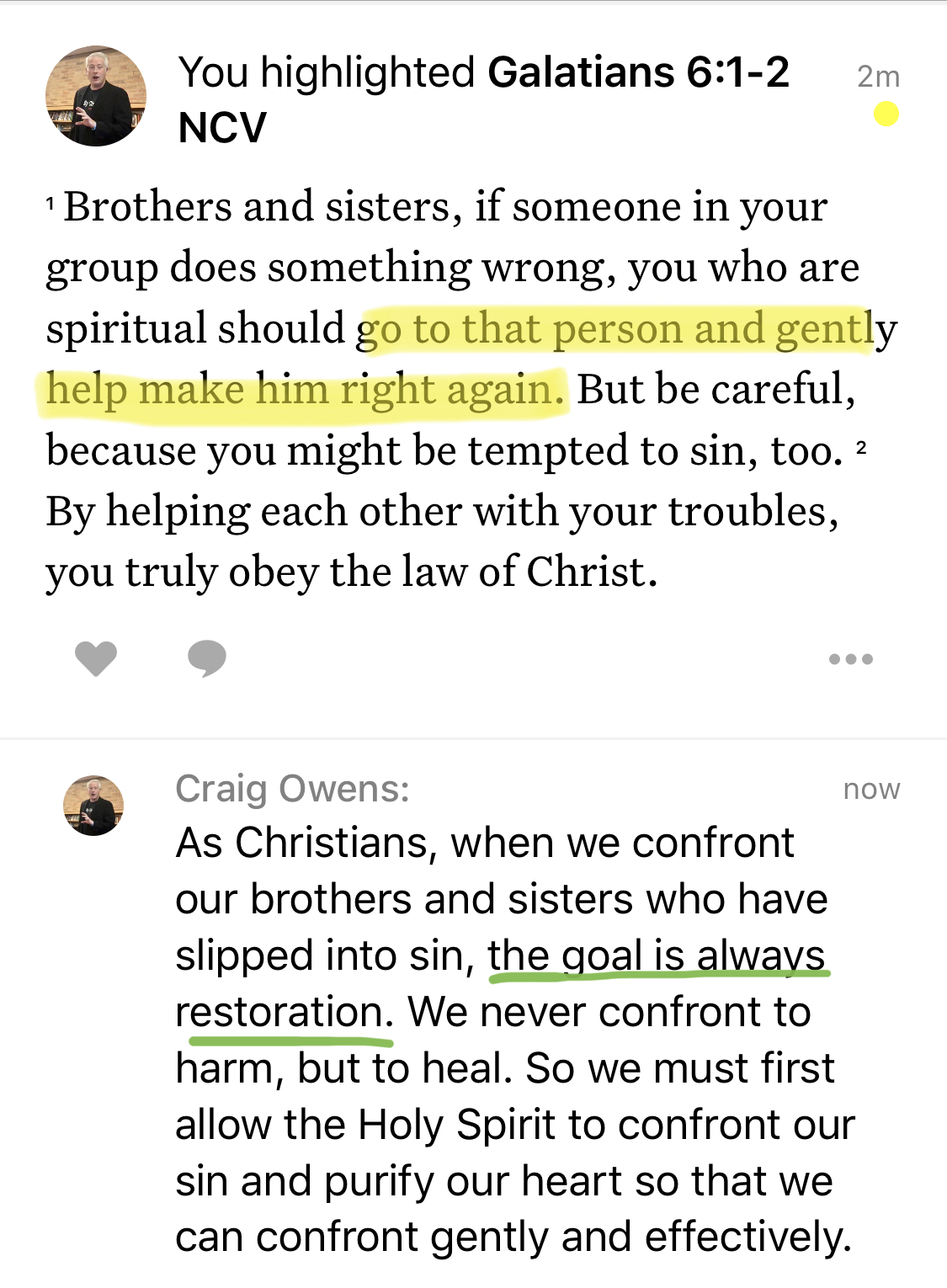
Brothers, if someone is caught in a sin, you who are spiritual should restore him gently. But watch yourself, or you also may be tempted. Carry each other’s burdens, and in this way you will fulfill the law of Christ. (Galatians 6:1-2)

Gentle restoration is hard work. But it’s so worth the effort!

If you have any thoughts on how to gently restore a friend, I’d love to have you share them with me in the comments section.

Wise Guys

I’m facing a big decision. I have an idea of the right way to go, but I’m taking some time to run my options by some wise guys. After all, even King Solomon—who was wiser than any other man, and probably could advise himself—wrote, “The more wise counsel you follow, the better your chances” (Proverbs 11:14, Message).

I also like what George Washington Carver said, “How much of God are we missing because we don’t stop to listen to the many voices God uses to speak to us?”

Of all the voices speaking to me, how am I choosing which wise guys to listen to?

Friendship—I have to know that my counselors are my friends. William Shakespeare asked the question, “Can he that speaks with the tongue of an enemy be a good counselor, or no?” I would answer “no.” I need wise guys that want me to be successful.

B.T.D.T.—I choose wise guys who have Been There Done That. Guys who have walked through the same scenario I’m facing now. Not a travel agent to point the way, but a tour guide who knows the path and will walk it with me.

Scarred—It’s hard to be helpful to someone else when you still have a gaping wound. I need wise guys who have been wounded in the past but now have the scars to show where they’ve been healed. It’s from this vantage point that they can be of the most help to me.

Successful—Finally, I choose to listen to wise guys who are successful. I don’t need some to tell me what should work—I want to hear what does work.

There’s an old attorney’s adage that says, “He who represents himself has a fool for a client.” If you have a decision to make I would modify this to say, “He who takes advice only from himself is taking counsel from a fool.”

What else would you look for in a wise guy? 

Lessons From A Puppy

I’m learning great lessons from hanging out with my puppy Grace. Today I was observing how Grace lives in the moment—how she is fully there in whatever and wherever there is.

  • When she’s hungry, she eats.
  • When she’s full, she walks away from her dish.
  • When she’s thirsty, she drinks.
  • When she’s satisfied, she walks away from the water bowl.
  • When someone is around to play with her, she’s on full-throttle GO!
  • When she’s alone, she amuses herself.
  • When she’s tired, she takes a nap.
  • When I leave a room, she follows me.
  • When I have to go somewhere in my car, she’s right with me.
  • When I’m happy, she wags her tail.
  • When I’m upset, her tail and ears hang low.

In short, whatever there is to do, she does just that without holding anything back. And most of the time what she’s doing is based around who’s doing what around her. She’s always fully there in the moment.

I have had a quote in my files for quite some time from Dr. Richard Dobbins. I’m challenged by this thought about married love because it can easily apply to every relationship I have:

“But most of the time Christian married love comes dressed in overalls—it is practical, down-to-earth, everyday hard work. It is really thinking of the other person and doing what the other person needs and being what the other person needs when he or she needs you to be there.”

The great “love chapter” in the Bible (1 Corinthians 13) really is about being there for others … focusing on others … and then living fully in the moment for them. Check out a few verses from this chapter from The Message paraphrase:

Love never gives up.
Love cares more for others than for self.
Love doesn’t want what it doesn’t have.
Love doesn’t strut,
Doesn’t have a swelled head,
Doesn’t force itself on others,
Isn’t always “me first,”
Doesn’t fly off the handle,
Doesn’t keep score of the sins of others,
Doesn’t revel when others grovel,
Takes pleasure in the flowering of truth,
Puts up with anything,
Trusts God always,
Always looks for the best,
Never looks back,
But keeps going to the end.

I’m working on being fully there for the ones I love today. How about you?

When Friends Wound

Bill Hybels wrote in Axiom, “The nature of human beings is such that we tend not to drift into better behaviors. We usually have to be asked by someone to consider taking it up a level.” I have learned that this is true not only for behaviors but for crucial decisions too.

I’m in the process of contemplating some major decisions for my life. During this time I am grateful for friends that can give me their counsel and can share with me their wisdom.

I’m also grateful that they wound me.

Huh?

Yes, I am glad for friends who wound me!

The wise King Solomon wrote, “Wounds from a friend can be trusted, but an enemy multiplies kisses” (Proverbs 27:6). So true. Those who don’t care about you don’t ask the tough questions; those who care about you challenge your logic and your reasoning. Those who don’t care about you let the little things slide; those who care about you challenge you to not settle for the status quo.

The New Living Translation renders this verse, “Wounds from a sincere friend are better than many kisses from an enemy.I would much prefer to be wounded by a friend during the decision-making time, than to have lots of so-called love upfront, only to walk smack-dab into a huge problem later. Wouldn’t you? So when I have an important decision to make, I get around people who love me enough to wound me.

And not only for the big decisions, but I need sharp friends for the day-in-day-out things that will help me “take it up a level.” Solomon also said, “Become wise by walking with the wise; hang out with fools and watch your life fall to pieces” (Proverbs 13:20, The Message).

Many years ago a Romanian friend shared with me a proverb from his homeland: “Show me who your friends are and I will tell you who you are becoming.”

What does your choice in friends say about you? Do your friends love you enough to wound you? Do your friends help you take it to the next level?

Poetry

Just finished a nice book of poems by Ralph Waldo Emerson and I thought I’d share a few maxims with you—

  • “To be great is to be misunderstood.”
  • “Happy is the house that shelters a friend.”
  • “Nothing great was ever achieved without enthusiasm.”
  • “A friend is a person with whom I may be sincere. Before him, I may think aloud.”
  • “Beauty without grace is the hook without the bait.”
  • “Life is not so short but there is time for courtesy.”
  • “Beware when the great God lets loose a thinker on this planet. Then all things are at risk.”
  • “No man thoroughly understands a truth until he has contended against it.”
  • “In skating over thin ice, our safety is in our speed.”

If you haven’t read any poetry lately, I encourage you to give it a try. It sounds/reads differently, but the rhythm and pace sort of sings to your mind and heart as you read it. For Americans I recommend starting out with some American poets like Emerson or Henry Wadsworth Longfellow; for you Brits, try some Robert Browning.

Happy reading!

Fill ’Er Up!

Listen to the podcast of this post by clicking on the player below, and you can also subscribe on AppleSpotify, or Audible.

I sort of remember the days of full-service gas stations. My Dad would drive in and say, “Fill ’er up!” and the gas station attendant would jump into action. Filling up the gas tank, cleaning the windshield, checking the oil level, and even checking the air pressure in the tires.

But, alas, those days of full service seem to be long gone, replaced by highly-efficient, less-personal self-serve stations. And I’m not necessarily talking just about gasoline stations either.

All of our lives seem to have become more efficient and less personal. We are a more do-it-yourself, leverage-technology kind of society today. And I wonder if the result is that many people aren’t getting filled up like they used to.

There is a well-known Bible story in 2 Kings 4. A widow is facing what would amount to foreclosure today. Except this foreclosure was on her sons. Her husband, a God-fearing man, had died and left her with debts she could not pay. The practice in that society was for her sons to be “sold” to pay off the debts. These boys would have to work all day long for someone else, and whatever money they would have earned for their labors would go to the creditors.

In her desperation, the widow turned to the prophet Elisha. He asked her if she had anything of value in her house, and she replied, “Just a little oil. But not enough to pay off my debts.” The counsel Elisha gave her is applicable for our self-serve society today—

Elisha said, “Go around and ask all your neighbors for empty jars. Don’t ask for just a few” (v. 3).

Elisha asked the woman and her family to humble themselves—ask all your neighbors. Sometimes this is one of our biggest hindrances: pride which keeps us from admitting we have a need. And this was no small task because she had to ask ALL her neighbors to, “Fill ’er up!”

Elisha asked them to be persistent—don’t ask for just a few. Not just a jar here and there, but ask for every available jar to, “Fill ’er up!”

The principles in this story shouldn’t just apply to times of desperation in our lives. Because maybe if we worked on being around our neighbors and asking what needs they have, and sharing our needs as well, maybe we wouldn’t get into such desperate situations.

In the story in 2 Kings, the oil stopped flowing only after every available jar had been filled. If I want God to continue to pour His oil of blessing into my life, He has to have room in which to pour. That means that I need to be pouring into others’ lives as often as I can. Listen to the blessings when we, “Fill ’er up!”—

     I want you to know how delighted I am to have Stephanas, Fortunatus, and Achaicus here with me. They partially make up for your absence! They’ve refreshed me by keeping me in touch with you. (1 Corinthians 16:17-18, The Message paraphrase)

     In addition to our own encouragement, we were especially delighted to see how happy Titus was, because his spirit has been refreshed by all of you. (2 Corinthians 7:13)

     God bless Onesiphorus and his family! Many’s the time I’ve been refreshed in that house. And he wasn’t embarrassed a bit that I was in jail. The first thing he did when he got to Rome was look me up. May God on the Last Day treat him as well as he treated me. (2 Timothy 1:16-18, The Message paraphrase)

     Your love has given me much joy and comfort, my brother, for your kindness has often refreshed the hearts of God’s people. (Philemon 7 NLT)

Get around other “full” people and let them fill you up.

Seek out “empty” people and pour abundantly into them.

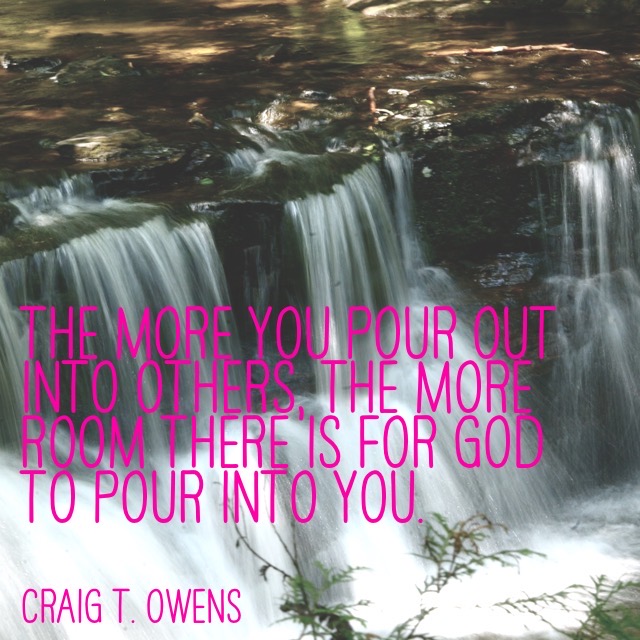
The more you pour out into others, the more room there is for God to pour into you.

God is always pleased when our lifestyle is one of “Fill ’er up!”

►► Would you please prayerfully consider supporting this ministry? My Patreon supporters get behind-the-scenes access to exclusive materials. ◀︎◀︎

I’ll Take My Roses Today, Please

My Grandfather used to say, “Give me my flowers while I’m still alive.” I think this was his way of restating the cliché, “Dead noses smell no roses.” It’s true: flowers at a gravesite—no matter how beautiful they are—aren’t appreciated by dead noses. Kind and loving words spoken at a funeral—no matter how eloquent they are—aren’t appreciated by dead ears.

The point is: today is special. Today is one-of-a-kind. Today is the best day to tell someone dear to you how truly special they are. Today may be the last day you have to make something right. Today is the day to send those flowers. Don’t put it off until tomorrow.

How many people live with regrets today because of the things they didn’t say before a loved one passed away from this life? How many people feel guilty today because they didn’t make things right in a strained relationship? How much better to live today knowing that we said and did all of the things we could to express our love, to show how valuable the relationship was.

Job said, “My days are swifter than a runner” (Job 9:25).

His friend Bildad agreed that, “Our days on earth are but a shadow” (Job 8:9).

And James wrote, “Your life is like the morning fog—it’s here a little while, then it’s gone” (James 4:14).

We never know how much time is left to send those flowers.

Today…

  • Make that phone call.
  • Ask forgiveness.
  • Write that letter.
  • Apologize.
  • Hug.
  • Go to lunch.
  • Say, “I love you.”
  • Send those flowers.

Don’t live your tomorrows with regrets for the things unsaid or undone—say them and do them today.

The Right Time To Do The Right Thing

I spent yesterday afternoon and a good portion of this morning with a precious family. The 93-year-old patriarch of the family is in his last days on this earth. This family is absolutely wonderful, and it has been such a blessing to spend this time with them.

They laugh, tell stories, sing songs, read Scripture, joke with each other, and cry. The full range of emotions overflowing from a full life.

I have learned something—the human heart is designed to know and to be known. The human heart longs for relationship—deep, meaningful, satisfying relationship. In order to achieve this type of relationship, two things are key: (1) Time and (2) Empathy.

(1) Time. Relationships cannot be microwaved. We cannot just show up, press a few buttons, and—voilá—expect a meaningful relationship. Of course, just spending a lot of time together doesn’t mean a relationship will be successful either. However, the greater the quantity of time that is spent means a greater likelihood of quality time.

(2) Empathy. The Bible says, “Rejoice with those who rejoice; mourn with those who mourn” (Romans 12:15). It doesn’t say, “If people are low, bring them up; if they are too high, bring them down to realistic levels.” Empathy is all about letting the other person drive the agenda—to match whatever they are feeling. A Swedish Proverb says, “A shared joy is a double joy, and a shared sorrow is half a sorrow.”

Here’s a good pattern to follow—

Right Time + Right Thing = Meaningful Relationships
<or>
Quality Time + Empathy Time = Satisfying Relationships

Be An Intrusive Friend

Yesterday I talked about how to defeat depression in our personal lives. Maybe you’re not battling depression yourself, but since anti-depressants are one of the most prescribed medications, there’s a good chance that someone you know is dealing with depression. Beyond medicine or counseling, one of the greatest antidotes for depression is a friend: an intrusive friend.

In 1 Kings 19 when Elijah was running scared and slipping into depression, there is an important verse at the beginning of the story—Elijah was afraid and ran for his life. When he came to Beersheba in Judah, he left his servant there (v. 3).

One of our most natural reactions when we’re battling depression is to withdraw from others. It’s natural to want to be alone, but it is one of the worst things to do. Throughout Scripture, powerful people became vulnerable to attack when they left their friends behind—Samson, David, and Peter are prime examples. Even Jesus was tempted by the devil when He was alone in the wilderness.

So if it’s natural to want to be alone when depression is raining on our souls, a true friend will have to be an intrusive friend … a tenacious friend … a persistent friend. I love the lines in the Toby Mac song “Face Of The Earth” that say—

Now Hope Road is calling
Let’s pack you up and move
‘Cause real friends are willing to intrude
So I’m gonna push you in because I wanna love you well
Let the ghosts of your past rest

If you have a friend who is starting to become distant, dropping out of activities, or spending more time alone, these may be the warning signs of depression. Don’t let him be like Elijah and leave you behind, but love him or her enough to intrude in his or her life. Your encouragement just may be the best anti-depressant he/she will ever receive.

So speak encouraging words to one another. Build up hope so you’ll all be together in this, no one left out, no one left behind. I know you’re already doing this; just keep on doing it. (1 Thessalonians 5:11, The Message)

Jonathan went to find David and encouraged him to stay strong in his faith in God. (1 Samuel 23:16, New Living Translation)