The word Selah appears nearly 70 times in the Bible, almost exclusively in the Psalms. Although it is primarily a musical term, it applies beautifully to our summer series.
Selah can mean…
Throughout the Psalms, Selah appears at the end of a verse, at the end of the psalm, or sometimes even mid-sentence. But each one of them is perfectly placed by the Spirit-inspired authors to get us to take a breath and deeply contemplate what we just read or sang.
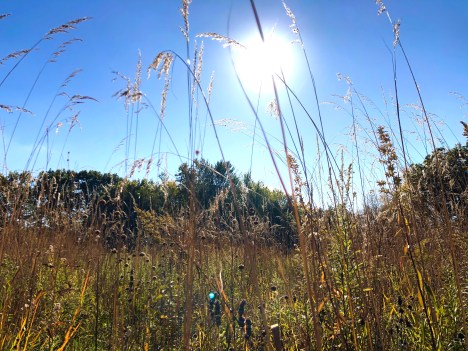
Summertime is typically a time for us to pause from our regular routine. Perhaps it’s a vacation, time with friends and family, driving around with the windows down and the music blasting, or just a quiet walk through woods or along a beach. In any case, whether we realize it or not, we’re actually doing Selah in these break-from-the-routine activities.
Join me this Sunday as we continue our summertime look at each of the Psalms that ask us to Selah. I think you will find that this Sunday summertime pause will be both refreshing and encouraging. You can join me either in person or on Facebook Live.
Since this is a continuation of our summer series, you can check out the Selahs we discussed in 2018 by clicking here, and the messages from the summer of 2019 are here.
The messages for this summer are:
Coronavirus And Christ is a quintessential example of how the Bible’s message is applicable to any situation we face. This book could have been written as “The Bubonic Plague And Christ” or “The Great War And Christ” or even “The Spanish Flu And Christ” and the message would have been the same.
John Piper himself states, “What John Piper has to say on this topic isn’t nearly as important as what God has to say on this topic.” God’s Word is timeless, always applicable, and always authoritative. Coronavirus And Christ is steeped in biblical principles.
The first half of this book reminds us of God’s sovereignty even in times that we may see as unexpected or chaotic. Pastor John writes, “The secret of ‘sorrowful, yet always rejoicing’ [2 Corinthians 6:10] is this: knowing that the same sovereignty that could stop the coronavirus, yet doesn’t, is the very sovereignty that sustains the soul in it. Indeed, more than sustains—sweetens. Sweetens with hope that God’s purposes are kind, even in death—for those who trust Him.”
In the second half of this book, Pastor John elaborates on six possible answers to the question, “What is God doing through the coronavirus?” I am confident that you will be encouraged to see how God is in control of events that seem out of our hands.
Coronavirus And Christ is a short book, but one that will arm you with faith-building insights that will help you throughout not just this time, but any others that will inevitably come along. Desiring God has made the ebook version of this book available for free (click here to access the link).
Listen to the podcast of this post by clicking on the player below, and you can also subscribe on Apple, Spotify, or Audible.
…to the church of the Thessalonians (2 Thessalonians 1:1).
This short letter from the apostle Paul to the church in Thessalonica is a masterpiece on how to correctly correct fellow Christian brothers and sisters.
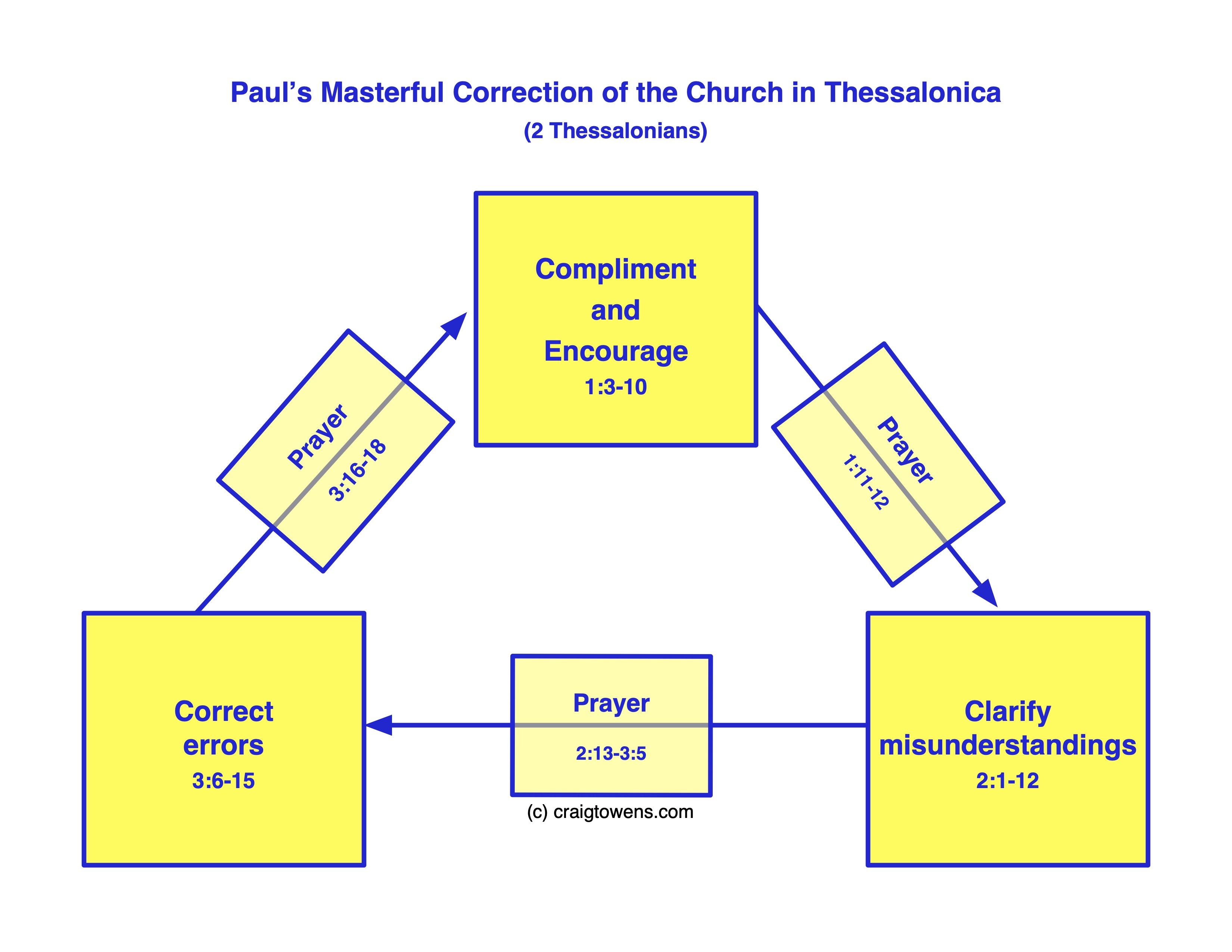
The entire letter follows this pattern: 3 Cs surrounded by prayer—
(And then repeat, if necessary.)
You can download the PDF of this flow chart → Paul’s correction of the Thessalonicans
(1) Compliment and encouragement—“We are bound to thank God always for you…because your faith grows exceedingly” (1:3). Paul complimented their love for each other, their patience and endurance in persecution, and their future glorification. He encouraged them that Jesus IS coming, and He will deal with their persecutors and take the righteous into glory with Him (1:3-10).
(2) Prayer—And then he prays for them to be equipped to endure to the end and finish well (1:11-12).
(3) Clarify misunderstandings—“Let no one deceive you by any means” (2:3). Paul reminds them of what he taught them about the end times and the Second Coming of Christ, clarifying that watchful Christians will by no means miss out on the signs (2:1-12).
(4) Prayer—Paul again praises their acceptance of the gospel and launches into another prayer for them to finish well (2:13-3:5).
(5) Correct errors of understanding—“But we command you” (3:6). There were those who were departing from the faith, growing slack in their work ethic, being disorderly, and meddling as busybodies. Paul said, “We command and exhort through our Lord Jesus Christ” that you knock it off! He even told the church to “not keep company” with such people (3:6-15).
(6) Prayer—Finally, Paul closes with a prayer for God’s peace to be with his brothers and sisters (3:16-18).
This is such a masterful pattern for all of us in church ministry to follow!
If you are in a leadership role, I hope your ongoing prayer would be the same as mine: “Holy Spirit, in all my interactions with my fellow saints, remind me of this godly, practical plan for confrontation, and help me to live it out for God’s glory. In Jesus’ name, amen.”
P.S. You can also learn a lesson from the way the prophet Samuel handled correction in this post.
►► Would you please prayerfully consider supporting this ministry? My Patreon supporters get behind-the-scenes access to exclusive materials. ◀︎◀︎
“Friendship is born at that moment when one person says to another, ‘What! You too? I thought I was the only one!’” —C.S. Lewis
“Friendship is precious, not only in the shade, but in the sunshine of life, and thanks to a benevolent arrangement the greater part of life is sunshine.” —Thomas Jefferson
“Friendship is a single soul dwelling in two bodies.” —Aristotle
“Friendship is not a way of accomplishing something but a way of being with another in which we become more authentically ourselves.” —Eugene Peterson
“The glory of friendship is not the outstretched hand, not the kindly smile, nor the joy of companionship; it is the spiritual inspiration that comes to one when you discover that someone else believes in you and is willing to trust you with a friendship.” —Emerson
“If the first law of friendship is that it has to be cultivated, the second law is to be indulgent when the first has been neglected.” —Voltaire
“Friendship is agreement with kindliness and affection about things human and divine.” —Cicero
“The light of friendship is seen plainest when all around is dark.” —Grace Noll Crowell
“For spiritual friendship, which is what we mean by true friendship, should be desired not with a view to any worldly good, nor for any reason extrinsic to itself, but from the worthiness of its own nature, and the feeling of the human heart, so that it offers no advantage or reward other than itself. … For in this true friendship one makes progress by bettering oneself, and one bears fruit by experiencing the enjoyment of this increasing degree of perfection. And so spiritual friendship is born among good people through the similarity of their characters, goals, and habits in life.” —Aelred of Rievaulx
“The quickest way to initiate friendship is to give people freedom to be themselves.” —Andy Braner
Dr. Kathy Koch has given parents—and anyone else who works with children—a marvelously helpful resource in her latest book Start With The Heart. Be sure to check out my full book review by clicking here.
“God created you and your children with five core, basic needs that must be met. These needs are interrelated. The health of one influences the others:
“Children who know their purpose will often choose to look for peers with similar goals and interests. They will want to hang out with people who affirm them and their purpose and be willing to end relationships that are not joyful and purposeful.”
“When you parent so your children believe three things, their hearts will be impacted and they will be motivated to succeed. This translates into less stress and anxiety and more peace. … Children who believe these things don’t want to be average. They are willing to work for more. … Children’s character will be more Christlike. They’ll want to be more others-centered than self-centered. They’ll be compassionate, brave and able to stand up for themselves and others.
“Which is better: ‘Be on time!’ or ‘Don’t be late!’? Do you hear the difference? Which one is positive? ‘Be on time’ communicates ‘I believe you’re capable of this.’ It’s more hopeful. It’s about what you want your children to do. ‘Don’t be late’ reminds them of how they’ve frustrated you.”
“Carol Dweck…has consistently found that children praised for using effort tackled more challenging tasks than those praised just for ability or for the quality of their work.”
“Sometimes have children tell you what they think they did before you offer your opinions. If they are relatively accurate, affirm them specifically. When they’re not, have the conversation.”
“Working to provide feedback that can be described with the following attributes will serve you and your children well—specific, believable, helpful, and thoughtful.”
You can also check out the first set of quotes I shared from Start With The Heart by clicking here.
Sarah Young does a masterful job in helping us hear Jesus speak to us in the first-person, as she weaves Scripture together so beautifully. Check out my full book review by clicking here.
“Taste and see that I am good. The more intimately you experience Me, the more convinced you become of My goodness.”
“Follow Me one step at a time. … Keep your mind on the present journey, enjoying My Presence. Walk by faith, not by sight, trusting Me to open up the way before you. … I set the pace in keeping with your needs and My purposes.”
“Walking in the light of My presence blesses you in many ways. Good things are better and bad things are more bearable when you share them with Me. As you bask in My Love-Light, you are better able to love others and enjoy fellowship with them. You are less likely to stumble or fall because sins are garishly obvious in My holy Light. As you walk in this Light with Me, I encourage you to exult in My righteousness.”
“Although your new self is being conformed to My image, this process does not erase the essence of who you are. On the contrary, the more you become like Me, the more you develop into the unique person I designed you to be.”
“Holiness is letting Me live through you. Since I dwell in you, you are fully equipped to be holy. Pause before responding to people or situations, giving My Spirit space to act through you. Hasty words and actions leave no room for Me; this is atheistic living. I want to inhabit all your moments—gracing your thoughts, words, and behavior.”
“Talk with Me about every aspect of your day, including your feelings. Remember that your ultimate goal is not to control or fix everything around you; it is to keep communing with Me. A successful day is one in which you have stayed in touch with Me, even if many things remain undone at the end of the day.”
“Do not let your to-do list (written or mental) become an idol directing your life. Instead, ask My Spirit to guide you moment by moment.”
“Exceeding Joy is for both you and Me. I delight in you now, but this Joy will be astronomically magnified when you join Me in Glory. The Joy you will experience in heaven is so far beyond anything you have known on earth that it is indescribable. Nothing can rob you of this glorious inheritance which is imperishable and will not fade away.”
“Thankfulness is not some sort of magic formula; it is the language of Love, which enables you to communicate intimately with Me.”
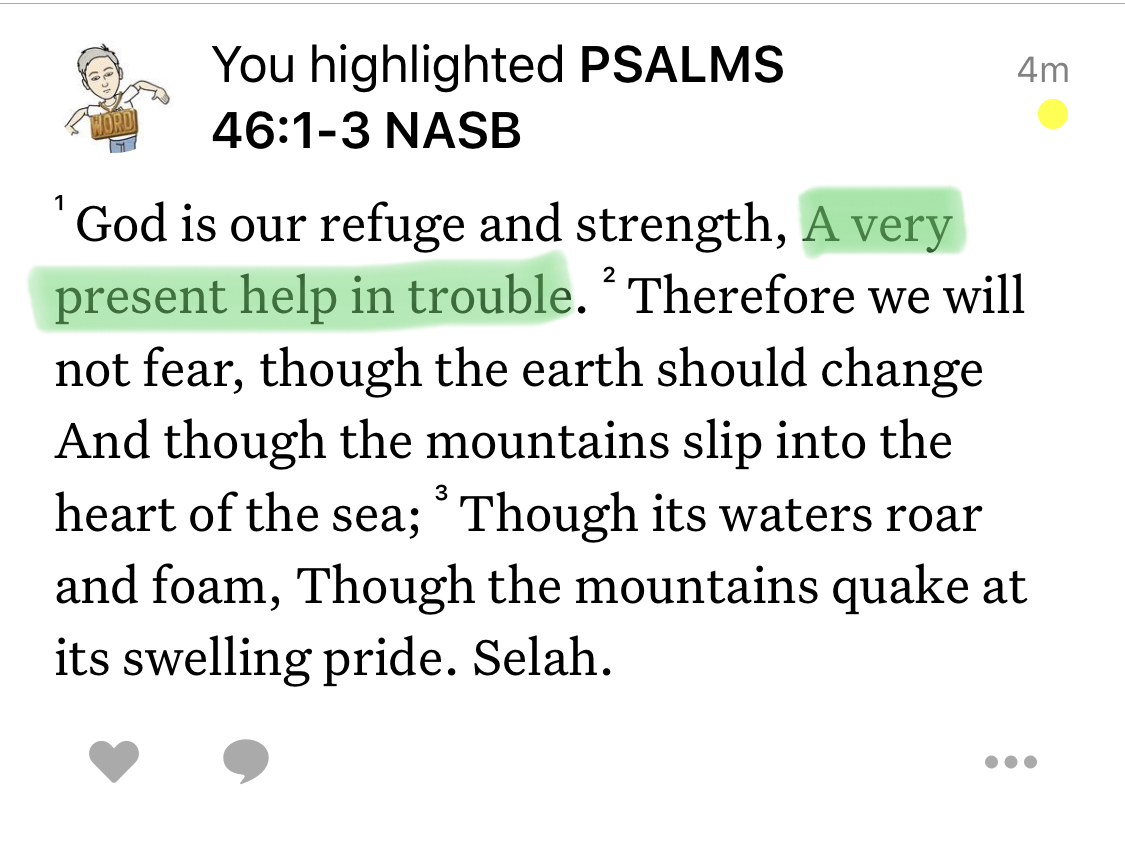
God is our refuge and strength, a very present help in trouble. (Psalm 46:1)
God is not just present—He is very present!
God is not merely in the room with you, He is fully attentive to you. He’s never distracted, preoccupied, or disinterested.
Regardless of the quaking or roaring around you, He is so very present that He knows your quietest sigh. You don’t have to look anywhere else for help because He is VERY present at this VERY moment.
The rest of this psalm reiterates this promise:
God Himself speaks the words of the natural conclusion we should draw when we realize that He is VERY present at this VERY moment—
“Be still, and know that I am God!”