10 Quotes From “You Don’t Need A Title To Be A Leader”

You Don't Need A Title To Be A LeaderMark Sanborn has given us a wonderful book to help people be more well-rounded in their leadership, whether they have a title or not. You can read my full book review by clicking here. These are some of the quotes from this book that caught my eye.

“Leaders, untitled or otherwise, realize the extraordinary impact they can have on others and the world around them. They consciously choose to exercise their abilities, skills, and knowledge to help make a difference.”

“The reality is that we all work ‘backstage’ in our lives at times. Real leaders bring the same commitment to excellence to whatever they do, whether on the stage or behind it.”

“I began to see what happened to me as an opportunity rather than an obligation. And it made all the difference. Now when the phone rings, I respond to each call as an opportunity to serve, earn, learn, influence, network, encourage, or teach. The difference isn’t in the caller or the purpose for the call; the difference is in my response. … Genuine, authentic leadership infuses meaning into your life, because you know that your efforts count and that you are serving the needs of others as well as your own.”

“I think of the ‘self-mastery index’ as the ratio between promises made and promises kept—both to oneself and to others. If your mouth keeps making promises that you can’t keep, there is a great deal of room for improvement. Integrity, after all, is measured by the distance between your lips and your life. If you want to be a leader in your own life and in the lives of others, you’ve got to follow through on your own promises, whether you have a title or not.”

“You don’t necessarily have to be smarter or better educated to succeed. Your power lies in your ability to focus on doing what is important. If you focus on the right things, and work at them often, you will achieve exceptional results.”

“People do things for their own reasons, not for yours. To be an effective leader, you need to know how to motivate others.”

“One of the greatest compliments you can be paid as a leader is to have someone say that you helped them be better than they thought they could be.”

“People remember stories. Stories are the coat pegs of the mind. They are where people hang their ideas. Once they have a memorable story to help them remember, they can recall whatever important moral or point you have to make. … Telling an entertaining story is important, but being the story is better.”

“When something doesn’t happen, there is always an explanation. But never accept an explanation as an excuse. … Instead, use explanations to figure out what happened, then look for the lesson that will prevent that something from happening again.”

“Everyone makes a difference. The choice we all have is whether we want to make positive difference or a negative one.”

Keep On Learning

Safe pathDon’t ever think you know it all.

Because you can’t!

There’s no way you can know it all.

So keep on learning.

Keep on digging into God’s Word.

Keep on letting the Holy Spirit teach you.

God is the only Know-It-All.

And He wants to teach you too.

What should a man learn?
Not hard to answer:
steadfastness in holiness,
shortness of words,
gentle brotherliness…
walking in obedience to God…
zeal in prayer…
bringing pride low,
simplicity of heart…
patience in the face of hardship. —Colmán mac Beógnai


Living Sermon

Pastors, this is a timely word from Mark Batterson…

There is a world of difference between preaching a sermon and living a sermon.  No amount of study can compensate for deficiencies in your life. You can “study it” but if you aren’t “living it” it’ll ring hollow.  The opposite is true as well.  Jesus’ teaching was authoritative because it was backed up by his life.  You can’t back up your sermons with a seminary degree.  You’ve got to back it up with your life. My advice?  Don’t just get a sermon. Get a life.  Then you’ll get a sermon!

Let me be blunt: if your life is boring your sermons will be too.

If you have no life outside of church—no hobbies, no friends, no interests, no goals—your illustrations will feel canned, your applications will feel theoretical instead of practical, and your sermons will be lifeless instead of life-giving.

The greatest sermons are not fashioned in the study.  They are fleshed out in the laboratory of everyday life.  Now, please don’t misinterpret what I’m saying.  You need to study to show yourself approved and rightly divide the word.  So keep studying!  In fact, study more.  But you can’t just study the word.  You need to live it.  The most powerful sermons are well-studied and well-lived.

At the end of the day, God won’t say, “Well studied, good and faithful servant.”  He won’t say, “Well thought” or “Well said” either.  There is only one commendation: “Well done.”

Now let’s be brutally honest: most Christians are educated way beyond the level of their obedience already! We don’t need to know more, we need to do more.  That’s why I think sermons should focus on application more than interpretation.  Theological doesn’t mean theoretical.  In fact, as you get a life, your messages will be less theoretical and more experiential.  You won’t just preach your sermons. You’ll incarnate them!

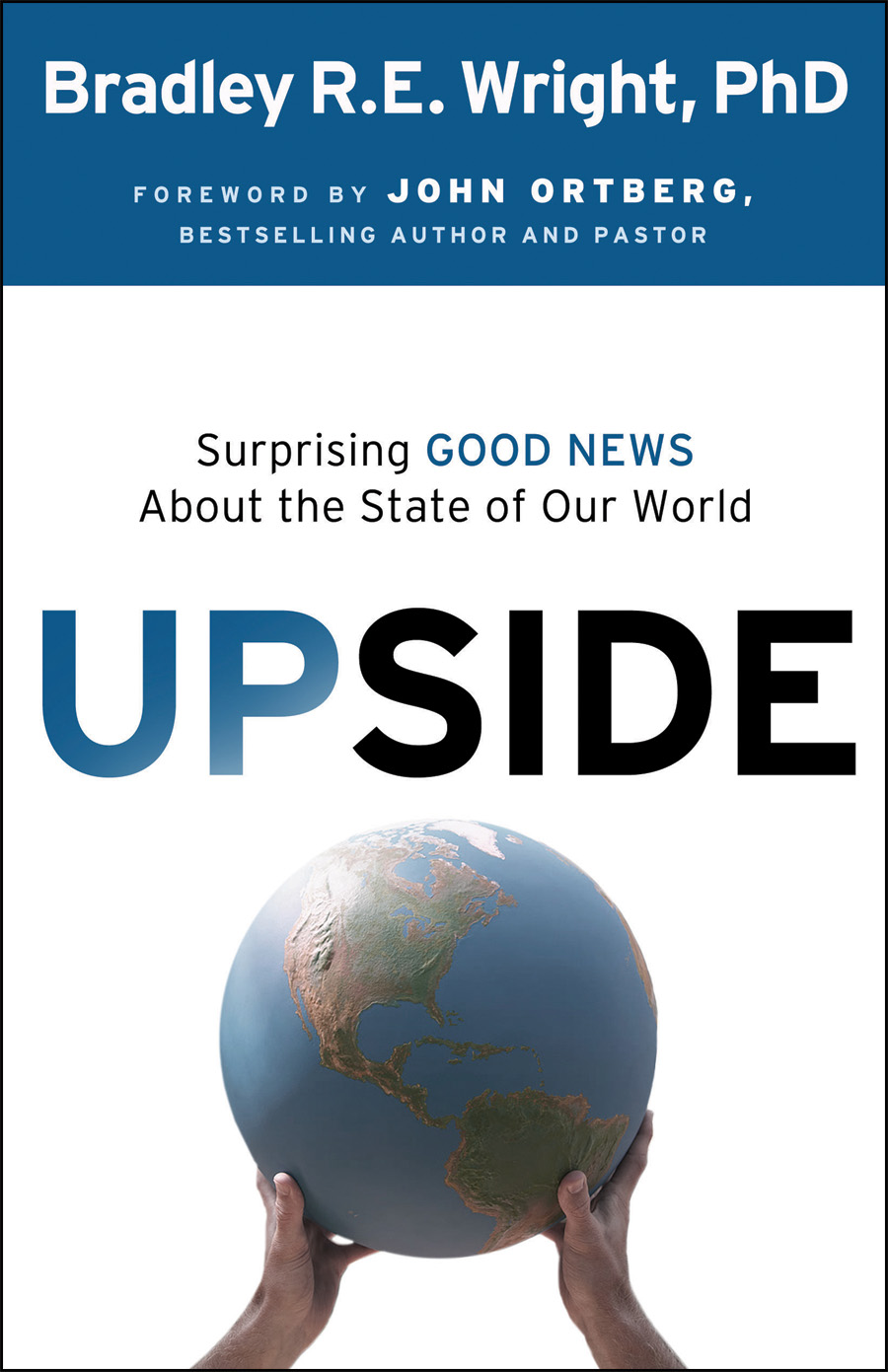
Upside (book review)

Have you ever heard how a TV news producer decides what the lead story will be? Or how a managing editor decides which stories get the front page of the newspaper? It comes down to this: “If it bleeds, it leads.” Sad, but too often true. With all of this negative news leading, Dr. Bradley R.E. Wright’s book Upside: Surprising Good News About the State of Our World is indeed surprisingly good news!

Dr. Wright notes that sociologist Joel Best “classifies the different types of bad statistics as follows: some numbers are bad to begin with; some numbers get bad as they are passed along; and some numbers are chosen because they are bad.” In other words, there’s just a lot of bad news out there!

But despite all of this negative press, people around the world are surprisingly upbeat. That’s because when a sociologist like Dr. Wright gets a hold of all of these statistics, he can put them into the proper perspective. He looks at the data on a variety of topics:

  • Personal finances
  • Education
  • Health
  • Crime and war
  • Marriage and divorce
  • The environment

“The trouble with this country is that there are too many people going about saying ‘the trouble with this country is….’” —Sinclair Lewis

Do bad things happen? Yes. Are there some issues that still need to be addressed? Absolutely. Is the world ready to collapse all around us? It doesn’t appear so. Christians should have the clearest and keenest worldview because it’s a biblical worldview. Dr. Wright does an excellent job of helping the reader find the perspective that is realistic, yet balanced.

Economist professor Julian Simons summarized it this way—

Almost every economic and social change or trend points in the positive direction, as long as we view the matter over a reasonably long period of time. That is, all aspects of material human welfare are improving in the aggregate.

I am a Bethany House book reviewer.

How To Read The Bible (book review)

People who call themselves Christians should know how to read the Bible, right? Maybe, but many times I think we assume far too much. Fortunately How To Read Your Bible by A.J. Conyers can help.

  • Some people avoid the Old Testament, saying, “It’s too confusing!”
  • Some people simply flip their Bibles open to any passage and simply start reading.
  • Some people only open their Bibles when they’re at church.

All of these methods may work, but they’re not the best way to learn what God has to say to us in His Word. A.J. Conyers explains to his readers the art of reading the Bible, as well as the practice of reading the Bible. He gives enough background information to get you started in the right direction, and he gives you ample resources to continue digging into God’s Word more.

As you might have noticed, I love to read. But hands-down-without-question my favorite book is the Bible. Every time I open it up, I find something new to apply to my life. If you’re having difficulty getting started on a Bible study, this book may be just the thing to help get things rolling.

(I’m also a big fan of YouVersion: the Bible app for your smart phone. You can download it for your iPhone or Droid by clicking here.)

Do You Read The Bible Or Does The Bible Read You?

I’ve been studying the lives of the kings of Judah. The last God-fearing king before the fall of Jerusalem was a man named Josiah. He became king as an 8-year-old and really began looking for God as a teenager. Apparently, during all of this time, the book of the Law (the first five books of our current Bible) was hidden away and forgotten. As Josiah started seeking God, he gave orders that the temple in Jerusalem be repaired. During the clean-up work, the workers rediscovered the book of the Law and brought it to the palace. They began to read the Law to Josiah

When the king heard the words of the Law, he tore his robes.

Tearing of the robes is a sign of deep mourning. The words of Scripture cut Josiah like a dagger to the heart because he knew he and his people weren’t living according to God’s standards. He started telling everyone the Scriptural standards that they needed to honor, and had the words of the Law read aloud for everyone to hear. Then in the presence of everyone, Josiah reaffirmed his commitment to be a man who lived by the words of God’s Word.

This got me thinking:

  • Do I have an emotional response when I read the Bible? Or is it just a mental exercise? Or worse yet, just a meaningless daily habit?
  • Am I truly sorry when I read in the Bible where I’ve fallen short of what God desires? Or do I make excuses?
  • Do I ask the Holy Spirit to help me live out what I’ve read in the Word? Or do I convince myself that those parts don’t pertain to me?
  • Do I share with others what’s been revealed to me? Or do I keep it to myself?
  • Am I willing to be accountable to others about the changes I need to make? Or am I trying to be a lone ranger saint?

Do I just read the Bible? Or do I allow the Bible to read me?

Challenging Concepts

Part two of our Spiritual Self-Defense series went well last night. Considering this was a difficult concept to wrap our finite, human brains around, I felt that everyone was tuned in. Trying to wrestle with the concepts of God as omnipresent, the unique Three-in-One arrangement of the Trinity, or Jesus as fully God and fully Man are not easy. But it is so important to keep learning and keep growing in our understanding of who God is.

Some people bail out too quickly. “It’s too hard,” they complain, and then walk away. But we have to keep stretching.

A couple of thoughts I’m pondering today:

“If you believe what you like in the gospels, and reject what you don’t like, it is not the gospel you believe, but yourself.” —Augustine

“It seems that when we encounter a hard truth about God, we either bend our understanding to Him or bend Him to our understanding.” —Chris Tomlinson

I want to believe the Bible more, so I’m asking the Holy Spirit to continue to bend me and shape me to the deeper truths about God.

I Went Back To Middle School

Yesterday morning was the second annual Parent Shadowing Day at Cedar Springs Middle School, so I got to follow my daughter for a couple of hours. It was a little weird being back in middle school after 30+ years, but I had a lot of fun being with my daughter.

Here are a couple of thoughts on my day:

First hour band

  • Got to sit in my old section: percussion. It was all I could do to keep from jumping in on the marimba!
  • A little painful to listen to middle schoolers working their way through a song, but slowly Feliz Navidad and Greensleeves begin to emerge.
  • I love the way band teachers explain music verbally. Mr. Green said to the brass, “You’re supposed to start with a strong staccato ‘Tah!’ but you’re giving me a slurred ‘Blaaah.’”

Second hour computers

  • When I was in middle school we had precisely zero computers … in the whole building! Now each student is sitting at their own workstation.
  • I’m amazed at how fast these students are on the computer (but I’m still faster!)
  • Some kid just sneezed into the sleeve of his sweatshirt. Nice catch! He says, “Eww, gross!” I say, “Better your sleeve than your computer monitor!”
  • My overachieving daughter just completed her project that isn’t due for another two weeks!

Third hour writing

  • I used to dread going to writing class in middle school, but now I love writing. I’m thankful to Mr. Cochrane who encouraged and invested in my writing skills.
  • The class welcomed a new student who just moved to Cedar Springs. It’s got to be tough to be “the new kid.” I need to remember how that feels so I can make new people feel welcomed.
  • Cool! This class throws around a Koosh ball to help identify who’s supposed to be talking. It’s like having gym in writing class.
  • I love the peer-to-peer editing of each other’s research papers. They have to write down PATS: Praise, Ask a question, Tell something that sticks in their mind, and give a Suggestion. Encouraging encouragement is way cool.
  • The students here are much more quiet and respectful of their teachers than we were in middle school. I’m just saying….

Fourth hour science

  • Fascinating how a folded piece of pre-printed paper and a brass brad can help students learn the position of the sun relative to our latitudinal position in Michigan. And I’m amazed at how quickly the students grasp the concept.
  • We got to leave science early to wish student teacher Miss Nicki a fond farewell. She’s graduating and now looking for a full-time teaching assignment. We celebrated with Tootsie Pops.

What a wonderful experience. It’s so cool to “walk in someone else’s shoes.” I need to make that a more regular discipline in my life.

Challenged

During my daily devotional time, I’m reading a book by Smith Wigglesworth called Power To Serve. And I’m really being challenged by it. Sometimes a certain book crosses my life at just the right time, and it really begins to stir something in me. Just thought I’d share a couple of quotes from the book, and how I’m trying to process/apply it to my life:

  • “Prayer is a time during which God wants you to be strengthened, and He wants you to remember that He is with you. …People come with their needs, they ask, and then they leave with their need because they do not faithfully wait to receive what God has promised them.”
    • So true for me! I’m such a hurry-up-and-get-it guy. I’m trying to learn to wait in God’s presence, and not take my need back with me.
  • “Today is a day of inspiration and divine intuition, a day in which God is enrapturing your heart, breaking all shorelines, getting my heart to the place where it is responsive only to His cry, where I live and move honoring and glorifying God in the Spirit.”
    • Wow, I’d love to be in the place where my heart is responsive only to His cry. Too many times I’m too responsive to other voices clamoring for my attention. Be still, my heart, listen for your Master.
  • “You never lose as much as when you lose your peace. …Possess patience to such an extent that you can suffer anything for the church, for your friends, for your neighbors, or for anyone. Remember this: we build character in others as our character is built.”
    • I want to live my life with the same confidence that the Apostle Paul did when he wrote, “Follow me as I follow Christ.” May my life be a blessing to others.
  • “O God, give us such a holy, intense, divine acquaintance with You that we would rather die than grieve You! Oh, for inward character that will make us say, ‘A thousand deaths rather than sinning once.’”
    • I want to be at this place. Amen!

What are you reading/listening to that’s challenging you to live differently?

The Importance Of Purity

Yesterday I read the Family Resource Council’s report about the devastating effects of pornography. Some highlights (or should I say “lowlights”?):

  • Married men who are involved in pornography feel less satisfied with their conjugal relations and less emotionally attached to their wives.
  • Pornography use is a pathway to infidelity and divorce and is frequently a major factor in these family disasters.
  • Pornography viewing leads to a loss of interest in good family relations.
  • Pornography is addictive.
  • Men who view pornography regularly have a higher tolerance for abnormal sexuality, including rape, sexual aggression, and sexual promiscuity.
  • Prolonged consumption of pornography by men produces stronger notions of women as commodities or as “sex objects.”
  • Child-sex offenders are more likely to view pornography regularly or to be involved in its distribution.

This is the reason my wife and I stress purity so highly with our children. Betsy is going through Every Young Woman’s Battle with our daughter, and I’m using Every Young Man’s Battle with our sons.

There are only two battles that Scripture consistently warns us to flee from: idolatry and sexual promiscuity. We cannot stress purity enough, and it’s never too early (or too late) to talk to your kids about this.

Hey, parents, don’t let their peers have the loudest voice in your kids’ ears about sexual standards. You help them set godly standards. And do it now.