Faithlife Illustrated Study Bible (book review)

If you’ve ever looked at the list of books I’ve read and reviewed at the end of each year, you will quickly discover how much I enjoy reading! I read science, biographies, theological works, philosophy, financial resources, relationship helpers, and on and on. But hands-down, not-even-close to second place, I read the Bible more than anything else. Not only do I read the Bible extensively every day, I then read all of my other books through the lens of Scripture. 

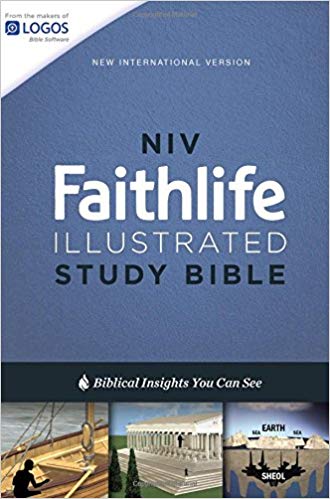
So whenever I come across a resource that helps with Bible reading and study, I’m absolutely thrilled to share it with you. One such resource I’ve been so excited about is the Faithlife Illustrated Study Bible. 

I originally purchased this study Bible because of the “illustrated” part. I glanced through it and found several things that make the biblical accounts more understandable. Things like: 

  • timelines 
  • genealogical records
  • “blueprints” of notable buildings and structures
  • infographics 
  • maps and tables 

Then I was excited to discover the wealth of articles embedded in the notes section next to the biblical texts. 

But the happiest discovery I made was the ability to combine the written text with so much additional online content. Using the Faithlife Study Bible app on my iPhone, I can access all of the content in the print version in addition to more resources that have become available since this study Bible was published. My favorite way to do this is via the “reference scanner” in the app. I use my iPhone camera to take a picture of the part of the Bible I’m studying and then the app pulls up all of the resources associated with nearly everything on that page. Amazing! 

If you already love studying the Bible, this book/app combination will take you to a whole new level. Even if you’re just getting started in a Bible study, you will love how much fullness these resources quickly bring to your fingertips. 

9 Quotes From Other Authors In “Marching Off The Map”

Tim Elmore’s books are always chockfull of the latest research and insights from multiple sources. Tim does an excellent job of synthesizing mountains of evidence to give parents and teachers actionable steps to help the students with whom they work. Here are just a few of the quotes he shared from other authors in his book Marching Off The Map.

“We all want to progress, but if you’re on the wrong road progress means doing an about-turn and walking back to the right road. In that case, the man who turns back the soonest is the one who is most progressive.” —C.S. Lewis

“Tell me a fact and I will learn. Tell me the truth and I will believe. Tell me a story, and it will live in my heart forever.” —Indian Proverb

“Start where people are before you try to take them where you want them to go.” —Jim Rohn

“Shooting above people’s heads doesn’t mean you have superior ammunition—it means you are a lousy shot.” —Oscar Handlin

“If you think our future will require better schools, you’re wrong. The future of education calls for entirely new learning environments. If you think we’ll need better teachers, you’re wrong. Tomorrow’s learners will need guides who take on fundamentally different roles.” —Dr. Wayne Hammond

“If we continue to develop our technology without wisdom or prudence, our servant may prove to be our executioner.” —Omar Bradley

“For the first time in human history, the majority of people in the developed world are being asked to make a living with their minds, rather than their muscles. For 3000 years, humankind had an economy based on farming: till the soil, plant the seed, harvest the crop. Hard to do, but fairly easy to learn. Then, for 300 years, we had an economy based on industry: mold the parts, turn the crank, assemble the product. Hard to do, but also fairly easy to learn. Now, we have an economy based on information: acquire the knowledge, apply the analytics, use your creativity. Hard to do, hard to learn, and even once you’ve mastered it, you’ll have to start learning all over again, pretty much every day.” —Michael Bloomberg

“He who has a why to live for can bear almost any how.” —Frederick Nietzsche

“Be the person you needed when you were young.” —Ayesha Saddiqi

Be sure to check out my review of Marching Off The Map by clicking here. You can also read some quotes and check out some infographics from Tim Elmore here, here, and here.

11 Quotes For Pastors From “Interpretation Of The Scriptures”

You don’t have to be a pastor to benefit from reading Interpretation Of The Scriptures by A.W. Pink, rather I think all students of the Bible will benefit from reading this classic book. However, the Apostle James did warn that “not many of you should presume to be teachers” because “we who teach will be judged more strictly” (James 3:1). In that light, A.W. Pink directs several of this comments in this book exclusively to those who teach/preach from the Bible. Here are a few of those quotes.

“The preacher’s task is both the most honorable and the most solemn of any calling, the most privileged and at the same time the most responsible one.”

“The ministry is no place for trifiers and idlers, but for those who are prepared to spend and be spent in the cause of Christ. The preacher ought to work harder than the miner, and to spend more hours per week in his study than does the man of business in his office.”

“Particularly does the minister need to attend unto this injunction ‘take heed unto thyself’ in his study of the Scriptures, reading them devotionally ere he does so professionally; that is, seeking their application and blessing to his own soul before searching for sermonic materials.”

“To ‘open’ the Scriptures helpfully to the saints requires something more than a few months’ training in a Bible institute, or a year or two in a seminary. None but those who have been personally taught of God in the hard school of experience are qualified so to ‘open’ the Word that Divine light is cast upon the spiritual problems of the believer, for while Scripture interprets experience, experience is often the best interpreter of Scripture.”

“The preacher should be with his time as the miser is with his gold—saving it with care, and spending it with caution.”

“Great care needs ever to be taken that we do not expound our own minds instead of God’s.”

“The preacher should be, above everything else, a man of the Book, thoroughly versed in the contents of God’s Word, one who is able to bring forth out of his treasure ‘things new and old’ (Matthew 13:52). The Bible is to be his sole text-book, and from its living waters he is to drink deeply and daily.”

“Commentaries we consult only after we have made a first-hand and exhaustive study of a passage.”

“It is at the feet of God that the preacher must take his place, learning from Him the meaning of His Word, waiting upon Him to open its mysteries, looking to Him for his message.” 

“To discourse upon the chemical properties of food will not feed a starving man, neither will tracing out the roots of the Hebrew and Greek words (necessary though that be in its proper place) the better enable Christ’s followers to fight the good fight of faith.”

“Scripture must be allowed to speak for itself, and it does so only so far as the preacher sets forth its genuine import. Not only is he to explain its terms, but also the nature of the ideas they express, otherwise he is apt to make use of scriptural terms and yet give them an unscriptural sense.”

To read the other quotes I shared from Interpretation Of The Scriptures, click here. You may also check out my full book review by clicking here.

11 Quotes From “Interpretation Of The Scriptures”

In my review of A.W. Pink’s book Interpretation Of The Scriptures, I noted that any student of the Bible will benefit from reading this exceptional book. The quotes I want to share today are for that universal audience, but I will also be sharing some additional quotes soon that are specifically aimed at those who are Bible teachers or pastors.

“God does not ask for blind credence from us, but an intelligent faith, and for that three things are indispensable: that His Word should be read (or heard), understood, and personally appropriated.”

“Moreover, the obscurity is not in them [the Scripture], but in the depravity of our nature which resists the holy requirements of God, and the pride of our hearts which disdains seeking enlightenment from Him.”

“It has pleased God to furnish His people with gifted instructors, and instead of haughtily ignoring them we ought (while testing their teaching—Acts 17:11) to accept thankfully whatever help they can afford us.”

“Methods of Bible study are only of relative importance; but the spirit in which it is studied is all-important. It calls for no argument to prove that a spiritual book calls for a spiritually minded reader. … Only where there is honesty of soul and spirituality of heart will there be clearness of vision to perceive the Truth; only then will the mind be capable of discerning the full import of what is read. … None but the Spirit of Truth can write God’s Law on my heart. Here, then, is the first and most essential qualification for understanding and interpreting the Scriptures, namely a mind illumined by the Holy Spirit.”

“That which conflicts with what is taught, plainly and uniformly, in the Scriptures as a whole, and which whole is set before us as the alone rule of our faith and obedience. This requires from the expositor not only a knowledge of the general sense of the Bible, but also that he takes the trouble to collect and compare all the passages which treat of or have a definite bearing upon the immediate point before him, so that he may obtain the full mind of the Spirit thereon. Having done that, any passage which is still obscure or doubtful to him must be interpreted by those which are clear. No doctrine is to be founded on a single passage.”

“By divorcing a verse from its setting or singling out a single clause, one may ‘prove’ not only absurdities but real falsities by the very words of Scripture.”

“The word for ‘search the Scriptures’ (John 5:39) signifies diligently to track out, as the hunter does the spoor of animals. The interpreter’s job is to bring out the sense and not merely the sound of the Word.”

“To a very large extent, and far more so than any uninspired book, the Bible is a self-explaining volume: not only because it records the performance of its promises and the fulfillment of its prophecies, not only because its types and antitypes mutually unfold each other, but because all its fundamental truths may be discovered by means of its own contents, without reference to anything extra or outside itself.”

“Assuredly God has not subordinated His Word to our reason for us to accept only what commends itself to our judgment. Nevertheless, He has furnished His people with this faculty, and though insufficient of itself it is a valuable aid in the understanding of Truth. While reason is not to be made the measurer of our belief, yet it is to be used as the handmaid of faith, by comparing passage with passage, deducing inferences and drawing consequences according to the legitimate laws of logic.”

“The concordance will stand [the Bible reader] in far better stead than the best dictionary.”

“There is a middle ground between hastily condemning or accepting, namely to weigh carefully and prayerfully what is presented, testing it by other passages and by our own experience.”

Interpretation Of The Scriptures (book review)

Bible reading and Bible study will be of immeasurable benefit to the reader if the Scriptures are interpreted correctly. Fortunately for us, A.W. Pink gives us some timeless principles for doing just this in his book Interpretation Of The Scriptures.

Pink acknowledges something that the Apostle Peter also acknowledged: sometimes the passages we read in the Bible can be challenging to understand. But Pink quickly adds, “God does not ask for blind credence from us, but an intelligent faith, and for that three things are indispensable: that His Word should be read (or heard), understood, and personally appropriated.”

In this book, Pink systematically gives us guidelines for the proper and effective interpretation of the the Scriptures. He does so by using many of the age-old maxims of logic and hermeneutics, but he also emphasizes the invaluable role the Holy Spirit plays in our Bible reading times. After all, the Holy Spirit was the One who inspired the writing of the Scriptures, so He is best able to illuminate the true meaning to our hearts and minds.

This is NOT a book exclusively for pastors and Bible teachers (although both will be greatly benefitted by studying this text), but it is for anyone who wants to read the Bible accurately, with an eye toward correctly applying the principles that God gives us.

I’m not sure how many times I have read through the Bible in my life, but while reading Interpretation Of The Scriptures I noticed a new attention to concepts and insights that I had previously overlooked. I highly recommend that all serious readers of the Bible read this book as well.

Saturday In The Psalms—Generations

I will utter dark sayings of old, which we have heard and known, and our fathers have told us. We will not hide them from their children, telling to the generation to come the praises of the Lord… (Psalm 78:3-4).

If George Santayana* was right about the dangers of unlearned history lessons for the general population, he identified something even more vital for those who follow God.

Asaph recounts a history of God’s people where God blessed them, the people became complacent in His blessing, until they turned from God and became subject to His wrath. The cycle, sadly, repeats again and again.

Asaph wants today’s generation to learn this lesson and to break this cycle. 

He calls on this generation to continually remind the next generation of God’s blessings for obedience, and God’s judgment for disobedience—

Make them known to their children (v. 5).

The children who would be born, that they may arise and declare them to their children (v. 6)

For today’s parents this means…
No complacency. 
No assumptions. 
No letting kids “figure it out on their own.” 
Constant diligence.
Constant communication.

May this generation speak words of life to the generation to come!

* George Santayana said, “Those who do not learn from history are doomed to repeat it.” And he also noted, “A child educated only in school is an uneducated child.”


9 More Quotes From “Marching Off The Map”

Dr. Tim Elmore has given parents, teachers, coaches, and anyone else who works with students some excellent insights in his book Marching Off The Map. Here are a few more quotes from Dr. Elmore.

“The Latin root word for ‘educate’ is ‘ducere’ which means to ‘push out.’ … We should not put students in a passive mode as we teach. We must be inspirers of learning. We must help pull ambition out of them, not push information into them.”
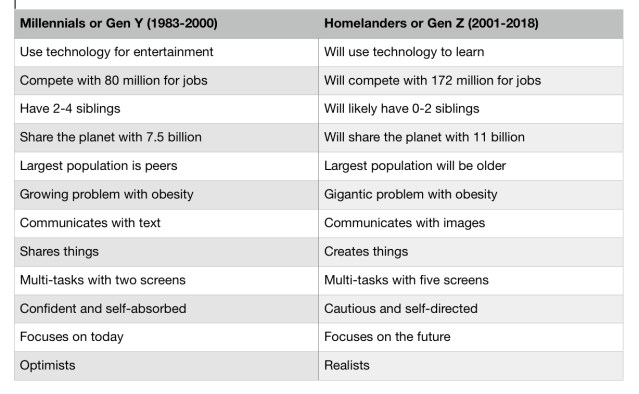
“According to Dr. Michael Leahy, ‘Today’s typical high school student endures the same anxiety levels as a psychiatric patient did in the early 1950s.’ In any given year, about one in five will experience an anxiety attack. Why? Their world is overwhelming, cluttered with information coming at them at the rate of a thousand messages a day.”

“Thousands of Baby Boomers retire each day in America. They will leave leadership positions needing to be filled. Even if everyone in Generation X were a brilliant leader, there would not be enough of them to fill the vacancies left by the Boomers. The young adults among the Millennial Generation will be needed for leadership, ready or not.”

“Although our young adults are rich in potential—we don’t really expect them to perform responsible acts until a full decade later that we expected a century ago. I believe it’s detrimental both for our kids and our society. In many states, we give them the rights to adulthood at 18 or 21, like smoking, drinking or voting. We don’t, however, expect the responsibilities that accompanied those rights. It’s unhealthy. The rights and responsibilities should always go together.”

“Remember that children (in general) cannot comprehend an addictive behavior. Adults must lead them into healthy moderation, where they both understand and enjoy technology, but utilize it as a ‘servant.’ 

“Remember that children will choose ice cream over lima beans—and screens over the healthy alternatives for play. While there are some exceptions, adults must be the ones to lead them in their emotional development, and introduce behaviors and habits that produce maturity.

“Remember that children are drawn to entertainment, whether or not they learn something from it. … Adults must leverage what they’re magnetically drawn to and make it beneficial.”

“Wise leaders utilize vision that can see both backward and forward. They look back and learn from the past. They glean from past mistakes in order to avoid repeating them. Additionally, they seek what was helpful and timeless so they can carry those elements forward. They swing backward so they can swing forward well.”

“A culture that offers the young information and autonomy without requiring equal parts accountability and responsibility produces ‘unready’ adults.”

“Students are incentivized if they know why a topic is relevant before they learn. Students bond with an experience more than a lecture. Students comprehend information when it’s connected to a narrative. Students remember data when an image is utilized in their learning.”

“Effective teachers don’t say as much as possible. They actually say as little as needed—allowing students to get on with their learning.”

You can also check out my review of Marching Off The Map by clicking here. The first set of quotes (and an infographic) I shared from the book are here, and a set of quotes that Dr. Elmore shared in his book are here.

The Maxwell Leadership Bible (book review)

Hands-down the best book for any aspiring, developing, or seasoned leader is the Bible! John Maxwell is a mentor of leaders that I have come to greatly appreciate over the years of my leadership development. So having John Maxwell’s commentary accompany my daily Bible reading time has been a  huge blessing! You can find this complete leadership development package in The Maxwell Leadership Bible.

The Bible is filled with leadership principles given by God Himself. John Maxwell is helping me compile various principles throughout the entirety of the Bible into cohesive units of study.

The Bible also presents us with various people who followed or violated God’s leadership principles. We are able to see the struggles that come to those who either ignore God’s directives or don’t consistently follow through on them. And we’re able to see the legacy of success that follows those who make it a priority to consistently walk in God’s precepts. Once again, Maxwell is brilliant at identifying these leadership lessons.

Normally I post reviews after I have read an entire book, but given the fact that my Bible reading time is in-depth and time-consuming, I wanted to post a review now to encourage Christian leaders to take advantage of this wonderful resource. If you want to use the Bible to grow your leadership capacities, the commentaries and insights provided by John Maxwell will be a huge blessing to you.

P.S. I am reading The Maxwell Leadership Bible on the Kindle version. I find it very convenient to tap on the footnotes, character studies, and leadership lessons that John Maxwell has prepared, and then quickly tap back to the biblical passage right where I left off.

9 More Quotes From “Marching Off The Map”

Tim Elmore’s insights on the youth culture are amazing. To synthesize such great insights he obviously needs to read lots and lots of research. In all of his books, Dr. Elmore freely shares the cream-of-the-crop quotes he’s uncovered in his research. Here are a few of those quotes which I appreciated.

“In the modern world we have invented ways of speeding up invention, and people’s lives change so fast that a person is born into one kind of world, grows up in another, and by the time his children are growing up, lives in still a different world.” —Margaret Mead

“We are morphing so fast that our ability to invent new things outpaces the rate we can civilize them.” —Kevin Kelly

“I beseech you to treasure up in your hearts these my parting words: Be ashamed to die until you have won some victory for humanity.” —Horace Mann

“The greatest gifts we can give our children are the roots of responsibility and the wings of independence.” —Denis Waitley

“Strangely, the world seems to be growing both more charitable and more selfish at the same time. I have a lot of faith that our children’s generation has the potential to rise to the unimaginable challenges that lie ahead. But at this fascinating crossroads in human history there’s also a sense that a traditional worldview and ethic will come under increasing assault in the western world.” —Chris Arias 

“[Generation Z] are the most connected, educated and sophisticated generation in history. They don’t just represent the future, they are creating it.” —Mark McCrindle

“In every society since the start of history, whenever you broke down any population this way, you’d always get a pyramid. But from 1960-2060, our pyramid will turn into a rectangle. We’ll have almost as many Americans over age 85 as under age 5. This is the result of longer lifespans and lower birthrates. It’s uncharted territory, not just for us, but for all of humanity. And while it’s certainly good news over the long haul for the sustainability of the earth resources, it will create political and economic stress in the short-term, as smaller cohorts of working age adults will be hard-pressed to finance the retirements of larger cohorts of older ones.” —Paul Taylor, Pew Research Center

“We are now at a point where we must educate our children in what no one knew yesterday, and prepare our schools for what no one knows yet.” —Margaret Mead

“The military tells us we must offer diversity training, but it seems to me what our sailors most need is unity training. How can we mesh our differences into a single unit and get results?” —Navy Captain Michael Abrashoff

Check out my review of Marching Off The Map by clicking here. And read some of Tim Elmore’s quotes which I shared here. I will be sharing more quotes from this book soon, so stay tuned!

7 Quotes + 1 Infographic From “Marching Off The Map”

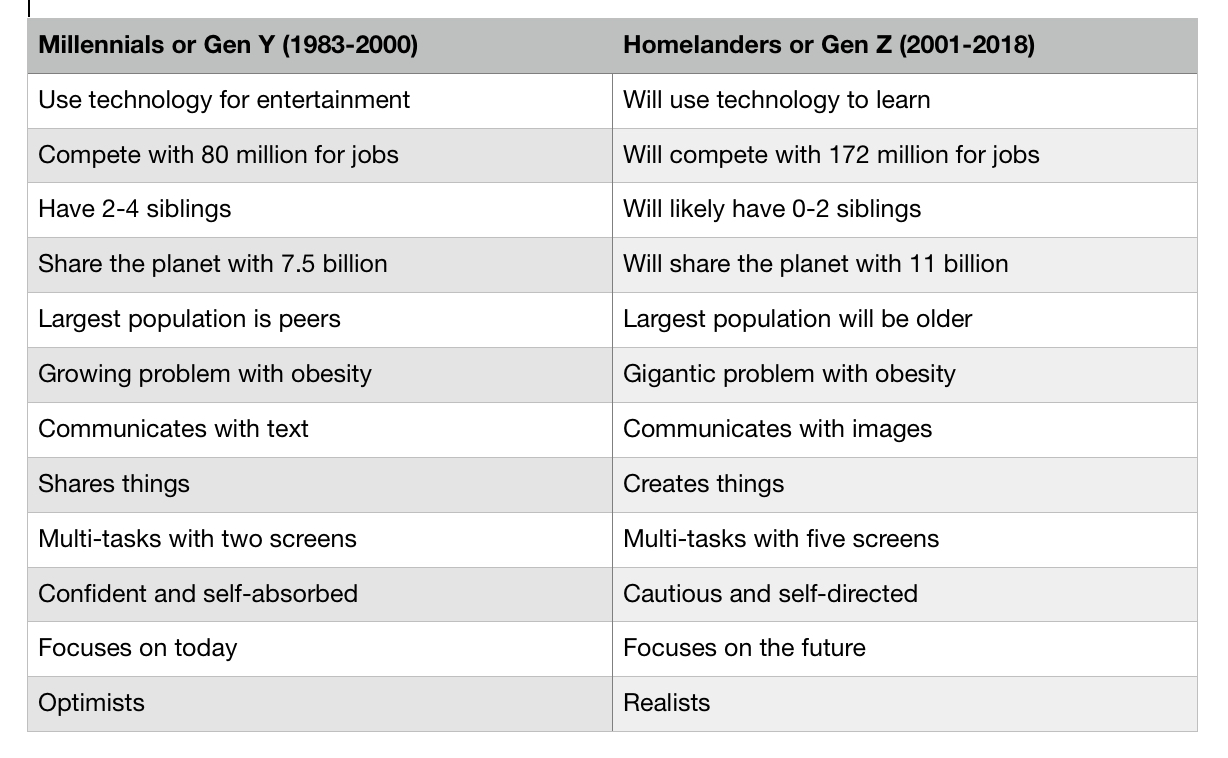
Once again, Tim Elmore has given us invaluable insight into the emerging youth culture. If you have kids or work with kids, you must read Marching Off The Map. You can check out my full book review by clicking here. Below is the first set of quotes I want to share with you, but there will be plenty more coming in the future, so stay tuned!

“Thanks to technology, information streams into their lives 24/7 and often has no filter on it, even for young children. When we determined not to censor content in the media, we had no idea (understandably) how it would affect our kids. We’re removing the opportunity for them to experience innocence and wonder. However, because they’re still maturing emotionally, socially, cognitively and biologically in their first 25 years, we have now begun to witness a strange paradox in our young: the extinction of childlikeness and the extension of childishness. …

“Since they are exposed to so much adult information, so early in their lives, they can prematurely lose (1) their sense of innocence, (2) their sense of wonder and (3) their sense of trust …

“Biologically, the graduate is an adult. Emotionally, the graduate may be unprepared for the adult world.” 

“If you think our kids are pitifully impulsive on social media—just look at the adult population. … If you think teens are addicted to Facebook, just study the hours their mothers spend on it. If you think young athletes on the Little League baseball field act childish, just look at their dads. The behavior of adults and children has become more and more similar. Society has baptized ‘youthfulness.’ We want to look young, feel young, dress young, talk young and act young. We argue with our children’s teachers. We push our kid’s coaches to get them special treatment. We are not good at delaying gratification, and we frequently don’t keep commitments we make … very much like children. The result? Adulthood has lost much of its aura and authority.”

“As you stand in front of your classroom or your own children—you are, in a sense, Galileo. You are Magellan. You are Christopher Columbus. You are Lewis and Clark. You are Neil Armstrong. Ready or not, they need you to play this role.

“Our world is both expanding and shrinking. Our past maps and methods are antiquated. Like it or not, we’re moving into unfamiliar territory and many think it’s too difficult to explore. We have fallen in love with our old maps. … 

“For educators, our role must change as we teach a generation of students who don’t need adults to get information.

“For parents, our role must change as we raise kids in a time of terrorism, economic recession, racial unrest, underemployment and ubiquitous technology.

“For coaches, our role must change as we train young athletes who have eight-second attention spans, and may arrive at practice with little resilience or grit.

“For youth workers, our role must change as we mentor students who have few life skills or values because adults either over-functioned or were absent.

“For employers, our role must change as we onboard young employees who may have never had a real job before, and may ask when ‘spring break’ will be.”

“Adults must enable the students to leverage what is new, yet at the same time, hold on to what is ancient, yet valuable. We must be both timeless and timely. So, our job as we serve the next generation is two-fold:

  • To adopt or adapt. We must seize what is new and help kids leverage it well.
  • To explain and equip. We must relate to them the timeless ideals every generation needs.”

“I believe we must cultivate one significant skill set in ourselves: we must be able to either adapt to the new world that’s emerging, or we must explain why a timeless virtue or value is still relevant in our 21st century world.”

“A third of young Americans say they don’t belong to any religion. I’ve found, however, they’ve traded in one God for many gods. They want to ‘feel’ spiritual, so they’ve created a buffet—seeking something to satisfy their soul. I often hear students say, ‘I don’t believe in religion, but I want to be a spiritual person.’ Today—pluralism is expanding across the landscape. It’s easier to say ‘no’ to one and enjoy a mixture of many.”

“A third of young Americans say they don’t belong to any religion. I’ve found, however, they’ve traded in one God for many gods. They want to ‘feel’ spiritual, so they’ve created a buffet—seeking something to satisfy their soul. I often hear students say, ‘I don’t believe in religion, but I want to be a spiritual person.’ Today—pluralism is expanding across the landscape. It’s easier to say ‘no’ to one and enjoy a mixture of many.”

“The Latin root word for ‘educate’ is ‘ducere’ which means to ‘push out.’ … We should not put students in a passive mode as we teach. We must be inspirers of learning. We must help pull ambition out of them, not push information into them.”

I’ll be posting some more quotes from Marching Off The Map next week.