Battling Depression

Have you ever been depressed? I have. I know all too well how depression robbed me of sleep, sapped joy from my day, kept me from smiling and on the verge of tears all the time, made sunny days seem cloudy, caused me to sigh all the time and lose interest in the things that used to bring me pleasure, and brought such a sense of loneliness and isolation.

Did you know that Jesus felt the crushing load of depression too? As He was praying in the Garden of Gethsemane just before His arrest, listen to these words—

  • He began to be sorrowful and troubled
  • He became anguished and distressed
  • He began to show grief and distress of mind and was deeply depressed
  • He said to them, “My soul is overwhelmed with sorrow to the point of death”
  • He prayed more fervently, and He was in such agony of spirit that His sweat fell to the ground like great drops of blood
  • “Abba, Father,” He cried out, “everything is possible for You. Please take this cup of suffering away from Me. Yet I want Your will to be done, not Mine.” (see Matthew 26:37-38; Mark 14:36; Luke 22:44)

The writer of Hebrews wrote this about Jesus—

While Jesus was here on earth, He offered prayers and pleadings, with a loud cry and tears, to the One who could rescue Him from death. And God heard His prayers because of His deep reverence for God. Even though Jesus was God’s Son, He learned obedience from the things He suffered. In this way, God qualified Him as a perfect High Priest, and He became the source of eternal salvation for all those who obey Him. (Hebrews 5:7-9)

We learn something in suffering that we can’t learn any other way. Jesus learned how to experience all of the grief, anxiety, and depression that you and I will ever feel. And that is what qualifies Him to be a perfect High Priest for us.

Our part is to pray. Time and time and time again, not only did Jesus pray, but He encouraged His disciples to pray as well. As you continue to pray, Jesus is your High Priest praying for you. Only He truly knows how to translate the cry of your heart into a language Abba Father can understand.

In all their troubles, He was troubled, too. He didn’t send someone else to help them. He did it Himself, in person. (Isaiah 63:9)

If you’ve missed any of the messages in this series called Where’s God, please check them all out by clicking here.

Don’t Fake It

Listen to the podcast of this post by clicking on the player below, and you can also subscribe on AppleSpotify, or Audible.

Have you ever had someone tell you, “Fake it until you make it”? In other words, you may not feel happy, but just start smiling and soon you will feel happy. Sadly, I’ve heard this type of so-called wisdom given by Christians to other Christians. Phrases like…

  • Don’t let anyone know that you feel scared, doubtful, or angry.
  • Never let ‘em see you sweat.
  • Even if you’re down, put on a happy face.

Turns out that this is not only bad advice, but harmful advice too. A study done by Michigan State University found:

     “Pretending to smile when you’re feeling bad makes you feel worse and be less productive. … [You] can’t just fake a smile and expect to feel good about it or negative feelings intensify.”

If you’re a follower of Jesus Christ, you should never fake it. Take a quick glance through the Psalms and you’ll see raw, real emotions: anger … depression … anxiety … vengeance … sadness … envy … spite … and many others. 

Here’s the deal: You may wear a {fake} smile on the outside, but God knows the {real} emotions in your heart. You’re not fooling Him. And, as it’s been revealed in this study, you’re not fooling anyone else either.

So go ahead and vent those negative emotions when you’re alone with God. Tell Him how you really feel (He already knows, but it’s good for you to hear you say it). And then let the Holy Spirit show you how to deal with those emotions in a healthy way.

Don’t bottle it up—don’t fake-it-until-you-make-it—be real and let God heal you.

UPDATE: I talk a lot about dealing with our strong, negative emotions in my book When Sheep Bite.

►► Would you please prayerfully consider supporting this ministry? My Patreon supporters get behind-the-scenes access to exclusive materials. ◀︎◀︎

Encouraging Presence

Have you ever been down in the dumps? Ever been discouraged or blue? Have you ever felt like no one gets you? In those moments, have you asked God for encouragement?

The Apostle Paul was feeling a little down, and he asked God to send him encouragement. God answered this way

But God, who encourages those who are discouraged, encouraged us by the arrival of Titus.

Paul says in the next verse, Titus’ presence was a joy.

This word for encourage simply means showing up for a friend. Do you realize you could be a huge source of encouragement to someone just by showing up?

“A real friend is one who walks in when the rest of the world walks out.” —Walter Winchell

Who needs you to just show up by their side today? Just by showing up, you could be the answer to someone’s desperate prayer for encouragement.

Go, be there for a friend!

How Are You Running?

Listen to the podcast of this post by clicking on the player below, and you can also subscribe on Apple or Spotify.

Ever noticed how often we use the word run in our everyday clichés?

  • I gotta run a few errands
  • I’m running the kids to soccer practice
  • Our funds are running a little low
  • We’re running a bit late
  • I’m running out of energy
  • My patience is running thin
  • Can’t talk now, I have to run

My question is: how are you running?

Elijah ran twice. Once in the power of God, and once in fear.

When he ran in fear, he became completely exhausted to the point where he became depressed and suicidal. When he ran in God’s power, there was no tiredness.

When he ran in fear, he forgot God and focused totally on his own needs. When he ran in God’s power, only God was exalted.

So how are you running today? Are you running in fear of disappointing someone … dropping the ball … losing the job … falling short … losing face?

Or are you running in God’s power … doing the things that draw you closer to Him … running to bring others to Christ … exalting God?

You will be running this week. The bigger question is how are you doing it?

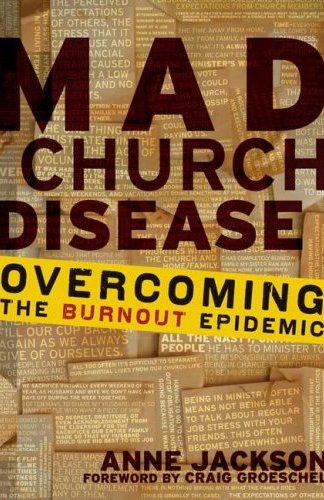
Mad Church Disease (book review)

Read this book and save your life.

Seriously.

I have seen far too many good people get burned-out in the most unlikely place. The one place where you would expect wholeness and vitality and safety and health: Church! In Mad Church Disease Anne Jackson draws the comparison to bovine spongiform encephalopathy (better known as mad cow disease) to confront mad church disease head-on.

Here’s the insidious thing about the way mad cow disease spreads: after infected cows die, they are ground up and fed to healthy cows. So unwittingly the disease is perpetuated because no one recognizes it’s there. Sadly that’s what happens far too often in the church. We have developed cultures that continue to burn-out people, and then we let those burned-out people feed (develop) new people

Anne shines the light of truth on this ugly disease. She confronts the symptoms head-on, and offers practical steps for helping people get healthy.

As someone who came very close to getting burned-out by mad church disease, I can attest how right-on-the-mark Anne’s book is. And to bolster her diagnosis, Anne interviews several leading pastors whose “second opinion” confirm the original diagnosis. I liked this observation from Bill Hybels:

“Especially as leaders in the church, we consistently need to be filled up and buoyed in our spirits because everybody takes their cue from the leader. If the leader is exhausted, then the people following that leader will feel exhausted. If the leader is wearing thin on hope, then people start losing hope too. If the leader gets pessimistic, everybody gets pessimistic.”

So who should read Mad Church Disease?

  • Pastors
  • Paid church staff
  • Volunteer church ministers
  • Counselors
  • Church board members

Whether you have been infected by mad church disease or not, you need to read this book. It will either be a source of healing for you, or an eye-opener to help protect yourself and others around you from this deadly disease.

The first step to eliminating mad church disease is recognizing its symptoms. Mad Church Disease does just that, and then goes further to talk about the steps for healing. Thanks, Anne, for a straightforward look at this serious disease.

Be An Intrusive Friend

Yesterday I talked about how to defeat depression in our personal lives. Maybe you’re not battling depression yourself, but since anti-depressants are one of the most prescribed medications, there’s a good chance that someone you know is dealing with depression. Beyond medicine or counseling, one of the greatest antidotes for depression is a friend: an intrusive friend.

In 1 Kings 19 when Elijah was running scared and slipping into depression, there is an important verse at the beginning of the story—Elijah was afraid and ran for his life. When he came to Beersheba in Judah, he left his servant there (v. 3).

One of our most natural reactions when we’re battling depression is to withdraw from others. It’s natural to want to be alone, but it is one of the worst things to do. Throughout Scripture, powerful people became vulnerable to attack when they left their friends behind—Samson, David, and Peter are prime examples. Even Jesus was tempted by the devil when He was alone in the wilderness.

So if it’s natural to want to be alone when depression is raining on our souls, a true friend will have to be an intrusive friend … a tenacious friend … a persistent friend. I love the lines in the Toby Mac song “Face Of The Earth” that say—

Now Hope Road is calling
Let’s pack you up and move
‘Cause real friends are willing to intrude
So I’m gonna push you in because I wanna love you well
Let the ghosts of your past rest

If you have a friend who is starting to become distant, dropping out of activities, or spending more time alone, these may be the warning signs of depression. Don’t let him be like Elijah and leave you behind, but love him or her enough to intrude in his or her life. Your encouragement just may be the best anti-depressant he/she will ever receive.

So speak encouraging words to one another. Build up hope so you’ll all be together in this, no one left out, no one left behind. I know you’re already doing this; just keep on doing it. (1 Thessalonians 5:11, The Message)

Jonathan went to find David and encouraged him to stay strong in his faith in God. (1 Samuel 23:16, New Living Translation)

Defeating Depression

In 1 Kings 19, Elijah hears that Queen Jezebel wants to kill him, so he “ran for his life.” Just four verses earlier Elijah “ran in the power of the Lord” (18:46) but now he is running scared. After 42 days of despondent wandering, Elijah ends up in a cave and God asks Elijah, “Why are you here?” (v. 9).

Elijah’s answer seems unresponsive. He tells God—as though He didn’t already know!—all about the spiritual conditions in Israel, but he never really answers the “why” question. God reveals Himself to Elijah more intimately (as “a gentle whisper”) and asks him again, “Why are you here?” Elijah gives the same, word-for-word answer.

During difficult times—when my “enemies” seem too numerous to count or too big to defeat—the eyes of my soul become cloudy. It becomes harder to look out and so I naturally tend to look inward. As a result, I become the center of my entire universe: “Now they are trying to kill me!”

In Psalms 42 and 43, the psalmist is clearly depressed. Look at his inward, me-focused questions—

  • When can I go and meet with God? (42:2)
  • My enemies continually taunt me, saying, “Where is this God of yours?” (42:3)
  • Why are you so downcast, O my soul? Why so disturbed within me? (42:5, 11; 43:5)
  • Why have You forgotten me? (42:9)
  • Why have You rejected me? (43:2)

Just as God’s question to Elijah was supposed to get him to look outward, the psalmist does begin to turn his gaze from himself. But notice how he does it—

  • My soul is downcast within me; therefore I will remember You (42:6)
  • Put your hope in God, for I will yet praise Him, my Savior and my God (42:11; 43:5)

When I’m battling depression, it takes an act of my will to praise God, to look outward and upward. Feelings follow actions. I don’t feel like praising Him because my problems feel so overwhelming, but when I will to praise Him, the feelings will follow.

Look how David did it—

I will extol the LORD at all times; His praise will always be on my lips.
My soul will boast in the LORD; let the afflicted hear and rejoice.
Glorify the LORD with me; let us exalt His name together.
(Psalm 34:1-3)

My friend, if you are depressed—if you have become inward-focused—only an act of your will can lift you out of this funk.

Use your willpower to act—look out, look up, praise God—and the cloud over your soul will begin to lift!