Just Passin’ Through

This world is not my home. I’m just a traveler passing through. At times this world sure is beautiful! I love the sunsets, and the thunderstorms, and the oceans, and the forests. I love the animals, and the art, and the music.

But this is not my home. C.S. Lewis wrote—

“The books or the music in which we thought the beauty was located will betray us if we trust to them; it was not in them, it only came through them, and what came through them was longing. These things—the beauty, the memory of our own past—are good images of what we really desire; but if they are mistaken for the thing itself they turn into dumb idols, breaking the hearts of their worshipers. For they are not the thing itself; they are only the scent of a flower we have not found, the echo of a tune we have not heard, news from a country we have never yet visited.

And the Apostle John gave me this warning—

Do not love this world nor the things it offers you, for when you love the world, you do not have the love of the Father in you. For the world offers only a craving for physical pleasure, a craving for everything we see, and pride in our achievements and possessions. These are not from the Father, but are from this world. (1 John 2:15-16 NLT)

This is not my home. I’m just passin’ through, and enjoying the scents and echoes of my Heavenly Homeland!

“Prayer Is Irksome”

I shared this quote from C.S. Lewis this morning—

“Well, let’s now at any rate come clean. Prayer is irksome. An excuse to omit it is never unwelcome. When it is over, this casts a feeling of relief and holiday over the rest of the day. We are reluctant to begin. We are delighted to finish. While we are at prayer, but not while we are reading a novel or solving a crossword puzzle, any trifle is enough to distract us…. Now the disquieting thing is not simply that we skimp and begrudge the duty of prayer. The really disquieting thing is it should be numbered among duties at all. For we believe that we were created ‘to glorify God and enjoy Him forever.’ And if the few, the very few, minutes we now spend on intercourse with God are a burden to us rather than a delight, what then?… The painful effort which prayer involves is not proof that we are doing something we were not created to do. If we were perfected, prayer would not be a duty, it would be a delight. Someday, please God, it will be.”

Why don’t we pray more? Why does it seem like prayer is not a regular part of our lives?

Perhaps… We don’t know what to pray. The Bible is an amazing prayer book! Just use the words of Scripture to form your prayers. You can use the psalms, or go to the New Testament where Jesus or the other New Testament writers say something like, “This is my prayer….” Borrow their words, personalize them, and it will be an incredible prayer.

Maybe… We don’t have time to pray. We always have the Holy Spirit with us, and He reminds us of the Word and helps us pray. So we can pray anytime, anywhere, no matter what we are doing.

It could be… We run out of things to say. The Bible gives us so many things on which to meditate. This word means to mull over, or to even talk to ourselves. Combining Bible reading and prayer helps us continue to talk to God all throughout the day.

Try these simple steps and you will begin to realize, as C.S. Lewis said: “If we were perfected, prayer would not be a duty, it would be a delight. Someday, please God, it will be.”

Busted!

C.S. Lewis nails me with this quote from Letters To Malcolm

“Well, let’s now at any rate come clean. Prayer is irksome. An excuse to omit it is never unwelcome. When it is over, this casts a feeling of relief and holiday over the rest of the day. We are reluctant to begin. We are delighted to finish. While we are at prayer, but not while we are reading a novel or solving a crossword puzzle, any trifle is enough to distract us….

Now the disquieting thing is not simply that we skimp and begrudge the duty of prayer. The really disquieting thing is it should be numbered among duties at all. For we believe that we were created ‘to glorify God and enjoy Him forever.’ And if the few, the very few, minutes we now spend on intercourse with God are a burden to us rather than a delight, what then?… 

The painful effort which prayer involves is not proof that we are doing something we were not created to do. 

If we were perfected, prayer would not be a duty, it would be a delight. Someday, please God, it will be.”

I don’t know about you, but this convicts me.

I want to be delighted for my prayer times. When I think that the Creator of the universe wants me to spend time with Him in prayer, how could this not be a delight?!

5 Quotes From “Questions Christians Hope No One Will Ask”

Earlier this week I reviewed Questions Christians Hope No One Will Ask Them (you can read my review here).

I wanted to share some of my favorite quotes from this book:

“When we fail to answer someone’s questions and objections, we become just one more excuse for them to disbelieve.” —Walter Martin

“I cannot believe that our existence in this universe is a mere quirk of fate. … We are truly meant to be here.” —Paul Davies, a physicist, cosmologist, and atheist

“Consider what you’d need for a protein molecule to form by chance. First, you need the right bonds between the amino acids. Second, amino acids come in right-handed and left-handed versions, and you’ve got to get only left-handed ones. Third, the amino acids must link up in a specified sequence, like letters in a sentence. Run the odds of these things falling into place on their own and you find that the probabilities of forming a rather short functional protein at random would be one chance in a hundred thousand trillion trillion trillion trillion trillion trillion trillion trillion trillion trillion. That’s a ten with 125 zeroes after it! And that would only be one protein molecule—a minimally complex cell would need between three hundred and five hundred protein molecules. … To suggest chance against those odds is really to invoke a naturalistic miracle.” —Stephen Meyer, a Cambridge-trained philosopher of science

“Here’s the key point to remember: there never was a time when the earliest community of followers of Jesus did not regard Him as far, far more than a good teacher.” —Mark Mittelberg

“If a good God made the world, why has it gone wrong? … My argument against God was that the universe seemed so cruel and unjust. But how had I got this idea of just and unjust? A man does not call a line crooked unless he has some idea of a straight line. What was I comparing this universe with when I called it unjust? If the whole show was bad and senseless from A to Z, so to speak, why did I, who was supposed to be part of the show, find myself in such violent reaction against it? … Thus in the very act of trying to prove that God did not exist—in other words, that the whole of reality was senseless—I found I was forced to assume that one part of reality—namely my idea of justice—was full of sense. Consequently, atheism turns out to be too simple. If the whole universe has no meaning, we should never have found out that it has no meaning: just as, if there were no light in the universe and therefore no creatures with eyes, we should never know it was dark. Dark would be without meaning.” —C.S. Lewis

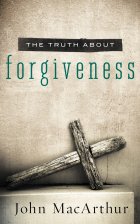
The Truth About Forgiveness (book review)

One of my favorite quotes about forgiveness comes from the pen of C.S. Lewis. He wrote: “We all agree that forgiveness is a beautiful idea until we have to practice it.” How true that is! In this short, but power-packed book, The Truth About Forgiveness, John MacArthur shares how beautiful and freeing true forgiveness is.

You may know John MacArthur as a preeminent Bible teacher. If so, you will not be disappointed in the content of this amazing book. Pastor MacArthur eloquently explains the need for forgiveness, how unworthy we are of God’s forgiveness, how unthinkable it is that God forgives us anyway, and how we should now live as people who regularly ask for forgiveness.

Pastor MacArthur’s Bible teaching skills are on full display as he digs deeply into well-known scriptural stories, and places us squarely in the middle of the character’s lives. In fact, one story he so beautifully portrays through the lens of forgiveness, but I had never seen it that way before!

This is not a long treatise on forgiveness, but it is a easy-to-read guide into new thinking about forgiveness. Trust me, after reading The Truth About Forgiveness, you will never look at forgiveness the same way again.

I am a Thomas Nelson book reviewer.

Getting Out Of The Hole

Yesterday in part two of our Immersed series, we looked at how helpless we are in trying to break free from sin’s pull on our lives. That is, we are helpless to help ourselves.

But with the Holy Spirit’s help, we go from helpless to hopeful!

In Romans 8, there are all of these contrasting statements about the sinful life versus the Spirit-led life. Our hope to move into the Spirit-led life turns on this phrase in verse 15: but by the Spirit. It is only by God’s Spirit that we can break free. To help illustrate this point, I read a rather long passage from C.S. Lewis’ Mere Christianity. Several people have asked to see this, so here it is—

“Now what was the sort of ‘hole’ man had got himself into? He had tried to set up on his own, to behave as if he belonged to himself. In other words, fallen man is not simply an imperfect creature who need improvement: he is a rebel who must lay down his arms. Laying down your arms, surrendering, saying you are sorry, realizing that you have been on the wrong track and getting ready to start life over again from the ground floor—that is the only way out of a ‘hole.’ This process of surrender—this movement full speed astern—is what Christians call repentance. Now repentance is no fun at all. It is something much harder than merely eating humble pie. It mean unlearning all the self-conceit and self-will that we have been training ourselves into for thousands of years. It means killing a part of yourself, undergoing a kind of death. In fact, it needs a good man to repent. And here comes the catch. Only a bad needs to repent: only a good man can repent perfectly. The worse you are the more you need it and the less you can do it. The only person who could do it perfectly would be a perfect person—and he would not need it.

“Remember, this repentance, this willing submission to humiliation and a kind of death, is not something God demands of you before He will take you back and which He could let you off is He chose: it is simply a description of what going back to Him is like. If you ask God to take you back without it, you are really asking Him to let you go back without going back. It cannot happen. Very well, then, we must go through with it. But the same badness which makes us need it, makes us unable to do it. Can we do it if God helps us? Yes, but what do we mean when we talk of God helping us? We mean God putting into us a bit of Himself.

When we invite Christ into our lives, He places “a bit of Himself” in us: the Holy Spirit. That enables us to be perfectly forgiven.

But then when we allow the Holy Spirit to immerse us in Himself, it’s not just “a bit of Himself” we get, but all of Him. This opens the door to deeper intimacy, greater closeness, and a more God-glorifying life!

I want to live immersed!

If you’ve missed any of the messages in the Immersed series, you can find them all here.

Thoughts From C.S. Lewis

I’ve been re-reading some of my notes that I made on a collection of essays from C.S. Lewis. He is one of my favorite authors, always helping me to see the spiritual realm in a whole new light.

These are just a few quotes that have me thinking…

“A live body is not one that never gets hurt, but one that can to some extent repair itself. In the same way a Christian is not a man who never goes wrong, but a man who is enabled to repent and pick himself up and begin over again after each stumble—because the Christ-life is inside him, repairing him all the time, enabling him to repeat (in some degree) the kind of voluntary death which Christ Himself carried out.”

“There are two ways in which the human machine goes wrong. One is when human individuals drift apart from one another, or else collide with one another and do one another damage. The other is when things go wrong inside the individual—when the different parts of him either drift apart or interfere with one another.”

“Those cautions which the tempter whispers in our ears are all plausible…. That is the truth in the temptation. The lie consists in the suggestion that our best protection is a prudent regard for the safety of our pocket, our habitual indulgences, and our ambitions.”

“When a man is getting better he understands more and more clearly the evil that is still left in him. When a man is getting worse he understands his own badness less and less. … Good people know about both good and evil: bad people do not know about either.”

If you haven’t read C.S. Lewis for yourself, he writes in so many different genres that you can find something for almost any taste: science fiction, children’s fairy tales, theology, apologetics, and on and on. He was truly gifted by God to see our world in a different light, and you will be greatly enriched by reading as much as you can from this master author.

Revelation Or Speculation

In answering questions that have been submitted for The Q Series, I noticed a recurring trend: How much of our “conventional thought” in church circles is not revelation, but speculation.

Yesterday I had some tough questions on Heaven, Hell, suicide, our resurrected bodies, the after-life, and so on. In answering these questions, I used many passages from the Bible, but I also quoted from Charles Spurgeon, Charles Dickens, and C.S. Lewis. There’s nothing wrong, per se, with quoting from extra-biblical sources, but we have to be very careful what we do with those.

I once heard renowned evangelist C.M. Ward say something like this:

“The Word of God is completely good; you can devour all of it. But reading anything else is like eating chicken. There is some meat that’s good, and there are some bones, and gristle, and fat that you should spit out. Be very careful of what you take in, unless it is the pure Word of God.”

The Bible reveals so much for our lives, and we put ourselves in a place God can bless us when we are obedient to the revelation of His Word. But we put ourselves on shaky ground when we live by speculation of what we think may be truth.

The Apostle Peter said it this way:

For no prophecy ever originated because some man willed it [to do so — it never came by human impulse], but men spoke from God who were borne along (moved and impelled) by the Holy Spirit. (2 Peter 1:21 AMP)

So whether you are looking for an answer yourself—or you are asking someone for an answer—make sure you are getting revelation from God’s Word, and not the speculation of man’s opinion.

Check out other questions in our Q Series by clicking here.

What Are You Exchanging?

Listen to the podcast of this post by clicking on the player below, and you can also subscribe on AppleSpotify, or Audible.

In Romans 1, the word exchanged shows up three times in just one passage (Romans 1:22-32). Quite simply, this means every encounter with God’s presence requires me to make a choice, to exchange something.

I cannot remain neutral. The interaction with God is not static, but dynamic.

There are two forces at work in my life: sin and the Holy Spirit.

Sin wants me to exchange…

  • …the creation for the Creator (Romans 1:23)
  • …lies for truth (v. 25)
  • …pleasure for purity (v. 26)
  • …depravity for holiness (v. 28)

One exchange toward sin makes the next one that much easier. Soon the downward spiral can be pulling me faster and faster until: it’s not as if they don’t know better. They know perfectly well they’re spitting in God’s face. And they don’t care—worse, they hand out prizes to those who do the worst things best! (v. 32, The Message)

C.S. Lewis said it this way:

Good and evil both increase at compound interest. That is why the little decisions you and I make every day are of such infinite importance. The smallest good act today is the capture of a strategic point from which, a few months later, you may be able to go on to victories you never dreamed of. An apparently trivial indulgence in lust or anger today is the loss of a ridge or railway line or bridgehead from which the enemy may launch an attack otherwise impossible.”

The Holy Spirit also asks for an exchange. He wants me to exchange…

  • …the momentary for the eternal
  • …self-gratification for God’s glory
  • …my desire for God’s will

You will encounter God today. The choice is yours: What exchange will you make?

►► Would you please prayerfully consider supporting this ministry? My Patreon supporters get behind-the-scenes access to exclusive materials. ◀︎◀︎

How Much Do I Have To Do?

I had a couple of questions along the line of “How much do I have to do” in The Q Series yesterday morning. We all have a tendency to want to know how to fill in the blanks of questions like:

  • How much time do I have to spend with God to make Him happy?
  • How holy do I have to be for God to accept me?
  • What do I have to do for God to love me more?
  • How much do I have to do to make it to Heaven?

But all of these questions start with a wrong premise. These questions all assume I can do something. If the history of mankind shows us anything, it’s that all of our attempts to build a bridge up to God always falls short.

So—wonder of wonders!—God reached down to us! Jesus gave all so that we could be restored to a relationship with God. And what does He want in return? He wants you! I love this thought from C.S. Lewis:

“For it is not so much of our time and so much of our attention that God demands; it is not even all our time and all our attention; it is ourselves.”

Sometimes we look at ourselves and think, “God wants this?! God wants me?!” In fact, I received another question yesterday that simply asked, “Why does God love us?”

God wants you because He made you to be in relationship with Him. He loves you as if you were the only person on earth to love. Again, consider these wise words from C.S. Lewis—

“We were made not primarily that we may love God (though we were made for that too) but that God may love us, that we may become objects in which the Divine love may rest ‘well pleased.’ …Because He already loves us He must labor to make us lovable.”

How much do you have to do to receive that love? Just believe that fact that God loves you, that He sent Jesus to pay the price for your forgiveness, and that the Holy Spirit is right now working to draw you into that ‘Divine love’ relationship.

Let me state it simply: God loves you. Will you let His love fill your life?

Check out other questions in our Q Series by clicking here.