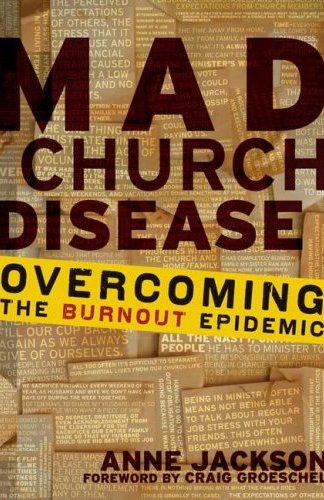
Mad Church Disease (book review)

Read this book and save your life.

Seriously.

I have seen far too many good people get burned-out in the most unlikely place. The one place where you would expect wholeness and vitality and safety and health: Church! In Mad Church Disease Anne Jackson draws the comparison to bovine spongiform encephalopathy (better known as mad cow disease) to confront mad church disease head-on.

Here’s the insidious thing about the way mad cow disease spreads: after infected cows die, they are ground up and fed to healthy cows. So unwittingly the disease is perpetuated because no one recognizes it’s there. Sadly that’s what happens far too often in the church. We have developed cultures that continue to burn-out people, and then we let those burned-out people feed (develop) new people

Anne shines the light of truth on this ugly disease. She confronts the symptoms head-on, and offers practical steps for helping people get healthy.

As someone who came very close to getting burned-out by mad church disease, I can attest how right-on-the-mark Anne’s book is. And to bolster her diagnosis, Anne interviews several leading pastors whose “second opinion” confirm the original diagnosis. I liked this observation from Bill Hybels:

“Especially as leaders in the church, we consistently need to be filled up and buoyed in our spirits because everybody takes their cue from the leader. If the leader is exhausted, then the people following that leader will feel exhausted. If the leader is wearing thin on hope, then people start losing hope too. If the leader gets pessimistic, everybody gets pessimistic.”

So who should read Mad Church Disease?

  • Pastors
  • Paid church staff
  • Volunteer church ministers
  • Counselors
  • Church board members

Whether you have been infected by mad church disease or not, you need to read this book. It will either be a source of healing for you, or an eye-opener to help protect yourself and others around you from this deadly disease.

The first step to eliminating mad church disease is recognizing its symptoms. Mad Church Disease does just that, and then goes further to talk about the steps for healing. Thanks, Anne, for a straightforward look at this serious disease.
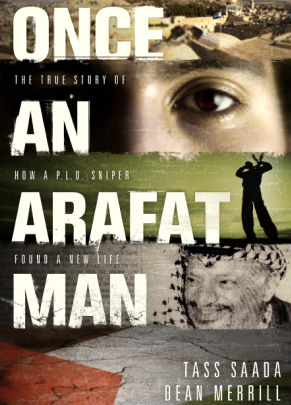

Once An Arafat Man (book review)

Tass Saada’s story reads like a screenplay for an upcoming movie! Once An Arafat Man is such a page-turner, that I could hardly put it down.

In a nutshell, Tass’s story is this: He was born in the Gaza Strip, but his family had to relocate to Saudi Arabia due to the turbulence in Gaza. The Saudi government, like many Arabic governments, talked about supporting the Palestinians, but they were more concerned about self-preservation; as a result, it was just talk and very little action. Tass became a disgruntled, disillusioned young man. As a  teenager, he had a chance to meet Yasser Arafat in Qatar and was enthralled with this dynamic Palestinian leader. So mesmerized, in fact, that Tass ran away from home to join Fatah with Arafat.

Once he was accepted into the Palestinian Liberation Organization (PLO), Tass was trained as a sniper. His mission: assassinate Jewish targets. He even served as Arafat’s personal chauffeur. But once again the unstable political and military conditions caused Fatah to pull out of Jordan and eventually Tass ended up fleeing to the United States of America.

Once in the US, he didn’t want to be forced to leave, so he married an American woman to get his green card. While working on his career, something Tass never expected happened: he became a Christian. As his friend Charlie was sharing with him from the Bible, Tass wrote:

Before I knew it, I was on my knees. I didn’t consciously decide to kneel; it just happened. I lost all awareness that Charlie was even in the room. A light came into my field of vision–a talking light….

The light said in an audible voice, “I am the way and the truth and the life. No one comes to the Father except through Me….”

In this indescribable moment, I knew something else: the triune God existed—Father, Son, and Holy Spirit. I knew that God loved me. “Oh, Jesus, come into my life!” I blurted out. “Forgive me and be my Lord and Savior!” I felt as if a heavy load went flying off my shoulders. A sense of peace and joy rushed into my heart. The presence of God was so real it seemed I could almost reach out and touch it.

Thus began a new journey for Tass, one of reconciliation. His wife and children eventually accepted Jesus Christ as their personal Savior too. But Tass’s family back in Qatar is a different story: they denounced him as an infidel

Tass felt compelled to take the good news of Jesus back to his family and to the very leader he used to work for: Yassar Arafat. The story of how God opened doors of opportunity, and provided supernatural protection, and allowed for reconciliation to occur is amazing.

Read this book. You will be blessed by this incredible story!

I’m a Tyndale book reviewer.

Points Of Power (book review)

Since you’re reading another book review from me, you probably know that I love to read. I’ve got wall-to-wall, floor-to-ceiling bookshelves in my office, just brimming full of books. Once someone asked me, “How do you read so many books?” To which I replied, “One page at a time.”

This is how most healthy growth takes place: one step at a time.

  • We lose weight one pound at a time.
  • We advance through school one class at a time.
  • We grow in our relationships one conversation at a time.
  • And we develop a greater love for God one principle at a time.

This is what I enjoyed about Yolanda Adams’ book Points Of Power. A total of 37 power points are spread out across 10 chapters. Each of the chapters zero-in on a different power point:

  • Faith
  • Love
  • Forgiveness
  • Confession
  • Praise
  • Confident Assurance
  • Prayer
  • Peace
  • Protection
  • Victory

In each power point, Yolanda deliberately leads us through the principle, a passage of Scripture, a prayer, and ten pensive points. I especially enjoyed the pensive points, as they challenged me to think more deeply about each power point.

This book would be excellent as an individual study, or as a group Bible study. One step at a time—one principle at a time—your reliance on God will grow.

I am a Faith Words book reviewer.

The Barbarian Way (book review)

With so many to follow or listen to, Erwin McManus is one of the select few pastors I tune into on a regular basis. I was never really sure what it is about Erwin that so resonates with me until I read The Barbarian Way. Now I have a reason for what I’ve always felt: I’m a barbarian too.

Religion bores me.

Religious people are de-motivating.

Denominations spend too much time with the already-churched.

Civilized Christianity is unremarkable.

Keying in on the life of John The Baptizer, Erwin takes an entirely different tact. John was so out of the religious mainstream: a long-haired, weird dresser who lived in the wilderness, eating locusts and honey, and preaching about Jesus. And, by the way, his ministry drew both the seeker and the civilized God-follower.

The seekers were both fascinated and motivated by John’s message. The religious were repulsed at the barbarity of John’s call to repentance. It was the same with Jesus’ ministry: the seekers were energized and liberated by Christ’s words; the religious were incensed.

What about me? Are my message and lifestyle barbaric enough to resonate with those seeking a relationship with Christ? Does it draw them into that relationship? Or do I live so tamed and civilized that only the religious people like my lifestyle?

Here’s how Erwin puts it:

“Civility focuses our energy on all the wrong places. We spend our lives emphasizing our personal development and spiritual well-being. We build churches that become nothing more than hiding places for the faithful while pretending that our actions are for the good of the world. … It may seem counterintuitive, but the more civilized we seem to become, the more detached from the pain of others we end up finding ourselves. The most civilized churches have really no practical concern for people outside their congregations. The brokenness of a lost and unbelieving world is not enough to inspire the painful changes necessary to make the church relevant to the world in which we live.”

I love the barbarian way of living. The Barbarian Way simply put words to what my heart was already crying out.

I am a Thomas Nelson book reviewer.

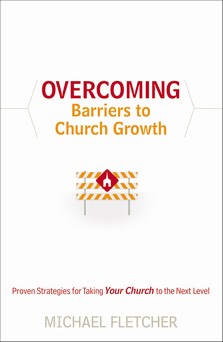
Overcoming Barriers To Church Growth (book review)

Hold on a second. I’m sure when you saw the title of Michael Fletcher’s book—Overcoming Barriers To Church Growththere were two thoughts that could have immediately popped in your mind: (1) “I’m not a pastor, so this book’s not for me”; or (2) “I am a pastor, but no one’s going to tell me how to grow my church.”

If you thought either of those things and didn’t explore this book any further, you’d really be robbing yourself.

In the case of the first objection (“I’m not a pastor”), Fletcher does a good job in making the case that church life is a team sport. The pastor cannot grow the church; the elders cannot grow the church; the attendees cannot grow the church. At least, not by themselves. Everyone needs to be involved for the church to be healthy.

In the case of the second objection (“No one’s going to tell me how to grow my church”), I would lovingly point out, “God opposes the proud, but gives grace to the humble.” Pastor Fletcher’s humble goal in writing this book was to help churches grow beyond the two natural barriers that every church will face. You’d be wise to let his hindsight be your foresight.

I found myself immediately drawn into this book. Michael’s writing style is very conversational and easy-flowing. And the concepts are uncomplicated and lend themselves to being quickly applied. The more I read the more excited I became about the potential in our church.

If you are a part of a church—pastor, elder, or attendee—you and your church will benefit from reading this book. Remember the church is a Body, so we all have our part to play in it. Arming yourself with the principles in this book will help you to play your part even better.

I’m a Bethany House book reviewer.

Living Life In The Zone (book review)

I’m frequently asked to recommend books for men for their devotional time, small group, or accountability groups, and I usually answer the same way: “I don’t know. Who’s in your group? Where are they now spiritually? What do they want to accomplish?”

But now, Living Life In The Zone by Kyle Rote, Jr. and Dr. Joe Pettigrew just may have given me my new standard answer. This book is applicable for almost any guy that is seeking a more energizing, more satisfying relationship with Jesus Christ.

Here’s what I like about this book—

  • Short chapters. Guys are busy, so just give us what we need and let’s get on with our day.
  • A “game plan” in each chapter that gives me the Scripture backing for each daily thought. I can read just the Scriptures listed here, or I can dig deeper.
  • Real-life “playmakers” help me see how this principle is being lived out in someone else’s life.
  • Discussion-stimulating questions. Guys don’t need questions that can be answered yes/no, but we need to have a reason to talk more.

This book is designed to take men on a 40-day journey. I suppose it could be done in 40 consecutive days, but I also see this book being used as a 40-week guide for men meeting together for accountability and spiritual growth.

For men who like to read and study, there is enough here for them to really dig into. For men who don’t particularly like to read, the short chapters will be appealing enough to engage their heart, mind, and soul.

I highly recommend this book to men seeking a deeper walk with God.

I am a Book Sneeze reviewer.

Finding Purpose Beyond Our Pain (book review)

I’ve been a fan of Dr. Paul Meier for quite some time, and his latest book—co-authored with Dr. David Henderson—kept me cheering. Finding Purpose Beyond Our Pain explores seven areas that prompt some of the deepest soul-searching and some of the stickiest questions that humans face.

There are a couple of things I admire about Drs. Meier and Henderson. One is their understanding that humans are a tri-part being: body, soul, and spirit. Those that try to bring help for the deep pain that we all experience by addressing just one area are missing the mark. There is physical pain, emotional pain, and spiritual pain.

I’ve often found that humanists who just want to address the physical and emotional symptoms, but ignore the spiritual symptoms, offer only short-sighted answers. On the other extreme, some in the church world want to offer spiritual solutions for everything, and completely ignore the physical and emotional causes. Either extreme is unhelpful to someone who is hurting. Drs. Meier and Henderson do an excellent job addressing all three areas.

The other thing I’ve always appreciated about Dr. Meier, and now his new coauthor as well, is his accessible writing style. In other words, although these are incredibly well-educated men, they write in a way that everyone can understand. And more importantly, their writing style allows for ready application.

This book is divided into seven sections of four chapters each. Each section diagnosis an area of pain, looks at the causes, explores the possible responses, and ultimately uncovers the purpose beyond the pain. In every section, the physical, emotional, and spiritual dimensions are addressed. These sections cover the most common pain-filled struggles we all face:

  • Injustice
  • Rejection
  • Loneliness
  • Loss
  • Discipline
  • Failure
  • Death

As a pastor, I have to deal with people who are experiencing past or present pain quite frequently. This book has enlightened me in some biblically-rooted, practical ways I can point to the purpose beyond their pain. But even if you are not a pastor or counselor, this book will be a great resource to have on your shelf. Whether you have lingering questions about the pain you have experienced, or you simply want to be ready to help a friend or loved one who may be battling one of these areas, you will appreciate Finding Purpose Beyond Our Pain.

I am a book review blogger for Thomas Nelson.

Primal (book review)

It’s been quite a while since I have been this excited about a book. Mark Batterson has given us a winner with the release of this third book entitled Primal. I highly recommend that you add this to your 2010 reading list, as this would be a great way to start your new year.

One of the knocks I hear non-churched people level at Christians is, “You have too many rules to follow. It seems like being a Christian is too restrictive.” Unfortunately, far too many people who call themselves Christian live like this. Their definition of Christianity boils down to We can’t do that or We don’t do that or These are the rules.

In Primal, Batterson takes us back to the life Jesus intended for His followers to live. Jesus is asked what it takes to be a follower of God, and He answers with this primal phrase, “Love the Lord your God with all your heart, with all your soul, with all your mind, and with all your strength.” This is primal Christianity.

Mark then leads us through a reawakening of what it really means to love God fully in these four areas:

  1. Passionate, God-directed, and others-focused love
  2. Wide-eyed, awe-struck, transcendent wonder
  3. A searching, engaged, holy curiosity
  4. Energetic, all-encompassing, servant-hearted work

It’s so simple. It’s so primal. And it’s so liberating to be reminded of the raw essence of living a Spirit-empowered life which is so God-glorifying and Christ-magnifying.

This book gets all five stars from me.

I am a Multnomah book review blogger.

Power To Serve (book review)

Smith Wigglesworth: funny-sounding name, but he spoke such powerful, confronting words. Power To Serve was not actually written by Wigglesworth, but spoken by him. This book—like most books that bear his name—is a series of sermons transcribed for us.

I liked the feel of this book. Instead of the fine polished writing of an accomplished author, these words feel like they are coming right from the mouth of this fiery Pentecostal preacher. Wigglesworth is an expositor of God’s Word with few peers. He takes a passage of Scripture and finds the many facets of life in which to bring its holy application.

This book (as its title suggests) challenged me to think about leadership in terms of servanthood. The greatest of leaders are the greatest of servants. And the best servants are those who serve like Jesus.

This is not a book I could speed-read, but had to digest it slowly as I thought about the application to my own life. Here’s a quote which sums up the head-on, no-holds-barred challenges that these words bring to me:

“The Bible is the plumb line of everything. And unless we are lined right up with the Word of God, we will fail in the measure in which we are not righteous. And so, may God the Holy Spirit bring us into that blessed ministry of righteousness.”

I’m trying to line up to God’s Word. These sermons are a great reminder of just how far I still have to go.

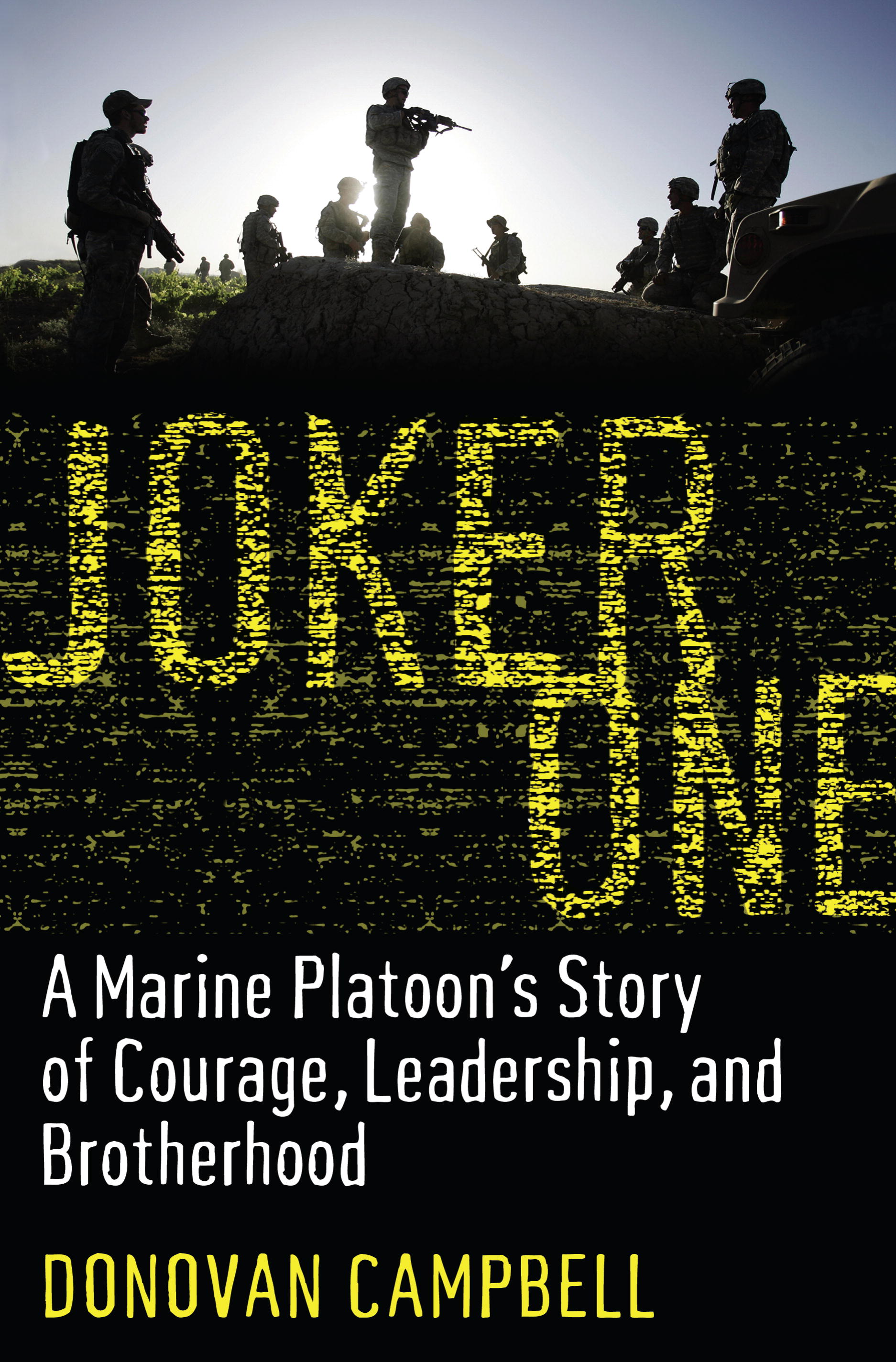
Joker One (book review)

At first glance, Donovan Campbell’s narrative of his time in Ramadi, Iraq, might seem like a typical war story. But, as the old cliché says, you cannot judge a book by its cover.

Joker One is the name of a United States Marine Corps platoon. But Joker One the book is really more about leadership. Lieutenant Campbell leads us through his day-by-day struggles to lead his men to success. Along the way he has to do the full 360-leadership cycle: leading up with his commanding officers; leading sideways with other commissioned officers; and lead leading down with his squad leaders. Along the way he discovers something remarkable: his Marines are great leaders themselves.

Lt. Campbell sees his men grow in their own leadership skills under his mentorship. He finds his strength in them. He carries a heavy leadership load until his men have to carry him. It reminded me so much of the leadership principles that others have postulated for the board room, but the Marines of Joker One make them happen on the battlefield.

This is a gripping story. Some of the battle scenes are gritty, and some of the language is a little rough (this is probably a PG-13 book). The love and respect that develops between this officer and his men is an amazing study in leadership. It’s also a book about decision-making under fire, the consequences of those decisions, pain, redemption, faith.

I cried and I cheered while reading this book. I hold the members of our military in very high esteem. This book raised my level of respect for our airmen, sailors, soldiers, and Marines even higher. You will be challenged and stirred by the exploits of Joker One.