14 Quotes From John Maxwell In “Mentoring 101”

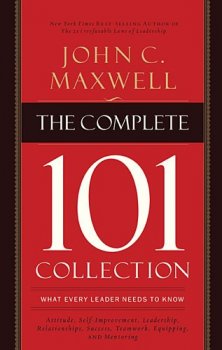
The Complete 101 SeriesI recently reviewed The Complete 101 Collection by John Maxwell. These are a great introduction to many of his more in-depth books (you can read my review by clicking here). Here are some quotes from Dr. Maxwell in Mentoring 101.

“Most people who desire success focus almost entirely on themselves, not others, when they start to make the journey. They usually think in terms of what they can get—in position, power, prestige, money, and perks. But that’s not the way to become truly successful. To do that, you have to give to others.”

“A person consumed with himself never considers spending time raising others up.”

“I believe that innate sense of motivation continues to exist in adults, but for too many people it has been beaten down by lack of support, busyness, stress, bad attitudes, lack of appreciation, scarce resources, poor training, or faulty communication. To get people excited about growing to their potential, you need to re-motivate them. Once you help them overcome the old things that knocked them down, they often motivate themselves.”

“As you develop people, remember that you are taking them on the journey towards success with you, not sending them. Stay with them until they’re ready to fly. And when they are ready, get them on their way.”

“The people closest to me determine my level of success or failure. The better they are, the better I am. And if I want to go to the highest level, I can do it only with the help of other people. We have to take each other higher.”

“When we examine ourselves, we naturally give ourselves the benefit of the doubt. Why? Because we see ourselves in the light of our intentions. On the other hand, when we look at others, we usually judge them according to their actions. Think about how much more positive our interaction with others would be if we believed the best in them and gave them the benefit of the doubt, just as we do for ourselves.”

“A study of 105 executives determined many of the characteristics shared by successful executives. One particular trait was defined as the most valuable: they admitted their mistakes and accepted the consequences rather than trying to blame others.”

“You can hire people to work for you, but you must win their hearts by believing in them in order to have them work with you.”

“Encouragement helps them reach their potential; it empowers them by giving them an energy to continue when they make mistakes. Use lots of positive reinforcement with your people. Don’t take acceptable work for granted; thank people for it. Praise a person every time you see improvement. And personalize your encouragement any time you can.”

“When you equip people, you teach them how to do a job. Development is different. When you develop people, you are helping them improve as individuals. You are helping them acquire personal qualities that will benefit them in many areas of life, not just their jobs.”

“There is no development without hard lessons. Almost all growth comes when we have positive responses to negative things.”

“When you don’t want to have a difficult conversation, you need to ask yourself: Is it because it will hurt them or hurt me? If it is because it will hurt you, then you’re being selfish. Good leaders get past the discomfort of having difficult conversations for the sake of the people they lead and the organization. The thing you need to remember is that people will work through difficult things if they believe you want to work with them.”

“Experience alone isn’t a good enough teacher—evaluated experience is. As the leader, you need to evaluate what looks like a win to make sure it is actually teaching what your employee needs to learn in order to grow and develop.”

“There is no greater accomplishment for mentors than when people they develop pass them by!”
41 (book review)

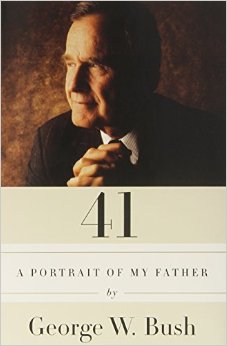
41It’s only happened twice in American history: A father and son both serving as President. The first was John Adams and John Quincy Adams, then George H.W. Bush and George W. Bush. But only once has the son written a memoir about his father, and that is 41: A Portrait Of My Father.

In the book’s preface, President George W. Bush writes, “Over the years, I suspect there will be many books analyzing George Herbert Walker Bush, the man and his presidency. Some of those works may be objective. This one is not. This book is a love story—a personal portrait of the extraordinary man who I am blessed to call my dad.” What a perfect description of this book, for indeed it is a love story, and a very moving one.

President Bush (the 43rd President) does an amazing job showing the “stuff” that went into making President Bush (the 41st President) the man that he is. It also helps us to then understand the decisions that 41 made throughout his extensive political career. I also appreciated reading how 43 used his personal, eye-witness experience with his Dad as material for his presidential decision-making.

This was a unique way to write a biography, and I found it very engaging and heartwarming. A truly great read!

The Complete 101 Collection (book review)

The Complete 101 SeriesI am a huge John Maxwell fan! Most of his books are quite in-depth, and feel like a graduate-level class in leadership. For those that are ready to go on a leadership development journey with Dr. Maxwell, The Complete 101 Collection would be a great place to start.

In college, the 101-level classes are intended to be the introduction to a subject. This is the class that will educate you, but more than that, it should whet your appetite to move on to the 201- 301, and 401-level classes in that subject. John Maxwell’s 101 books will do exactly the same thing.

When you read the books in this collection on attitude, self-improvement, leadership, relationships, success, teamwork, equipping, and mentoring, you will be able to see (a) which subject peaks your interest for more, and (b) which subject is calling you to more improvement. Then you can move on to other Maxwell books which will be the higher level classes in that subject.

This is an excellent book for anyone wanting to improve their interactions with others.

I am a Thomas Nelson book reviewer.

15 More Quotes From “Success 101”

Susscess 101One of the things I enjoy about John Maxwell’s books is the number of other resources he employs to make his point: motivational sources, historical sources, quotes, stories, personal examples, and more. Here are some of the quotes Dr. Maxwell shared in his Success 101 book.

“Everyone has his own specific vocation or mission in life. Everyone must carry out a concrete assignment that demands fulfillment. Therein he cannot be replaced, nor can his life be repeated. Thus everyone’s task is as unique as his specific opportunity to implement it.” —Viktor Frankl

“There is no man living who isn’t capable of doing more than he thinks he can do.” —Henry Ford

“A blind man’s world is bounded by the limits of his touch; an ignorant man’s world by the limits of his knowledge; a great man’s world by the limits of his vision.” —E. Paul Hovey

“Failure is really a matter of conceit. People don’t work hard because, in their conceit, they imagine they’ll succeed without ever making an effort. Most people believe that they’ll wake up someday and find themselves rich. Actually, they’ve got it half right, because eventually they do wake up.” —Thomas Edison

“Sir, I salute you not only as a great leader of men, but as an indomitable Christian gentleman who wouldn’t give up.” —General Charles Cornwallis, when he surrendered to George Washington

“I start where the last man left off.” —Thomas Edison

“Success is a little like wrestling a gorilla. You don’t quit when you’re tired—you quit when the gorilla is tired.” —Robert Strauss

“Every successful person finds that great success lies just beyond the point when they’re convinced their idea is not going to work.” —Napoleon Hill

“The greatest mistake one can make in life is to be continually fearing you will make one.” —Elbert Hubbard

“He who makes no mistakes, makes no progress.” —Theodore Roosevelt

“Nobody whoever gave their best ever regretted it.” —George Halas

“If you do what you can, with what you have, where you are, then God won’t leave you where you are, and He will increase what you have.” —Bill Purvis

“Each time you decide to grow again, you realize you are starting at the bottom of another ladder.” —Ken Rosenthals

“Start doing what is necessary; then do what is possible; and suddenly you are doing the impossible.” —Francis of Assisi

“The only conquests which are permanent and leave no regrets are our conquests over ourselves.” —Napoleon Bonaparte

I also shared some quotes from John Maxwell himself in Success 101. You can read those by clicking here.

11 Quotes From John Maxwell In “Success 101”

Susscess 101John Maxwell’s 101-series of books are a great introduction to some of his other more in-depth books. As I like to explain it, the 101-level introduces you to the topic, and the 301- and 401-level classes/books take you deeper.

I am in the process of reading The Complete 101 Collection (I’ll post my review of this shortly). In the meantime, here are some quotes from Success 101 which I found thought-provoking.

“You cannot achieve what you have not defined. The problem for most people who want to be successful is not that they can’t achieve success. The main obstacle for them is that they misunderstand success.”

“What does it take to be a success? Two things are required: The right picture of success and the right principles for getting there.”

“Success is a journey rather than a destination. No matter how long you live or what you decide to do in your life, you will never exhaust your capacity to grow toward your potential or run out of opportunities to help others.” 

“Without a dream, we may struggle to see potential in ourselves because we don’t look beyond our current circumstances. But with a dream, we begin to see ourselves in a new light, as having greater potential and being capable of stretching and growing to reach it.”

“The bottom line in managing your emotions is that you should put others—not yourself—first in how you handle and process them. Whether you delay or display your emotions should not be for your own gratification. You should ask yourself, What does the team need? not, What will make me feel better?

“The greatest enemy of good thinking is busyness.”

“Successful people face the danger of contentment with the status quo. After all, if a successful person already possesses influence and has achieved a level of respect, why should he keep growing? The answer is simple: your growth determines who you are; who you are determines who you attract; who you attract determines the success of your organization. If you want to grow your organization, you have to remain teachable.”

“Few things gain the appreciation of a top leader more quickly than an employee with a whatever-it-takes attitude. That is what successful people must have. They must be willing and able to think outside of their job description, to be willing to tackle the kinds of jobs that others are too proud or too frightened to take on. These things are what often elevate successful people above their peers.”

“Good leaders…find a way to succeed with people who are hard to work with.” 

“Successful people admit faults but never make excuses.”

“If you are successful where you are, I believe you will be given an opportunity to succeed at a higher level. … Leadership is a journey that starts where you are, not where you want to be.”

7 Quotes From “Self-Improvement 101”

Self-Improvement 101In all of John Maxwell’s 101 books there is an overall theme, but there are also numerous snippets which we can immediately apply. Here are just a few of those thoughts from Self-Improvement 101.

“The ironic thing is that change is inevitable. Everybody has to deal with it. On the other hand, growth is optional. You can choose to grow or fight it. But know this: people unwilling to grow will never reach their potential.”

“The only way to improve the quality of your life is to improve yourself. If you want to grow your organization, you must grow a leader. If you want better children, you must become a better person. If you want others to treat you more kindly, you must develop better people skills. There is no sure way to make other people in your environment improve. The only thing you truly have the ability to improve is yourself.”

“There’s certainly nothing wrong with the desire to progress in your career, But never try to ‘arrive.’ Instead, intend your journey to be open-ended. Most people have no idea how far they can go in life. They aim way too low.”

“Pride is the number one hindrance to teachability. … While envy is the deadly sin that comes from feelings of inferiority, the deadly sin of pride comes from feelings of superiority. It creates an arrogance of success, an inflated sense of self-worth accompanied by a distorted perspective of reality. Such an attitude leads to a loss of desire to learn and an unwillingness to change. It makes a person unteachable.”

“People’s purpose in life is always connected to their giftedness. It always works that way. You are not called to do something that you have no talent for. You will discover your purpose by finding and remaining in your strength zone. Similarly, you cannot grow to your maximum potential if you continually work outside of your strength zone.” 

“What is the greatest obstacle you will face once you have achieved your goals and tasted success? I believe it is the ability to let go of what you have so that you can reach for something new.”

“Every new level of growth we hope to experience as leaders calls for a new level of change. You cannot have one without the other.”

You can check out my review of Self-Improvement 101 by clicking here.

Self-Improvement 101 (book review)

Self-Improvement 101As with all of the books in John Maxwell’s 101 series, Self-Improvement 101 is a quick-hitting introduction to the power of making personal changes.

When you attend college, the 101 level classes are the introductions to a subject that could be very deep and involved. That’s exactly what John Maxwell intended to do with all of his 101 books—give us just enough information to entice us to go deeper.

Self-Improvement 101 will introduce you to some of the concepts that Dr. Maxwell deals with in more depth (think a 301 or 401 level class) in his other books. He tells us the benefits that come from making improvements, the first steps we can take on the road to improvement, and hints at how we can live a life of continual improvement.

If you’d like to make some changes in your life, Self-Improvement 101 could be a great starting point for you, and could be a great introduction to some of John Maxwell’s other outstanding books.

I am a Thomas Nelson book reviewer.

12 Quotes From “Poke The Box”

10-1080R1 PoketheBoxMechSeth Godin really shakes up the status quo in his book Poke The Box. I loved it! You can read my full book review by clicking here. Below are some quotes I especially liked.

“The job isn’t to catch up to the status quo; the job is to invent the status quo.”

“Imagine that the world had no middlemen, no publishers, no bosses, no HR folks, no one telling you what you couldn’t do. If you lived in that world, what would you do? Go. Do that.”

“Creative people or those with something to say believe that they have to wait to be chosen. … ‘Pick me, pick me’ acknowledges the power of the system and passes responsibility to someone else to initiate. Even better, ‘pick me, pick me’ moves the blame from you to them. If you don’t get picked, it’s their fault, not yours. If you do get picked, well, they said you were good, right? Not your fault anymore. Reject the tyranny of picked. Pick yourself.”

“The fact that it doesn’t work every time should give you confidence, because it means you’re doing something that frightens others.”

“Poking successfully also requires tact. You are trying to change things, not have people recoil in anger or fear from your poking.”

“Excellence isn’t about working extra hard to do what you’re told. It’s about taking the initiative to do work you decide is worth doing. … It’s a personal, urgent, this-is-my-call/this-is-my-calling way to do your job.”

“Not-allowed lists exist in school, in relationships, and in jobs. The park near my house doesn’t allow dogs, non-residents, or birthday parties. It’s interesting that the allowed list is harder to remember and to write down. I think we might be afraid of how much freedom we actually have, and how much we’re expected to do with that freedom. It’s comforting to live with a list of what’s not allowed. We remember it, we push against it, but ultimately we enjoy the confinement that the limits bring us. When revolutions appear, when the list gets much shorter, it’s surprising how long it takes for us to take action.”

“‘This might not work.’ Is it okay to say these four words? Is your work so serious and flawless and urgent that each thing you do, every day, must work? Change is powerful, but change always comes with failure as its partner. ‘This might not work’ isn’t merely something to be tolerated; it something you should seek out. … Try is the opposite of hiding.”

“Starting means you’re going to finish. … To merely start without finishing is just boasting, or stalling, or a waste of time. … If you don’t finish, it doesn’t really count as starting, and if you don’t start, you’re not poking.”

“Starting something is not an event; it’s a series of events. … Keep starting until you finish. … Today, not starting is far, far worse than being wrong. If you start, you’ve got a shot at evolving and adjusting to turn your wrong into a right. But if you don’t start, you never get a chance.”

“I believe that if you’ve got the platform and the ability to make a difference, then this goes beyond ‘should’ and reaches the level of ‘must.’ You must make a difference or you squander the opportunity. Wasting the opportunity both degrades your own ability to contribute and, more urgently, takes something away from the rest of us. … To do less is to steal from them.”

“Failure is an event, though, and with rare exceptions, is not fatal. The process of starting, regularly, and of seeking out opportunities to do it more often, is never a failure. The process is now essential for those who seek to succeed.”

Poke The Box (book review)

10-1080R1 PoketheBoxMechSeth Godin is skilled at asking the uncomfortable questions, at demolishing our excuses, at getting us to look at age-old things in a new light. In short, he’s really good at poking the box. Poke The Box is an attempt to shake up the status quo, and wake us up to the value of starting something fresh and new.

On the opening page Seth says, “The job isn’t to catch up to the status quo; the job is to invent the status quo.” Indeed, this is what Poke The Box addresses head-on. Why do we accept the status quo? Why don’t we initiate something new? What fears are holding us back? What might happen if we try and fail?

Poke The Box is written in a similar style to Seth’s popular blog. In fact, the book itself is “poking the box” of the typical, tried-and-true publishing style. Instead of chapters organized around a particular thought, the whole book is one big chapter, with the constant theme of challenging the just-sit-there-and-do-the-usual-thing attitude.

I loved it!

If you are ready to shake some things up, Poke The Box might be the nudge you need. Seth closes the book with this word of encouragement—

“Speaking up is not safe. People might be offended. Innovation is not safe. You’ll fail. Perhaps badly. Now that we’ve got that out of the way, what are you going to do about it? Hide? Crouch in a corner and work as hard as you can to fit in? That’s not safe, either. Might as well do something that matters instead.”

12 Quotes From “God-Breathed”

God-BreathedJosh McDowell has given us another outstanding Christian apologetic. In God-Breathed, Josh shares with us some astounding facts that show the amazing reliability of the Bible. You can read my book review of God-Breathed by clicking here. Below are some of the quotes I especially appreciated.

“The doctrines and commands of Scripture act as two guardrails to guide us down the right path of life. The teachings of Scripture (doctrine) keep us thinking and believing rightly. The instructions of Scripture (commands) keep us acting and living rightly. But without the proper context, we can miss the true purpose of Scripture, which is to guide us into keeping right thinking and right living in balance. … Scripture was given to lead us into a deeper love relationship with the One Who wrote the Book, and then also with everyone around us.” 

“The infinite God is personal. And because He is personal, we can love Him, worship Him, and please Him with our trust and obedience. Because He is personal, He can love us, rejoice with us, comfort us, and reveal Himself and His ways to us.”

“What is it that really parents our children? Is it the directives, instructions, and commands we give them? Those are behavioral guidelines, but they are not what raises our kids. It is not ‘parenting,’ as a concept, that brings up children; it is the parents themselves—relational human beings—who do the work and perform that role. That is the way God designed it. He wants kids to be brought up in loving relationships. Without relationship with another person, all attempts to instill right beliefs and right behavior will be ineffective, because they are detached from the necessary elements of personal love and care. … The Holy Spirit administers Scripture to us like a loving parent, in order to provide us with wisdom through its lessons (Proverbs 3:5), security through its boundaries (Exodus 20), caution through its warnings (Ephesians 4:17-22), and reproof through its discipline (Philippians 2:3-4).” 

“By AD 100, the apostles had died, but the Christian Church was still in its infancy, with fewer than twenty-five thousand proclaimed followers of Christ. But within the next two hundred years, the fledgling church experienced explosive multiplication of growth, to include as many as twenty million people. This means the church of Jesus Christ quadrupled every generation for five consecutive generations!”

“In AD 367, Athanasius of Alexandria compiled the first official list of books that we know today as the New Testament. There were twenty-seven books listed in all. These books were then canonized officially by the church at the councils of Hippo (AD 393) and Carthage (AD 397). Again, these councils didn’t authorize which writings were God-breathed works; rather, they recognized that these writings were authorized by God Himself.” 

“The Old Testament, comprised of thirty-nine books, was officially recognized as God-breathed Scripture as early as the fourth century BC and certainly no later than 150 BC.”

“The Bible is now the most translated book of all-time. The United Bible Society reports that, as of 2014, the Bible or portions of the Bible has been translated into 2,650 languages. Their Digital Bible Library now hosts more than 800 translations in 636 languages spoken by 4.3 billion people.” 

“Compared with other ancient writings, the Bible has more manuscript evidence to support it then the top ten pieces of classical literature combined.”

“No other work in all literature has been so carefully and accurately copied as the Old Testament.”

“Once archaeologists completed their search of the Qumran caves—eleven caves in all—almost 1,050 scrolls have been found in about 25,000 to 50,000 pieces (a number that varies depending on how the fragments are counted). Of these manuscripts, about 300 were texts from the Bible, and many of the rest had ‘direct relevance to early Judaism and emerging Christianity.’ Every book of the Old Testament was represented, except for the book of Esther, and the earliest copies dated from about 250 BC. … Once the Dead Sea Scrolls were translated and compared with modern versions of the Hebrew Bible, the text proved to be identical, word for word, in more than 95% of the cases. (The 5 percent deviation consists mainly of spelling variations. For example, of the 166 words and Isaiah 53, only seventeen letters are in question. Of those, ten are a matter of spelling, and four are stylistic differences; the remaining three letters comprise the word light, which was added to Isaiah 53:11.)”

“The writings of the most authoritative writers of the early church—the leaders scholars referred to collectively as the Apostolic Fathers—give overwhelming support to the existence of the twenty-seven authoritative books of the New Testament. Some Apostolic Fathers produced extensive, highly accurate quotes from the text of the New Testament. … Early church writers provide quotations so numerous and widespread that if no manuscripts of the New Testament were extant, ‘the New Testament could be reproduced from the writings of the early Fathers alone.’” —Norman Geisler and William Nix 

“The earliest preachers of the gospel knew the value of…first-hand testimony, and appealed to it time and again. ‘We are witnesses of these things,’ was there constant and confident assertion. And it can have been by no means so easy as some writers seem to think to invent words and deeds of Jesus in those early years, when so many of His disciples were about, who could remember what had and had not happened. … One of the strong points in the original apostolic preaching is the confident appeal to the knowledge of the hearers; they not only said, ‘We are witnesses of these things,’ but also, ‘As you yourselves also know’ (Acts 2:22). Had there been any tendency to depart from the facts in any material respect, the possible presence of hostile witnesses in the audience would have served as a further corrective.” —F.F. Bruce