Knowing What To Look For

On Sunday afternoon Betsy left our house to meet with our KidZone team. She had only been gone for a few minutes when she called me. “I just had to pull over to the side of the road,” she said. “It sounds like something is dragging underneath my van.”

I quickly threw my coat on and drove to meet her. Sure enough, as I pulled up behind her van I could see something hanging down. I laid down next to the van to look underneath and discovered that the band which holds up the gas tank was missing a bolt. I’m not a mechanic, but even I know that’s not a good thing!

I called a friend at church who’s got a lot of hands-on experience with cars. He said, “I’ll be right there.” He arrived quickly with a metal coat hanger, which he used to take the place of the missing bolt.

We turned around to head back to my house. Jeff was in front of me and had only driven about 150 feet when he jammed on his brakes, pulled to the side of the road, and leaped out of his car. I then watched as he ran across the road, bent down, and picked up the missing bolt!

When we got back to my house I said, “You must have the eye of an eagle to spot a rusty bolt on wet pavement.”

“No,” he said, “I just knew what to look for.”

In Genesis 45, Joseph reveals himself to his brothers. Twice he tells them, “Don’t be afraid. God sent me here.”

“Wait a minute,” you might protest, “God sent him to Egypt?! I thought his brothers sold him as a slave. God put Joseph in the position as prime minister of Egypt?! I thought his special dream-interpreting skills did that.”

Joseph went from a prince in Jacob’s family, to a slave in Egypt, to comptroller of Potiphar’s affairs, to a falsely-accused rapist, to a prisoner, to a prison trustee, to a forgotten man, to Pharaoh’s dream interpreter, to Egypt’s prime minister.

Joseph knew what to look for along the way. He knew God had given him a direction for his life, so he was constantly looking for it.

Prayer does this for me, too. I may know verses like

  • I am fearfully and wonderfully made.
  • Before I was born, God knew me.
  • All things are working together for good for me because I love God and called me for a purpose.
  • I should rejoice in my trials because God is developing something in me.

but it’s only when I’m praying these verses that the Holy Spirit trains my eyes to know what to look for.

God was placing Joseph and preparing Joseph to be just where he needed to be, at just the right time, and with just the right skills.

God is doing something with me: He’s preparing me and placing me in His perfect timing to fulfill His perfect plan. When it seems my life has become derailed, I need to know what to look for. Prayer does this: Prayer trains my heart and my mind and my eyes to know what to look for.

I can also assuredly tell you that God is doing something with YOU: He’s preparing YOU and placing YOU in His perfect timing to fulfill His perfect plan. Prayer will help you know what to look for too.

The Big Ask

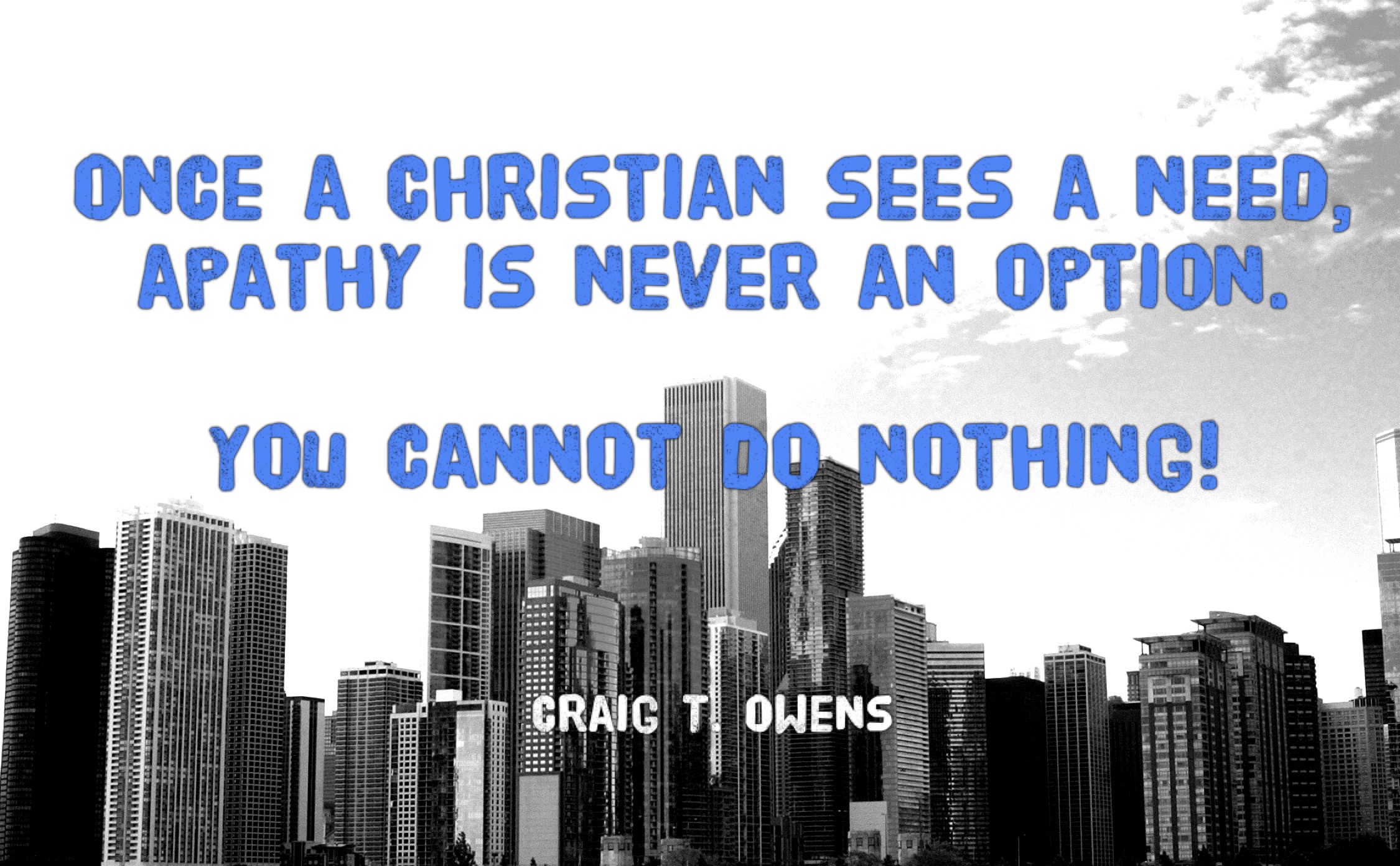
Tonight in our Impact! Youth service we are wrapping up a great series called Bigger Than Me. We’ve been challenging our youth to look out from themselves and see the big world around them. This has been an amazing series and I’ve been so excited to see so many students step out in a big way. You can read more here and here.

But tonight is the big ask. Tonight I’m going to challenge our students to make a commitment that’s going to hit them in a really sensitive area—their wallets. We’re going to present the opportunity to confront a real need in a very practical way: by giving money. Not just once, but every month.

Here’s the way the apostle James laid it on the line:

Dear friends, do you think you’ll get anywhere in this if you learn all the right words but never do anything? Does merely talking about faith indicate that a person really has it? For instance, you come upon an old friend dressed in rags and half-starved and say, “Good morning, friend! Be clothed in Christ! Be filled with the Holy Spirit!” and walk off without providing so much as a coat or a cup of soup—where does that get you? Isn’t it obvious that God-talk without God-acts is outrageous nonsense?

Here’s how you can be involved:

  1. Pray for me that I can present the big ask in a compelling way.
  2. Pray for our students that they’ll be moved to respond.
  3. Check out my blog tomorrow for an update on tonight’s response, and to see how you can help too.

I can hardly wait!

A Silly Dream World Or The Real Deal?

“What is ‘real’? How do you define ‘real’? If real is what you can feel, smell, taste, and see, then ‘real’ is simply electrical signals interpreted by your brain. … Have you ever had a dream, Neo, that you were so sure was real? What if you were unable to wake from that dream? How would you know the difference between the dream world and the real world?” —“Morpheus” in The Matrix

We are created in God’s image. God is eternal and unrestricted, yet we are contained in finite bodies and constrained to the time-space dimension of our universe. That hardly seems “real.” Yet our souls—the “real” part of us—were made to be timeless and unbound. It seems like a dream, and yet sounds real.

To help humanity navigate the dream-real state in which we find ourselves, God gave us incredible insights into His Word: the Bible. The answers to our dream-real questions are there if we’re willing to search for them.

C.S. Lewis wrote, “What we see when we think we are looking into the depths of Scripture may sometimes be only the reflection of our own silly faces.” The Apostle James talks about God’s Word as a mirror in his letter to the church (1:22-25). In this, I see three people.

(1) One who never looks in the mirror; one who simply accepts what’s presented to him. Again “Morpheus” comes close: “You have the look of a man who accepts what he sees because he is expecting to wake up.” James says this is a man who attends church regularly, but never applies what he hears. In fact, he probably never even hears anything other than what he thinks the pastor said. That man is silly, shallow, and stunted in his spiritual growth (if there is even any growth at all!).

(2) One who looks in the mirror but doesn’t do anything about what he sees. He hears the Word of God at church and perhaps even reads his Bible often at home; he knows all the stories and how everything should be. But he, too, never makes any changes in his spiritual “appearance.” He is content with where he is. If he ever feels the pull of desire that there could be more real to his dream-real world, he quickly explains it away. He is at the same spiritual maturity level today as he was years ago.

(3) One who looks into the mirror, recognizes that he is silly-looking, and then does something about it. It’s hard work and often this man feels like he’s not growing because he continues to see his silly face reflected back to him. As Albert Einstein noted, “As a sphere of light increases, so does the circumference of darkness around it.”

James says only this third man has been freed from his dream-real constraints and is called blessed by God. Only he is beginning to understand how to make the dream real.

In which category are you? Are you brave enough to look into the depths of God’s Word and see your silly face? Are you willing to make the changes the Bible shows you to free your soul?

The Thinking Book

“The book to read is not the one which thinks for you, but the one which makes you think. No book in the world equals the Bible for that.” —James McCosh

My kids recently returned from a PK (Pastor’s Kids) Retreat weekend. Our Michigan Assembly of God District Youth Director Jeff Kennedy coordinates this weekend every year. A fun part of their time together is a take-off of Jeff Foxworthy’s “You might be a redneck if…” routine. It’s called “You might be a PK if….” Here are a couple of my favorites—

  • You might be a PK if you’ve used the church sound system as your personal stereo.
  • You might be a PK if National Take Your Kid To Work Day is any day you don’t have school.
  • You might be a PK if you’ve ever taken a bath in the baptismal tank.
  • You might be a PK if you occasionally take Sunday afternoon naps on a church pew.
  • You might be a PK if every answer your Dad gives you comes from the Bible.

Cute! And, for the most part, dead-on accurate!

But that last one got me thinking: do I do this? I sincerely hope (not just because I’m a pastor) that the answer is always “yes.”

I agree with James McCosh that no other book in the world compares to the Bible for challenging me to think. In the King James Version of the Bible, there is a phrase that James uses about God’s Word: he says that we should “receive with meekness the engrafted Word” (James 1:21).

The more I read the Bible, the more its principles become engrafted into my thought patterns. The more I think about the Bible, the more my attitude about life conforms to God’s attitude. And the more my attitude conforms to God, the more my actions and words align with the Bible.

You don’t have to read much every day for God’s Word to make a difference in your life. If you are honest with the Holy Spirit as He illuminates a passage of Scripture to you, you will see how God’s Word can be applied to your life today.

“The Bible is…a chart by which the Christian sails to eternity, the map by which he daily walks; the sundial by which he sets his life; the balance in which he weighs his actions.” —Thomas Watson

To be successful make sure you are looking often at the chart, the map, the sundial, and the balance of God’s Word.

Still Learning

I live by the axiom, “If you’re through learning, you’re through.” So I try to learn something new every day.

I just finished a class called New Testament Survey: a quick overview of the 27 books that compromise the New Testament of the Bible. Here’s a couple of interesting factoids I picked up from my studies:

  • The earliest-written book was James. Interesting, because at one point James thought Jesus (his half-brother) was nuts.
  • Only Matthew uses the term kingdom of heaven; all of the other writers use kingdom of God.
  • Mark uses the word immediately more times than anyone else. Perhaps because his source (Peter) was always doing things so quickly… sort of a ready, FIRE!, aim kinda guy.
  • Luke wrote what is called “the global gospel” for everyone, so he included 45 teachings/events that no one else records.
  • John doesn’t record any of Jesus’ parables.
  • John uses the word believe nearly 100 times— way more than any other writer.
  • Luke talks about the Holy Spirit nearly 60 times in the 28 chapters of Acts.
  • Romans is the longest of Paul’s epistles with 7101 words; Philemon is the shortest with just 355 words.
  • With the exception of the pastoral epistles (1 Timothy, 2 Timothy, Titus) Paul’s letters are arranged in the Bible from longest to shortest.
  • In 1 & 2 Thessalonians (only 136 verses) Paul refers to God, Christ, the Holy Spirit, or a combination thereof more than 150 times.
  • Paul gives Timothy seven word pictures to describe the kind of pastor he should be: son, soldier, athlete, farmer, workman, instrument, and servant.
  • Hebrews is called “the book of better things” so better is used 13 times. This word is used only six times in the remaining 26 books of the New Testament.
  • James wrote 108 verses but issues 50+ direct commands.
  • In John’s three short epistles he uses the word know 33 times, and the word dear ten times.

Keep on learning! There’s a lot of good stuff out there. What have you learned lately?

I’ll Take My Roses Today, Please

My Grandfather used to say, “Give me my flowers while I’m still alive.” I think this was his way of restating the cliché, “Dead noses smell no roses.” It’s true: flowers at a gravesite—no matter how beautiful they are—aren’t appreciated by dead noses. Kind and loving words spoken at a funeral—no matter how eloquent they are—aren’t appreciated by dead ears.

The point is: today is special. Today is one-of-a-kind. Today is the best day to tell someone dear to you how truly special they are. Today may be the last day you have to make something right. Today is the day to send those flowers. Don’t put it off until tomorrow.

How many people live with regrets today because of the things they didn’t say before a loved one passed away from this life? How many people feel guilty today because they didn’t make things right in a strained relationship? How much better to live today knowing that we said and did all of the things we could to express our love, to show how valuable the relationship was.

Job said, “My days are swifter than a runner” (Job 9:25).

His friend Bildad agreed that, “Our days on earth are but a shadow” (Job 8:9).

And James wrote, “Your life is like the morning fog—it’s here a little while, then it’s gone” (James 4:14).

We never know how much time is left to send those flowers.

Today…

  • Make that phone call.
  • Ask forgiveness.
  • Write that letter.
  • Apologize.
  • Hug.
  • Go to lunch.
  • Say, “I love you.”
  • Send those flowers.

Don’t live your tomorrows with regrets for the things unsaid or undone—say them and do them today.