Pouring Holy Water On Strange Fire (book review)

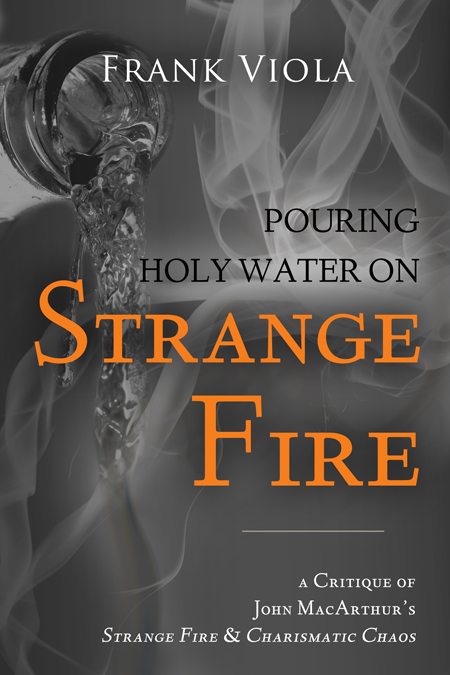
Pouring Holy Water On Strange FireI fully admit that I’m a little biased on this one. After all, what would you expect from a fourth generation Pentecostal? But even with that disclaimer, I thought Frank Viola did a masterful job in his critique called Pouring Holy Water On Strange Fire.

Viola’s book is a critique of John MacArthur’s book Strange Fire, in which MacArthur attempts to make the case that the way Pentecostals and Charismatics advocate and practice their faith is unscriptural. MacArthur would fall into the camp of the cessationists, who claim that all of the operational gifts of the Holy Spirit enumerated in the New Testament ceased when the apostles died, or when the canon of Scripture was closed. I’ve always found this a strained argument at best, or as Mark Driscoll says, one needs to do “exegetical origami” to reach the cessationists’ conclusion.

Frank Viola systematically critiques Strange Fire thought-by-thought, section-by-section. He does so fairly and academically, using respected Bible commentators, the writings of Church fathers, logic, personal examples, as well as other respected contemporary voices who express similar concerns against MacArthur’s arguments.

This is a good book for any student of the Bible to read. It’s not a lengthy tome, so you will not get bogged down in reams of academia, but you will be able to weigh the evidence that both cessationists and Pentecostals use. You can download the ebook version by clicking here.

God’s Favorite Place On Earth (book review)

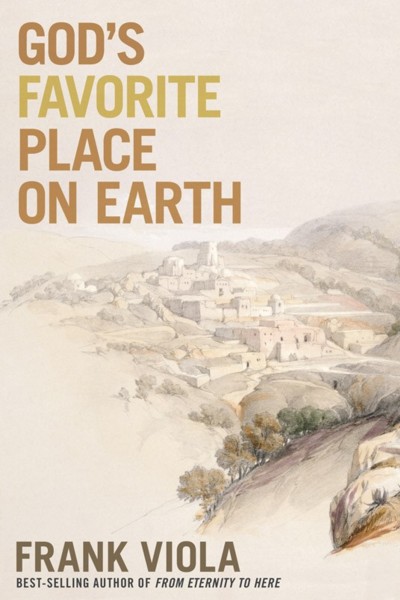
God's Favorite Place On EarthGod’s Favorite Place On Earth by Frank Viola is one of those rare books that I could hardly put down! This is easily one of the most interesting looks at the earthly life of Jesus Christ that I have read in quite awhile.

This book focuses on the visits that Jesus made to the village of Bethany, and the family that lived there with whom Jesus spent considerable time. In fact, some of the most loved stories from Christ’s public ministry took place in Bethany; specifically, the raising of Lazarus from the dead, and the pre-crucifixion anointing of Jesus by Mary.

God’s Favorite Place On Earth doesn’t fit neatly into one literary genre. Each visit Jesus made to Bethany is told in first-person narrative form through the eyes of Lazarus. Although none of his words are recorded in Scripture, the way he “speaks” in this book makes the scriptural text come alive in a very tangible way.

After Lazarus tells his story, Frank Viola then steps in to help us apply that visit of Jesus to our lives. He makes the connection between the historical village of Bethany, and our hearts becoming a modern-day, present-tense Bethany for Jesus to visit and to minister.

So the book was simultaneously enlightening, inspiring, and immediately applicable. To help further the conversation, there are some great discussion questions included at the back of the book.

For a unique look at the ministry of Christ both in historical Israel and in your life in present-day, I believe you too will thoroughly enjoy this book!

Note: I happily reviewed this book at the request of the author.

If Thou Wilt Be Perfect (book review)

If Thou Wilt Be PerfectOswald Chambers points out something very interesting in his book If Thou Wilt Be Perfect: discipleship with Jesus is optional.

Chambers writes: “Whenever our Lord speaks of discipleship He prefaces what He says with an ‘IF.’ ‘If any man come after Me….’” So this book focuses on the IFs of discipleship, reminding us that is optional for us to step into this deeper relationship with Jesus.

Each chapter was originally a lecture that Chambers gave at the Bible Training College in 1912, and they clearly reveal the mindset that drives him. Most of the chapters/lectures are entitled “The Philosophy Of …” so you will gain a deeper insight into how Oswald Chambers reads the Bible and applies the truths there to the Christian walk.

As I have said before, there are few authors who challenge me to go deeper in Christ than Oswald Chambers. All of the chapters are meaty, but well worth your time and attention.

Wrapping Up “The Q Series”

Bible questionsI love our annual Q Series where the subject matter for those Sundays is driven by the questions people have submitted to me. It’s a bit scary too! Over the last couple of Sundays I’ve fielded questions on topics like freewill versus predestination, divorce and remarriage, the Trinity, backsliding, and more.

As is usually the case, there were more questions than I had time for, so I’ve attempted to answer a couple of remaining questions via video—

Just because The Q Series is done for this year doesn’t mean I’m done answering questions. I love having these sorts of conversations! So feel free to keep sending the questions my way and let’s search the Bible together.

“Heaven will solve our problems, but not, I think, by showing us subtle reconciliations between all our apparently contradictory notions. The notions will all be knocked from under our feet. We shall see that there never was any problem.” —C.S. Lewis

13 Quotes From “Dear Abba”

Dear AbbaDear Abba is an intimate book of prayer and personal reflection; it’s thought-provoking and emotionally-moving. You can read my full book review by clicking here. Below are some of the quotes and prayers I found especially meaningful.

“Dear Abba, I’ve come to the place where I’m letting You love me more each day, but I still struggle with letting You like me.” 

“It would be comical if it wasn’t so sad: all of our desires to make ourselves worthy of this world but unfit for the world to come.”

“Peace and joy go a-begging when the heart of a Christian pants for one sign after another of God’s merciful love. Nothing is taken for granted, and nothing is received with gratitude.”

“I feel like the psalmist tonight—downcast. I was upcast, bright, enjoying the warmth of the day and then suddenly my joy was pickpocketed. It was a small thing, a minor misunderstanding that I could have let roll off like water, but I held on to it and nursed it awhile, and like sin always does, it grew. Now I find my mind completely disturbed, anxious, angry, and my imagination is conjuring up all sorts of somebody-done-me-wrong songs. Why do I not trust You? After so many demonstrations of Your infinitely tender hand, why do I not trust You?”

“Sin does not magnify the suffering of man’s plight; instead, it mitigates it. When I sin, I seek an escape from my humanity. I used to say to myself, ‘Well, you’re only human!’ But sin does not make me human; it compromises my humanity. The philandering husband with his mistress on business trips, the chemically addicted, the thieves who build ivory towers out of stolen money, the sensation-seekers and power brokers who seek substitutes. They do not drink the poverty of the human situation down to the last drop. They dare not stare it full in the face.” 

Yet. Those three letters stop me in my rutted tracks of besetting sins. For You were tempted as I am, yet You did not sin. The humbling point is that on a scale from 1 to 10, I usually give in when the heat reaches 3 or 4, yet You experienced the 10—the full-in-the-face of temptation—and did not give in. You are the friend of sinners, yet You are also the Great High Priest who invites us to come with confidence to Your throne and receive both our daily bread and extra rations for emergencies.”

“To practice poverty of spirit calls us not to take offense or be supersensitive to criticism.

“When the gift of a humble heart is granted, we are more accepting of ourselves and less critical of others. … For the humble person there is a constant awareness of his or her own weakness, insufficiency, and desperate need for God.”

“My friends in Christ, the simple truth is that the Christian Church in America is divided by doctrine, history, and day-to-day living. We have come a long sad journey from the first century, when pagans exclaimed with awe and wonder, ‘See how these Christians love one another!’” 

“Christ’s breakthrough into new life on Easter morning unfettered Him from the space-time limitations of existence in the flesh and empowered Him to touch not only Nepal, but New Orleans, not only Matthew and Magdalene, but me. The Lion of Judah in His present risenness pursues, tracks, and stalks us here and now.”

“I realized today that there is a third character who goes up to the temple to pray: the pharisaic tax collector—a ragamuffin who knows she’s a ragamuffin and wants to make sure everyone else knows she’s a ragamuffin. So she ends up using her sinner status not to cry out for mercy to You, but rather to seek out the attention of others as one who is real and authentic, when in reality she is nothing more than hubris in thrift-shop fashions. I realized this today because I looked in the mirror. God, be merciful to me.” 

“The tendency to continually berate ourselves for real or imaginary failures, to belittle ourselves and underestimate our worth, to dwell exclusively on our dishonesty, self-centeredness, and lack of personal discipline, is the influence of our negative self-esteem. Reinforced by the critical feedback of our peers and the reproofs and humiliations of our community, we seem radically incapable of accepting, forgiving, or loving ourselves.”

“If nobody remembers my name or the works of my hands, if everything that I’ve worked so hard to build over the years crumbles into insignificance, if I lose my health and my wits and even, heaven forbid, my memory, You are still my refuge and strength.” 

867-5309

MeditatingI know I’m showing my age with this example: But how many of you remember the song by Tommy Tutone that contained Jenny’s phone number. That song hit #4 on the charts in 1982, and yet after all of these years if you start singing the song, people can tell you that Jenny’s number is 867-5309.

Why do we remember such trivial things?!

The way God designed the human brain is absolutely astounding! Electrical impulses from our five senses filter into the brain and are saved as short-term memories, with the emphasis on short. Short-term memories usually last 20-30 seconds. But we can reset the timer by repeating the information again and again.

If we repeat it enough or think about it more, our brain realizes that it has some significance to us, and begins to “solidify” the information in our intermediate memory banks. These intermediary memories last 5-8 hours.

But in order for the intermediary memories to be stored away in our long-term memory—where they can be stored indefinitely—there needs to be an added component from us. That component is emotion.

The more important the information is to us, the greater the likelihood it will be filed in the “do not delete” section of our brain.

People tell me all the time how difficult it is for them to memorize Scripture, but the keys to memorization are built into the Scripture itself.

First, you have to approach it with a passion. Oh, how I love your law! … Therefore I hate every wrong path (Psalm 119:97, 104). The “bookends” of this section show passionate emotion.

Second, you need to sing the Word. Twice the psalmist said he mediated on God’s Word all day long (vv. 97, 99). At the root of this word is to hum. Singing God’s Word attaches emotion to it, and the emotion tells your brain to move it to long-term storage.

Third, you need to realize just how important it is to have the Scripture stored away in your memory banks. In one section of the 119th Psalm we see benefits like: makes me wiser, gives me more insight, I have greater understanding, I can avoid evil paths (vv. 98-102).

C.S. Lewis commented, “All that is not eternal is eternally useless.” Jenny’s phone number won’t keep us out of trouble, or draw us closer to God, or even give us insight into helping a friend. But God’s Word will do all of those things … and so much more!

These steps will help you store and retrieve eternally useful truths, and not just fictional phone numbers! Try it and let me know how it works for you.

If you have missed any of the messages in our P119 series, you can access them all by clicking here.

Word Of The Lord

BibleTwice in one chapter of the life of Abraham this phrase appears: The word of the Lord came to him (Genesis 15:1, 4). As awe-inspiring as it is to think about God speaking, what’s even more astounding to me is Abraham’s response.

Obedience.

God spoke. Abraham obeyed.

His first obedience was believing. So the Bible tells us, “Abraham believed God, and He credited to him as righteousness” (verse 6). By definition, righteousness means “right doing.” But doing comes directly out of believing, so Abraham had to first believe that what God said was the real deal.

God spoke. Abraham believed. God said, “You are righteous.” Then Abraham followed through on the word of God which he believed.

Why can’t it be the same with me? Or with you?

God speaks, I believe, God sees me as righteous, I act. It should be just that simple—there’s absolutely no need for me to add, subtract, modify, clarify, or delay.

The word of the Lord should be all I need.

Learning & Teaching

LamedhI’ve been leading my congregation through a spiritual workout from the 119th Psalm. This psalm is unique for a couple of reasons: (1) It’s the longest chapter in the Bible; (2) It’s divided into twenty-two 8-verse segments, with each segment beginning with its own Hebrew letter; and (3) All but four of the 176 verses directly mention God’s Word (using words like command, precept, statues, commands, etc.).

Something else that makes this psalm interesting to study is the Hebrew alphabet itself. In our western world, a letter is just a letter: an L is just an L. But in the Hebrew language, the letters have a name, a meaning, and even a numeric value. So the Hebrew equivalent to our English L is the letter/word lamedh.

Lamedh is the tallest of all the Hebrew letters, so that means it stands out. The section called lamedh in Psalm 119 is one of big proportions. Words like eternal, boundless, established, enduring, and forever are prominent in these eight verses. The psalmist is inviting us to climb up into God’s Word and get a bigger view, a higher vantage point of who God is.

When we are in difficult places, we tend to focus more on our problems, and less on God’s awesomeness. So lamedh is a call to shift our gaze.

But this letter/word also has a definition, and lamedh is a double-edged definition. This word can mean to learn. Indeed, as we gaze upon God’s majesty, we learn so much more about Him! But lamedh also means to teach.

I have found that as I go through difficult times and choose to change my focus from my situation to my Savior, that I learn more about His faithfulness. But at the same time, others are learning from that decision to switch my gaze to God.

So I’ve got one word of advice for you if you feel like your problem is too big and you’re thinking about throwing in the towel: DON’T!!

By focusing on God’s bigness instead of your circumstance, you will learn to grow in faith. And at the same times you will be teaching others to place their faith in God too.

Those who wait on God will soar to new heights!

If you have missed any of the messages in our P119 series, you can access them all by clicking here.

Thursdays With Oswald—The Word & The Words

This is a weekly series with things I’m reading and pondering from Oswald Chambers. You can read the original seed thought here, or type “Thursdays With Oswald” in the search box to read more entries.

Oswald Chambers

The Word & The Words

     The Bible is the Word of God only to those who are born from above and who walk in the light. Our Lord Jesus Christ, the Word of God, and the Bible, the words of God, stand or fall together, they can never be separated without fatal results. A man’s attitude to our Lord determines his attitude to the Bible. 

     The “sayings” of God to a man not born from above are of no moment; to him the Bible is simply a remarkable compilation of literature—“that it is, and nothing more.” All the confusion arises from not recognizing this. 

     But to the soul born from above, the Bible is the universe of God’s revealed will. The Word of God to me is ever according to my spiritual character; it makes clear my responsibility to God as well as my individuality apart from Him. 

From Christian Disciplines (emphasis mine)

Do you agree with Chambers on this viewpoint?

In light of this, how will you view Scripture differently?

Small Beginnings

Small beginnings“Hey, Pete,” I asked, “How’s the new workout routine going?”

“Well,” said Pete a little sheepishly, “It’s not.”

“What do you mean?”

“I wanted to be able to run that 5k charity run next spring, but I can hardly make it around the block. How in the world am I ever going to run 5 kilometers?! So I just threw in the towel.”

If Pete has never run before, it’s a bit unrealistic for him to complete a 5k on his first day lacing up his running shoes, don’t you think? But far too often we throw in the towel before we even get started! 

How about someone’s pursuit of God? God is so vast, so majestic, so awesome. And then we hear words from Jesus telling us, “Be perfect just as your heavenly Father is perfect” (Matthew 5:48). Just like Pete we think, “How am I ever going to do that?!” and we throw in the towel before we even start.

But God already started something when He created you. What God creates, He completes; and what He completes, He completes perfectly.

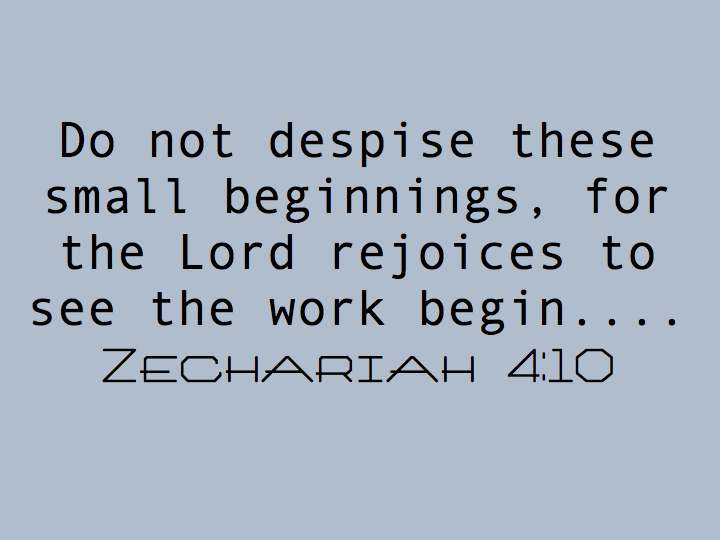
The prophet Zechariah said, “Do not despise small beginnings, for the Lord rejoices to see the work begin” (Zechariah 4:10).

The psalmist wrote, “Your hands formed me and made me; give me understanding to learn Your commands” (Psalm 119:73). There is just one Hebrew word for “Your hands” and it also happens to be the name of that section in Psalm 119: Yodh.

Yodh has a corresponding Greek word: Iota. This word shows up in Matthew 5:18 when Jesus says, “Not one iota of God’s Word will ever be wasted.”

God created you perfectly and on purpose. What He created, He wants to see completed perfectly too. He will do this through His Word working in you. The question is: Will you get started? The Hebrew letter yodh is the smallest of the Hebrew letters, but don’t despise its small beginning. Don’t despise the work God started in you either. So what if you can’t run a spiritual 5k yet … you can grow into that maturity by letting God’s Word work on you right now, right where you are.

Will you let God get started today?

If you have missed any of the messages in our P119 series, you can access them all by clicking here.