How To See A National Revival

Listen to the podcast of this post by clicking on the player below, and you can also subscribe on AppleSpotify, or Audible. 

After making it up to the 11th step—so close to the top now—how could the psalmist be saying, “Out of the depths I cry to You, O LORD”? (Psalm 130:1) 

I think that the more we ascend in God, the more sensitive we should be to any semblance of sin in our lives that would offend Him. The mark of a maturing Christian is one who is constantly closing the gap between sin and confession. 

(You can check out all of the biblical references in this post by clicking here.)

I like the bridge in the song I Keep Falling In Love With Him

When I first fell in love with Jesus,
I gave Him all my heart
And I thought I couldn’t love him more
than I did right at the start.
But now I look back over the mountains,
and the valleys where I’ve been
And It makes me know I love Him so much
more than I did then


Out of the depths—Think how far we’ve come on this climb. In the first Song of Ascent, we were experiencing the woes of being in the valley (Psalm 120:5-7). But now in this song, the feelings of being in the depths are not from someone else’s sinful activity. 

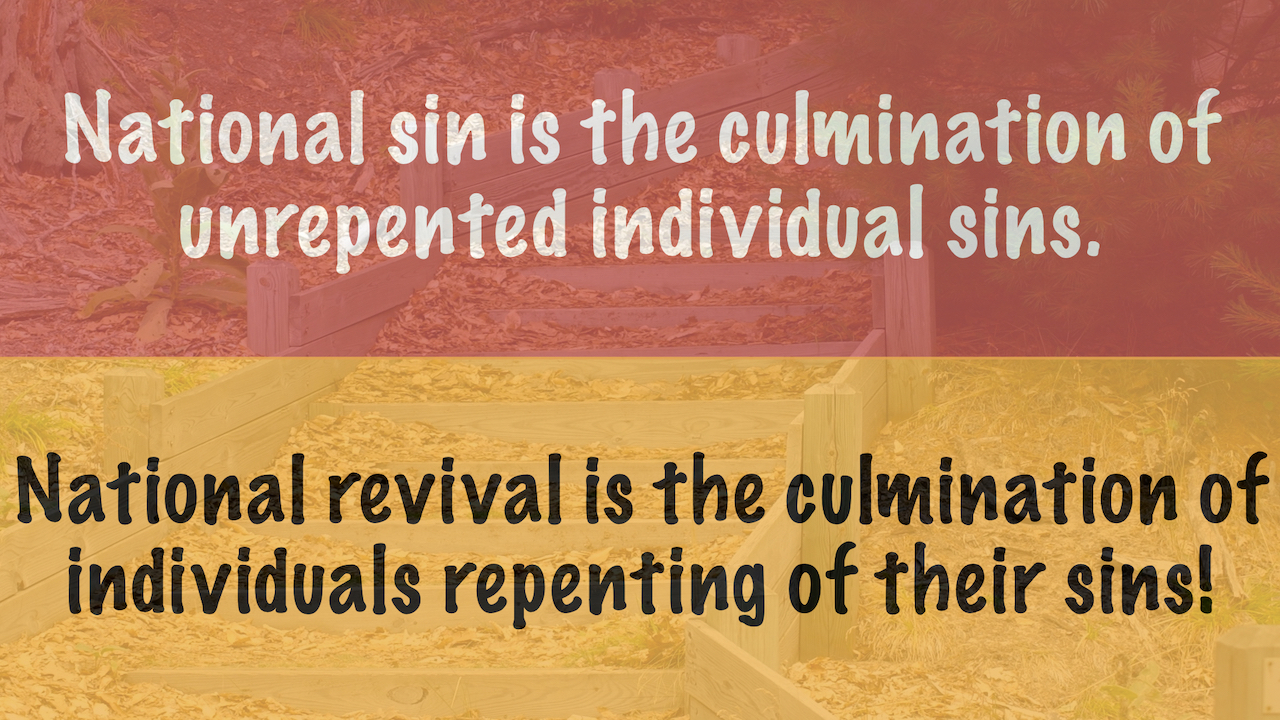
The psalmist is pointing out that national sin is the culmination of unrepented individual sins. God addressed this in Leviticus 20:22—Keep all My decrees and laws and follow them, so that the land where I am bringing you to live may not vomit you out.  

Even in these depths, the psalmist is confident that God will hear—let Your ears be attentive (v. 2). Nehemiah was confident too. Look how he joins his personal sin to the national sin after Israel had be vomited out of the land (Nehemiah 1:1-7). 

Our confidence comes from the rock-solid assurance that God completely forgives our sins and then forgets all that He forgives (vv. 2-3; Psalm 103:10-12). 

The middle verses (vv. 5-6) have the key words wait, watch, and hope. This middle part comes down to: (1) What I’m going to pay attention to, and (2) What God pays attention to. 

God is attentive to our cries for mercy, and He is watchful for our care, not for our punishment! 

We are called to wait and watch in hope because God has proven that He is all in for us. Look at this completeness:  

  • full forgiveness (v. 3) 
  • unfailing love (v. 7a) 
  • full redemption (v. 7b) 
  • all their sins (v. 8) 

Notice in v. 7 the phrase “all THEIR sins” is now corporate (not singular, personal as in the opening verses). 

We’ve gone FROM my voice, my cry TO your hope, O Israel and redemption of their sins. 

If national sin is the culmination of unrepented individual sins, then national revival is the culmination of individuals repenting of their sins! 

National revival starts with you and with me. 

If you’ve missed any of the Songs of Ascent we’ve looked at, you can find them all here. 

►► Would you please prayerfully consider supporting this ministry? My Patreon supporters get behind-the-scenes access to exclusive materials. ◀︎◀︎

Links & Quotes

In what may be the best-known parable that Jesus told, what’s the difference between the hard path where the seeds failed to produce anything and the fertile soil where the seeds produced an abundant harvest? The fertile soil had a plow applied to it. In the same way, God wants to “plow” the hard places in our life so that there can be an abundant harvest! Check out this full sermon here.

I have lots of new content every week, which you can check out on my YouTube channel.

“The greatest reason for a loss of reality is that while we say we believe one thing, we allow the spirit of the naturalism of the age to creep into our thinking, unrecognized.” —Francis Schaeffer, in True Spirituality 

“The glory of God is a silver thread, which must run through all our actions.” —Thomas Watson 

“Christianity is not the removal of weakness, nor is it merely the manifestation of divine power. Rather, it is the manifestation of divine power through human weakness.” —Dr. Donald Stamps, Life In The Spirit Study Bible, commenting on 2 Corinthians 4:7-9, 12:9-10 

“In our media-rich, secular age, we must be especially vigilant against unbelief finding its way into our hearts [Hebrews 3:12]. The heavenly calling of God is really real, and we can really partake of it. But we’ll need to be continuously on guard against ideas and messages that can undermine our confidence, stifle our boasting, rob us of the reality of our experience of Christ, set us adrift from the Lord, and end up proving us to be someone other than we thought.” —T.M. Moore

“If you don’t want responsibility, don’t sit in the big chair. To be successful, you must accept full responsibility.” —Pat Summitt 

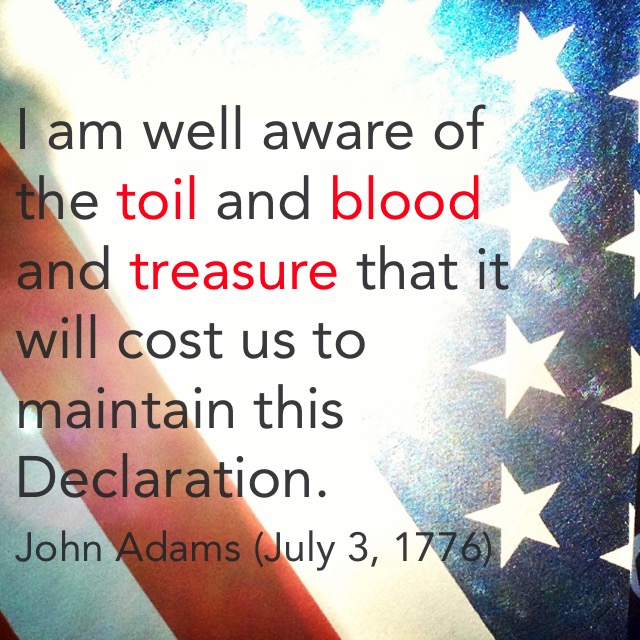
From the 1440 Daily Digest: Congratulations, America—July 4, 2024, marks the 248th commemoration of the day the Declaration of Independence was adopted by the Second Continental Congress. Through the centuries, the US has grown from 13 colonies with about 2.5 million people to 50 states and 14 territories with a population of more than 330 million. The economy has swelled to over $27T. Advances in public health have cut the child mortality rate from over 45% to under 1%, while our citizens live over 35 years longer on average. Scientific achievements in the US have delivered everything from the light bulb, modern flight, and the internet to air conditioning, movies, and the polio vaccine. More than 2.7 million miles of power lines electrify the country across over 4 million miles of paved roads, with over 90% of households accessing broadband internet. The US has also been responsible for more than 800 human visits to space—the most of any country.

Unique Worshippers

Listen to the podcast of this post by clicking on the player below, and you can also subscribe on AppleSpotify, or Audible. 

How do you know if something is lavishly beautiful or a totally inappropriate wastefulness? Let’s talk about how people worship God.

Check out this episode of The Podcast.

The Scriptures I mention in this post: Luke 7:36-50; John 12:1-8; 1 Samuel 16:7.

Register for my upcoming cohort here. Space is limited to 10 cohorts, so register soon.

The blog post and video I mention in this episode is Awesome God, Awesome Praise.

I talk more about one of the ladies who anointed Jesus in the post and video Grateful for what you have. I also have two blog posts about Mary:

Keep up with everything else I have going on—including my newest book and the cohort I am facilitating— by clicking here.

►► Would you please prayerfully consider supporting this ministry? My Patreon supporters get behind-the-scenes access to exclusive materials. ◀︎◀︎
It’s Not “Them,” It’s Us

This is God speaking—

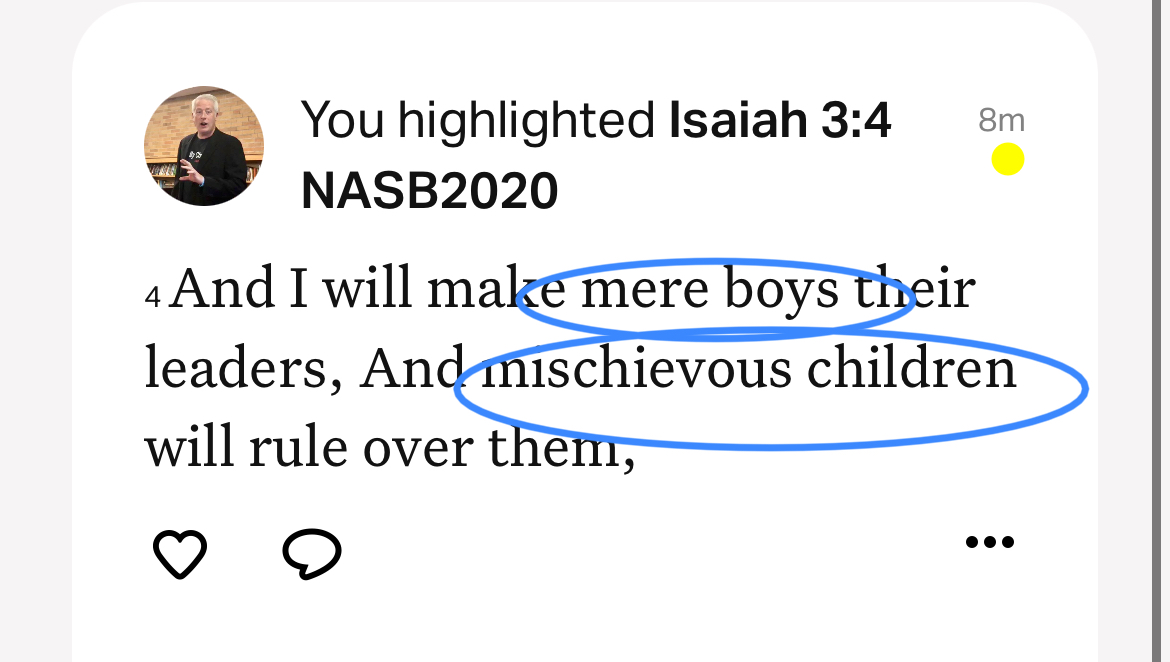
“And I will make mere boys their leaders, and mischievous children will rule over them, and the people will be oppressed, each one by another, and each one by his neighbor; the youth will assault the elder, and the contemptible person will assault the one honored.” (Isaiah 3:4-5)

God gives nations the “leaders” they deserve. They are leaders in that they occupy an office, but they don’t lead people nor care for the citizens—they don’t have wisdom to lead nor do they care about anyone but themselves. This is the inevitable result for a nation that turns its back on God! 

In Hebrew, “mere boys” and “mischievous children” are defined as arbitrary, unprepared, unskilled, immature people. The AMPC translation says, “And I will make boys their princes, and with childishness shall they rule over them with outrage instead of justice” (Isaiah 3:4). 

If we think our political and civic leaders are self-focused, unskilled, and childish, we should look in the mirror. We must be the leaders in confession and repentance if we want to see a change “downstream” in our governmental leaders. It’s not “them,” it’s us. We have to change—turning wholeheartedly to God—and only then God can change our leadership. 

You may also want to check out:

Still Maturing

Listen to the podcast of this post by clicking on the player below, and you can also subscribe on AppleSpotify, or Audible. 

Have you ever said to yourself… 

  • …I should have known better?  
  • …why I am going through this again?  
  • …I thought I was over this hurdle? 
  • …you would think I would have matured enough by now to not have to deal with this?  

Maybe the author of Psalm 129 felt this way: “Here I am on the 10th step and I’m still having to deal with this! When will I finally arrive at the top and be done with these issues?” (compare Psalm 129:1-2 with 124:1-5). 

(Check out all of the Scriptures I use in this post by clicking here.) 

I think those statements—“I should have known better” or “I thought I was over this”—pre-suppose that we will reach a point in our life where we “arrive.” If nothing else, this psalm is a reminder that we are still on the journey, that we are still a work-in-progress, that the saint-ification process is still ongoing. It’s clear from Scripture that we never “arrive” until we arrive in Heaven and hear our Master say, “Well done, good and faithful servant.” 

While we are ascending up toward our heavenly home, these great oppressions and plowings remind us that there is still work to be done in us and through us to bring glory to God (Romans 5:3-4; James 1:2-4, 12). 

Of his Soviet prison, Alexander Solzhenitsyn said, “I bless you, prison—I bless you for being in my life—for there lying on rotting prison straw, I learned the object of life is not prospering as I had grown up believing, but the maturing of the soul.” 

The reality is God is using all of those things for my good and for His glory (Romans 8:28). 

What happens as I am oppressed and plowed? 

(1) I am refined—Psalm 66:8-12, 16-20. God is removing the impurities from my life. 

(2) My prayers are matured. Psalm 129:5-8 is an imprecatory prayer, a prayer that says, “Get ‘em, God!” These have their place, but for us they are to be our emergency release valve (which I discuss in more depth in my book When Sheep Bite). But Jesus calls for our prayers to mature from imprecatory to intercessory (Matthew 5:43-45). In my book I write, “This is the highest level of Christian maturity: To pray like Jesus did for those who insulted Him, slandered Him, and crucified Him, ‘Father, forgive them for they don’t understand what they are doing’ (Luke 23:34)” 

(3) I develop more intimate God-dependence—2 Corinthians 1:8-10. 

(4) I am better equipped to help others—2 Corinthians 1:3-6.  

(5) Others feel more inclined to pray for me—2 Corinthians 1:7, 11.  

“God uses broken things. It takes broken soil to produce a crop, broken clouds to give rain, broken grain to give bread, broken bread to give strength.” —Vance Havner 

Oppressed? Yes! Defeated? No! 

Plowed? Yes! Enslaved by the plow’s cords? No! 

God uses this to bring us closer and closer to Him until He can eventually say to us face-to-face, “Well done, good and faithful servant!” That’s when we truly arrive! Until then, we keep on ascending. 

If you’ve missed any of the other messages in our series looking at these songs of ascent, you can check them all out here. 

►► Would you please prayerfully consider supporting this ministry? My Patreon supporters get behind-the-scenes access to exclusive materials. ◀︎◀︎