This is a weekly series with things I’m reading and pondering from Charles Spurgeon. You can read the original seed thought here, or type “Thursdays With Spurgeon” in the search box to read more entries.
Jesus Is All We Need
So is it with every other ordinance, whether ordained of God or of man. It must never be placed in the front as if it were the means of salvation! I say to you who may have been sprinkled, or to you who may have been immersed; to you who may bow at your altars, or to you who may come to the communion table, I do not place these rites on a level, certainly, for some are of God and some are not. But I do place them all on a par in this respect: that they enter not into the essence of our salvation! And I say to all of you, “These things cannot save you, for ‘Christ is all’” [Colossians 3:11]. Be you who you may, and do you what you may, you will not be saved because of your natural birth or because of any supposed holy acts that you may perform! Neither will you be saved by any transactions that may be the work of a human priest! You must have Christ as your Savior and you must rest in Him alone, or you cannot be saved! He is the one foundation, “For no other foundation can anyone lay than that which is laid, which is Jesus Christ” (1 Corinthians 3:11), for “Christ is all.” The Lord Jesus Christ sums up everything that ordinances can possibly mean and all that pedigree and descent can possibly bring, and He is infinitely more than all of them! …
You must not add anything to Christ as your ground of confidence, but just lean the weight of your sin, your sorrow, your needs, and your desires wholly and entirely upon Him who lives to stand for you before God. Christ, then, is all our trust!
From All And All In All
It’s not our family lineage, it’s not our church attendance, it’s not our religious activities. It’s all Jesus.
Jesus alone paid for our salvation, and it’s by faith in Him alone that we have the forgiveness of our sins. Don’t let anyone try to convince you that it’s “Jesus plus something else.” Nothing else needs to be added—Jesus is completely sufficient in and of Himself!
“The man who says, ‘I want to go to heaven, but I don’t want to live a pure life; I want to be free to continue with my present life. I will change a little and do better, but I have no desire to be pure,’ or the man who says, ‘I want to escape hell and make heaven my home at last, but I have no particular desire to cease to live as I have lived’ is deceiving himself. You are hearing the language of a moral fool. This is not the language of wisdom, but the folly of the damned. …
“The penitent man wants to be changed. If you are still sufficiently in love with yourself and all you want is a little improvement, I see no possibility of faith approaching your heart. Unless a man comes to Christ seeking to be a different person, to be humble, meek, and self-effacing, he is not coming to Christ at all. Unless we hate evil and love righteousness, at least to the degree we are able at the moment, we are still in the bonds of iniquity and the enemies of righteousness. …
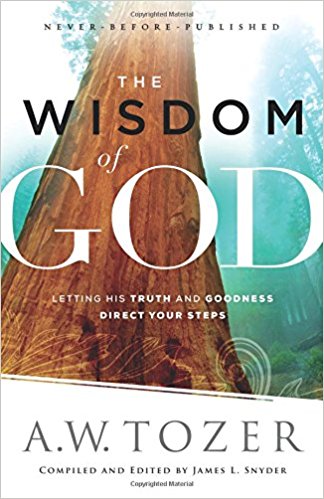
“Join me in this prayer: “Oh, I want to be other than what I am. I want to be different. I want to change. I am not satisfied. I want to believe in Thee, and trust in Thee, and throw myself boldly on Thee, and I want to be made like Thyself. I do not want only to escape hell, I want to escape sin. I not only want to go to Heaven at last, but I want to have Heaven in my heart now. I not only want to dwell with the redeemed, I want to be like the redeemed here on earth. I want to be another kind of person.” —A.W. Tozer, in The Wisdom of God
…the things which happen to me have actually turned out for the furtherance of the gospel (Philippians 1:12).
About 4-5 years before Paul wrote this, he wrote to the church in Rome: “And we know that in all things God works for the good of those who love Him, who have been called according to His purpose” (Romans 8:28).
Paul said, “All things” were being used in God’s plan for his life.
If I was one of those Philippian Christians I might respond, “Even in imprisonment?! C’mon, Paul, your liberty has been taken away and you can’t travel and preach anymore—can God use even that??”
Paul would give me an emphatic “Yes!”
Paul said even his imprisonment was being used by God…
It’s still true today: God has a plan for your life, which He will work out even in the most difficult trials.
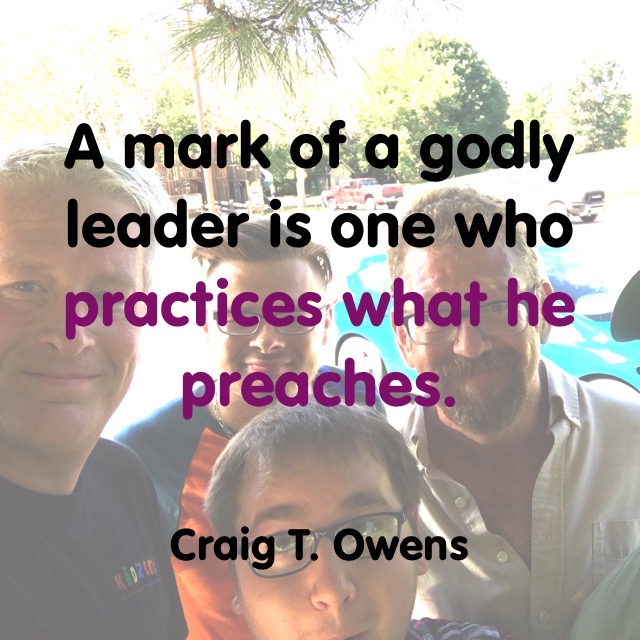
How powerful it is when a leader continues to practice what he preaches even in the toughest of circumstances!
This is part 40 in my series on godly leadership. You can check out all of my posts in this series by clicking here.
“And behold, two men were conversing with Him—Moses and Elijah, who appeared in splendor and majesty and brightness and were speaking of His exit from life, which He was about to bring to realization at Jerusalem.” (Luke 9:30-31)
Jesus was constantly making decisions that kept Him on the path straight toward Calvary’s Cross. He would let nothing deter Him from God’s appointed mission. Even when His own friends and family urged Him to find another route.
It was at a moment like this—when Jesus had yet another choice to make about what path He would follow—that Moses and Elijah talked to Him, reminding Him of the ultimate outcome of His obedient and correct choices.
At every crossroads—at every decision point—Jesus chose correctly. He chose to do God’s will for His life. He could have decided to do things His own way, but He leaned into the unmistakable voice of the Holy Spirit pointing Him toward the right path.
What does that mean for us today?