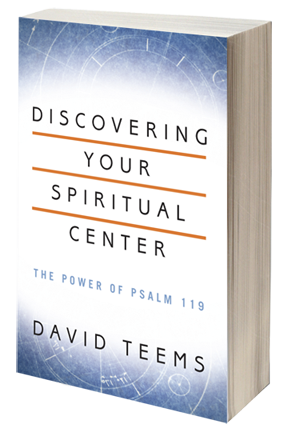
Discovering Your Spiritual Center (book review)

I enjoy books and commentaries that help me study the Bible in a different way. Discovering Your Spiritual Center by David Teems is a unique angle at one chapter of the Psalms that I have never seen before.

The big idea of this book is to take a long, introspective look at Psalm 119. It’s the longest chapter in the Bible (at 176 verses), but it is conveniently divided into 22 eight-verse sections, with each section corresponding to a letter of the Hebrew alphabet. David Teems makes the case that rabbis considered the Hebrew letters to be living things, so that there is a significance to why each of these eight verses are grouped together.

The next idea of this book is to take a 22-day journey of rediscovering the power of the Scripture, by reading one 8-verse section each day. Then to take time to reflect on each day’s passage. It’s a good idea to use this one psalm to (re)awaken a passion for Scripture, as all but four of the verses mention God’s Word (law, statutes, commands, etc.).

So far, so good.

However, I did find some of the author’s fascination with the Hebrew letters—like their shape, or their placement in the alphabetic order—a bit unsettling. I also thought at times his pointing out other words in Scripture that start with the same letter of the Hebrew alphabet a bit stretched. So although the concept is good in theory (taking a 22-day journey through this psalm), I found the approach a bit, well, creepy.

I am a Leafwood book reviewer.
Set Them Free!

Jesus has some pointed words for us in Matthew 5—

Therefore, if you are offering your gift at the altar and there remember that your brother has something against you, leave your gift there in front of the altar. First go and be reconciled to your brother; then come and offer your gift. (vv. 23-24)

Notice that Jesus says that your brother has something against you. Since the first word of this verse is therefore, we have to back up a couple of verses to get the context. In the preceding two verses Jesus talks to us about our anger, our harsh words, and our rash judgments leveled at others. In other words, things we have done to others which has made them upset at us.

In our prayer time, the Holy Spirit will help us remember what we have done. Now what are you going to do about it? Excuse it? Justify it? Or will you rectify it? Will you be obedient to go and make it right?

Until we do, we’re keeping our offended brother or sister in bondage to us. But as soon as we ask forgiveness, we set them free.

I love what C.S. Lewis said about recognizing where we may have offended someone—

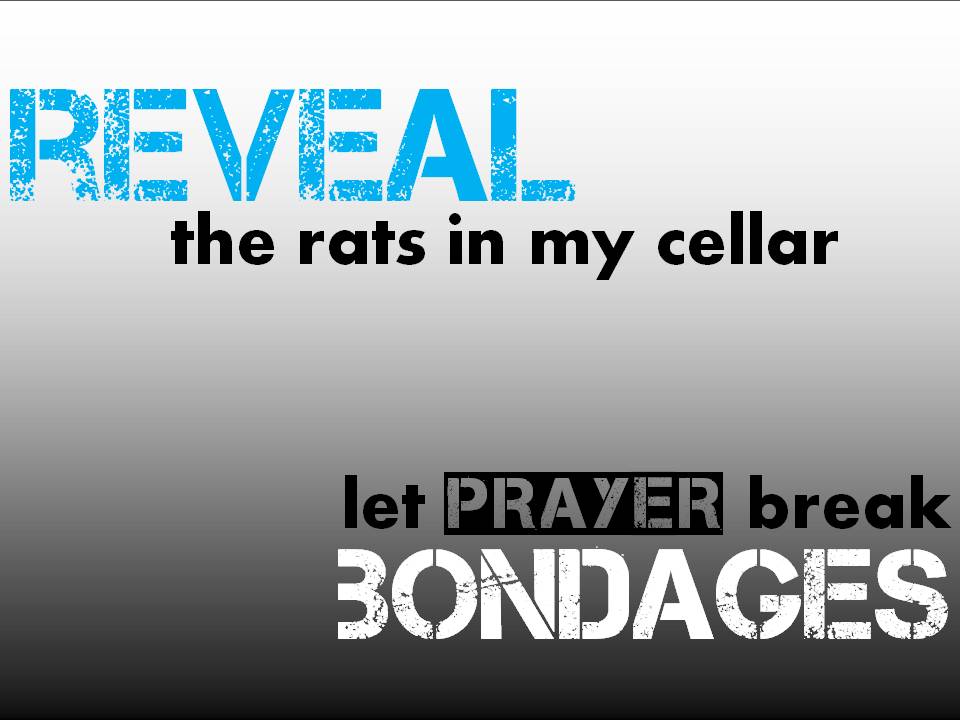
“When I come to my evening prayers and try to reckon up the sins of the day, nine times out of ten the most obvious one is some sin against charity; I have sulked or snapped or sneered or snubbed or stormed. And the excuse that immediately springs to mind is that the provocation was so sudden or unexpected. I was caught off my guard, I had not time to collect myself…. Surely what a man does when he is taken off guard is the best evidence of what sort of man he is. Surely what pops out before the man has time to put on a disguise is the truth. If there are rats in the cellar you are most likely to see them if you go in very suddenly. But the suddenness did not create the rats; it only prevents them from hiding. In the same way the suddenness of the provocation does not make me an ill-tempered man: it only shows what an ill-tempered man I am.

When the Holy Spirit shows you the rats in your cellar—when He helps you remember how your ratty words or behavior hurt someone else—take care of it immediately! It’s the fastest way to freedom!

I will be speaking on The Danger Of Prayerlessness again next Sunday. I hope you can join me.

Praying Through

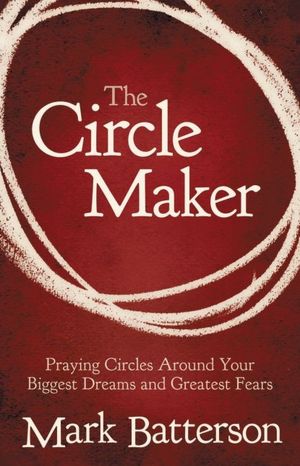
I love this quote from Mark Batterson’s book The Circle Maker.

“Our generation desperately needs to rediscover the difference between praying for and praying through.  Praying through is grabbing hold of the horns of the altar and refusing to let go until God answers.” 

I grew up hearing that phrase praying through, but how quickly we pray one-and-done prayers! There is such a power in praying through. May I learn to do this better!

(By the way, Draw The Circle is a great companion book to The Circle Maker.)

Copartnership

Do you want your church services to be more engaging?

Do you want your pastor to preach more effectively?

Do you want to come away from church more energized?

If so, you need to enter into a partnership. E.M. Bounds, in his fascinating book The Weapon of Prayer, wrote this—

“Prayerlessness, therefore, as it concerns the preacher is a very serious matter. If it exists in the preacher himself, then he ties his own hands and makes the Word as preached by him ineffective and void. If prayerless people be found in the pew, then it hurts the preacher, robs him of an invaluable help, and interferes seriously with the success of his work. How great the need of a praying church to help in the preaching of the Word of the Lord! Both pew and pulpit are jointly concerned in this preaching business. It is a copartnership.”

If you want more engagement, effectiveness, and energy at your church, partner with your pastor in prayer.

If you don’t have a church home, I hope you can partner with me this Sunday at Calvary Assembly of God as I continue a series called The Danger Of Prayerlessness.

Thursdays With Oswald—Destroyed By Neglect

This is a weekly series with things I’m reading and pondering from Oswald Chambers. You can read the original seed thought here, or type “Thursdays With Oswald” in the search box to read more entries.

Destroyed By Neglect

Mortify therefore your members which are upon the earth; fornication, uncleanness, passion, evil desire, and covetousness, the which is idolatry. (Colossians 3:5 RV)

     In this passage Paul mentions things that are of the nature of rubbish, and he mentions them in their complete ugliness. They are the abortion of the stuff human nature is made of, and he says, ‘Mortify them, destroy them by neglect.’ Certain things can only be dealt with by ignoring them; if you face them you increase their power. It is absurd to say, Pray about them; when once a thing is seen to be wrong, don’t pray about it, it fixes the mind on it; never for a second brood on it, destroy it by neglect.

From Biblical Ethics

What things in my life do I need to stop praying about, and simply stop doing them?

Stop praying and mortify them … destroy them by starving them … strangle them by not giving them the oxygen of thought … abandon them like yesterday’s trash.

Some things do require prayer. And other things just need to be neglected.

Live Dead (book review)

Live Dead is not for the faint of heart. Nor those who don’t want their regular routine disturbed. Nor those who like the status quo. Nor those who want life to be comfortable. But if your desire is to allow God to use you anyplace, anytime, anywhere, this just may be the resource you’ve been looking for.

Live Dead takes its name from the scriptural principles of considering everything in our lives dead so that we can live for Christ. This journal is compromised of 30 days of thought-provoking devotional material from those who are living dead. Namely: missionaries who are living in remote, unfriendly places, in order to take the Gospel of Jesus Christ to unreached and unengaged people groups.

Each day you will get a glimpse into their personal lives, the sacrifices they have made, and the joy they have discovered in living dead. And you will be confronted on how you too can follow them in living dead. Not everyone will hear God calling them to move to a foreign land to share the love of Jesus, but I believe everyone who takes this month-long journey will hear God calling them to live dead right where they are.

I did.

I’m glad I took the 30-day challenge, and I encourage you to do so as well. You can order live dead materials, including this journal, from their website. And if you live near Cedar Springs, MI, you can join me at Calvary Assembly of God as I teach a series based on this book during the month of February 2012.

Defeating Temptation

Listen to the podcast of this post by clicking on the player below, and you can also subscribe on AppleSpotify, or Audible.

In probably the best-known prayer, the one Jesus taught us to pray, there is a line I have breezed past way too many times without thinking more about it. It says, “And lead us not into temptation, but deliver us from the evil one” (Matthew 6:13).

This prayer is addressed to our Heavenly Father, the One Who is all-loving and all-powerful. God loves us and He gives us His power. Even power to defeat temptation.

Sometimes we have to battle the same temptation again and again and again. Perhaps we have seen that we are overcoming that temptation more times than we’re being overcome by it; perhaps not. Sometimes it’s a totally new temptation that sneaks up on us each time. In either case, God knows what temptation we are going to face.

This line of the prayer is really saying, “God, please don’t bring me into battle with a temptation I’m not ready to face. Help me to be ready to overcome that temptation when it comes” (see 1 Corinthians 10:13; James 1:13-17).

NEWS FLASH—Instead of waiting to pray for help until I’m facing a temptation (a reactive prayer), I can pray for God’s help before I even face the temptation (a proactive prayer).

In my mind, proactive is way better than reactive!

Check out what John Bunyan learned about this—

“…I did not, when I was delivered from the temptation that went before, still pray to God to keep me from the temptations that were to come; for though, as I can say in truth, my soul was much in prayer before this trial seized me, yet then I prayed only, or at the most principally, for the removal of present troubles, and for fresh discoveries of His love in Christ, which I saw afterwards was not enough to do; I also should have prayed that the great God would keep me from the evil that was to come. … This I had not done, and therefore was thus suffered to sin and fall, according to what is written, Pray that ye enter not into temptation. And truly this very thing is to this day of such weight and awe upon me, that I dare not, when I come before the Lord, go off my knees, until I entreat Him for help and mercy against the temptations that are to come; and I do beseech thee, reader, that thou learn to beware of my negligence, by the afflictions, that for this thing I did for days, and months, and years, with sorrow undergo.”

What would happen if the next time you are facing a temptation you could say, “Hello, temptation! I’ve already prayed about you, and my Heavenly Father has already given me strength to defeat you”? Don’t you think you would be much more successful? I do!

►► Would you please prayerfully consider supporting this ministry? My Patreon supporters get behind-the-scenes access to exclusive materials. ◀︎◀︎

Grace Abounding To The Chief Of Sinners (book review)

One of my favorite books is Pilgrim’s Progress by John Bunyan. I just finished reading Bunyan’s autobiography called Grace Abounding To The Chief Of Sinners, so now I cannot wait to read Pilgrim’s Progress again!

John Bunyan’s autobiography is almost solely focused around how he became a Christian, and then how he defended himself against the Church of England after he became a follower of Jesus Christ.

At times Bunyan’s account of his struggle with his self-doubts about whether God would ever receive a sinner such as himself are absolutely heart-wrenching. He clung so desperately to the Scriptures that said God wanted to forgive him, and yet beat himself up with other Scriptures that talked about the vileness of sin. He felt that his sin had so wounded God, that he was unsure if he could ever be forgiven.

In a way, I found this quite refreshing. It reminded me of Dietrich Bonhoeffer’s warning against “cheap grace,” where far too many people trivialize the high price Christ paid on the Cross. But John Bunyan acutely felt his sin.

So once he finally received God’s forgiveness, he was a changed man who wanted to tell the world about his Savior. Unfortunately for the time in which he lived, his message of salvation wasn’t “sanctioned” by the Church of England, which landed him in jail for over a decade. The second-half of his autobiography is a play-by-play account of his interaction with the judges who tried and sentenced him. In this account, we read the words of a man who thoroughly knew Scripture, and knew how to use it!

It’s a fascinating biography, which I think any reader will enjoy.

The Circle Maker (book review)

I’m a huge fan of Mark Batterson’s books! So I’ll admit that when I received my copy of The Circle Maker, I went into it with high expectations. And this book didn’t disappoint!

I grew up with a phrase repeated often around our church and my home: The Church (and Christians) move forward on its knees. I believe that because I have tested it in my life. I know firsthand that my life is more centered and in-tune with God when I make prayer a regular habit. And on the flip side, I know how hectic and disjointed my life seems when my prayer time is abbreviated.

I’m an action-oriented guy. I like to do things quick, and I like quick responses. This frequently carries over into my prayer life, where I pray for something, and quickly check it off my list if the answer doesn’t come quickly enough. But that’s not how Honi The Circle Maker prayed.

This is the man Mark uses to teach us to pray with more intensity and more perseverance. Honi would—literallydraw a circle and kneel in prayer in that circle until God answered his prayer. Wow! From this man’s example, Mark teaches us three key concepts about becoming circle-maker pray-ers.

  1. Dream Big
  2. Pray Hard
  3. Think Long

In every section I was convicted on how short-sighted and puny my prayers seemed. But at the same time, I was also encouraged and energized to make the changes to become a circle maker in my prayer life. I’m excited to see how my life will change because my prayers are changing. I’m going to be a circle maker!

If you would like to revolutionize your prayer life, I wholeheartedly recommend this book.

I am a Zondervan book reviewer.

Great Plans!

As Jesus was approaching Jerusalem just prior to His passion, He told His disciples, “Everything that is written about the Son of Man will be fulfilled” (Luke 18:31).

Nothing about Jesus Christ’s life was haphazard, or random, or coincidental. Everything was a part of a perfect plan. So in order for everything about His life to fulfill the prophesies, every word He spoke and every action He completed also had to be fulfilling. And they were (see John 12:49-50)!

Sadly, His followers “did not understand any of this” (Luke 18:34).

Sadly, many people today don’t understand their own life’s purpose.

Sadly, often times I don’t either.

But God has a perfect plan for you and me.

All the days ordered for me were written in Your book before one of them came to be. (Psalm 139:16)

For we are God’s workmanship, created in Christ Jesus to do good works, which God prepared in advance for us to do. (Ephesians 2:10)

I don’t have to lack understanding in this (John 14:16).

I can pray for wisdom (James 1:5).

And Jesus Himself is praying for me to follow the Father’s plans (Hebrews 7:25).

God has great plans for my life—and for your life. Don’t be like the disciples that did not understand any of this. Pray … ask for God’s wisdom … ask for the Holy Spirit’s illumination … and trust in Christ’s interceding prayer for you.

May your words and actions today fulfill the plans God has for you!