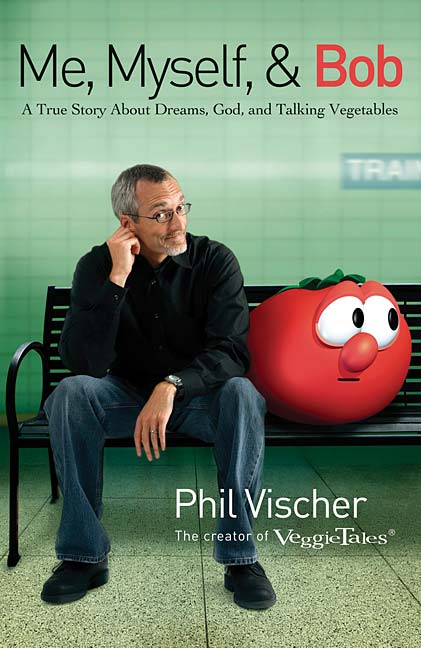
Me, Myself & Bob (book review)

As a parent of young children, I really appreciated the biblical values delivered in a fun way through so many VeggieTales videos. Now I’m really appreciating the wisdom of VeggieTales creator Phil Vischer in his book Me, Myself & Bob.

Written in the same witty style that made the VeggieTales videos so engaging, Me, Myself & Bob leads us through the meteoric rise and sudden collapse of Big Idea Productions. We read about the passion that drove the start of this incredible vision, and how—as the Bible says—zeal without a foundation of wisdom is a  dangerous thing.

With such candor, Phil shares about the vision and talents God gave him to do something so groundbreaking, how others caught that vision and jumped on board to help, and then how the company sort of took on a life of its own and how corporate executives took this highly successful business in a direction Phil never imagined.

This book is more like a business strategy book told as Phil Vischer’s autobiography. From the business board room to the family living room, there are valuable lessons to be learned from the rise and fall of VeggieTales. So whether you’re a fan of Bob the Tomato & Larry the Cucumber, an entrepreneur, or a parent, you will find something to love about Me, Myself & Bob.


Thursdays With Oswald—Pseudo-evangelism

This is a weekly series with things I’m reading and pondering from Oswald Chambers. You can read the original seed thought here, or type “Thursdays With Oswald” in the search box to read more entries.

Pseudo-evangelism

It was this form of pseudo-evangelism, so unlike the New Testament evangelism, that made [Thomas] Huxley say—“I object to Christians: they know too much about God.” … God is the only Being who can afford to be misunderstood; we cannot not, Job could not, but God can. If we are misunderstood we “get about” the man as soon as we can. St. Augustine prayed, “O Lord, deliver me from this lust of always vindicating myself.” God never vindicates Himself, He deliberately stands aside and lets all sorts of slanders heap on Him, yet He is not in any hurry.

From Baffled To Fight Better

I’m learning more and more that when people ask why God behaves in such-and-such a way that the best answer may be, “I don’t know why, but I still trust Him.” I trust Him even when I don’t have all of the answers, because I know He has all of the answers.

To try to answer for God—or, as is probably more likely, to try to defend my theology—is rightly called pseudo-evangelism. O Lord, deliver me from pseudo-evangelism!

I Am Drowned

I love this thought from John Bunyan:

God is the chief good—good so as nothing but Himself. He is in Himself most happy; yes, all good and all true happiness are only to be found in God, as that which is essential to His nature; nor is there any good or any happiness in or with any creature or thing but which is communicated to it by God. God is the only desirable good; nothing without Him is worthy of our hearts. Right thoughts of God are able to ravish the heart; how much more happy is the man that has interest in God. God alone is able by himself to put the soul into a more blessed, comfortable, and happy condition that can the whole world; yes, and more than if all created happiness of all the angels of heaven did dwell on one man’s bosom. I cannot tell what to say. I am drowned. The life, the glory, the blessedness, the soul-satisfying goodness that is in God are beyond all expression. (emphasis added)

I love drowning in God’s glorious, blessed, soul-satisfying, beyond-all-expression love!

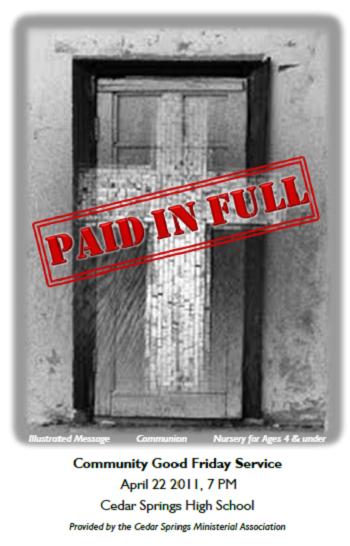
Paid In Full

We’ve got a super group of churches that form the Cedar Springs Ministerial Association. I love collaborating with these fellow pastors, that have become great friends along the way.

On Good Friday we are combining together to present a Good Friday service. Please join us at 7pm at the Cedar Springs High School auditorium. We’ll enjoy some worship from a worship team combined from all of our churches, and a time of Communion too. A nursery will be provided for children 4-years-old and younger.

And I am very honored to have been asked to deliver the message in this service. I’ll be sharing a powerful illustrated message entitled Paid In Full.

Please don’t miss out on this service!

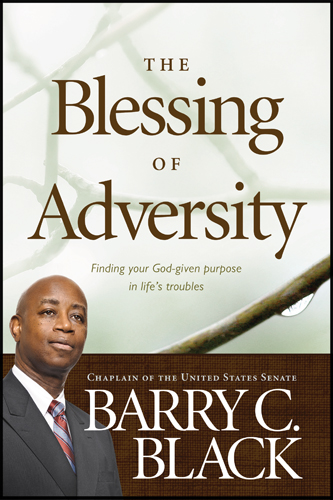
The Blessing Of Adversity (book review)

Barry C. Black has lived a full life, and that fullness has been poured into his timely book The Blessing Of Adversity: Finding your God-given purpose in life’s troubles.

A quick show of hands: how many of you have experienced trouble lately? How many of you are experiencing it right now? If you raised your hand in either category, this book could be quite helpful to you.

The Blessing Of Adversity is arranged into 23 chapters, but each chapter is broken down into several “mini chapters.” By that I mean that Chaplain Clark gives us several different ways of viewing the same topic of how to respond to adversity. He might tell you a personal story from his boyhood or his 23-year military career; or perhaps he’ll give you a modern-day example from his current ministry as chaplain to the U.S. Senate; or maybe a story from the pages of history; or a well-timed quote. Whatever his method, he always connects it with an encouraging word from the Bible to help the reader correctly process the times of adversity we all must pass through.

I found this book to be highly practical, and immediately applicable to my life. And for those of you who didn’t raise your hand earlier, there are a couple of chapters for you on how to prepare for the future adversity you are bound to face. This book would work very well as either an individual or small group Bible study.

I am a Tyndale book reviewer.

Disagreeing Agreeably

Listen to the podcast of this post by clicking on the player below, and you can also subscribe on Apple or Spotify.

Why do disagreements have to become so, well, disagreeable?

Is it possible to disagree agreeably?

It’s not easy, but I think it’s possible.

When I was younger I couldn’t stand the idea of “losing” an argument: I always had to be right. I think I’ve matured a bit (at least, I hope I have), and I no longer feel the same way. So here are a few lessons I’ve learned:

(1) Remember the person I’m disagreeing with is my brother or sister. God has created both of us, so that makes us siblings.

(2) Always go for win-win. Don’t look out only for your own interests, but take an interest in others, too (Philippians 2:4).

(3) Choose your battles wisely. You can’t make everything an issue worth dying over. Thomas Jefferson wisely said, “In matters of principle, stand like a rock; in matters of taste, swim with the current.”

(4) Redefine the “win.” What does it mean to win? Is it to put someone else in their place? That doesn’t seem very healthy. Perhaps a “win” is when values or principles are agreed to, although the way they are applied may be very different from person to person.

(5) Leave the baggage behind. Don’t bring previous hurts into a new situation. Don’t assume this new person will act like someone else from your past.

We’re all different people, so we’re going to have disagreements. The key: let’s find a way to disagree agreeably.

If you have other thoughts about how to disagree agreeably, I would love it if you would share them in the comments.

►► Would you please prayerfully consider supporting this ministry? ◀︎◀︎

The Champion

The most amazing story in all of history (or should I say “His story”) is the story of God coming to earth to rescue us! We were made to be in intimate relationship with God, but our sin made us captives of satan—slaves to his power. Jesus came to set us free!

He was born of a virgin, lived a sinless life, died on the Cross for my sins, defeated satan, broke the power of sin’s hold on me, and rose to life again! JESUS IS THE CHAMPION!

I’m so excited about this year’s Easter breakfast drama at Calvary Assembly of God called The Champion! This is a free event, but we do have tickets available to ensure there is enough space for everyone to attend.

If you would like to join us for a powerful, visual portrayal of Christ’s victory over sin, please let me know how many tickets you would like, and whether you want to attend at 9am or 11am, and I’ll set them aside for you. Don’t miss this one!

Night (book review)

Night by Elie Wiesel is not an easy read. But it is a vital read. In order to ensure that the evil perpetrated on the Jewish people by the Nazi regime never, ever happens to any other people group again, we must read what is not easy for us to read.

This book is the heart-wrenching account of the atrocities committed by the Nazis during the Holocaust. But it’s not simply a factual retelling of these horrendous events. Night takes you right into the utter despair felt by people who were completely dehumanized. People who were treated less humanely than animals. People who lived in the midst of pure Evil.

Elie Wiesel tells his firsthand account as a teenage boy forcibly removed from his home, separated from his mother and sisters, stripped of his dignity, treated in despicable ways, struggled with his anger toward God, and watched his father die right before his eyes. No one should have had to endure such things.

Elie Wiesel survived to tell his story, so that he could become the voice for the voiceless oppressed. What a great lesson for all of us to learn! We, too, should speak up for those who cannot. As Elie said in his Nobel Peace Prize acceptance speech:

We must take sides. Neutrality helps the oppressor, never the victim. Silence encourages the tormentor, never the tormented. Sometimes we must interfere. … Human suffering anywhere concerns men and women everywhere. … And action is the only remedy to indifference, the most insidious danger of all. … One person of integrity can make a difference, a difference of life and death.

Please read this book, and then be one person of integrity who makes a difference.

Thursdays With Oswald—Bad Theology

This is a weekly series with things I’m reading and pondering from Oswald Chambers. You can read the original seed thought here, or type “Thursdays With Oswald” in the search box to read more entries.

Bad Theology

Job’s friends came slowly to the conclusion that their view of God was right, therefore Job must be wrong. They had the ban of finality [the limitation or “curse” of having one’s mind made up] about their views, which is always the result of theology being put before God.

From Baffled To Fight Better

Putting theology before God makes a god out of my mind—and a very weak god at that. Or as G.K. Chesterton put it, “A weak mind is like a microscope, which magnifies trifling things but cannot receive great ones.”

Or maybe God said it best of all“As the heavens are higher than the earth, so are My ways higher than your ways and My thoughts higher than your thoughts.”

Job got it right. He continued to believe that God was doing something bigger than he could think or imagine. He didn’t close off his mind, or put his theology before God, or make a god out of his own ideas.

I pray that when the pressure is on, I can continue to trust God and not give in to the ban of finality.

How The Mighty Fall (book review)

This is the third in the series of books from Dr. Jim Collins: Built To Last, Good To Great, and now How The Mighty Fall. This is a book that Dr. Collins wished he didn’t have to write, as he uncovers the markers that contributed to the failure of once-great companies.

If you are a frequent reader of my blog, you’re probably wondering why I’m reading/reviewing a business book. The answer is simple: the principles Jim Collins uncovers in his books are rock-solid principles of success and failure, regardless of the organization in which they are practiced or ignored. In all three of his books, I have mined so many great truths to apply to my personal life, as well as the organizations I lead.

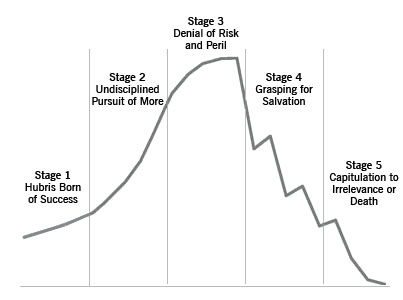
In How The Mighty Fall we learn about the five stages of decline for once-great organizations. Working backward from his evidence, Dr. Collins then gives us “markers” to look for in our own organizations that would tip us off to the stages of decline.

Why study this? Because I want to lead a great church! This quote from the book especially resonates with me:

“The point of struggle is not just to survive, but to build an enterprise that makes such a distinctive impact on the world it touches, and does so with such superior performance, that it would leave a gaping hole — a hole that could not be easily filled by any other institution—if it ceased to exist.” (emphasis added)

If you are involved in the leadership of any organization (whether for-profit or non-profit), I would encourage you to devour all three of Jim Collins’ books.