



It was so incredible to celebrate Good Friday with all of the other churches in Cedar Springs!
The worship team was anointed … the Paid In Full drama was powerful … Communion was meaningful … which made the whole evening so memorable.
It was so incredible to celebrate Good Friday with all of the other churches in Cedar Springs!
The worship team was anointed … the Paid In Full drama was powerful … Communion was meaningful … which made the whole evening so memorable.
 There was no more terrible death than death by crucifixion. Even the Romans themselves regarded it with a shudder of horror. Cicero declared that it was “the most cruel and horrifying death.” Tacitus said that it was a “despicable death.” It was originally a Persian method of execution. It may have been used because, to the Persians, the earth was sacred, and they wished to avoid defiling it with the body of an evil-doer. So they nailed him to a cross and left him to die there, looking to the vultures and the carrion crows to complete the work. The Carthaginians took over crucifixion from the Persians; and the Romans learned it from the Carthaginians.
Crucifixion was never used as a method of execution in the homeland, but only in the provinces, and there only in the case of slaves. It was unthinkable that a Roman citizen should die such a death. Cicero says: “It is a crime for a Roman citizen to be bound; it is a worse crime for him to be beaten; it is well nigh parricide for him to be killed; what am I to say if he be killed on a cross? A nefarious action such as that is incapable of description by any word, for there is none fit to describe it.” It was that death, the most dreaded in the ancient world, the death of slaves and criminals, that Jesus died.
The routine of crucifixion was always the same. When the case had been heard and the criminal condemned, the judge uttered the fateful sentence: Ibis ad crucem, “You will go to the cross.” The verdict was carried out there and then. The condemned man was placed in the centre of a quaternion, a company of four Roman soldiers. His own cross was placed upon his shoulders. Scourging always preceded crucifixion and it is to be remembered how terrible scourging was. Often the criminal had to be lashed and goaded along the road, to keep him on his feet, as he staggered to the place of crucifixion. Before him walked an officer with a placard on which was written the crime for which he was to die and he was led through as many streets as possible on the way to execution. There was a double reason for that. There was the grim reason that as many as possible should see and take warning from his fate. But there was a merciful reason. The placard was carried before the condemned man and the long route was chosen, so that if anyone could still bear witness in his favor, he might come forward and do so. In such a case, the procession was halted and the case retried. —William Barclay, Commentary on John

—Betty Ann King, I Hear Him
I pray that today you can hear Jesus calling your name and saying, “You are mine; I paid an incredibly high price to show you how much I love you!”

A friend introduced me to the writings of Alan Hirsch, and I’m so glad he did! Co-written with his wife Debra, Untamed resonated with me on so many levels.
Untamed is about discipleship the way it should be; not the way those in Christendom have made it. It’s about viewing our lives as an integrated whole; not the part-Christian, part-other roles in which we tend to operate. It’s about seeing the Church operate as a living, breathing, loving organism; not as an only-meets-once-a-week organization.
There were parts of this book that made me say, “Yes! That’s what I want to be a part of.” There were other parts that made me pause and say, “Hmmm, I never thought of it like that before.” And there were still other parts (honestly) that I said, “That’s a bit too radical for me to try right now.”
If you’re tired of clichéd “Christians” or the same-old-same-old “church,” Untamed will probably resonate with you. At the end of each chapter are some great discussion questions, which will help you begin to see discipleship in a new light.
If, however, you think the church and Christendom are doing just fine, then stay far away from Untamed, because you just might begin to think otherwise!
As for me, I loved this book!
This is a weekly series with things I’m reading and pondering from Oswald Chambers. You can read the original seed thought here, or type “Thursdays With Oswald” in the search box to read more entries.
 Hate Properly
A Quaker friend of mine referring to a certain man said he did not like him because he did not hate properly. … The Christian standpoint should be one of positive anger when anyone is made to stumble. To remain indifferent when there is injustice abroad is to come under the curse of Meroz, who “came not to the help of the Lord…against the mighty” (Judges 5:23).
From Baffled To Fight Better
There are six things the Lord hates, seven that are detestable to Him: haughty eyes, a lying tongue, hands that shed innocent blood, a heart that devises wicked schemes, feet that are quick to rush into evil, a false witness who pours out lies and a man who stirs up dissension among brothers. (Proverbs 6:16-19)
But if anyone causes one of these little ones who believe in Me to sin, it would be better for him to have a large millstone hung around his neck and to be drowned in the depths of the sea. (Matthew 18:6; Mark 9:42; Luke 17:2)
And the word of the Lord came again to Zechariah: “This is what the Lord Almighty says: ‘Administer true justice; show mercy and compassion to one another. Do not oppress the widow or the fatherless, the alien or the poor. In your hearts do not think evil of each other.’ But they refused to pay attention; stubbornly they turned their backs and stopped up their ears. They made their hearts as hard as flint and would not listen to the law or to the words that the LORD Almighty had sent by his Spirit through the earlier prophets. So the Lord Almighty was very angry.” (Zechariah 7:8-12)
It’s time for us to get positively angry and hate the things that God hates.
 There is a progression that I believe Christians should be aware of as they lead others toward Christ.
First: .
Those who have been de-churched, or who have had a negative experience with another Christian, or who have become disenchanted with the Church, make factual statements about Christians and Church.
“The Church is….”
“Christians always….”
But if are truly the salt of the earth and the light of the world, we can season and shine in a way that will cause them to question their own factual statements.
Next comes: ?
“The Christian Church exists to reveal God and to utter forth His praise, to make God known to men who know Him not, that in the presence of the revelation they may be filled with awe, and wonder, and amazement—to make God known, that God shall be attractive to humanity.” —G. Morgan Campbell
“This is Church?”
“You’re a Christian?”
Which leads to: !
Jesus stated that the greatest of all commandments—indeed the fulfillment of all the commandments—was loving God with all of our heart, soul, mind, and strength and then loving others as we love ourselves. Once people see Christians as true representations of Christ … people so intent on loving God and loving others, they too will find what their hearts have been longing for.
“This is what I’ve been looking for!”
“Now this is what I call a real Church!”
Can I suggest an easy place to start? With your smile. Look at what Job said:
Men listened to me expectantly, waiting in silence for my counsel. After I had spoken, they spoke no more; my words fell gently on their ears. They waited for me as for showers and drank in my words as the spring rain. When I smiled at them, they scarcely believed it; the light of my face was precious to them. (Job 29:21-24)
Living in this way can move people from close-minded skeptics, to curious questioners, to enthusiastic followers of Jesus Christ. Let’s do this!
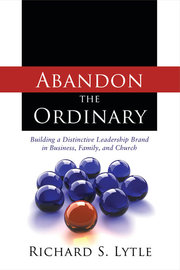
Ordinary. Plain. Generic. Non-descript. Boring. According to Richard S. Lytle in Abandon The Ordinary, these words should never be the descriptors for those who want to create a distinctive brand of leadership for their business, family, or church. And they should never, ever be used to describe Christians.
Dr. Lytle is a business professor, so he comes at this topic from a distinctly business paradigm. But make no mistake: this is not a dry academic treatise. Abandon The Ordinary is an exciting and practical way to develop a distinct, unique brand for your life. In the opening chapter, Dr. Lytle quotes:
“To make ordinary that which God calls life and use your gifts and capacities for nothing is to prostitute great potential. Jesus Christ came into the world to convict us not so much of our transgressions but of our possibilities and to deliver us from an empty way of life. …God must become ill at times when He sees us so trivial, so paltry, thinking such little things, when such great and honorable and glorious things are there in front of us.” — Jim McGuiggan
This is such a refreshing viewpoint for so many people who have bought-in to the “cookie cutter” mentality that says every business should operate like this, or every family should look this way, or every Christian must behave like such-and-such.
To help aide the reader in developing a distinctive, far-from-the-ordinary brand, Dr. Lytle has included several worksheets at the back of the book, which will help you apply the methods about which he teaches. I’m looking forward to utilizing this helpful tool.
If you’re tired of ordinary, Abandon The Ordinary will be a welcomed book for your library.
I am an ACU Press book reviewer.

Dichotomy is a big word that means two parts that are opposed to each other. But it also means that they were once joined together—they were once in unity. Much like the first Christians: when people looked at them they saw Jesus; when they heard them speak they heard Jesus; when they watched their lives they saw the life of Jesus.
Christ and Christian were the same unified picture.
Today this is, sadly, far from the truth. People have a lot of wonderful things to say about Jesus, and a lot of nasty things to say about Christians. An unfortunate, and unnecessary, dichotomy exists.
I read an editorial from Ricky Gervais, a self-proclaimed atheist, entitled “Why I’m A Good Christian.” You can read his full editorial in the Wall Street Journal here, but for me this was the key passage:
I am of course not a good Christian in the sense that I believe that Jesus was half man, half God, but I do believe I am a good Christian compared to a lot of Christians.
It’s not that I don’t believe that the teachings of Jesus wouldn’t make this a better world if they were followed. It’s just that they are rarely followed.
Gandhi summed it up really. He said, “I like your Christ, I do not like your Christians. Your Christians are so unlike your Christ.”
I have always felt this way, even when I believed in God, and in a weird way I feel I am still a pretty good “Christian” who doesn’t believe in God.
I think the way back from this dichotomy is two-fold:
(1) Christ-followers need to make an intentional effort to act more Christ-like.
(2) We Christians need to be more thoughtful in our responses to people like Ricky Gervais. I like the pattern Peter recommends—
Honor Christ and let Him be the Lord of your life [our motivation for action]. Always be ready to give an answer when someone asks you about your hope [“hope,” not theology, not bad behavior]. Give a kind and respectful answer and keep your conscience clear [there is zero justification for a Christian to give a crass, disrespectful, or sarcastic answer]. This way you will make people ashamed for saying bad things about your good conduct as a follower of Christ [good conduct = we live, talk, and act like Jesus].

Have you ever wanted to have a conversation with Max Lucado? Just sit with him for awhile and pick his brain? With Max On Life you can do just that!
Max On Life is a compilation of 172 questions that Max has been asked. Some of his answers come from his previously written books, some are answers formed with brand new insights, but all of the answers come from his very pastoral heart.
The book is divided into seven sections – hope, hurt, help, him/her, home, have/have-nots, and hereafter. But even more helpful is the index of topics at the back of the book, as well as a listing of all of the scriptural references Max uses throughout Max On Life. I can imagine this book staying very close at hand, because I’m going to be referring to it often.
If you are a pastor or counselor, I think you will find a lot of helpful insights in this book to pass on to others. If you have a friend with lots of questions about the Christian faith, this book would make an excellent gift. Or if you just want to be a helpful friend when others are in need, this book will help prepare you to be a blessing to them.
I am a Thomas Nelson book reviewer.

Somehow I don’t think this is the most effective way to start a conversation about your faith!
Here are four thoughts I have…
Don’t compartmentalize. In other words, don’t put on your “Christian hat” to talk about your relationship with Jesus. Just be Christ-like all the time. People are looking for something real, not someone who’s playing an act.
Develop relationships first. Don’t lead with a sermon; lead with a friendship. As the saying goes, “People don’t care how much (or Who) you know, until they know how much you care.” Be a genuine friend first.
Wait until they’re ready. Jesus told stories with a deeper meaning and asked a lot of questions of people before He spoke to them directly about the kingdom of God. Don’t force people into a conversation. Keep the door open, and let them step in when they are ready.
Don’t get discouraged. Just like there are some topics you’re not ready to discuss right now, others feel the same way. So just because they say “No thanks” today doesn’t mean nothing happened. The Bible says that we are the salt of the earth and the light of the world. Salt and light are always seasoning and illuminating everywhere they go. Your life is making a difference.


 Craig T. Owens