Was Your Church Successful?

These thoughts are especially for my fellow pastors (although I think they pertain to anyone who attended a church service recently).

So… how successful was your church gathering this weekend?

Was it successful because lots of people were there? Or because the pastor preached a good sermon? Or maybe the offering was better than usual? Or because you could feel something special as the worship team sang and played their instruments?

How about these measurements:

“The great business of the church is not our number by addition, but by grace, by growing up in Christ.” (John Owen)

“The perfect church service would be one we were almost unaware of. Our attention would have been on God.” (C.S. Lewis)

“Revival is the church getting back to ‘normal.’” (A.W. Tozer)

I hope these quotes have you thinking about church “success” as much as they are working on me!

UPDATE: This post was one of the seed thoughts that went into fashioning my book Shepherd Leadership: The Metrics That Really Matter.
Leadership Tension

Along time ago I was studying the virtues that the Greek philosophers taught. To the Greeks, the virtue was considered the “golden mean” between two opposite extremes. It was the ability to balance the tensions that produced the virtue.

In areas where I have leadership responsibilities, I try to find the virtue of leadership as the balance between these two tensions:

  • Here is a trustworthy saying: Whoever aspires to be an overseer desires a noble task. (1 Timothy 3:1)
  • Should you then seek great things for yourself? Do not seek them. (Jeremiah 45:5)

On the one side: desire leadership. On the other side: don’t desire leadership. Do your best at it, but be ready to give it up.

I love this statement on leadership from John Maxwell—

Leadership is the willingness to put oneself at risk.
Leadership is the passion to make a difference with others.
Leadership is being dissatisfied with the current reality.
Leadership is taking responsibility while others are making excuses.
Leadership is seeing the possibilities while others are seeing the limitations.
Leadership is the readiness to stand out in a crowd.
Leadership is an open mind and an open heart.
Leadership is the ability to submerge your ego for the sake of what is best.
Leadership is evoking in other the capacity to dream.
Leadership is inspiring others with a vision of what they can contribute.
Leadership is the power of one harnessing the power of many.
Leadership is your heart speaking to the hearts of others.
Leadership is the integration of heart, head, and soul.
Leadership is the capacity to care, and in caring, to liberate the ideas, energy and capacity of others.
Leadership is the dream made reality.
Leadership is, above all, courageous.

I am trying to balance the pulls of leadership, but while I do I’m loving the leadership tension!

UPDATE: This idea of leadership tension became one of the key seed thoughts for my book Shepherd Leadership: The Metrics That Really Matter

Baaaa!

Listen to the podcast of this post by clicking on the player below, and you can also subscribe on AppleSpotify, or Audible.

Of all the things God could have used as a picture of our relationship with Him, He used an animal. And, no, it wasn’t an animal that seems particularly powerful or smart or noble.

He picked a sheep.

A fuzzy, sometimes dimwitted, needs-a-lot-of-help animal.

I’m a sheep. Baaaa!

But then I have the great picture of God as my loving Shepherd. How wonderful to know that the Lord is my Shepherd, I shall not be in want!

As a pastor I am called to be the shepherd to God’s flock of sheep under my watchful eye. Jesus set the example for me:

But the one who enters through the gate is the shepherd of the sheep. The gatekeeper opens the gate for him, and the sheep recognize his voice and come to him. He calls his own sheep by name and leads them out. After he has gathered his own flock, he walks ahead of them, and they follow him because they know his voice.

And Solomon said:

Be sure you know the condition of your flocks, give careful attention to your herds.

Pastors, here are the questions I’m asking of myself, and I invite you to ask them of yourself too:

  • Do my sheep recognize my voice? Or am I trying to sound like someone else?
  • Do I know all my sheep by name?
  • Are my sheep following me as I follow Jesus?
  • Am I willing to go first?
  • Do I find fresh pastures and clean water for my sheep? Or is it recycled food I’m serving them?
  • Am I spending enough time with my sheep to know the condition of each one?
  • Do my sheep get my undivided attention?

What a privilege to be a pastor! What a responsibility! What a joy to know my sheep and to be known by them!

Baaaa!

UPDATE: This post was one of the seed thoughts that went into fashioning my book Shepherd Leadership: The Metrics That Really Matter.
►► Would you please prayerfully consider supporting this ministry? ◀︎◀︎

An Extra Hour Of Sleep

I’m a morning person. I absolutely love getting up early and spending some quiet time alone with my Bible. This is the time of day I most absorb all that God is saying to me. It’s my most creative time too. In fact, I so love getting up early that most mornings I’m awake before my alarm clock goes off.

But not this morning.

Today my alarm clock began playing Way-FM and I felt like I was in a fog. It took me a minute or so to even open my eyes and sit up.

I was about to press ahead with my morning, when I thought, “I should sleep some more.”

You see, I’ve learned a few things about myself. When I’m tired…

  • I have a shorter attention span.
  • I’m not as creative.
  • I’m not as patient.
  • I am more prone to give in to temptation.
  • I make decisions that are too short-sighted.
  • I’m more susceptible to colds and flu.

So I re-set the alarm and slept another hour.

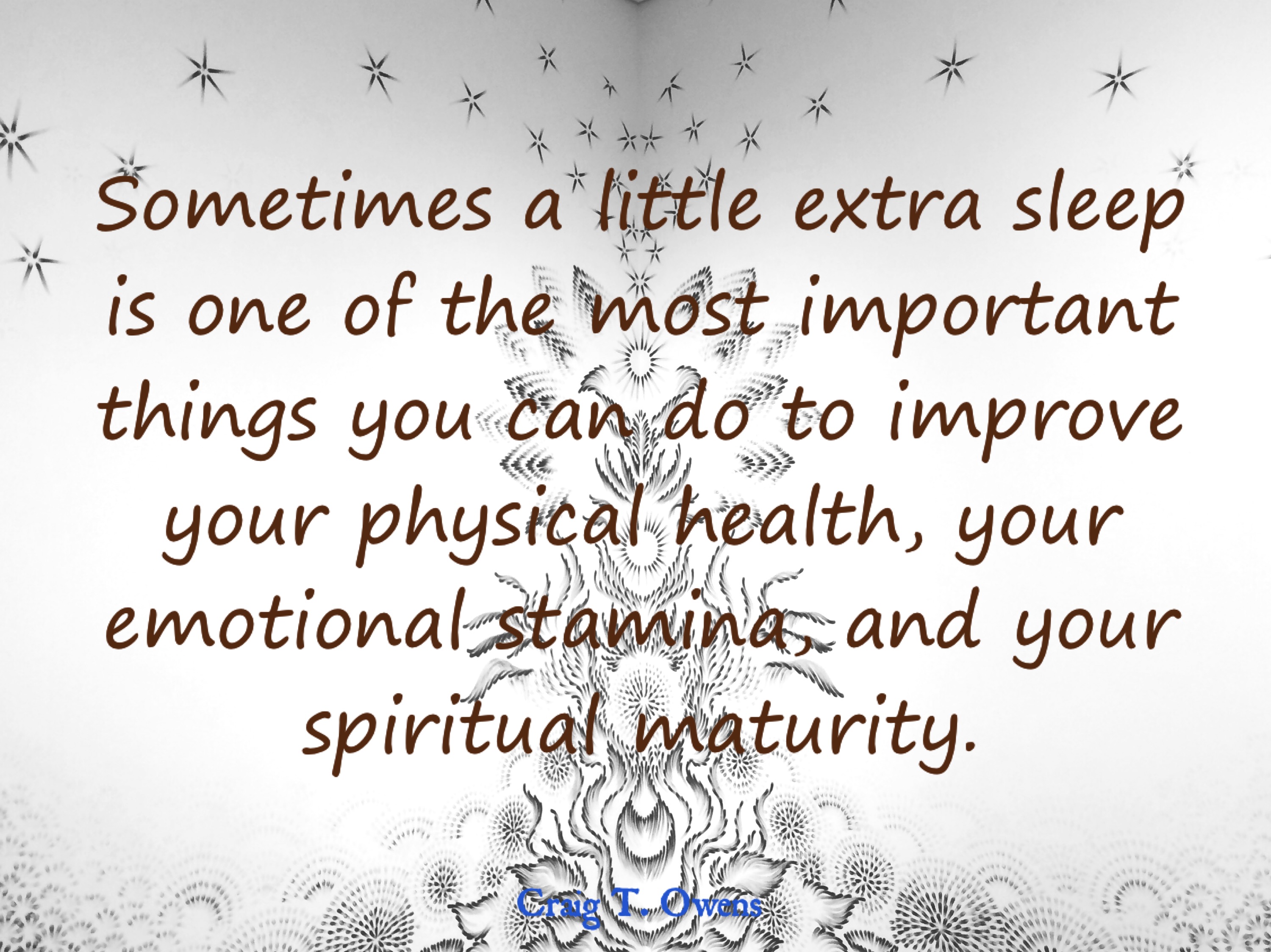
Sometimes a little extra sleep is one of the most important things you can do to improve your physical health, your emotional stamina, and your spiritual maturity.

UPDATE: In my book Shepherd Leadership: The Metrics That Really Matter I have five chapters about a leader’s health—mental, physical, spiritual, and emotional health is vital to a leader’s effectiveness and longevity.

Tick, Tock! Drip, Drop!

Tick, Tock! “There just is never enough time in my day!”

Tick, Tock! “Wow, this day has just flown by and I got nothing done!”

Tick, Tock! “Why do I always have so much To Do List left at the end of my week?”

May I suggest that instead of Tick, Tock! you focus on Drip, Drop!

(The data compiling website Flowing Data has a fascinating look at how men and women of all ages spend their time throughout the day.)

I’ve gotten some great insight on time usage from Paul Meyer. Check it out:

“Most time is wasted, not in hours, but in minutes. A bucket with a small hole in the bottom gets just as empty as a bucket that is deliberately emptied.”

Usually our time doesn’t just Tick! by, it Drips! by. In other words, it’s really easy to spot the huge time-wasters; it’s much more difficult to find the time-leakers. But they can be found and plugged. Listen to more good advice from Dr. Meyer:

“Time is usually wasted in the same way every day.”

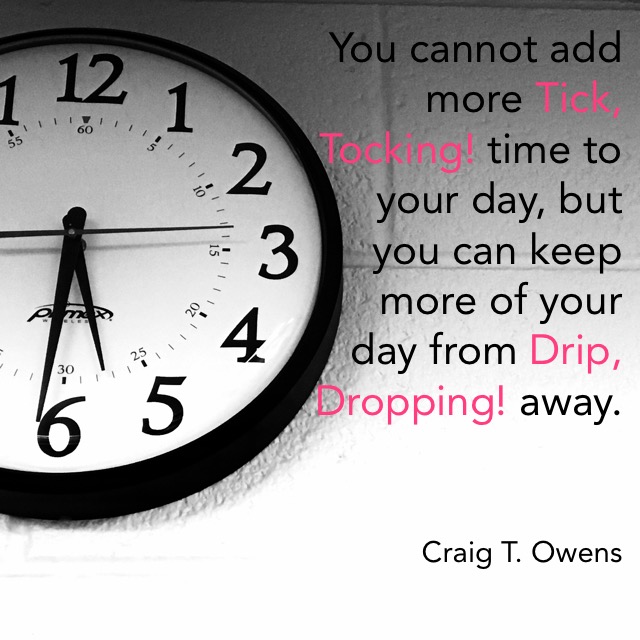
You cannot add more Tick, Tocking! time to your day, but you can keep more of your day from Drip, Dropping! away. Here are two things I’ve done which have really helped me:

  1. For one week (7 full days) I kept a log of how I spent every 15-minute increment. This might sound like a Drip, Drop! thing to do, but I was amazed at how many leaks I discovered after a week of doing this.
  2. Then I prayed the same prayer Moses prayed, “Give me wisdom to use my days the right way.”

If you can identify the time leaks, God can give you the wisdom to help you plug them. When you can control the Drip, Drop! you’ll get more out of your Tick, Tock! each day.

UPDATE: The thoughts in this chapter became a whole chapter in my book Shepherd Leadership. The chapter is called ‘Can’t, Won’t, or Don’t,’ and it addresses the three attitudes that hold us back from stewarding our time.