Eternally Confident

Listen to the podcast of this post by clicking on the player below, and you can also subscribe on AppleSpotify, or Audible. 

When we hear the word “if” we hear something that is uncertain: “If only I get that job” or “If I have enough money at the end of the month” or “If we get there in enough time.” 

The dictionary tells us “if” has an element of uncertainty. Like when King George III said of George Washington’s decision to step down as the president, “If he does that, he will be the greatest man in the world.” 

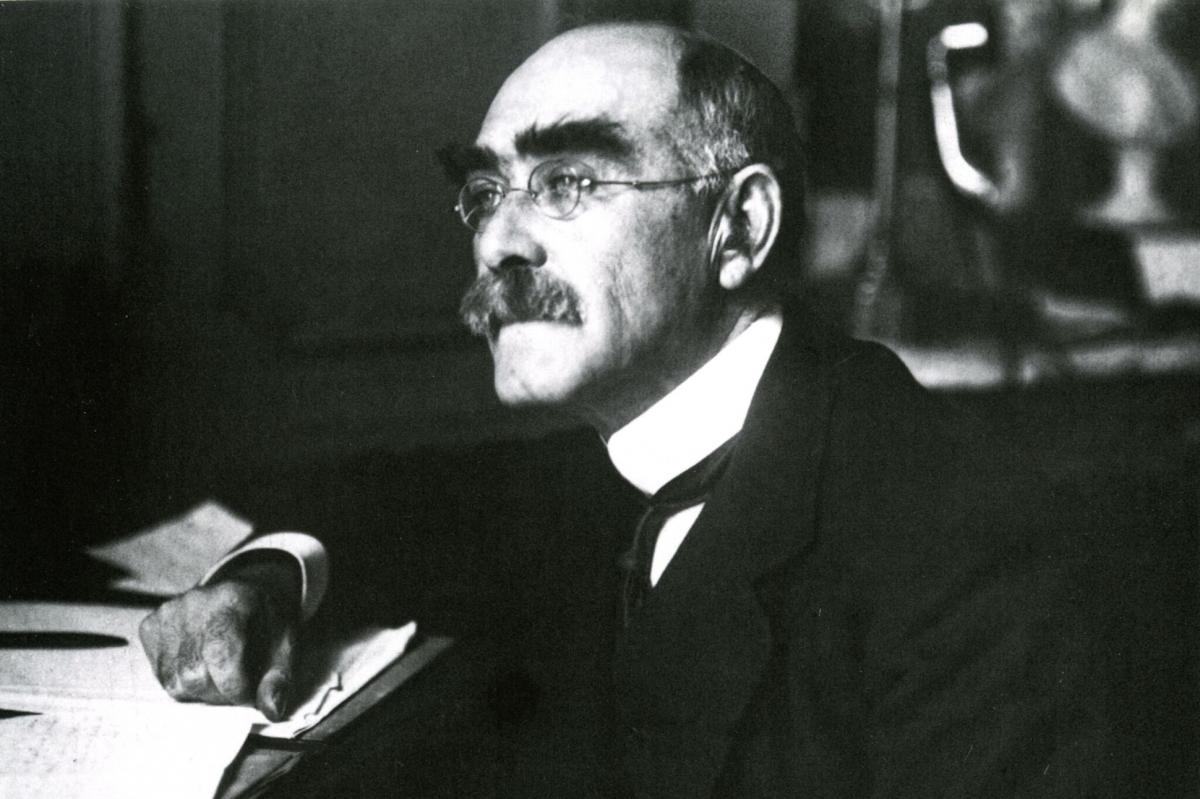
Sometimes we think of “if” as a condition to receive some sort of award or recognition. Like Rudyard Kipling’s famous poem If

If you can keep your head when all about you are losing theirs and blaming it on you … [then] Yours is the Earth and everything that’s in it, and—which is more—you’ll be a Man, my son! 

We need to be careful of those paradigms when we come to the next song of ascent in Psalm 124, since the word “if” appears twice in the opening two verses. 

David is not saying, “Weren’t we lucky that God was there for us” or “I wonder if He will be for us again in the future.” I like how the New Living Translation renders this verse: “What if the Lord had not been on our side?” In other words, He was on our side, therefore look what we avoided! 

Far from being a statement of uncertainty, this is a statement of total assurance: It’s saying, “I’m confident of what would have happened if God wasn’t there, and I’m assured of what will happen in the future.” This is why in the next verses David calls on us to praise God in the present tense. 

Every one of these songs of ascent can be sung as stand-alone songs, but the Jewish sages believed that these 15 songs are like the 15 steps that go up to the center of the courtyard. No one climbs the steps from their basement, stops after three or four steps, and says, “I was lucky that the first steps held me! Now I’m wondering if the next step is going to fail me or not.” No, the fact that we have already climbed some steps gives us assurance of the stability of the next step. 

Look at a quick review of the previous steps: 

  • in Psalm 120 pilgrims climb away from the pull of the dark valleys 
  • in Psalm 121 we read the phrase, “I lift my eyes up to the One who is watching over me”  
  • in Psalm 122 we climb the steps knowing that we aren’t climbing to a throne of judgment but a throne of shalom because of the peace Jesus purchased for us
  • in Psalm 123 we are called to only have eyes for our Savior who has lavished His grace on us, and who continues to lavish His grace on us
  • now in Psalm 124 we continue to climb up in growing assurance 

The devil loves to use “if” as a weapon to keep us from this confidence. Perhaps the doubt comes like this, “This song was written by David. If I’m not King David—or even a part of the Jewish nation—can I be assured that God is on my side?” 

Yes, you can! Remember that God’s grace is unearned, undeserved, and unending. And it’s for anyone and everyone who puts their faith in Jesus (Romans 4:23-24; 1 Corinthians 1:30; Romans 8:31-32). 

Or perhaps the devil’s doubt comes like this, “If I sin, will God no longer be on my side?” 

No, neither our efforts nor our shortcomings increase nor decrease God’s love for us. He loved us before we even knew we needed Him, and our sin cannot diminish His love one iota (Romans 5:20-21; 2 Corinthians 5:21; Ephesians 2:4-5). 

When the devil confronted Jesus, he used that little weapon “if” with all three of his temptations. Jesus dismantled those temptations to doubt God by quoting Scripture. So too with Joshua. As he contemplated leading the Israelites into the Promised Land, he may have felt a bit insecure. God told Joshua to continue to meditate on His Word and as a result, Joshua would be strong and courageous. 

David’s closing words in Psalm 124:8 is the Source of our doubt-destroying confidence: “Our help is in the name of the Lord, the Maker of heaven and earth!” 

Whenever the devil plagues you with doubts, keep your eyes on your Maker, keep His Word in your mouth, and then feel His confidence grow in your heart. 

If you’ve missed any of the messages in our Ascending series, you can find all of them here. 

►► Would you please prayerfully consider supporting this ministry? My Patreon supporters get behind-the-scenes access to exclusive materials. ◀︎◀︎
An Unmistakable Response

Listen to the podcast of this post by clicking on the player below, and you can also subscribe on Apple or Spotify.

When something goes wrong, the response from most people is pretty predictable, isn’t it? Some try to ignore the problem, some complain about it, many get quite angry, and most people try to find someone or something to blame. 

These responses don’t sound very Christian-like, do they? What many people think the Christian response should be is something closer to the opening words of Rudyard Kipling’s poem—“If you can keep your head when all about you are losing theirs and blaming it on you….” 

And yet, though this sounds Christian-like, it still misses the mark for Spirit-baptized Christians. Remember that a couple of weeks ago I described the baptism in the Holy Spirit as a “distinctive doctrine.” There is nothing distinct about a Christian responding predictably like everyone else does. 

A Spirit-baptized Christian is distinguished by the miraculous ways God confirms His presence in that person’s life. What really honors God is not a predictable response or even a learned response, but an unpredictable, miraculous response: A Spirit-baptized Christian’s response to bad news should be peace and joy. 

I believe the Holy Spirit can so transform our hearts that our response becomes an unmistakable testimony of the power of God. We may experience the initial pang of regret and pain but our next response turns all the focus off of us and on to God.  

The Holy Spirit uses trials to transform our hearts and minds into Christlike thinking and action. 

Our Heavenly Father’s desire is for everyone to come into a close, personal relationship with Him. Before Jesus came this was first pictured for us in the operations of the temple and its sacrifices. Yet man’s attempts to control this hijacked what God intended. This is why we see Jesus acting in righteous anger to clear out the temple of merchants and money-changers (John 2:12-17; Luke 19:45-48). 

Oswald Chambers noted the similarities between what Jesus did in the physical temple and what the Holy Spirit does in our hearts: 

“Immediately the Spirit of God comes in we begin to realize what it means—everything that is not of God has to be cleaned out. People are surprised and say, ‘I asked for the Holy Spirit and expected that He would bring me joy and peace, but I have had a terrible time ever since.’ That is the sign He has come, He is turning out the ‘money-changers,’ that is, the things that make the temple into a trafficking place for self-realization.” 

The Holy Spirit has to disturb our man-made peace so that His peace can take its place. Or as Jesus said, “Do not think that I came to bring peace on earth. I did not come to bring peace but a sword” (Matthew 10:34). 

Jesus told us that the indwelling Holy Spirit would bring about this heart and mind transformation in His followers. The Holy Spirit doesn’t teach us how to respond in a learned, predictable way, but He transforms us to respond in an unmistakably unpredictable way (John 16:12-15, 20-22; 14:26-27). 

The transformed response of the Spirit-baptized Christian is joy in place of anger, and peace in place of frustration (James 1:2-4; Romans 5:3-5). I like how the Amplified Bible defines “blessed” in the Beatitudes Jesus lists in Matthew 5: “happy, to be envied, and spiritually prosperous—with life-joy and satisfaction in God’s favor and salvation, regardless of [the] outward conditions.” 

This transformation brings God glory and is exactly what Jesus prays for us (John 17:13-18), which is why I keep on saying: Don’t stop at salvation—press on to be baptized in the Holy Spirit! 

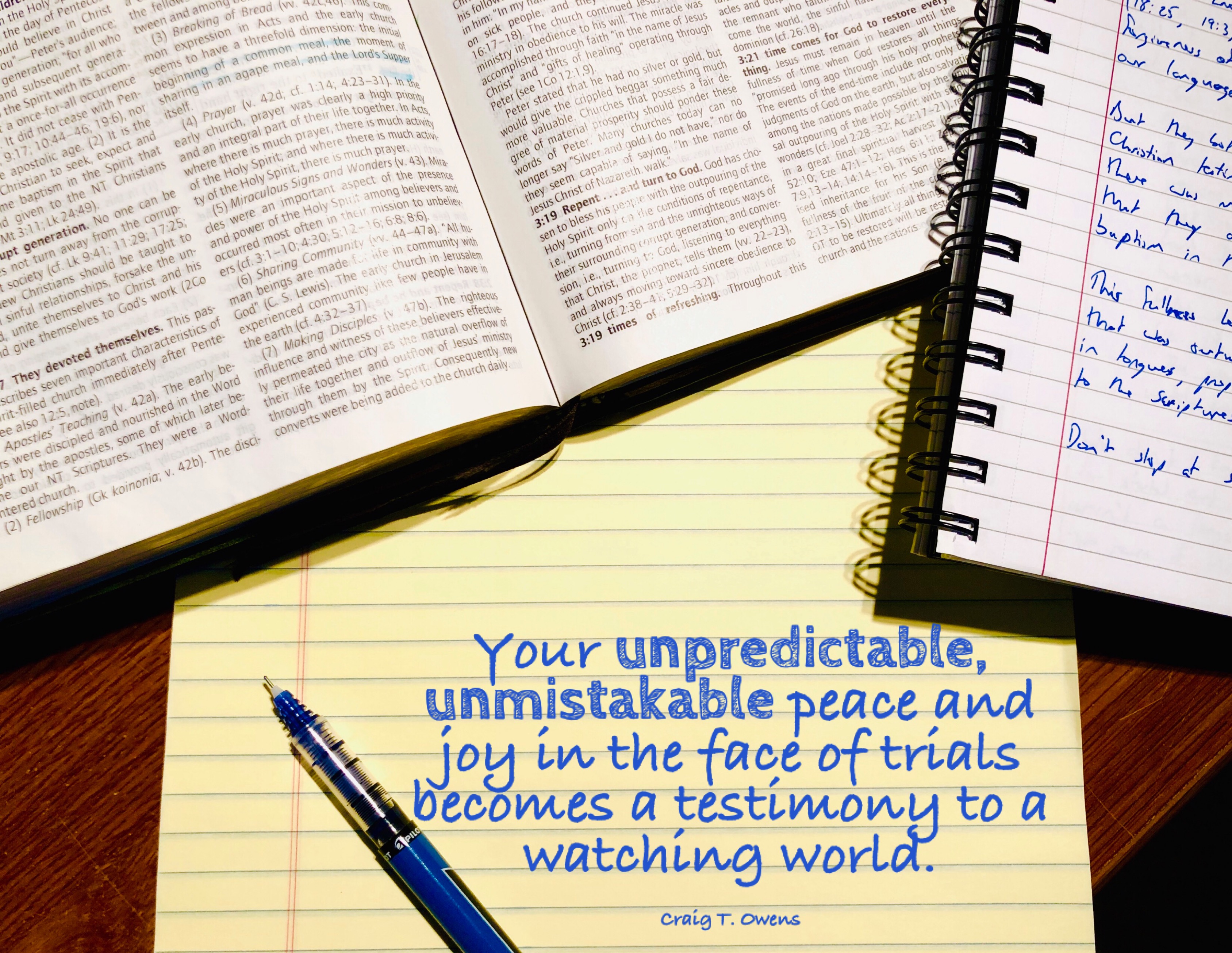
Your unpredictable, unmistakable peace and joy in the face of trials becomes a testimony to a watching world. 

If you’ve missed any of the posts in our series on the empowerment that comes from being baptized in the Holy Spirit, you can find the full list by clicking here.

►► Would you please prayerfully consider supporting this ministry? ◀︎◀︎

Poetry Saturday—If

If you can keep your head when all about you   
    Are losing theirs and blaming it on you,   
If you can trust yourself when all men doubt you,
    But make allowance for their doubting too;   
If you can wait and not be tired by waiting,
    Or being lied about, don’t deal in lies,
Or being hated, don’t give way to hating,
    And yet don’t look too good, nor talk too wise:

If you can dream—and not make dreams your master;   
    If you can think—and not make thoughts your aim;   
If you can meet with Triumph and Disaster
    And treat those two impostors just the same;   
If you can bear to hear the truth you’ve spoken
    Twisted by knaves to make a trap for fools,
Or watch the things you gave your life to, broken,
    And stoop and build ’em up with worn-out tools:

If you can make one heap of all your winnings
    And risk it on one turn of pitch-and-toss,
And lose, and start again at your beginnings
    And never breathe a word about your loss;
If you can force your heart and nerve and sinew
    To serve your turn long after they are gone,   
And so hold on when there is nothing in you
    Except the Will which says to them: ‘Hold on!’

If you can talk with crowds and keep your virtue,   
    Or walk with Kings—nor lose the common touch,
If neither foes nor loving friends can hurt you,
    If all men count with you, but none too much;
If you can fill the unforgiving minute
    With sixty seconds’ worth of distance run,   
Yours is the Earth and everything that’s in it,   
    And—which is more—you’ll be a Man, my son! —Rudyard Kipling