Listen to the podcast of this post by clicking on the player below, and you can also subscribe on Apple, Spotify, or Audible.
On the Leading From Alignment podcast, I was discussing my book When Sheep Bite which is about leadership pain. John Opalewski asked me to share some things leaders should consider when they get bit.
On a different podcast, I discussed in more detail the idea in Luke 2:52 about Jesus growing in favor with men. Check out The Pinnacle of a Leader’s Health.
You can get more information on When Sheep Bitehere. And also check out my book of prayer for pastors called Amen Indeed.
Listen to the podcast of this post by clicking on the player below, and you can also subscribe on Apple, Spotify, or Audible.
When people lash out at us—when they bite us—they could be giving us invaluable insight into what is truly in our heart. Before we respond too quickly, we need to take some time for introspection.
Check out this part of my conversation with John Opalewski and Jim Wiegand on the Leading From Alignment podcast.
Chapter 2 of When Sheep Bite is entitled ‘Is God Trying to Get My Attention?’ I tell a story about two similar bites I received from two totally different people who didn’t even know each other. I wrote—
As I drove back across the state, I kept the radio off and my ears open. I could feel the Holy Spirit asking me, “Why do you think two different people have called you the same nasty word?” The only honest answer I could give was, “Because it’s true.”
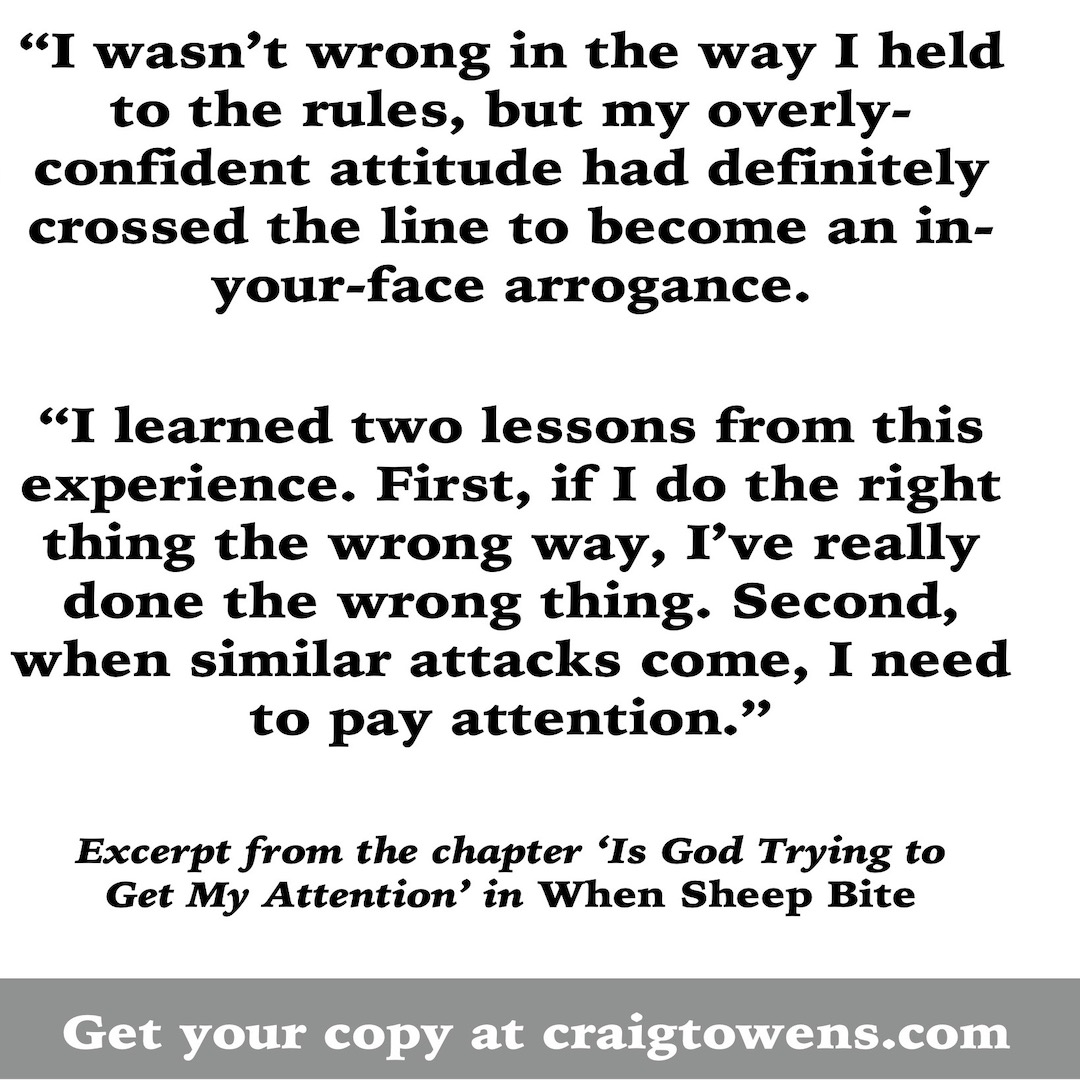
I wasn’t wrong in the way I held to the rules, but my overly-confident attitude had definitely crossed the line to become an in-your-face arrogance. I learned two lessons from this experience. First, if I do the right thing the wrong way, I’ve really done the wrong thing. Second, when similar attacks come, I need to pay attention.
Now, when a painful attack suddenly confronts me, I go to the mirror. Instead of asking, “What’s wrong with them that they would bite me like this?” I go to prayer to ask, “Did I do something that provoked this?” Sometimes I have literally gone into my bathroom, closed the door, and gotten nose-to-nose with myself to ask this question, and then listened for the Holy Spirit to speak to my heart.
My cousin Dick Brogden wrote, “Critics and skeptics are gifts to us, for in their aspersions they often bring to light a brokenness or a liability early on in its development in us. If we are secure enough to ferret out the truth through the condemnation of others, we remain healthy in the long term as our malady is exposed and dealt with before it becomes too serious.”
Remember that we are naturally self-protective, so this time of introspection will need to be supernaturally empowered by the Holy Spirit if we are going to see the true prompter of the attack.
Please check out my book When Sheep Bite to both heal from past bites and prepare yourself for the bites which are inevitably coming in the future.
Listen to the podcast of this post by clicking on the player below, and you can also subscribe on Apple, Spotify, or Audible.
If leaders say or do the right thing in the wrong way, it really becomes the wrong thing. This is why leaders—especially those who have been sheep-bitten and want to bring corrections—need to take a pause.
In that short moment of reflection, the Holy Spirit can help pastoral leaders respond in a way that will bring restoration, not more pain and possibly division.
I talked about this idea from chapter 2 of my book When Sheep Bite on the Leading From Alignment podcast with John Opalewski and Jim Wiegand.
Listen to the podcast of this post by clicking on the player below, and you can also subscribe on Apple, Spotify, or Audible.
All leaders—but especially pastoral leaders—need to work on a better response when we are bitten by a sheep in our pasture. Our natural first response is usually not going to be very helpful for us or for the biting sheep.
When a painful attack suddenly confronts me, I go to the mirror. Instead of asking, “What’s wrong with them that they would bite me like this?” I go to prayer to ask, ‘“Did I do something that provoked this?’’ Sometimes I have literally gone into my bathroom, closed the door, and gotten nose-to-nose with myself to ask this question, and then listened for the Holy Spirit to speak to my heart.
My cousin Dick Brogden wrote, “Critics and skeptics are gifts to us, for in their aspersions they often bring to light a brokenness or a liability early on in its development in us. If we are secure enough to ferret out the truth through the condemnation of others, we remain healthy in the long term as our malady is exposed and dealt with before it becomes to serious.”
Remember that we are naturally self-protective, so this time of introspection will need to be supernaturally empowered by the Holy Spirit if we are going to see the true prompter of the attack. A prayer I have prayed more times than I can count is, “Search me thoroughly, O God, and know my heart! Try me and know my thoughts! And see if there is any wicked or hurtful way in me, and lead me in the way everlasting” (Psalm 139:23-24 AMPC).
Get a copy of my book here to help you heal from the painful sheep bites, and to learn how to respond better with each new biting experience.
Listen to the podcast of this post by clicking on the player below, and you can also subscribe on Apple, Spotify, or Audible.
Say the word “confrontation” and many people cringe. “I try to avoid confrontations with others,” people will quickly say.
The origin of the word comes from a derivative of the word for “forehead.” The original intent of confrontation was simply putting the facts in front of someone’s face so that they could acknowledge them.
The problem for most of us (myself included) is two-fold:
I don’t like to be confronted with things I may be doing incorrectly or incompletely.
I don’t like making others defensive when I confront them with the things they may be doing incorrectly or incompletely.
As a result, we usually don’t confront others and they usually don’t confront us. Sadly, this can keep us from maturing in areas where we may be able to soar if we could only make some minor changes.
Christians should be especially open to confrontation from a brother or sister. After all, Solomon told us, “Wounds from a friend can be trusted, but an enemy only multiplies kisses” (Proverbs 27:6). And Jesus warned us, “Woe to you when all men speak well of you, for so did their fathers to the false prophets” (Luke 6:26 NKJV).
The best confrontation is self-confrontation in the presence of the Holy Spirit. After we have submitted to that loving spotlight, then we can proceed with our loving confrontation with our brothers and sisters.
Remember this:
The goals of Christian confrontation are restoration and maturity.
We want to see wandering saints return to God’s path, and we want those saints who are immature to blossom into Christ-like maturity that brings glory to God.
I have prepared a flowchart that can help you with a biblical framework for the work of confrontation. Please work through this flowchart slowly and prayerfully. Don’t rush any step, but make sure you can answer an honest “yes” to each question. When you get to the last step, keep in mind these three Ms:
Maturity—self-confrontation and confrontation of others should always be moving us toward maturity.
Mutual accountability—agree to stay involved in this process, with each of you remaining accountable to each other.
The word Selah appears nearly 70 times in the Bible, almost exclusively in the Psalms. Although it is primarily a musical term, it applies beautifully to our summer series.
Selah can mean…
a pause from the noise to reflect;
a preparation for an exciting accent; or
a reflective time of consideration
Throughout the Psalms, Selah appears at the end of a verse, at the end of the psalm, or sometimes even mid-sentence. But each one of them is perfectly placed by the Spirit-inspired authors to get us to take a breath and deeply contemplate what we just read or sang.
Summertime is typically a time for us to pause from our regular routine. Perhaps it’s a vacation, time with friends and family, driving around with the windows down and the music blasting, or just a quiet walk through woods or along a beach. In any case, whether we realize it or not, we’re actually doing Selah in these break-from-the-routine activities.
Join me this Sunday as we continue our summertime look at each of the Psalms that ask us to Selah. I think you will find that this Sunday summertime pause will be both refreshing and encouraging. You can join me either in person or on Facebook or YouTube.
Since this is a continuation of our summer series, you can check out the Selahs we discussed by clicking here for the 2018 messages, here for the 2019 messages, here for the 2020 messages, and here for the 2021 messages.
The word Selah appears nearly 70 times in the Bible, almost exclusively in the Psalms. Although it is primarily a musical term, it applies beautifully to our summer series.
Selah can mean…
a pause from the noise to reflect;
a preparation for an exciting accent; or
a reflective time of consideration
Throughout the Psalms, Selah appears at the end of a verse, at the end of the psalm, or sometimes even mid-sentence. But each one of them is perfectly placed by the Spirit-inspired authors to get us to take a breath and deeply contemplate what we just read or sang.
Summertime is typically a time for us to pause from our regular routine. Perhaps it’s a vacation, time with friends and family, driving around with the windows down and the music blasting, or just a quiet walk through woods or along a beach. In any case, whether we realize it or not, we’re actually doing Selah in these break-from-the-routine activities.
Join me this Sunday as we continue our summertime look at each of the Psalms that ask us to Selah. I think you will find that this Sunday summertime pause will be both refreshing and encouraging. You can join me either in person or on Facebook Live.
Since this is a continuation of our summer series, you can check out the Selahs we discussed by clicking here for the 2018 messages, here for the 2019 messages, and here for the 2020 messages.
Oh, wait. It doesn’t really work that way, does it? At least it hasn’t for me. After I’ve been hurt, it takes quite a while to get to a place of healing. We have cliches for this sort of thing—phrases like “Once bitten, twice shy” and “Fool me once, shame on you; fool me twice, shame on me.”
We begin to react to the past instead of reflecting and responding in the present.
It’s interesting that those who compiled the Psalter placed Psalm 55 where they did. There is no introduction that gives us a background or setting, but David still seems to be looking for those “Ziphites” that betrayed him to King Saul.
Here’s an important physiological and psychological truth: Our brains cannot tell the difference between a real threat and an imagined threat. Our physical bodies react the same way in response to any threat.
It’s interesting to note that both Selahs in Psalm 55 are in the middle of a sentence, almost as if David is interrupting his own thoughts. Which, I believe, is exactly what he’s doing.
As this psalm opens David is still praying, but he’s praying about his internal threats:
my thoughts trouble me
I am distraught
I notice the conversations and the stares of potential enemies
myheart is in anguish
I feel like terrors of death, fear and trembling, and horror are closing in on me!
This leads to David’s fight/flight response (although really, it’s his flight response): “Oh, that I had the wings of a dove! I would fly away and be at rest—I would flee far away and stay in the desert.”
David has been listening to himself, and he finally at least attempts to put a halt to these distressing thoughts with his first Selah—which means “pause, and calmly think of that.”
Most of our natural reactions are driven by fear. But fear—by its very nature—is limiting. Fear keeps us tunnel-visioned on the perceived threat. Fear closes us off to accepting any new information. Fear limits our creative responses. Fear perpetuates more fear.
So David tries a second time to Selah. He is attempting to interrupt his negative thoughts—to stop listening to himself and start talking to himself. To move from a self-preserving reaction to a God-glorifying response requires a Selah pause to reflect. Reflecting on things like:
Where will these thoughts ultimately take me?
How has God responded before?
What does God’s Word say?
Could I imagine Jesus responding the way I’m responding?
What changes can I make?
I love David’s conclusion: “But as for me, I TRUST IN YOU.” He’s saying, “I’m not going to listen to those negative fears anymore. It’s time to put my trust in God.”
David had to do this “evening, morning, and noon”—again and again and again! Until finally he could say, “I will cast all my cares on the Lord and He will sustain me; He will never let me fall” (Psalm 55:22).
This is what Jesus promises us, “Come to Me, all of you who are tired and have heavy loads, and I will give you rest” (Matthew 11:28).
The word Selah appears nearly 70 times in the Bible, almost exclusively in the Psalms. Although it is primarily a musical term, it applies beautifully to our summer series.
Selah can mean…
a pause from the noise to reflect;
a preparation for an exciting accent; or
a reflective time of consideration
Throughout the Psalms, Selah appears at the end of a verse, at the end of the psalm, or sometimes even mid-sentence. But each one of them is perfectly placed by the Spirit-inspired authors to get us to take a breath and deeply contemplate what we just read or sang.
Summertime is typically a time for us to pause from our regular routine. Perhaps it’s a vacation, time with friends and family, driving around with the windows down and the music blasting, or just a quiet walk through woods or along a beach. In any case, whether we realize it or not, we’re actually doing Selah in these break-from-the-routine activities.
Join me this Sunday as we continue our summertime look at each of the Psalms that ask us to Selah. I think you will find that this Sunday summertime pause will be both refreshing and encouraging. You can join me either in person or on Facebook Live.
A psalm. A song for the Sabbath day (preface to Psalm 92).
The Sabbath is—
a day of reflection
a day of rejoicing
a day of reconnecting
a day of meditating on past blessings
a day of strengthening for the upcoming week
a day of acknowledging the Creator
a day of appreciating creation
a day of assessing the investment of my God-given talents
a holy day—different from all other days
So … “It is good to give thanks to the Lord, and to sing praises to Your name, O Most High; to declare Your lovingkindness in the morning, and Your faithfulness every night” (vv. 1, 2).
Sabbath is not just a noun, but a verb—sabbathing—something that can be done every day, but something which also takes on special significance for the one day each week that we set aside as our holy day or worship and reflection.
The Creator’s works and wisdom should be pondered and praised as we sabbath (vv. 4-6), something “a fool” doesn’t take time to do.
As we sabbath, we should confess to God—and then turn over to Him—those things which have overly preoccupied our minds (vv. 7-9).
We should recommit that the place of growth and blessing is in God’s presence (v. 13) as we endeavor to keep our hearts there. And then we can be energized and joy-filled as we contemplate His blessing which never diminishes nor grows old (vv. 14, 15).
Truly sabbathing is a good thing!
Do you have a Sabbath day? Do you find time to regularly sabbath in God’s presence?









 Craig T. Owens