Derailed (book review)

Derailed

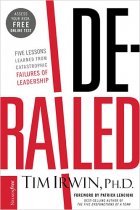
As I read Dr. Tim Irwin’s latest book, Derailed, I thought about a quote from John Maxwell: “A wise man learns from his mistakes. A wiser man learns from others’ mistakes. The wisest man learns from others’ successes.”

The subtitle of this book is “Five lessons learned from catastrophic failures of leadership.” In this, we learn from others’ mistakes. But then Dr. Irwin goes on to show us successes that we can learn from as well. Combining the insight from successful—or should I say “non-derailed” leaders—with his own discernment, Dr. Irwin shows us how to stay on the rails.

When I first noticed that the examples in the book were all high-profile CEOs, I thought, “What could I learn from them? After all, I’m not the CEO of a Fortune 500 company.” But Dr. Irwin does an excellent job of bringing the four qualities of character—authenticity, self-management, humility, and courage—down to a pedestrian level where even we non-CEO-types can benefit from his wisdom.

Although the principles in Derailed can benefit anyone in leadership, or aspiring to a leadership position, this book still might not be for everyone. The six case studies in the book are all derailed CEOs, and unless you have a penchant for the business world, you might not find them very enjoyable reading. However, for those of you who enjoy business history, there is much to gain from a careful reading of Derailed.

I am a Thomas Nelson book reviewer.

Loving Servanthood

Over the past couple of days I’ve been thinking a lot about something: What does it mean to serve? Or more specifically, what does God say about how we should serve?

The typical image that comes to mind when someone says “servant” is a person of lower status—someone who is at the lower end of the organizational chart, someone who is expected to do more with less, someone who doesn’t have many opportunities for advancement (or even a day off), or maybe someone who is expected to be tuned into everyone else’s needs but seldom has his own needs met.

Is being a servant the same thing as being a doormat?

Consider Jesus:

He now showed them the full extent of His love…. Jesus knew that the Father had put all things under His power, and that He had come from God and was returning to God; so He got up from the meal, took off His outer clothing, and wrapped a towel around His waist. After that, He poured water into a basin and began to wash His disciples’ feet, drying them with the towel that was wrapped around Him.

Jesus was the most important person in the room: Jesus KNEW that the Father had put all things under His power. He was also the most love-filled person in the room. What did He do with all of His love and power? He served others.

When He finished, John writes that He returned to His place, and asked His disciples a question, “Do you understand what I just did?” Then in the only instance of Scripture where Jesus Himself said this, “I have set you an example that you should do as I have done.”

Servants are people who use the power they have to lovingly serve others.

Servants don’t serve because someone else forces them to serve. Servants serve because the love of God empowers them to serve.

Do you love your spouse enough to serve him/her? Do you love your family enough to serve them? Do you love your coworkers enough to serve them? The greater the love we have for others, the greater the empowerment to serve. Love empowers us for service.

Surprise!

Last night I went to a surprise party for a great guy in our church. His sons initiated the idea on Sunday evening, and we all went into action to figure out when, where, and (most importantly) what food we were going to bring. After just a few minutes of discussion, everything was in place, and it all came together pretty smoothly.

I think the birthday boy was genuinely surprised. And pleased. And everyone had a fun evening.

But I got to thinking, “Should it really be a surprise that we want to express our appreciation, love, and respect to someone?” Hmmm.

Perhaps today—and every day—we could find a way to “surprise” someone we love or appreciate. You know, just find an unexpected way to let someone know they’re special.

  • A surprise note/text/email
  • A surprise gift
  • A surprise hug
  • A surprise phone call
  • A surprise lunch invitation
  • A surprise cup of coffee or favorite treat

It’s amazing what happens inside people’s hearts when we go out of our way to express our love. Try it, and see what happens.

Make today a surprise day for the people you love and appreciate.

Do It

Here’s what God said to His people through the prophet Ezekiel, “I will judge you according to your conduct.” God says the same thing in the New Testament too.

It’s not what I believe. It’s not what I discuss. It’s not what I intend to do. It’s not what I know is right and wrong. It’s what I do.

I have to give an account of my conduct. I have to answer to God for how I lived out my beliefs. I have to show God what I did with what I believe about Him. I have to put into practice what’s in my heart.

Do I believe God is God? Do I have idols?

Do I believe God is holy? Do I sin?

Do I believe God forgives? Do I repent?

Do I believe God looks after orphans and widows? Do I?

Do I believe God is my Provider? Do I steal?

Do I believe He is Lord? Do I give Him control of everything?

Do I believe I should do something for the hungry, thirsty, naked, sick, and imprisoned? Do I do something?

This is what God judges: belief put into action. Not just beliefs, but godly actions motivated by those godly beliefs.

Faith without works is just wishful dreaming. Works without faith is just religious posturing. Works with faith is God-glorifying!

Don’t just believe it… do it.

Life On Life

In my remarks at the funeral in which I was officiating on Wednesday, I quoted the great Green Bay Packers coach Vince Lombardi. He was reportedly addressing a couple of under-performing players when he said, “When all’s said and done, usually more is said than done.” In other words, don’t talk about what you’re going to do, just do it.

One of my passions is to mentor and equip other people to do great things. I’ve found that the best way to do this is not to just talk about what they should be doing, but to step into their life and do those things with them—to do more than I say.

This life-on-life mentoring is challenging but so incredibly rewarding. The Apostle Paul wrote, “Follow me as I follow Christ. C’mon, let’s pursue this relationship with Jesus together. I’m going to keep you close to me so that you can look in on what I’m doing, and I’m going to be right here for you too. Let’s draw closer to Jesus together” (see 1 Corinthians 11:1)

I love the one-on-one times with my kids … brainstorming with the young leaders-in-training at church … having challenging conversations with an accountability friend … opening our home to a young single mom. These interactions keep me focused on staying as close to Christ as I can. Because if I lose sight of Him, so might the others who are connected with me life-on-life.

It’s pretty hard to say, “Follow me while I do my own thing.” So I’m redoubling my efforts to stay close to the Master today.

It’s A Love-Hate Thing

Are there things you love to do, but hate to do at the same time?

Ah, yes, that wonderful love-hate relationship. I spent most of the first part of this week in a love-hate thing, and I discovered yet again that love outweighs hate. To rediscover this, all I had to do was agree to walk through a funeral with a grieving family again.

I hate seeing families grieving. I love being able to share hope with them.

I hate how drained I feel after funerals. I love seeing the flicker of encouragement glow in others.

I hate tearful goodbyes. I love the knowledge of joyful reunions.

I hate preparing funeral messages that remind people of eternity. I love sharing that Jesus is the Promise of an eternity in heaven.

I hate having every eye in the room on me. I love seeing God speak His truth through me.

Yup, it’s true: walking through a funeral with a grieving family is—hands down—something that so drains me physically, emotionally, mentally, and spiritually more than anything else I do. But I wouldn’t trade this privilege to step into hurting people’s lives for anything. Yes, love triumphs over hate!

Familiar Conversations

DSCN0995

I read a long time ago the statement, “Leaders are readers.” I’m a wholehearted supporter of this. Thanks to a marvelously talented carpenter in our church, I have a new home for all of my books. I was so excited to get my library out of boxes and onto the shelves.

Actually, they’re more than just books, they are familiar conversations. Rene Descartes said, “The reading of all good books is like conversation with the finest men of past centuries.” I agree.

People often ask me what I’m reading or what they should be reading. As to the second question—what should they read—I answer, “What conversation would you like to have? Is there an area of your life you would love to talk with someone who’s been-there-done-that?” That’s what reading is, having a conversation with some of the great thinkers or most articulate people in past or modern history.

As to the first question—what am I reading—I try to keep readers of the blog up-to-date. Down the right column you will see the list of books I have in progress, and the ones I’ve read this year. Let me highlight just a couple of books.

Wounded Healer. To go deeper in my relationships with others, I have to be able to relate to them at deeper levels. Henri Nouwen has captured the essence of this in Wounded Healer. We cannot minister to others out of our wounds, but out of our scars. In other words, once we’ve healed, but the scar is still there to remind us of the wound, we’re ready to help others heal from the same injury.

Love & Respect. Even though Betsy and I have known each other for nearly 25 years, I know I can still learn more about being a better husband. Emerson Eggerichs is helping me do a better job.

21 Laws of Leadership. This is a classic leadership book from John Maxwell. I can’t even count how many times I’ve read through this book. But I’m going through it again with my church Board, and watching John teach the video series on this book too. Every time I have this conversation with John Maxwell I learn something new.

To be a better leader in any area of your life, don’t shy away from having better conversations with great authors. If you’ve got a book to suggest, send it my way. I’d also be happy to help you find a book as a conversation-starter for you, just ask me.

Take The Initiative

“You have not lived today until you have done something for someone who can never repay you.” —John Bunyan

I love doing something unexpected for someone. Something kind and thoughtful, but totally “out of the blue.” It’s especially nice when the person for whom you do something nice needs it the most, yet would be the last person to ask for help.

In Matthew 25 Jesus talks about people who take the initiative to help the poor, the hungry, the needy. Jesus never says that they asked for help, but simply that His followers saw the need and addressed it. Jesus concludes by saying, “When you did it to one of the least of these My brothers and sisters, you were doing it to Me!

Even better: we take the initiative to bless one of the least of these and we get a blessing from God. How cool is that!

Over the weekend our youth group showed up at a precious lady’s house unannounced. We all affectionately refer to Thelma as “Grandma.” We didn’t tell her that we were coming, we just showed up and started cleaning up her yard. (Disclaimer: I have to admit that we did get an immediate blessing, in that Grandma’s daughter Joan made us a cake, so we got a slice before we left.) Pictures are here.

I’m so proud of these young servants who showed up to bless Grandma. As you helped her, you were helping Jesus. Great will be your reward in heaven—way to go!

Walking In Someone Else’s Flip-Flops

DSCN0970“Empathy is a stunning act of imaginative derring-do, the ultimate virtual reality—climbing into another’s mind to experience the world from that person’s perspective.” —Donald H. Pink

As we continued our series called Bigger Than Me last night (part 1 is here), we challenged our Impact! youth group to develop greater empathy. That word literally means to be immersed in the feelings of others … to step into someone else’s reality … to walk around in someone else’s flip-flops.

The greatest example ever of this is when Jesus Christ came to earth. He stepped into our flip-flops by coming to live among us in human flesh. He experienced everything we ever have or ever will experience; He knows our weaknesses, our dreams, our joys.

For we do not have a High Priest Who is unable to understand and sympathize and have a shared feeling with our weaknesses and infirmities and liability to the assaults of temptation, but One Who has been tempted in every respect as we are, yet without sinning. … For because He Himself [in His humanity] has suffered in being tempted (tested and tried), He is able [immediately] to run to the cry of (assist, relieve) those who are being tempted and tested and tried…. (Hebrews 4:15, 2:18)

Our youth have committed themselves to develop this Christ-like attribute of empathy. Last night they came to the altar to pick up a flip-flop keychain to remind themselves of this commitment. All of us who made this commitment are going to try to walk in others’ flip-flops by trying to find out:

  1. What do they cry about?
  2. What do they sing about?
  3. What do they dream about?

(Thank you, John Maxwell, for your instruction to me on this!)

I hope you have personally experienced the incredible empathy of Jesus. He understands your fears, your joys, and your dreams even better than you understand them yourself. And I hope that you will join us in our commitment to greater empathy with each other. What a blessing you can be to others when you choose to walk in their flip-flops for awhile.

Biodegradable Words

The day has been a good one so far: There’s been a lot of traffic through the store, all of the employees showed up for their shifts on time, and the manager is feeling great. Then because of one complaint from a finicky customer, the whole day seems to crumble.

The day has been a good one so far: You got up on time, found the right outfit to wear, got to school on time, smiled at your classmates, and got right down to business. Then a teacher points out a mistake you made yesterday, and your whole afternoon becomes gloomy.

Usually that’s all it takes. Just one complaint, one correction, one unkind word, one angry look, one unfriendly email. Just one, and it’s hard to remember any of the good stuff which happened earlier. Just one, and the rest of the day seems so hard to bear.

That’s because good words are biodegradable. Kind words break down faster than unkind words. Compliments are quickly erased by complaints.

“One of the commodities in life that most people can’t get enough of is compliments. The ego is never so intact that one can’t find a hole in which to plug a little praise. But, compliments by their very nature are highly biodegradable and tend to dissolve in hours or days after we receive them—which is why we can always use another.” —Phyllis Theroux

Here’s how you can help today. It might take a couple of extra minutes, but the results are so worth it! Give three compliments today.

  • Tell the barista at your coffee shop how much you appreciate her smile every morning.
  • Mention to the building custodian how nice he keeps the office looking.
  • Say “thanks” to the band for playing one of your favorite songs.
  • Compliment your kids for doing their homework without you having to ask them.
  • Thank your school teacher for her informative lesson.
  • Tell your supervisor you appreciate their extra effort.

It’s not hard to find something to compliment about anyone. Your compliment may be just the antidote they need to counteract a complaint that has gotten them down. And when you treat others this way, you can be sure that compliments will be coming your way too!