A Leader’s Grace And Power

None of them could stand against the wisdom and the Spirit with which Stephen spoke. (Acts 6:10)

Here’s a truth we can all stand on: The man with an experience is never at the mercy of a man with an argument.

A large group of people wanted to debate with Stephen about his belief in Jesus Christ. I’m sure that these debaters had some excellent points. But they couldn’t win the debate with Stephen because he had something they didn’t have: grace and power from God that was irrefutable!

Stephen’s words were backed up and verified by a lifestyle that was undeniable—

Stephen, a man full of God’s grace and power, performed amazing miracles and signs among the people. But one day some men from the Synagogue of Freed Slaves, as it was called, started to debate with him. They were Jews from Cyrene, Alexandria, Cilicia, and the province of Asia. None of them could stand against the wisdom and the Spirit with which Stephen spoke. (Acts 6:8-10)

“Knowing that we have God’s ability in us, should give us the confidence to lead well when others don’t approve of or appreciate our leadership.” —Liz Sarno

A mark of a godly leader is one who demonstrates God’s grace and power that is within him.

This is Part 8 in my series on godly leadership. To read my other posts, please click here.

Jesus Our Healer

“It’s clear from the Gospels that Jesus was a healer. We don’t know the exact number of people He healed, but it was certainly in the thousands, as on many occasions the Gospel writers tell us He healed ‘multitudes.’ We don’t know all the afflictions people suffered from, but they included leprosy, a deformed hand, swollen limbs, hemorrhaging, blindness, deafness, lameness, paralysis, seizures, a severed ear, and even death.

“It’s tempting to believe that all these people were healed by their faith, but we don’t know that for sure. We do know, however, that they were all healed by Jesus.

“I’m not just playing with words here.

“There are about forty different descriptions of healings in the four Gospels (some are described in more than one place), but faith is said to play an explicit part in only a little more than one-third of them. And in most of those healings, the faith of another person, not the afflicted, is stated. Faith is not even mentioned in the majority of Jesus’ recorded healings. Only twice did Jesus remark about someone (the centurion in Matthew 8:10 and the Gentile mother in Matthew 15:28) having great faith before He healed that person’s loved one.

“The common factor in all Jesus’ recorded healing miracles was Jesus Himself—not the faith of the sick people or their loved ones.” —Lynn Eib, in Peace In The Face Of Cancer

“What Is Meant By Following Jesus?”

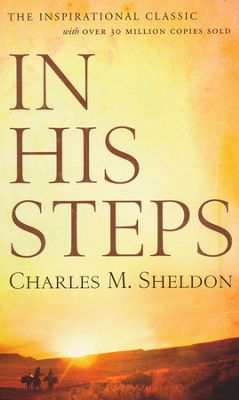
Charles Sheldon wrote an eye-opening, heart-challenging book in 1896 entitled In His Steps. From this book came the well-known phrase “What would Jesus do?”

In this book, Pastor Henry Maxwell challenges his congregation to ask this question regarding everything they do throughout their day. One skeptical man asked this pointed question: what is meant by following Jesus?

“I’ve tramped through this city for three days trying to find a job; and in all that time I’ve not had a word of sympathy or comfort except from your minister here, who said he was sorry for me and hoped I would find a job somewhere. 

“Of course, I understand you can’t all go out of your way to hunt up jobs for other people like me. I’m not asking you to; but what is meant by following Jesus? Do you mean that you are suffering and denying yourselves and trying to save lost, suffering humanity just as I understand Jesus did? What do you mean by it? 

“I see the ragged edge of things a good deal. My wife died four months ago. I’m glad she is out of trouble. My little girl is staying with a printer’s family until I find a job. Somehow I get puzzled when I see so many Christians living in luxury and remember how my wife died in a tenement in New York City, gasping for air and asking God to take the little girl too. Of course I don’t expect you people can prevent everyone from dying of starvation, lack of proper nourishment, and tenement air, but what does following Jesus mean? A member of a church was the owner of the tenement where my wife died, and I have wondered if following Jesus all the way was true in his case. 

“It seems to me there’s an awful lot of trouble in the world that somehow wouldn’t exist if all the people who sing your songs went and lived them out. I suppose I don’t understand. But what would Jesus do? It seems to me sometimes as if the people in the big churches have good clothes and nice houses to live in, and money to spend for luxuries, while the people outside the churches, thousands of them, I mean, die in tenements, and walk the streets for jobs, and grow up in misery and drunkenness and sin.”

So for you, what does it mean if you say you are following Jesus?

How Our Faith Is Perfected

“God’s promises and His provision do not lift us from the world of common sense and everyday trials, for it is through these very things that our faith is perfected.” —Lettie Cowman, in Streams In The Desert

Now More Than Ever Christians Must Exalt The Cross

“Think for a moment what the power of the gospel accomplished in the early centuries. With no political base in the Roman government, without any majority in the culture, the gospel changed the spiritual and moral climate of the Roman Empire. Christianity competed with paganism and, for the most part, won the hearts and minds of the populace. Christians were radicals in the best sense of the word—radically committed to community in worship, radically committed to serving their pagan neighbors, and radically committed to living out the implications of their redemption.

“Without freedom of religion, without a media presence, and without the ability to redress the wrongs against them, the Christians discovered that the gospel had the power to change individuals, families, and the culture.” —Dr. Erwin Lutzer, in When A Nation Forgets God (emphasis added)

Please check out my review of When A Nation Forgets God by clicking here, and then get a copy for yourself. You can also read other quotes I have shared from this book by clicking here and here.

God Isn’t Trying To Cast People Into Hell

“God isn’t trying to cast people into hell; He’s trying to bring them into heaven. He wants people to be with Him and to have everything His sons and daughters should have. So it’s odd to focus on the question of whether people need to hear the name Jesus to go to heaven, as if knowing Him in this life were an annoyance people would prefer to avoid.

“It’s just the opposite. Knowing Jesus and knowing all about Him are meant to be monumental blessings in this life. So we should be tripping over ourselves to get to know Him rather than trying to figure out ways people might get to heaven without Him. Peoples lives here and now will be infinitely better if they know Jesus and the freedom He wants them to have.” —Eric Metaxas, Everything You Always Wanted To Know About God

Self-Evident

“It happens that we meet together once every year, sometime about the 4th of July. … We run our memory back over the pages of history [to 1776]. We find a race of men living in that day whom we claim as our fathers and grandfathers. They were iron men. They fought for the principle that they were contending for; and we understand that by what they then did, it has followed that the degree of prosperity that we now enjoy has come to us. We hold this annual celebration to remind ourselves of all the good done, of how it was done and who did it, and how we are historically connected with it. …

“We have [among us immigrants] who are not descendants at all of these men. … If they look back through this history to trace their connection with those days by blood, they find they have none. … But when they look through that old Declaration of Independence, they find that those old men say that ‘We hold these truths to be self-evident, that all men are created equal.’ And then they feel that that moral sentiment taught in that day evidences their relation to those men, that it is the father of all moral principle in them, and that they have a right to claim it as though they were blood of the blood, and flesh of the flesh of the men who wrote that Declaration. And so they are. That is the electric cord in that Declaration that links the hearts of patriotic and liberty-loving men together, that will link those patriotic hearts as long as the love of freedom exists in the minds of men throughout the world.” —Abraham Lincoln

No Room For God?

My friend Scott delivered a right-between-the-eyes message yesterday. Here are my takeaways.

Quite possibly the deadliest of the relationship killers is pride.

Think of all the ugly things surrounding Pride:

  • Always fault-finding
  • Always defensive
  • Constantly craving attention
  • Disregarding advice
  • Saying “I’m better than you!”
  • Saying “I don’t need your help!”
  • Quick to tell others “Here’s how you should do that”
  • Can’t handle any constructive criticism
  • But always critical of others

In fact, C.S. Lewis said, “Pride leads to every other vice: it is the complete anti-God state of mind.”

One psalmist got right to the root of the problem of pride when he wrote—

In his pride the wicked does not seek Him; in all his thoughts there is no room for God. (Psalm 10:4)

No room for God?!

The Bible is all about relationships. Adam was first created to be in a relationship with God, and then Eve was created so she and Adam could be in a relationship with each other. Jesus reiterated this when He was asked what the greatest commandment was, and He said, “Love God with all your heart, mind and soul.”

But if Pride rules in my heart, and there is no room for God, how can I love Him with all I’ve got? The simple answer is: I can’t.

Jesus quickly added that the next greatest commandment also revolved around relationships when He said, “And love your neighbor as yourself.”

If my proud heart is filled with prideful love, it cannot be filled with God’s love.

If my pride-filled heart has no room for God’s love, then it has no room to love anyone else.

Pride kills every relationship.

Jesus had absolutely no trace of pride when He set aside all His heavenly privileges and came to earth as a Human (Philippians 2:6-8). The Apostle Paul then tells us that our attitude should be the same as Christ’s attitude.

Humility kills pride!

Are you filled with pride? Ask yourself some of these questions:

  • Do I have a problem submitting to authority?
  • When I get into an argument, do I always have to have the last word?
  • Am I willing to accept blame?
  • Can I ask for forgiveness, or am I always right?
  • Do I sometimes cheat at a game just so I can win?
  • If I lose, is it someone else’s fault?
  • If I win, do I brag about how good I am?
  • Do I think I’m the only one who can solve all my own issues?
  • Do I think I can solve everyone else’s issues too?

If you found yourself saying “yes” to these questions it’s probably time to ask the Holy Spirit to do a heart-check on your level of pride. Make sure that in your heart there is increasingly more room for God.

Know Who You Are (book review)

Tim Tebow continues to astound me! Few people have used their celebrity status to promote other people like he has. In his latest book—Know Who You Are—he turns his sights on something near and dear to his heart: homeschool students and parents.

A key component of any student’s education is learning to articulate their thoughts in writing. At the beginning of his book Tim shares about some research on this topic:

“An esteemed professor of psychology at the University of Texas at Austin studied the impact of journaling. Through a handful of studies, this expert found that expressive writing in a personal and meaningful way positively impacts health, well-being, and self-development. It can put us in a better mood. It can help us process tough situations. It can challenge us to make good changes. It can pave the way for a more impactful future.”

Know Who You Are helps students journal their thoughts by giving them some positive things to ponder. Tim shares his personal stories, many of which involve mistakes he’s made or things which have caused him to second-guess himself, and then talks about the life lessons he learned from those experiences. He then gives students an opportunity to apply those same lessons to their own life. Each week’s lesson wraps up with a couple of writing prompts for the student’s journaling exercises.

This book is designed to take a student through their entire school year, but will help students to think better about themselves and their circumstances for a lifetime. Know who you are—Live like it matters is an excellent resource!

I am a Waterbrook book reviewer.

P.S. If you would like to check out other Tim Tebow books, my review for Through My Eyes is here, and my review for Shaken is here.

Last Full Measure Of Devotion

“But, in a larger sense, we can not dedicate—we can not consecrate—we can not hallow—this ground. The brave men, living and dead, who struggled here, have consecrated it, far above our poor power to add or detract. The world will little note, nor long remember what we say here, but it can never forget what they did here. It is for us the living, rather, to be dedicated here to the unfinished work which they who fought here have thus far so nobly advanced. It is rather for us to be here dedicated to the great task remaining before us—that from these honored dead we take increased devotion to that cause for which they gave the last full measure of devotion—that we here highly resolve that these dead shall not have died in vain—that this nation, under God, shall have a new birth of freedom—and that government of the people, by the people, for the people, shall not perish from the earth.” —Abraham Lincoln