A Voice Behind Me

In our series on Building Blocks, I’ve been talking about the basics of a relationship with Jesus Christ. An obvious foundation for any relationship is meaningful conversation.

If you think about any close relationship you have, the closeness was developed through conversation. Gradually you began to know their voice and know their heart. Our meaningful conversation with God produces the same increased intimacy. We talk with Him through reading His Word and through prayer.

The more you read the Bible and the more you pray, the clearer His voice becomes. Isaiah said it this way:

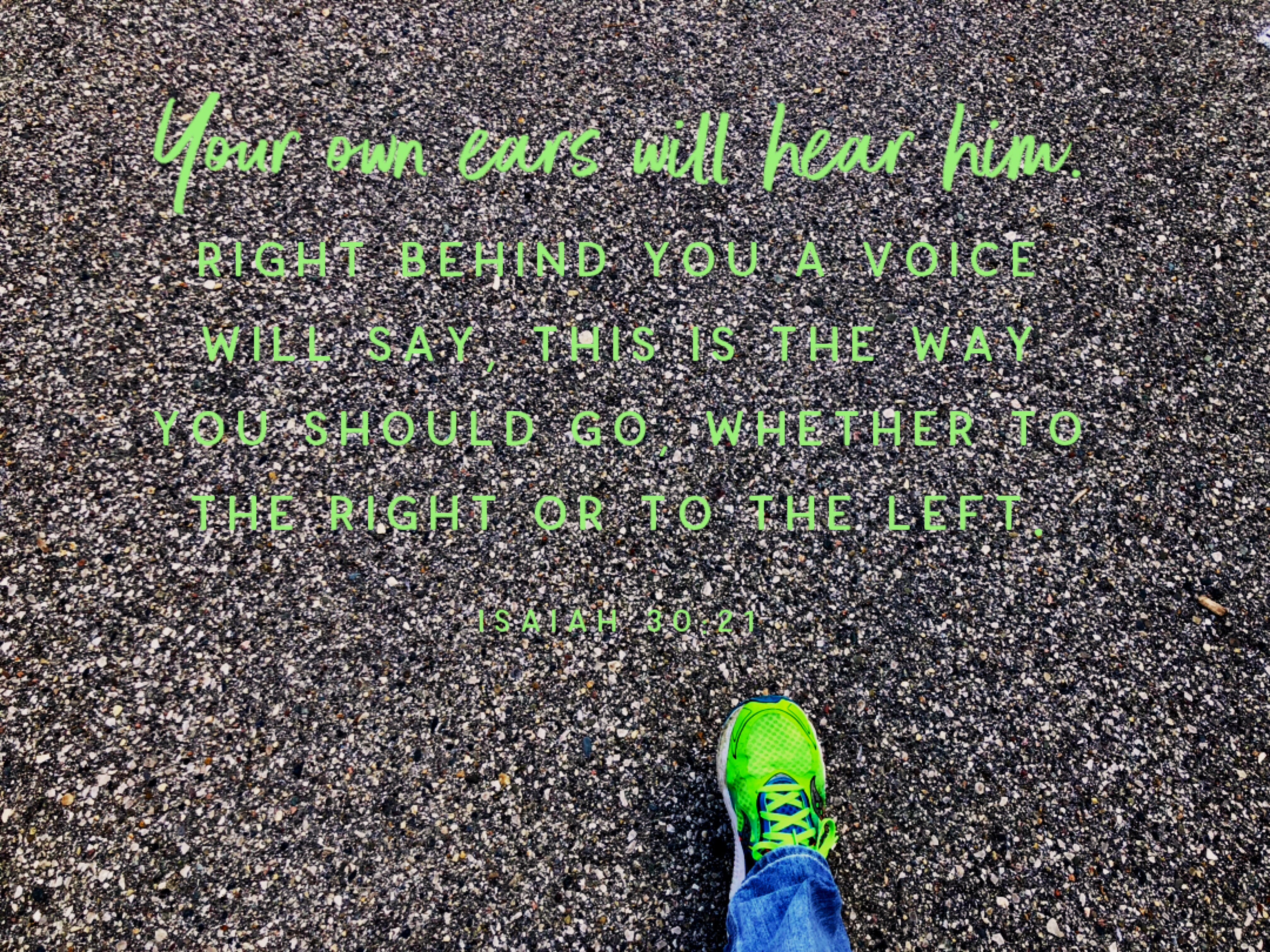
Your own ears will hear Him. Right behind you a voice will say, “This is the way you should go,” whether to the right or to the left. (Isaiah 30:21)

Earlier this week I was on a long road trip, so I took our dog Grace with me. After grabbing some lunch, I wanted to find a place for Grace to run around and stretch her legs, but I was in a town I didn’t know. As I came to the end of the driveway, my next appointment would have been right, but I felt I should turn left instead.

I did, and two blocks away was a huge, grassy park where I could sit and eat my lunch and Grace could frolic to her heart’s content.

Did I actually hear a Voice? No, but I felt a Voice. His Voice. Yes, I believe God even cares about helping me find a place for my lunch and for my dog to run. He cares that much about me. And you too!

He’s speaking to you all the time. Are you listening to the Voice behind you?

Two Helpful Questions

Some people tell me that they don’t read the Bible for themselves because they don’t understand parts of what they read, or they don’t know what to do with the parts they do understand.

To which I reply, “That’s understandable.”

The Bible is filled with timeless principles given to us by an Eternal God. The principles may be timeless, but their application is not universal. For example, God’s timeless principle of, say, honoring your parents may be applied one way by someone living in the 12th century B.C. and applied completely differently by someone living today.

Same principle. Different application.

This is easy to say, but much harder to put into action. But I believe it is imperative that we continue to read God’s timeless principles in His Word and find daily application for our lives. So I’d like to suggest two questions to help you in this pursuit. They are the same two questions that people asked the day of Peter’s first sermon after the birth of the Christian church. Try these the next time you read your Bible:

  • What does this mean? (Acts 2:12)
  • What should I do? (Acts 2:37)

Don’t avoid reading the Bible. And don’t approach the Bible the way Søren Kierkegaard said some people do: “Many read the Bible the way a mouse tries to remove the cheese from a trap: trying not to get caught.”

I’m still learning too. Two things that help me immensely: (1) Pray before I read my Bible, asking the Holy Spirit to illuminate His inspired Word, and (2) Talk with other wise friends about the application questions I have.

If you have some strategies that are working for you, please share them in the comments below.

Glowing With God

I’m struck by this passage:

…[Moses’] face was radiant because he had spoken with the Lord.

This has got me thinking…

  1. Am I different after I speak with the Lord?
  2. Can people tell I’ve been in His presence?
  3. Do I spend enough time with God, or do I just dash through His tabernacle?
  4. Are people coming near me to hear what I learned in God’s presence?

If I were to answer honestly, I cannot say “yes” to all of these. If I want to glow with God I’ve got to be willing to spend enough time with Him.

I’m working on it. How about you?

Building Blocks

Whether you have been a follower of Jesus for years, or you’ve just invited Him into your life, there are important building blocks that can help this relationship grow stronger. Join us as we discuss the basic building blocks of a relationship with God over the next four Sundays…

April 11—Relationships. A satisfying relationship with God shows up in satisfying relationships with others. How do we make all our relationships better?

April 18—Bible Reading. Just what is this big book and how can we use it to help us every day?

April 25—Prayer. Does talking to God sound scary? It doesn’t have to be. In fact, it can be the best conversation ever!

May 2—The Holy Spirit. His role is probably the least understood, but the most vital, for our day-to-day lives.

We’d love to see you on Sundays at 10:30am.

Guard These Bones

Here’s an odd one. The Israelites had been slaves in Egypt for a long, long time. God does these miraculous things, culminating in the death of every firstborn child in Egypt who’s not in a house covered by lamb’s blood. Pharaoh has finally had enough, “Quick!” he shouts, “Get out of here now! Leave this country!”

So the Israelites pack up as quickly as they can to leave before Pharaoh changes his mind. And then this odd statement appears, “Moses took the bones of Joseph with him.”

Seriously? Bones? We’re kinda in a rush here!

Well, they’re not just any bones. It’s not like they’re just loose bones lying around. They’re in a mummy case.

Yeah, and…?

They were the bones of Joseph. The one who foresaw the coming famine. The one whom Pharaoh put as second-in-command to make preparations for the famine. The one who saved the Israelites from starvation. That Joseph. Just before he died he made his family take an oath that when they left Egypt, they would take his bones with them (Genesis 50:25-26).

They took the oath. And for the next 430 years someone had to watch over the bones. Through about twelve generations, from father to son, from son to grandson, from grandson to great-grandson, the oath was passed: “Guard these bones. When we leave, the bones go with us.”

So when they left Egypt, Moses took the bones with him. But then the Israelites sinned and had to wander in the wilderness for another 40 years. Another whole generation died, and still the oath was passed: “Guard these bones.”

The Israelites finally re-entered their home land, but had to defeat their enemies that had taken possession of their land while they were in Egypt. For about 30 years the Israelites fought. And still the oath was passed: “Guard these bones.”

Finally as a postscript to Joshua’s account we see Joseph’s bones being buried in Shechem, nearly 500 years after Joseph died!

For 500 years they kept the oath; they guarded the bones.

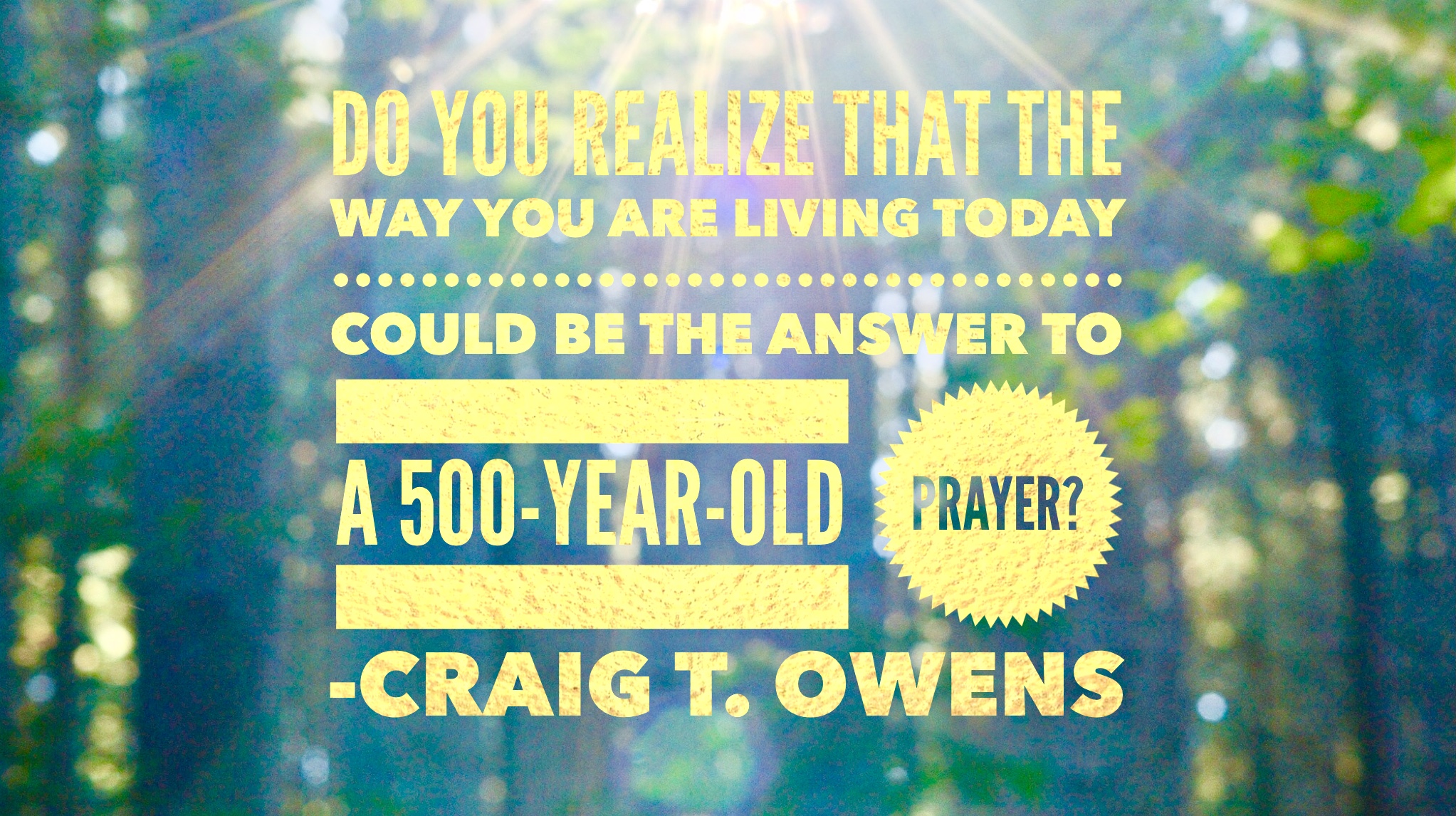
Do you realize that the way you are living today could be the answer to a 500-year-old prayer? Just like the Israelites who kept their eyes on God, you and I must live today with a purpose and with a mission. When we live godly lives, we are guarding the bones of prayers that were prayed, the bones of petitions that were made, the bones of oaths that were requested and honored.

What are you doing today to guard the bones of your ancestor’s prayers?

Knowing What To Look For

On Sunday afternoon Betsy left our house to meet with our KidZone team. She had only been gone for a few minutes when she called me. “I just had to pull over to the side of the road,” she said. “It sounds like something is dragging underneath my van.”

I quickly threw my coat on and drove to meet her. Sure enough, as I pulled up behind her van I could see something hanging down. I laid down next to the van to look underneath and discovered that the band which holds up the gas tank was missing a bolt. I’m not a mechanic, but even I know that’s not a good thing!

I called a friend at church who’s got a lot of hands-on experience with cars. He said, “I’ll be right there.” He arrived quickly with a metal coat hanger, which he used to take the place of the missing bolt.

We turned around to head back to my house. Jeff was in front of me and had only driven about 150 feet when he jammed on his brakes, pulled to the side of the road, and leaped out of his car. I then watched as he ran across the road, bent down, and picked up the missing bolt!

When we got back to my house I said, “You must have the eye of an eagle to spot a rusty bolt on wet pavement.”

“No,” he said, “I just knew what to look for.”

In Genesis 45, Joseph reveals himself to his brothers. Twice he tells them, “Don’t be afraid. God sent me here.”

“Wait a minute,” you might protest, “God sent him to Egypt?! I thought his brothers sold him as a slave. God put Joseph in the position as prime minister of Egypt?! I thought his special dream-interpreting skills did that.”

Joseph went from a prince in Jacob’s family, to a slave in Egypt, to comptroller of Potiphar’s affairs, to a falsely-accused rapist, to a prisoner, to a prison trustee, to a forgotten man, to Pharaoh’s dream interpreter, to Egypt’s prime minister.

Joseph knew what to look for along the way. He knew God had given him a direction for his life, so he was constantly looking for it.

Prayer does this for me, too. I may know verses like

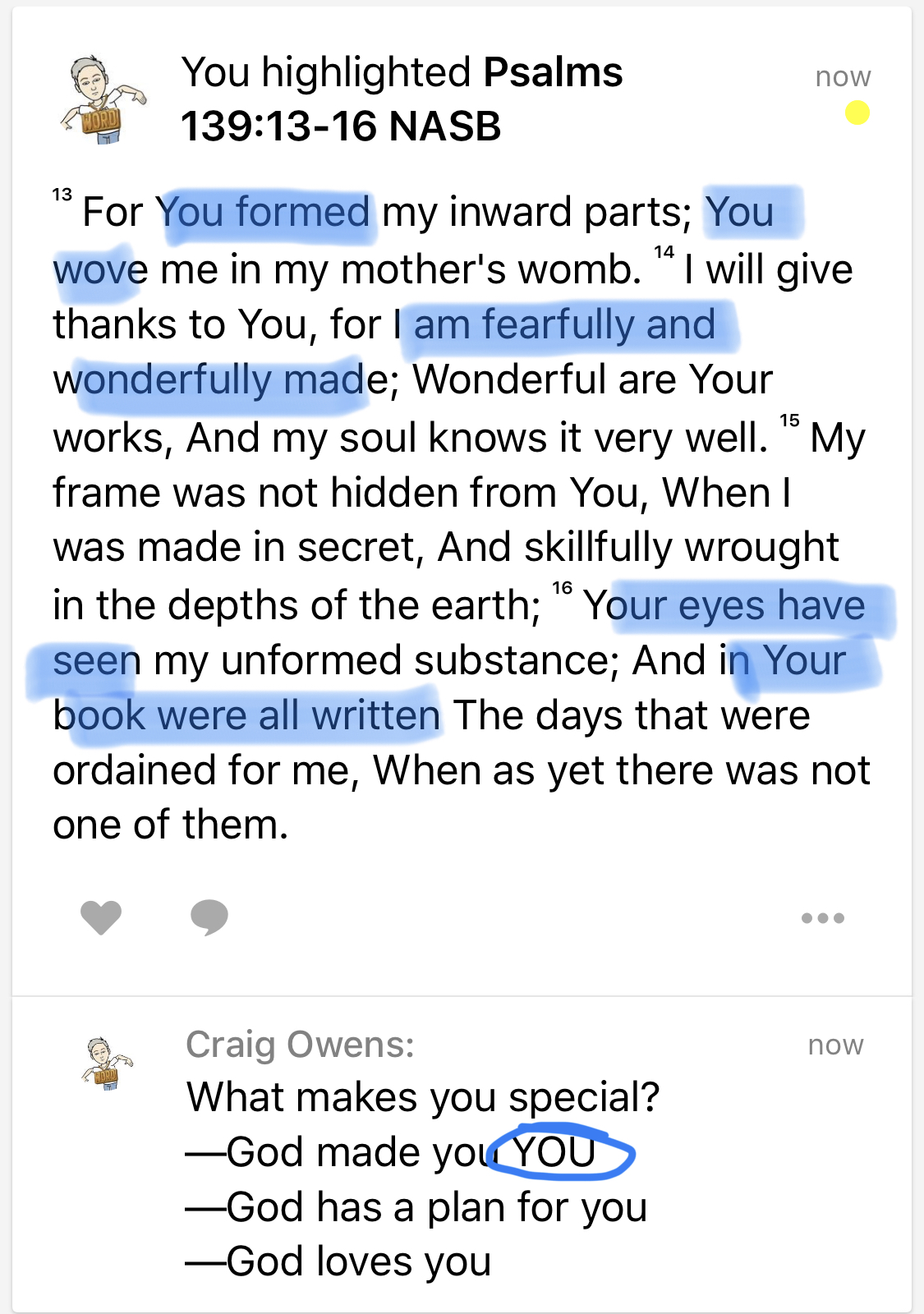
  • I am fearfully and wonderfully made.
  • Before I was born, God knew me.
  • All things are working together for good for me because I love God and called me for a purpose.
  • I should rejoice in my trials because God is developing something in me.

but it’s only when I’m praying these verses that the Holy Spirit trains my eyes to know what to look for.

God was placing Joseph and preparing Joseph to be just where he needed to be, at just the right time, and with just the right skills.

God is doing something with me: He’s preparing me and placing me in His perfect timing to fulfill His perfect plan. When it seems my life has become derailed, I need to know what to look for. Prayer does this: Prayer trains my heart and my mind and my eyes to know what to look for.

I can also assuredly tell you that God is doing something with YOU: He’s preparing YOU and placing YOU in His perfect timing to fulfill His perfect plan. Prayer will help you know what to look for too.

Specificity

Sometimes only a big word will do. Specificity means something particularly fitted to a use or purpose. In pharmacology terms, it is a remedy intended for a particular ailment or disorder, or the selective influence of one substance on another.

In other words, the medicine is targeted for a selected pain or disease.

Yesterday at Calvary Assembly of God we heard a powerful word from our guest speaker Jeff Hlavin. But one thought from Jeff has been particularly working on me. He said, “The enemy fires his darts at your most vulnerable places.” Or said another way: the enemy is specific in his targeting.

My defense against the attack of the enemy is prayer. But my best defense is prayer with specificity.

Perhaps something like this:

  • In praying for Bethany, I’m not just praying for healing from cancer, but healing from neuroblastoma.
  • In praying for Brody who has Pierre Robin Syndrome, I’m praying with specificity for his lower jaw to continue to grow to its proper size. And in the meantime, that he will not experience any problems with choking.
  • In praying for friends whose marriage is in trouble, I’m praying specifically for healing from past mistakes, for open lines of communication, and for a willingness to seek out professional counseling.
  • In praying for a young man who is in a soul-searching time, I’m targeting my prayers at the low self-esteem issues he’s battling.

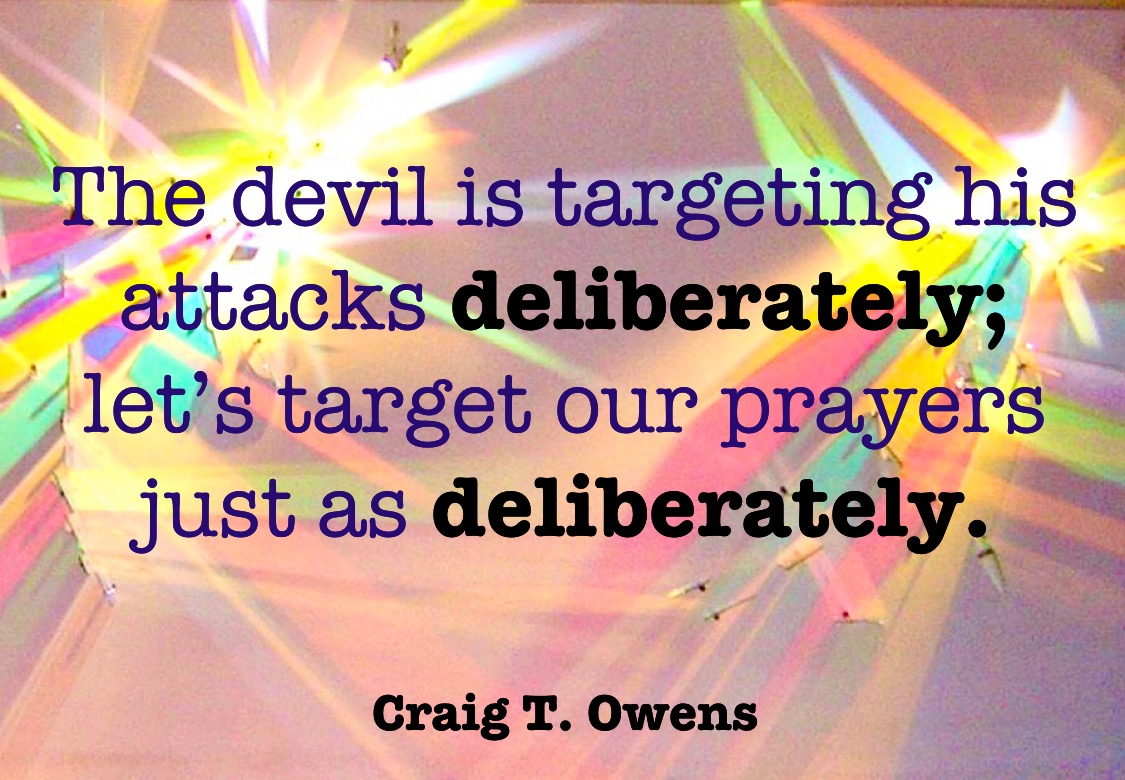
Let’s not just pray; let’s pray with specificity. The devil is targeting his attacks deliberately; let’s target our prayers just as deliberately.

Listen To Me

Have you ever been involved in high-level negotiations? The stakes are high. The potential for reward is great, but the chances of crashing-and-burning are also great. Everyone is on their A-game both mentally and emotionally. No one wants to misstep or misspeak.

Sounds like a hostage negotiator, or a government official brokering a treaty, or a business leader finalizing a multi-million dollar business deal, right?

Actually, these high-level, high-stress, high risk-or-reward negotiations happen almost every day. And you’re involved. Whenever you have a conversation with someone where you’re opening your heart to them—or they’re opening up to you—you’ve stepped into a place where wonderful or tragic things can happen.

Think about how your blood pressure rises when you hear…

  • …your spouse say, “We need to talk.”
  • …your boss intercoms you and says, “Will you come into my office.”
  • …your friend says, “This isn’t very easy for me to tell you this, but….”
  • …your coworker says, “You need to sit down for this.”

Here’s a scene from the Bible: Abraham’s beloved wife Sarah has died, and he wants to bury her somewhere special. The problem is, Abraham doesn’t own any land. So for the first time since leaving Ur, he has to negotiate the purchase of land. The Hittites know Abraham is a powerful man. They don’t want to give anything away for free, but neither do they want to anger him. Abraham is a wealthy man. He can probably pay any price for the land, but he doesn’t want to be seen as a sucker.

Let the negotiations begin. Multiple times throughout their conversation a phrase is repeated:

“Listen to me.”

In the Hebrew language, there is nothing unique or noteworthy about these words. But the fact that the phrase is repeated so frequently in so few verses is interesting. In fact, this phrase is only used one other time in all of Genesis.

Both parties are saying, “I realize that one misspoken word here could be hurtful. This is a difficult, touchy subject, but I want it to be a win-win. So don’t just listen to my words, hear my heart.

Here’s my takeaway for my emotionally-charged conversations:

  1. Take a deep breath and ask God for help.
  2. Go slowly.
  3. Make sure I’m in the right place emotionally to listen to them.
  4. Listen to the other person’s heart, not just their words.
  5. Be committed to finding a win-win.
  6. Go slowly.

Keep this in mind the next time you hear one of those blood-pressure-elevating opening phrases. When you hear those phrases, you have just entered into high-level negotiations. You can successfully broker a win-win for everyone if you’ll just hear their heart.

Hurrying To Wait

In Genesis 18 God comes to visit Abraham. It’s interesting to note how Abraham responds. In a word: quickly.

  • He hurried from where he was sitting to meet God.
  • He hurried back to his wife Sarah and said, “Quick, make some bread for our Guest.”
  • He ran to his herd to pick out a calf to serve.
  • His servant then hurried to prepare the calf.

Abraham hurried to get into God’s presence.

However, once he’s there everything slows down.

  • He stood nearby while the Lord and His angels ate the food.
  • He walked with God as He continued toward Sodom.

Abraham WASN’T quick to leave God’s presence.

At this point, the Bible gives us an important word: Then. After Abraham hurried to get into God’s presence and continued to linger there, THEN God took Abraham into His counsel.

Why is it that my natural tendency is to do just the opposite?

  • I delay going into God’s presence because I try to figure things out on my own.
  • Once I finally go into His presence, I share my need with Him and then hurry along my way.

Abraham was called God’s friend. Maybe because he hurried into God’s presence, and then stayed right there.

Today I’m going to try it Abraham’s way.

Relearning To Pray

I’ve been sharing a series about prayer with my congregation. It’s called Total Access. The premise of the series is that we have total access to the treasure trove of God’s blessings, and prayer is the key which unlocks the door.

One of the things I love about preparing a message for my congregation…

how much more I learn.

One of the things that challenges me about preparing a message for my congregation…

how much the Holy Spirit convicts me.

I feel like I’m having to relearn how to pray.

It’s so simple, yet it is so deep.

I love the words to Kari Jobe’s song The More I Seek You

The more I seek You
The more I find You
The more I find You
The more I love You 
 
I wanna sit at Your feet
Drink from the cup in Your hand
Lay back against You and breath
Hear Your heart beat
This love is so deep
It’s more than I can stand.
I melt in Your peace
It’s overwhelming

It is overwhelming. And at the same time so comforting. I love relearning to pray… again and again and again.