Others First

Listen to the podcast of this post by clicking on the player below, and you can also subscribe on AppleSpotify, or Audible.

I have a friend who has a photo album on Facebook called “Me.” The description says, “Sometimes it is just all about me.” And, sure enough, all of the pictures in that album are just her. I know her well enough to know that this is tongue-in-cheek, because she is not a self-absorbed prima donna.

Sadly, some Christian leaders exhibit the It’s-All-About-Me attitude. This really irks me, especially because we see the exact opposite characteristic in Jesus.

Let me key in on just one example from His public ministry. John the baptizer has just been martyred by King Herod. John was Jesus’ cousin. I’m not sure if you’ve ever had a loved one martyred or even murdered, but I’m sure we’ve all lost a loved one at some point. It might be a little easier to take if we saw it coming, but the sudden deaths always jar us the most. We have to have time to grieve our loss.

Jesus had all of the same emotional responses that you and I have, and He wanted some time away to grieve. He got into a boat with His disciples and headed to a remote place on the other side of the lake. Looking for a little time alone to grieve the death of His cousin, Jesus was met by a huge crowd. He would have been perfectly justified in saying, “Not today.” Or even in saying, “I’m going to let My disciples pray with you today.” Instead, Jesus put the needs of others first.

  • Jesus healed all who were sick
  • He taught them
  • Then He provided food for the nearly 10,000 people who were there
  • After the meal, Jesus sent His disciples (who also needed some grieving time) back across the lake without Him
  • Jesus stayed behind and dismissed the entire crowd. I sort of imagine Him hugging people, shaking hands, and continuing to listen to the questions and concerns of everyone

It was only after this that Jesus went up into the hills to spend some time alone in prayer.

Yes, leaders have to take care of themselves and their people. But good leaders take care of others first.

I unpack this idea in even great detail in my book Shepherd Leadership. If you want to be used as a leader, you must allow the Holy Spirit to cultivate this others-first attitude in you.

►► Would you please prayerfully consider supporting this ministry? My Patreon supporters get behind-the-scenes access to exclusive materials. ◀︎◀︎

Lead Like David

I’ve always been fascinated by the leadership of Israel’s second king: David. There are so many leadership lessons to be learned from his life. A few things I’ve noted about his leadership that I am always trying to implement in my life as well.

Respect—David treated everyone (even his enemies) with respect.

Shrewdness—David used his wits exceptionally well. He knew how to shower gifts on the right people, show recognition to those who needed their ego stroked, be gracious to those who were uncertain, and even flex his muscles with show-offs who got out of line.

Prayer—David was a man of prayer. He prayed for direction, he asked God for strategies, he prayed for deliverance. He prayed for everything.

Confident humility—I know it sounds like an oxymoron (how can someone be both confident and humble?), but David really got this. Check out this commentary:

And David became more and more powerful, because the Lord God Almighty was with him. … And David knew that the Lord had established him as king over Israel and had exalted his kingdom for the sake of His people Israel.

Man of the people—David didn’t closet himself away; he lived and led in full sight of everyone.

All the people took note and were pleased; indeed, everything the king did pleased them.

I want to lead like David led!

What about you? Are there other areas of David’s leadership that you admire or want to imitate?

Lamenting Over The Fallen

How The Mighty Have Fallen! Long before Jim Collins entitled his latest book with this phrase, David said this when King Saul and Prince Jonathan were killed in battle. In fact, he said it not once, but three times in just eight verses.

It is understandable that David would lament the death of his friend Jonathan. They were covenant brothers, they shared the same heartbeat for God and for Israel, and they stood by each other through thick and thin.

But Saul? Why would David lament the death of Saul? This is the man who was jealous of David. So jealous that he did everything he could to trip David up. Including trying to kill him. Saul chased David from his home, from his family, from his wife, even from his country.

Why would David lament Saul’s death? Wouldn’t it be more appropriate to rejoice over it?

But David still saw Saul as “the Lord’s anointed.” David recognized the good in Saul. He called him…

  • the glory of Israel
  • a successful warrior
  • gracious
  • lovable
  • strong
  • Israel’s provider

When David heard Saul had been killed, he lamented, Oh, how the mighty have fallen!

When I see the mighty, God-anointed leader fall, do I lament?

I may shake my head, I may feel vindicated, I may be disgusted, but I don’t know that I have ever lamented or grieved when one of these mighty brothers has fallen. Or if I have, my lament has been short-circuited by other less appropriate emotions.

Despite their sin, they are still God’s anointed.

Who am I to sit in judgment? Who am I to do anything but lament their fall?

Lord, forgive me! Father, help me to see Your anointed ones in the proper perspective: as Your anointed. Holy Spirit, remind me of the tragedy of even one mighty one who falls. May my response be one of lament, and mercy, and prayer.

Brave Enough

If God asks me to give $1, I can quickly and easily say, “Yes!”

If God asks me to give $10, I say, “Okay!”

If God asks me to give $100, I say, “Um, well, if You say so.”

If God asks me to give $1000, I say, “I need to pray about this ‘faith promise.’”

If God asks me to give $10,000, I say, “As soon as You bless me, I’ll be able to do this.”

This same principle holds true for anything else:

  • Used clothing? Sure. Brand new stuff? I’m not so sure.
  • Volunteer an hour? Okay! Make a commitment for an hour every week? Let me pray about it.
  • Pray for someone? No problem. Add them to my daily prayer list? Whoa!
  • Support missionaries? Yes! Become a missionary? Well….

It’s easy to obey when we think the stakes are low. But the more “zeroes” that get added to the amount, the higher the stakes seem. Am I brave enough to obey then?

This is what tripped up Saul, Israel’s first king. He was supposed to devote everything from the defeated Amalekites to God. “Devote” means a complete and irrevocable giving to God. When the stakes were low, he obeyed, but when he perceived the stakes being too high, he lost the courage to follow through:

Saul and his men spared Agag’s life and kept the best of the sheep and goats, the cattle, the fat calves, and the lambs—everything, in fact, that appealed to them. They destroyed only what was worthless or of poor quality. (1 Samuel 15:9 NLT)

He captured Agag, king of Amalek, alive. Everyone else was killed under the terms of the holy ban. Saul and the army made an exception for Agag, and for the choice sheep and cattle. They didn’t include them under the terms of the holy ban. But all the rest, which nobody wanted anyway, they destroyed as decreed by the holy ban. (1 Samuel 15:9, The Message)

Ironically, because Saul held on to what he thought was valuable, he lost something invaluable: a close relationship with God. His cowardice led to disobedience, and his disobedience led to his ultimate collapse.

I pray that I’m brave enough to obey just as quickly when the stakes are higher as I do when the stakes are lower.

What about you? Are you brave enough?

How A Leader Should Bring Correction

Listen to the podcast of this post by clicking on the player below, and you can also subscribe on AppleSpotify, or Audible.

Bringing correction is one of the toughest jobs for those in leadership, but it’s a responsibility that cannot be delegated or ignored. In order for correction to be effective, it must not be too light or too heavy. Unfortunately, many of us have experienced far too many ineffective forms of leadership correction.

I read a great example of how to properly correct in the life of Samuel. In 1 Samuel 12, the people had gotten off track, and Samuel lovingly and effectively brought them back into line. Here’s what his example teaches us on how to correct followers:

1.  Shared history (v. 2). Samuel reminded them of what had happened in their history, and even what they had experienced together. “Newbie” leaders need to be cautious about bringing correction that violates an organization’s established culture.

2. Integrity (v. 3). Samuel’s words and lifestyle lined up. That doesn’t mean he never made a mistake, but it does mean that he was willing to acknowledge and repair his mistakes. Nothing is worse than a leader who says, “Do as I say, not as I do!”

3. Common ground (vv. 6-11). A leader needs to get everyone on the same page. Find something somewhere on which everyone can agree, and then move forward from there.

4. Just say it (vv. 12-13). Don’t beat around the bush; don’t try to bring correction through a parable; don’t soften the blow. Just say it: “This is where I believe you made a mistake.” Far too many leaders talk too much and leave their followers saying, “Huh?” If you are going to bring correction, make sure your followers know exactly what it is you are correcting.

5. Give the remedy (vv. 14-15, 20-21). Samuel pointed out the error, and he just as clearly told them how to get back on track. The remedy should be as clear and simple as possible.

6. Remove the fear (vv. 20, 22). Don’t let the corrected follower be afraid of you! Fear will never re-establish trust. Samuel couldn’t have been more clear on this. He literally said to the Israelites, “Do not be afraid.”

7. Demonstrate servant leadership (v. 23). At the close of the meeting, Samuel said he would do two things: “I will continue to pray for you, and I will continue to teach you.” In telling them this, Samuel was really saying, “Let’s walk through this together.”

If you lead your family, your church, your company, or your team, you are going to have to bring correction at some point. When you need to do this, take some time to review this list and bring correction the way Samuel did: lovingly and effectively.

P.S. You can also check out this post where the apostle Paul gives us another example of how to handle correction properly.

►► Would you please prayerfully consider supporting this ministry? My Patreon supporters get behind-the-scenes access to exclusive materials. ◀︎◀︎

Borrowed Brains

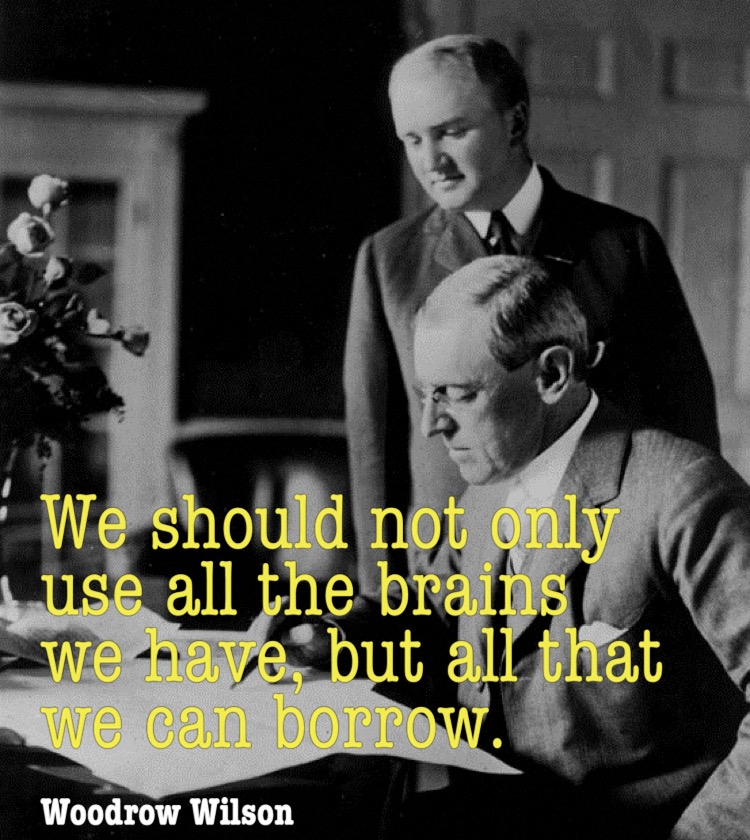
“We should not only use all the brains we have, but all that we can borrow.” —Woodrow Wilson

It’s so important to learn from others—to borrow their brains. I try to take something from other people’s brains every day.

  • Every morning I begin my day by studying the timeless truths found in the Bible.
  • Then I pray to ask God to give me the mind of Christ for my day.
  • Throughout my day I learn from the brains of other business and ministry leaders. People who have been-there-done-that and are willing to share are an invaluable source of wisdom.
  • I also consume a regular diet of biographies and autobiographies of past and present leaders. I try to put myself in their shoes to see why they made the decisions they made.
  • And I have some close friends that can give me their honest insight and critique.

One of the saddest things is to hear someone say, “I’m a self-made man” or “I’m a self-made woman.” Really?! That’s rather limited, isn’t it?

So whose brains are you borrowing? 

The Lord’s Prayer (book review)

Yeah, yeah… you know about the Lord’s Prayer. Maybe you know it by heart. Maybe you pray this prayer every week at your church, or maybe even every day in your home. But do you really know the Lord’s Prayer? R.T. Kendall is about to take you on a journey of discovery that will energize this prayer like never before.

The Lord’s Prayer leads you through this powerful prayer phrase by phrase, petition by petition. Dr. Kendall calls this “the perfect prayer,” and after reading his insights, I think you will agree with him.

I know that anything I do or say time and time again can lose some of its meaning. The Lord’s Prayer is so well known that many of us can rattle it off from rote memory, almost in one breath, and never really comprehend what we’re actually praying. Dr. Kendall brings out such a depth of understanding in each phrase of this prayer, that I don’t think I will ever pray it the same way again.

For instance, I never realized the significance of even the order of the prayer. Jesus put the first thing first and then puts each following phrase in its perfect place as well. The way Dr. Kendall explains it brings out such a richness of understanding.

I could imagine this book being the perfect tool to help your personal prayer life go deeper. I can also see this book being used by a church’s prayer team to help energize their prayer times together. Whether personally or corporately, your prayer life will be greatly benefitted by this book.

I am a Chosen Books book reviewer.

We Were Robbed!

Yesterday morning I walked into the church and noticed the office door was open. “Hmm,” I thought to myself, “I am sure that I closed that door before I left yesterday.”

Then I walked around the corner and noticed my office door standing open. “I know I closed that door,” I said. The hair on the back of my neck stood up, and I could feel all my muscles starting to tense. I walked into my office and saw the mess. I looked more closely at my office door and saw it had been jimmied open. So too had the office door.

Someone broke into the church. We had been robbed!

I made an inventory through the church, called the sheriff, and called our Board members. What else was there to do? I returned to my office, sat down in my chair, and looked around my office. Two thoughts overwhelmed me:

1.  All of the things that were taken were replaceable. I am grateful that the things that have sentimental value to me were left untouched.

2.  The words from Matthew Henry’s journal on the day he was robbed immediately came to mind:

“Let me be thankful first, because I was never robbed before; second, because, although they took my purse, they did not take my life; third, because, although they took my all, it was not much; and fourth, because it was I who was robbed, not I that robbed.”

So sitting in my office waiting for the sheriff deputy to arrive I prayed. I thanked God for His protection, and I prayed for the desperate individual who broke in. Clearly, this is someone who is at their wit’s end. Our thief is someone who needs my prayers, not my scorn.

I still feel violated. I still had a sick feeling in my stomach all day (and even now as I recall the events of yesterday). But I also remain grateful to God for His protection, and I’m continuing to pray for our thief that in His desperation He will meet this same loving God.

Faith-Filled Vocabulary

Listen to the podcast of this post by clicking on the player below, and you can also subscribe on AppleSpotify, or Audible.

I love this short story in Judges 13. There’s this woman, who for whatever reason, cannot have a baby. The Bible doesn’t say whether she had multiple miscarriages or just simply couldn’t get pregnant. Perhaps her husband’s body wasn’t “cooperating” in the process. In any case, this is a couple who desperately wants a child to carry on their family line, but they have been frustrated.

And then an amazing thing happens!

There must have been countless couples who were childless, but an angel from God shows up to this barren woman and says, “You are going to have a baby boy!” This thrilled (and probably somewhat dazed) mother-to-be runs to tell her husband Manoah what has just happened.

We know from the Book of Hebrews that the definition of faith is being sure of what we hope for and certain of what we do not see. But how do we express this faith? … this hope? … this certainty in unseen things?

It starts with our everyday vocabulary choices.

Look at Manoah’s vocabulary. When he hears this news from his wife, he doesn’t say, “Yeah, right!” Instead, he prays this incredible faith-filled prayer:

“O Lord, I beg You, let the man of God You sent to us come again to teach us how to bring up the boy who is to be born.”

Not: “I need more proof.” Or even: “A child.” But: “The boy that is to be born.”

God answers this prayer and the angel appears again. Once again Manoah’s faith-filled vocabulary is on full display for us:

When Your words are fulfilled, what is to be the rule for the boy’s life and work?”

Not: “If.” Or even: “I hope.” But: “When Your words are fulfilled.”

What a great example from Manoah!

Is there something for which you are waiting on God? Do you feel like He’s given you an assurance in your heart for this? Then change your vocabulary—let it be faith-filled vocabulary.

Change your Ifs to Whens to show that you are confident of what you hope for and certain of what you do not see. 

►► Would you please prayerfully consider supporting this ministry? My Patreon supporters get behind-the-scenes access to exclusive materials. ◀︎◀︎
Going Through The Motions

I was talking to a friend who is a missionary in Africa who had just experienced an interesting church service. Many times Africans will hear a worship song from a visiting group of Americans, and they will try to implement that worship song into their church services. Sometimes this can be quite beautiful.

And sometimes it’s quite comical.

These precious African saints were trying their best to imitate the English words they had heard sung in the song Friend Of God. However, their chorus sounded something like this:

I am afraid of God

I am afraid of God

I am afraid of God

He calls me Fred

Comical? Sure. But it’s also very instructional.

How many times do you and I go into a church service and just mimic words, without really thinking about the meaning behind the words?

We go through the motions—we imitate the sounds we have heard before—and think we are really worshiping.

Here’s what Jesus said:

And when you pray, do not heap up empty phrases… [and] think that you will be heard for your many words.

Are you going through the motions?

  • Do you pray the same prayer at every meal?
  • Do you sing the same songs the same way every time?
  • Do you worship God the same way every time you come into His presence?
  • Do you pray the same prayer every night before bed?

Do you really mean what you are saying? Or are you just going through the motions?